

Borderstation Gregorios II
⚠️ Content Warning
This article is part of the Oikos setting and may contain mature themes, including sexuality, reproductive biology, power dynamics, and emotionally intense content. Reader discretion is advised.
TABLE OF CONTENTS in the World Navigation
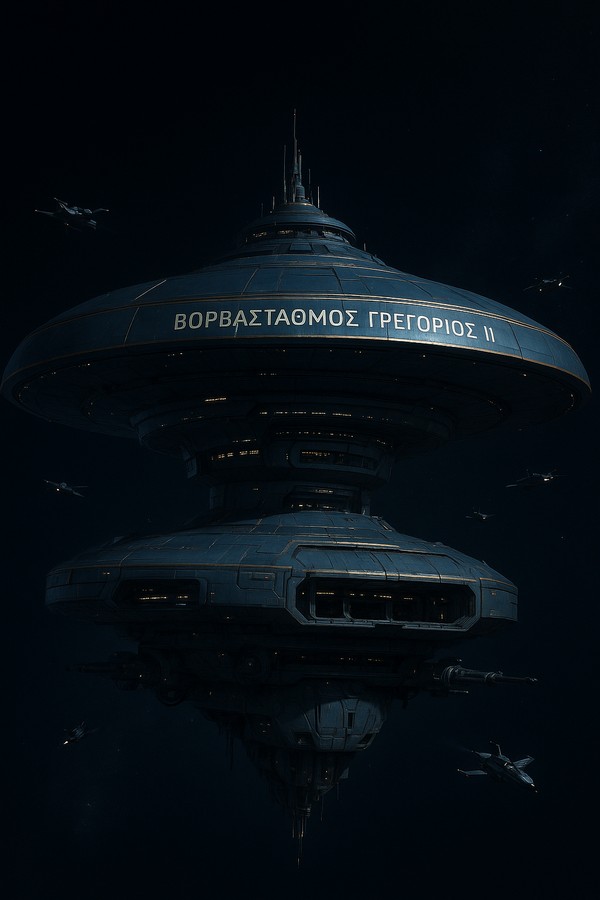
Gregorios II is the second sentinel in a ring of twelve stations bracketing the Oikos system. Its mandate is simple and unforgiving: see threats long before they see Oikos. The platform maintains constant watch for vessels and signatures originating from Earth-space and other unknown vectors, fusing military readiness with a quiet, relentless scientific curiosity. Operated by the P.D.F., Gregorios II pairs teeth (railguns, torpedoes, and two full fighter squadrons) with brains (a dedicated science deck that dissects everything from ghost pings to slow-rolling asteroid families).
Layout & Facilities
- Deep-Space Sensor Spine: A gimballed array of long-baseline scanners (EM, gravitic drift, neutrino sniffers) tied into the Gregorios network’s shared telemetry.
- Control Ring: Traffic, identification, and rules-of-approach enforcement for anything crossing the border net.
- Flight Deck: Pressurized hangars, fast-launch catapults, and recovery booms for two fighter squadrons; auxiliary bays for interceptors and SAR craft.
- Weapons Nodes: Distributed railgun turrets on armored trusses; internal magazines feeding guided space-torpedoes and point-defense clusters.
- Science Deck: Signal intelligence, debris cataloging, and deep-space anomaly labs with their own clean power buffers — so analysis never drops when the station cycles to battle-ready.
- Habitat Spokes: Crew quarters, gym/micro-g, med bay, mess, chapel, and a small arboretum for long-shift sanity.
Capabilities
- Early Warning: Long-range detection and classification of inbound contacts; cross-checks with the other Gregorios stations to triangulate and time-slice trajectories.
- Interception: Scramble-to-vector times measured in seconds; fighters carry modular hardpoints for either deterrence or capture.
- Area Denial: Railgun slugs for stand-off warning shots, torpedoes for credible last-resort interdiction.
- Scientific Analysis: Continuous spectrum logging of “deep-space weather,” micro-object tracking, and signal forensics when something whispers from far away.
Garrison & Wings
- Command: P.D.F. line command with attached intel and logistics officers.
- Fighter Complement: Two squadrons (rotation designations vary by cycle) trained for intercept, escort, and SAR.
- Deck & Ordnance: Tech crews certified on mag-rail maintenance, torpedo handling, and rapid rearm within hard vacuum protocols.
- Science Cadre: Mixed team of signal analysts and astro-geologists embedded alongside operations — if it pings, glows, hums, or drifts, they name it and file it.
Standard Protocols
- The Quiet Screen: All active scans run on staggered patterns to look passive while they’re not.
- Three-Tone Challenge: Any unregistered contact receives a three-step hail: Identify, De-spin/Heave-to, Submit to boarding. Skipping a tone escalates posture.
- Cold Berth Doctrine: Boarding teams prioritize system capture over hull breach; recovery and interrogation outrank spectacle.
Culture on Station
Life aboard Gregorios II runs on long watches and longer memories. Crew swap stories of “the blinks” — transient sensor ghosts that turn out to be nothing… until one isn’t. The arboretum is sacred ground, the gym is loud at twilight, and the mess serves the same three comfort staples before scramble hour. People sleep with boots by the door.
History
After Oikos chose isolation from Earth, the Gregorios ring became its most patient voice — listening outward, speaking only when necessary. As the capital’s records put it, “a web of stations watch the system’s borders.”

Comments