
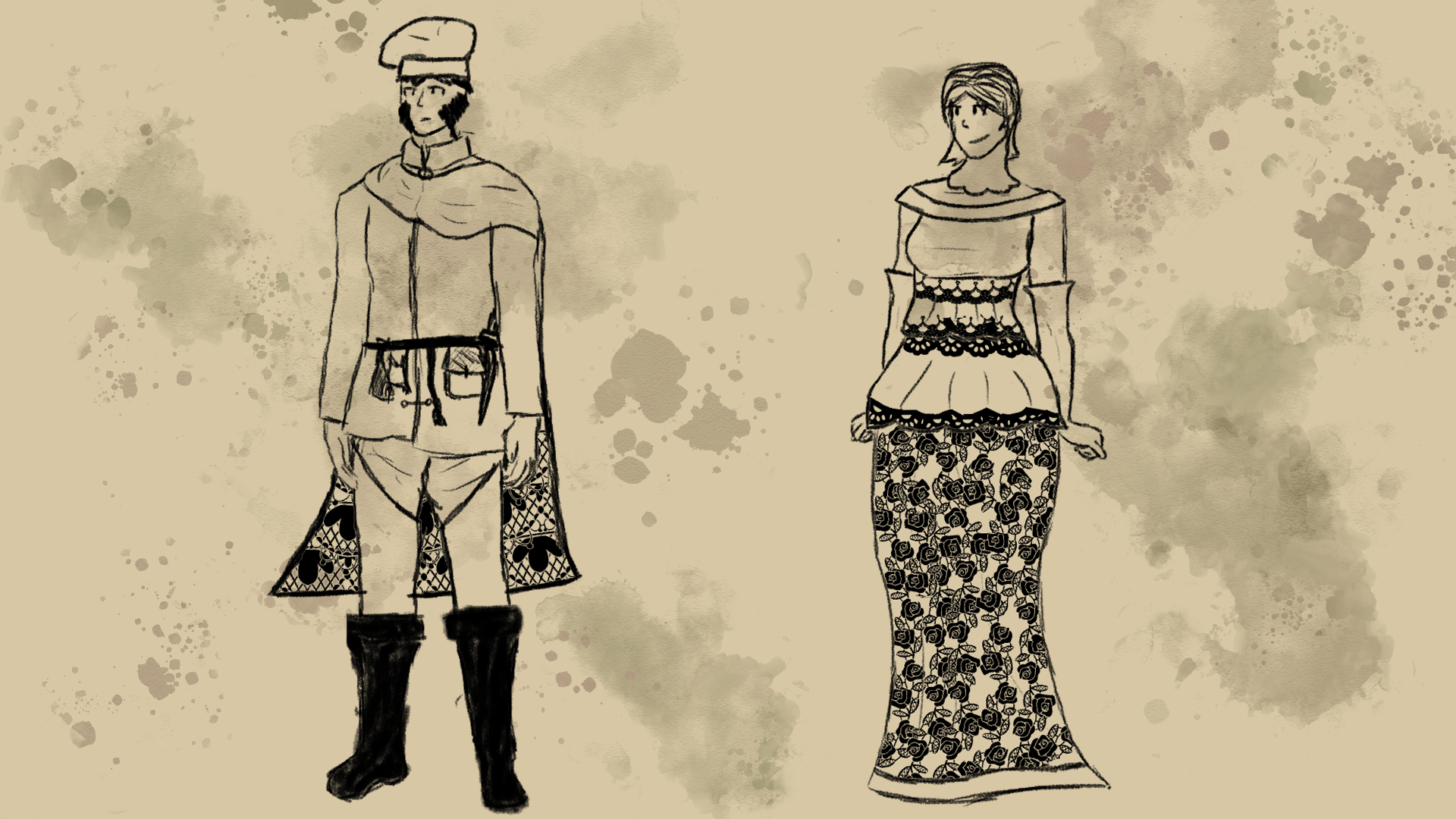
Human
Human villages and great cities are found across the majority of Ravreka, surrounded by seas of golden wheat, emerald pastures, and bustling vegetable gardens, with flowers scattered throughout their realms like jewels spilled from a dragon’s hoard. They are a joyous and prideful people, and their traditions reflect this spirit. Festivals are commonplace for one reason or another, and holidays often emphasize sharing with your neighbors. For example, during the holiday celebrating Father Time’s eternal march, Noccvrem, lambs and boars are slaughtered and divided into chunks - sending the most tender parts to your closest neighbors, while keeping the fatty scraps and bones for yourself. This symbolizes how Father Time selflessly crumbles and decays, so that all creatures may experience life.
In the modern age, these beautiful realms are too often torn asunder by petty conflict, as the nature of man swings wildly between astoundingly passionate and good to jaded and bloodthirsty.
Before the Downpour, humans ruled mighty empires boasting marble temples and sprawling granite palaces. But in the Era of the Withering Bloom, Ravreka's ruins were picked apart and divided into city-states and independent homesteads that survive through trade or secrecy. These realms are ruled by barons whose ancestors sheltered people in underground halls, warlords who seized the ruins of Ofadin by fire and sword, or eccentric sorcerers whose mastery of magic commands royal courts and marching armies alike.
With the northern wars flaring up and mercenaries from across the world flocking to its bloody fields, rulers look southward with eager eyes. There, a new theatre of war opens - where the first modern nation may yet form, should one power emerge victorious. The human realms are often havens for scarred veterans seeking peace, or refugees hoping to start anew. They find mutual benefit in pooling their talents to safeguard this fragile tranquility, while avoiding the creeping influences of Mormiloan politics or Pelagekin bickering.
The armies of men are as varied as the cultures they hail from. Northern realms rely on rich iron deposits to produce heavy plate armor, riding through dense woodlands on horseback, supported by militia - shield-and-spear units ideal for holding narrow forest passes. In the middle lands, doctrine shifts rapidly as dukespowder weapons become dominant. There, ancient ruins are excavated by entire battalions, scavenging technology that is now fused with sorcery to create terrifying war machines. Far to the south, navies shape politics and trade. Soldiers wear scale-like armor, employ unique metals from the ancient Mormiloan empire, and use the jagged karst terrain to devastating effect - confusing enemies with sudden ambushes and leaping from white cliffs to deliver shock assaults.
The Rise of Nations
After centuries of fractured rule and local dominance, a new era is dawning. The age of scattered baronies and city-states is giving way to the birth of true nations. The spark was lit in the woodlands with the Ascorni Federation, a populist uprising that ousted hereditary lords and established a tenuous but determined people’s republic. Their ideas of shared power and universal equality now echo across distant valleys.
To the far north, the Trodansk Republic rises from the frostbitten ashes of a people long betrayed. Once a proud voivode, its lands - once called Toletiva - were led to ruin after falling under the sway of a fanatical order of lycan knights who pledged themselves to Nonskis, the Insatiable Wolf. Their war, waged in darkness and fervor, ended in catastrophic defeat. In its wake, a mosaic of small warlords has banded together under the banner of reunion and reform. They now call themselves Trodansk - a name evoking the ancient totems of northern unity. Though still young and held together by fragile treaties, its spirit is fierce and its cause righteous: to rebuild a motherland that was torn apart by superstition and blood.
To the south, the Wyrmskinned Empire of Mormiloa still endures. Ancient, cunning, and steeped in ceremonial splendor, it is said that its emperors carry the blood of true wyrms and that its court has never once bowed to time. Built on the bones of its many ancient foes, Mormiloa maintains vast bureaucracies, sacred rites, and an economy of incense, gold-leaf, and memory. It holds sway over the salt roads and southern seas, and its cities glitter with basilicas and colonnades where serpentine mosaics tell stories far older than the Downpour. Though its glory dims with each decade, it remains a cultural titan - and its agents, both political and arcane, move like smoke across the world stage.
Finally, to the central plains, the rising power of Smyklion cannot be ignored. Born of inventors, spies, and merchants, it thrives on ceaseless innovation and ruthless diplomacy. It is a republic in name but a guild in truth, where loyalty to progress often trumps loyalty to one another. While others squabble over territory, Smyklion seeks to shape the future itself - unearthing lost technologies and bending sorcery to industrial purpose. It is whispered that their dreams are not of conquest, but of supremacy in all things: knowledge, wealth, and the shaping of the next world order.
These four—Trodansk, Mormiloa, the Ascorni Federation and Smyklion - now draw the eyes of historians, adventurers, and kings. The world watches, wondering if one might rise to unify the broken pieces of Ofadin - or shatter it even further.

Comments