
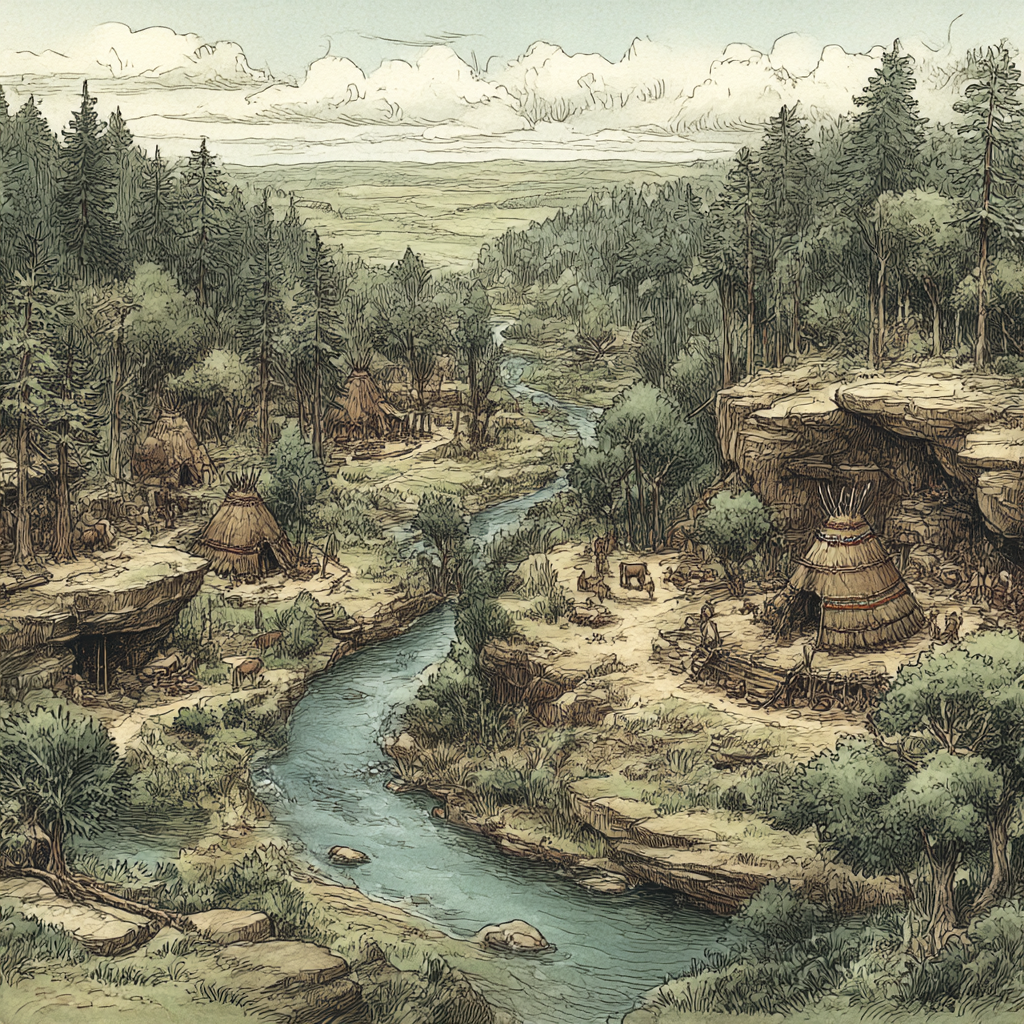
Ainari Turtle Clan
Overview
Society Name:
Ainari Turtle Clan
Society Concept:
A small tribe of hunter gatherers found a relatively peaceful valley nestled in a large forest. A large freshwater river meanders nearby, stocked with horned salmon and prismatic trout. The surrounding area is lush with fruits and berries and teeming with wildlife. Herds of Red Elk and Fleetfoot Deer provide ample meat, furs, hides, and horns. The Ainari are able to eke out a comfortable life, relatively safe from the dangers of the world.
World Placement:
Along the banks of the Ainari River in Ainaria on the continent of Keotura .
Scope:
1 - Village (unwalled)
Location:
Geographic Size:
Population Size:
Foundations of Society
Society Age
Society Age Value:
5
Society Age (yrs.):
about 150 years
Founding Date:
Philosophical Orientation
Orientation/Posture:
Equilibrium/Passive
Orientation Aspects:
Conviction (code of honor), Tradition (Ruled by Chieftain)
Isolation
Isolation Value:
10
Isolation Description:
The society exists in an average level of Isolation. It may be somewhat difficult to reach, although many access routes exist. A handful of these routes are well traveled and passable (ex. unpaved roads through forest or heathlands).
Interaction
Interaction Value:
7
Interaction Description:
The society seldom Interacts with others, but will on occasion. Commerce, traffic, and communication with neighboring societies is limited, but occurs on a regular basis. The society is not completely internalized. It invites limited degrees of external influence and Interaction. Greater resource levels are likely present, and their Exploitation levels will be higher than average.
Technology and Innovation
Technology
Technology Value (avg.):
3
Areas of Technological Emphasis:
Transport, Agriculture
Rate of Advancement:
7 Difficulty, Trial Every 70 Years
Rate of Assimilation:
Available Technology:
Innovation Scales
Dominant Material Value:
5 - Stone, Bone, Wood, Skins, Clay, and Woven Cloth
Power/Manufacturing Value:
3 - Manpower, FIRE, and Stone Tool Industries. Wood and Bone used to make tools of same.
Agriculture/Environment Value:
2 - No Cultivation. Hunting, Fishing, and Gathering are common means of Subsistence.
Building/Architecture Value:
4 - Crude HUTS and TENTS (Animal Skin stretched over Wooden Frame)
Transport/Communication Value:
4 - Dugout Canoe and Travois
Military Value:
3 - Hafted Weapons (axes, spears, harpoons), BOW AND ARROW, Spear-thrower, Snares, and Barbed spears, Stone Points and Small Flint Blades
Miscellaneous Value:
3 - Specialized and Permanent Camp environments, Early Paint (2 Pigments only), Burial Rituals, Engraved and Painted Artworks, Primitive Sculpture, Lamps (burn fat), and BONE needles.
Subsistence And Mobility
Subsistence
Major Classification:
Pure Hunter/Gatherer
Minor Classification:
Hunter/Fisher/Gatherer
Subsistence Description:
The Ainari hunt animals for meat, bones, and skins. They also fish the Ainari River for horned salmon and prismatic trout. They also gather fruits, nuts, and vegetables from the surrounding area leading to a fairly healthy diet. Herds of Red Elk and Fleetfoot Deer provide ample meat, furs, hides, and horns.
Societal Mobility
Mobility Classification:
Semi-Nomadic
Mobility Sub classification:
Mobility Description:
The society still has nomadic clans but some families have started to become Sedentary
Politics and Kinship
Political Infrastructure
Infrastructure Class (Prim. or Adv.):
Primitive
Infrastructure Type:
Clan
Power Value:
10
Power Description:
The Clanhead has the Power to act and to get things done as mandated by the Authority given to it by the Consent of the people.
Authority Value:
10
Authority Description:
The Clanhead derives Authority from the Consent of the People
Suppression Value:
0 - No difference between Power and Authority
Consent Value:
10
Consent Description:
The people are content with giving the Authority to the Ruling Agency
Constitutional Support:
The populace support the unwritten laws that the Chieftain holds Power and Authority as it is Tradition.
Legal Complexity:
2 - unwritten oral traditional laws
Kinship
Kinship Ascendant:
Patriarchal
Lineage Determinant:
Matrilineal
Inheritance Pattern:
Primogeniture - The eldest of the primary lineage inherits the bulk of the estate.
Notes:
Interests of Society
Economic Environment
Economic Exchange System:
Trading system
Economic System Description:
Economic Value:
-4.8
Economic Type:
Free Market
Military Infrastructure
Primary Force Composition:
All Inclusive
Primary Force Description:
Every able bodied soul in the society
Supplementary Forces:
None
Military Infrastructure Value:
54
Military Value:
6
Force Value:
1000
Military Size:
Can field 1000 troops in all out war.
Economic Foundation
Resource Value:
13
Resource Description:
The society possesses enough resources to be considered to have a productive economy. The standard of living is slowly rising and will continue to do so as long as both Exploitation and Trade do not decline significantly. Society may become renowned for a few of its resources or resultant industries.
Exploitation Value:
3.3
Exploitation % (Exploit. Value x 5%):
15%
Exploitation Description:
The society has vast resources but is not technologically advanced enough to exploit all of its resources.
Trade Value:
4
Trade Description:
The society engages in minimal extra-communal Trade. Resources and materials are traded in small volumes when trade does occur. Reasons for trade level include isolation, and resource self-sufficiency.
Wealth Value:
3
Social Humanities
Religion
Religious Tolerance Value:
5 - The society does not openly tolerate the practice of religion. Engagement in Religion is socially discouraged and is considered offensive or ridiculous in the society. Penalties for openly practicing Religion earn the offender a poor reputation if not outright social rejection. Any who manage to earn a living from these talents are considered Semi-skilled Professionals by the general public.
Religious Prevalence Value:
15 - The society evinces a wide selection of Religions. The many practitioners compete to provide for the market demand. The discipline enjoys government sponsorship and exhibition in prominent locations within the societal environ. Sequestered districts or quarters within the societal environ may be allocated for use by practicing organizations.
Religious Diversity Value:
8 - While the society continues to favor a predominant belief system, its divergent subschools begin to receive support from a significant portion of all those who embrace the discipline. Only 40-50% of total participants follow the predominant school of teaching. The rest subscribe to one of the branch divisions of the predominant humanity.
Religion Description:
The Chieftain and council sanction a state religion. There is a pantheon of gods with more than one branching religions or offshoots. 40-50% of the populace follow the main state sanctioned religion while the rest follow the offshoot. This could potentially cause a religious reformation.
Arts
Art Tolerance Value:
10 - The society professes indifference or tacit approval toward the practice of the humanity. Those engaging in such activity find varying degrees of acceptance within the social hierarchy of society. Though such disciplines are still considered inessential to the daily business of society, notable practitioners are considered to be Professionals.
Art Prevalence Value:
10 - The society commonly evinces Art in public environ. Products and Services of practitioners are sought by approximately half the populace. Heightened demand is met by larger numbers or organizations of practitioners. The Humanity in question is well established in the popular culture of the society.
Art Diversity Value:
10 - The society support 2 or more separate belief systems or schools of thought. While divergent systems may have originated from a single source, they are now accepted as completely separate traditions. Diversity within traditions is common. Concentrations of followers (by %) vary among the traditions. The Ruling Agency may favor one predominant or minority belief system. Some belief systems may exist "underground".
Arts Description:
Art is found in the decorations of homes and even bodies. Colors used are tied to the religion of the owner. Red and Black are the two colors used. Each denotes the support of a different belief.
Scholastics
Scholastic Tolerance Value:
16 - The society welcomes the practice of the humanity in question. Particular social circles develop around the appreciation of the discipline with many neophytes claiming to be practitioners. Those practitioners with a modicum of talent may enjoy an increase of status, while those possessing great talent may enter the Privileged Status Archetype if the Rigidity of Status permits such mobility. Street performers are viewed favorably.
Scholastic Prevalence Value:
15 - The society evinces a wide selection of the humanity in question. The many practitioners compete to provide for the market demand. The discipline enjoys government sponsorship and exhibition in prominent locations within the societal environ. Sequestered districts or quarters within the societal environ may be allocated for use by practicing organizations.
Scholastic Diversity Value:
11 - The society support 2 or more separate belief systems or schools of thought. While divergent systems may have originated from a single source, they are now accepted as completely separate traditions. Diversity within traditions is common. Concentrations of followers (by %) vary among the traditions. The Ruling Agency may favor one predominant or minority belief system. Some belief systems may exist "underground".
Scholastic Description:
Magic
Magic Tolerance Value:
10
Magic Prevalence Value:
2
Magic Diversity Value:
1
Magic Description:
Magic is relatively unknown at this time but it would depend on the context of facing magic for the first time to determine how the society will view it in the future.
Hierarchy of Social Estates
Status
Primary Status Foundation:
Secondary Status Foundation:
Other Status Foundations:
Custom of Status Value:
Custom of Status Description:
Rigidity of Status Value:
Rigidity of Status Description:
Personal Freedom
Freedom Aspects (Vertical):
Freedom Aspects (Horizontal):
Status Hierarchy
Status Hierarchy Table:
| Status Archetype | Vocational Clusters | Sample Vocations | Status Range |
|---|---|---|---|
| Ruling Agency | Political I | Chieftain (Elected by Trial) | 20 |
| War Captain (appointed Councilors) | 19 | ||
| Ecclesiastical I | Spiritual Leader (appointed Councilor) | 18 | |
| Ruling Class | None | n/a | |
| Privileged Class | Political II | Clan Chieftains | 17 |
| Ecclesiastical II | Medicine Men | 16 | |
| Political III | Clanheads | 15-13 | |
| Professional Class | Academic | Historians | 13-12 |
| Artisan I | Smiths | 11 | |
| Warrior I | War Party members | 10 | |
| Labor | Warrior II | Eligible conscript warriors | 9 |
| Ecclesiastical I | Apprentice Medicine Men | 8 | |
| Unskilled Labor I | Hunters, Fishermen | 8 | |
| Miners, Carpenters, Masons | 7 | ||
| Weavers, Tanners | 6 | ||
| Foragers, Kindlers | 5 | ||
| Arts | Dancers and Singers, Storyteller | 4 | |
| Unskilled Labor II | Professional Understudies (adolescents) | 2 | |
| Fringe | Unemployed (Aged and Children) | 1 | |
| Marginal | Special | Dishonored Clansmen | 0 |
Comments