

Artificer
Eberron: Forge of the Artificer
Core Artificer Traits
| Primary Ability | Intelligence |
|---|---|
| Hit Point Die | D8 |
| Saving Throw Proficiencies | Constitution and Intelligence |
| Skill Proficiencies | Choose 2: Arcana, History, Investigation, Medicine, Nature, Perception, or Sleight of Hand |
| Weapon Proficiencies | Simple weapons |
| Tool Proficiencies | Thieves’ Tools, Tinker’s Tools, and one type of Artisan’s Tools of your choice |
| Armor Training | Light and Medium armor and Shields |
| Starting Equipment | Choose A or B: (A) Studded Leather Armor, Dagger, Thieves’ Tools, Tinker’s Tools, Dungeoneer’s Pack, and 16 GP; or (B) 150 GP |
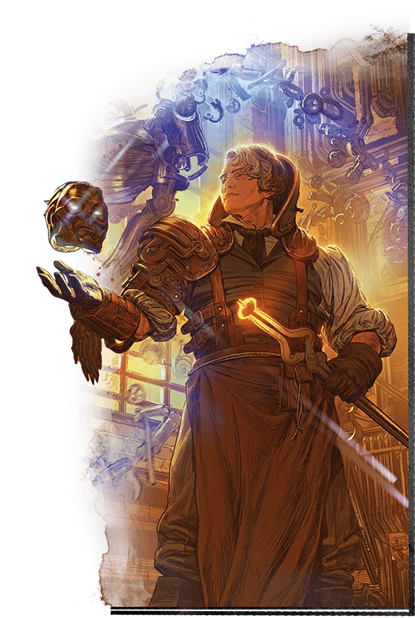
Masters of invention, Artificers use ingenuity and magic to unlock extraordinary capabilities in objects. They see magic as a complex system waiting to be decoded and then harnessed in their spells and inventions.
- Gain all the traits in the Core Artificer Traits table.
- Gain the Artificer’s level 1 features, which are listed in the Artificer Features table.
- Gain the following traits from the Core Artificer Traits table: Hit Point Die, proficiency with Tinker’s Tools, proficiency in one skill of your choice from the Artificer’s skill list, and training with Light and Medium armor and Shields.
- Gain the Artificer’s level 1 features, which are listed in the Artificer Features table. See the multiclassing rules in the Player’s Handbook to determine your available spell slots, adding half your Artificer levels (round up). ]
| Level | Proficiency Bonus | Class Features | Plans Known | Magic Items | Cantrips | Prepared Spells | 1 | 2 | 3 | 4 | 5 |
|---|---|---|---|---|---|---|---|---|---|---|---|
| 1 | +2 | Spellcasting, Tinker’s Magic | — | — | 2 | 2 | 2 | — | — | — | — |
| 2 | +2 | Replicate Magic Item | 4 | 2 | 2 | 3 | 2 | — | — | — | — |
| 3 | +2 | Artificer Subclass | 4 | 2 | 2 | 4 | 3 | — | — | — | — |
| 4 | +2 | Ability Score Improvement | 4 | 2 | 2 | 5 | 3 | — | — | — | — |
| 5 | +3 | Subclass feature | 4 | 2 | 2 | 6 | 4 | 2 | — | — | — |
| 6 | +3 | Magic Item Tinker | 5 | 3 | 2 | 6 | 4 | 2 | — | — | — |
| 7 | +3 | Flash of Genius | 5 | 3 | 2 | 7 | 4 | 3 | — | — | — |
| 8 | +3 | Ability Score Improvement | 5 | 3 | 2 | 7 | 4 | 3 | — | — | — |
| 9 | +4 | Subclass feature | 5 | 3 | 2 | 9 | 4 | 3 | 2 | — | — |
| 10 | +4 | Magic Item Adept | 6 | 4 | 3 | 9 | 4 | 3 | 2 | — | — |
| 11 | +4 | Spell-Storing Item | 6 | 4 | 3 | 10 | 4 | 3 | 3 | — | — |
| 12 | +4 | Ability Score Improvement | 6 | 4 | 3 | 10 | 4 | 3 | 3 | — | — |
| 13 | +5 | — | 6 | 4 | 3 | 11 | 4 | 3 | 3 | 1 | — |
| 14 | +5 | Advanced Artifice | 7 | 5 | 4 | 11 | 4 | 3 | 3 | 1 | — |
| 15 | +5 | Subclass feature | 7 | 5 | 4 | 12 | 4 | 3 | 3 | 2 | — |
| 16 | +5 | Ability Score Improvement | 7 | 5 | 4 | 12 | 4 | 3 | 3 | 2 | — |
| 17 | +6 | — | 7 | 5 | 4 | 14 | 4 | 3 | 3 | 3 | 1 |
| 18 | +6 | Magic Item Master | 8 | 6 | 4 | 14 | 4 | 3 | 3 | 3 | 1 |
| 19 | +6 | Epic Boon | 8 | 6 | 4 | 15 | 4 | 3 | 3 | 3 | 2 |
| 20 | +6 | Soul of Artifice | 8 | 6 | 4 | 15 | 4 | 3 | 3 | 3 | 2 |
You have learned how to channel magical energy through objects. See the Player’s Handbook for the rules on spellcasting. The information below details how you use those rules with Artificer spells, which appear in the Artificer spell list later in the class’s description. Tools Required. You produce your Artificer spells through tools. You can use Thieves’ Tools, Tinker’s Tools, or another kind of Artisan’s Tools with which you have proficiency as a Spellcasting Focus, and you must have one of those focuses in hand when you cast an Artificer spell (meaning the spell has an M component when you cast it). Cantrips. You know two Artificer cantrips of your choice. Acid Splash and Prestidigitation are recommended. Whenever you finish a Long Rest, you can replace one of your cantrips from this feature with another Artificer cantrip of your choice. When you reach Artificer levels 10 and 14, you learn another Artificer cantrip of your choice, as shown in the Cantrips column of the Artificer Features table. Spell Slots. The Artificer Features table shows how many spell slots you have to cast your level 1+ spells. You regain all expended slots when you finish a Long Rest. Prepared Spells of Level 1+. You prepare the list of level 1+ spells that are available for you to cast with this feature. To start, choose two level 1 Artificer spells. Cure Wounds and Grease are recommended. The number of spells on your list increases as you gain Artificer levels, as shown in the Prepared Spells column of the Artificer Features table. Whenever that number increases, choose additional Artificer spells until the number of spells on your list matches the number on the table. The chosen spells must be of a level for which you have spell slots. For example, if you’re a level 5 Artificer, your list of prepared spells can include six Artificer spells of levels 1 and 2 in any combination. If another Artificer feature gives you spells that you always have prepared, those don’t count against the number of spells you can prepare with this feature, but those spells otherwise count as Artificer spells for you. Changing Your Prepared Spells. Whenever you finish a Long Rest, you can change your list of prepared spells, replacing any of the spells there with other Artificer spells for which you have spell slots. Spellcasting Ability. Intelligence is your spellcasting ability for your Artificer spells. Level 1: Tinker’s Magic
You know the Mending cantrip. As a Magic action while holding Tinker’s Tools, you can create one item in an unoccupied space within 5 feet of yourself, choosing the item from the following list:
| Ball Bearings | Flask | Pouch |
| Basket | Grappling Hook | Rope |
| Bedroll | Hunting Trap | Sack |
| Bell | Jug | Shovel |
| Blanket | Lamp | Spikes, Iron |
| Block and Tackle | Manacles | String |
| Bottle, Glass | Net | Tinderbox |
| Bucket | Oil | Torch |
| Caltrops | Paper | Vial |
| Candle | Parchment | |
| Crowbar | Pole |
You have learned arcane plans that you use to make magic items. Plans Known. When you gain this feature, choose four plans to learn from the Magic Item Plans (Artificer Level 2+) table (see the Dungeon Master’s Guide for the items’ descriptions). Bag of Holding, Cap of Water Breathing, Sending Stones, and Wand of the War Mage are recommended. Whenever you gain an Artificer level, you can replace one of the plans you know with a new plan for which you qualify. You learn another plan of your choice when you reach certain Artificer levels, as shown in the Plans Known column of the Artificer Features table. When you choose a plan to learn, you choose it from any Magic Item Plans table for which you qualify; your qualification is based on your Artificer level. Creating an Item. When you finish a Long Rest, you can create one or two different magic items if you have Tinker’s Tools in hand. Each item is based on one of the plans you know for this feature. If a created item requires Attunement, you can attune yourself to it the instant you create it. If you decide to attune to the item later, you must do so using the normal process for Attunement. When you reach certain Artificer levels specified in the Magic Items column of the Artificer Features table, the number of magic items you can create at the end of a Long Rest increases. Each item you create must be based on a different plan you know. You can’t have more magic items from this feature than the number shown in the Magic Items column of the Artificer Features table for your level. If you try to exceed your maximum number of magic items for this feature, the oldest item vanishes, and then the new item appears. Duration. A magic item created by this feature functions as the normal magic item, except its magic isn’t permanent; when you die, the magic item vanishes after 1d4 days. If you replace a plan you know with a new plan, any magic item created with the replaced plan immediately vanishes. If an item that you created with this feature is a container, such as a Bag of Holding , and it vanishes, its contents harmlessly appear in and around its space. Spellcasting Focus. You can use any Wand or Weapon created by this feature as a Spellcasting Focus in lieu of using a set of Artisan’s Tools. Magic Item Plans (Artificer Level 2+)
| Magic Item Plan | Attunement |
|---|---|
| Alchemy Jug | No |
| Bag of Holding | No |
| Cap of Water Breathing | No |
| Common magic item that isn’t a Potion, a Scroll, or cursed* | Varies |
| Goggles of Night | No |
| Manifold Tool† | Yes |
| Repeating Shot† | Yes |
| Returning Weapon† | No |
| Rope of Climbing | No |
| Sending Stones | No |
| Shield, +1 | No |
| Wand of Magic Detection | No |
| Wand of Secrets | No |
| Wand of the War Mage, +1 | Yes |
| Weapon, +1 | No |
| Wraps of Unarmed Power, +1 | No |
| Magic Item Plan | Attunement |
|---|---|
| Armor, +1 | No |
| Boots of Elvenkind | No |
| Boots of the Winding Path† | Yes |
| Cloak of Elvenkind | Yes |
| Cloak of the Manta Ray | Yes |
| Dazzling Weapon† | Yes |
| Eyes of Charming | Yes |
| Eyes of Minute Seeing | No |
| Gloves of Thievery | No |
| Helm of Awareness† | No |
| Lantern of Revealing | No |
| Mind Sharpener† | Yes |
| Necklace of Adaptation | Yes |
| Pipes of Haunting | No |
| Repulsion Shield† | No |
| Ring of Swimming | No |
| Ring of Water Walking | No |
| Sentinel Shield | No |
| Spell-Refueling Ring† | Yes |
| Wand of Magic Missiles | No |
| Wand of Web | Yes |
| Weapon of Warning | Yes |
| Magic Item Plan | Attunement |
|---|---|
| Armor of Resistance | Yes |
| Dagger of Venom | No |
| Elven Chain | No |
| Ring of Feather Falling | Yes |
| Ring of Jumping | Yes |
| Ring of Mind Shielding | Yes |
| Shield, +2 | No |
| Uncommon Wondrous Item that isn’t cursed* | Varies |
| Wand of the War Mage, +2 | Yes |
| Weapon, +2 | No |
| Wraps of Unarmed Power, +2 | No |
| Magic Item Plan | Attunement |
|---|---|
| Armor, +2 | No |
| Arrow-Catching Shield | Yes |
| Flame Tongue | Yes |
| Rare Wondrous Item that isn’t cursed* | Varies |
| Ring of Free Action | Yes |
| Ring of Protection | Yes |
| Ring of the Ram | Yes |
You gain an Artificer subclass of your choice. A subclass is a specialization that grants you features at certain Artificer levels. For the rest of your career, you gain each of your subclass’s features that are of your Artificer level or lower. Level 4: Ability Score Improvement
You gain the Ability Score Improvement feat or another feat of your choice for which you qualify. You gain this feature again at Artificer levels 8, 12, and 16. Level 6: Magic Item Tinker
Your Replicate Magic Item feature gains the following options. Charge Magic Item. As a Bonus Action, you can touch a magic item within 5 feet of yourself that you created with Replicate Magic Item and that uses charges. You expend a level 1+ spell slot and recharge the item. The number of charges the item regains is equal to the level of spell slot expended. Drain Magic Item. As a Bonus Action, you can touch a magic item within 5 feet of yourself that you created with Replicate Magic Item and cause the item to vanish, converting its magical energy into a spell slot. The slot is level 1 if the item is Common or level 2 if the item is Uncommon or Rare. Once you use this feature, you can’t do so again until you finish a Long Rest. Any spell slot you create with this feature vanishes when you finish a Long Rest. Transmute Magic Item. As a Magic action, you can touch one magic item within 5 feet of yourself that you created with Replicate Magic Item and transform it into a different magic item. The resulting item must be based on a magic item plan you know. Once you use this feature, you can’t do so again until you finish a Long Rest. Level 7: Flash of Genius
When you or a creature you can see within 30 feet of you fails an ability check or a saving throw, you can take a Reaction to add a bonus to the roll, potentially causing it to succeed. The bonus equals your Intelligence modifier (minimum of +1). You can take this Reaction a number of times equal to your Intelligence modifier (minimum of once). You regain all expended uses when you finish a Long Rest. Level 10: Magic Item Adept
You can now attune to up to four magic items at once. Level 11: Spell-Storing Item
Whenever you finish a Long Rest, you can touch one Simple or Martial weapon or one item that you can use as a Spellcasting Focus, and you store a spell in it, choosing a level 1, 2, or 3 Artificer spell that has a casting time of an action and doesn’t require a Material component that is consumed by the spell (you needn’t have the spell prepared). While holding the object, a creature can take a Magic action to produce the spell’s effect from it, using your spellcasting ability modifier. If the spell requires Concentration, the creature must concentrate. Once a creature has used the object to produce the spell’s effect, the object can’t be used this way again until the start of the creature’s next turn. The spell stays in the object until it’s been used a number of times equal to twice your Intelligence modifier (minimum of twice) or until you use this feature again to store a spell in an object. Level 14: Advanced Artifice
You gain the following benefits. Magic Item Savant. You can now attune to up to five magic items at once. Refreshed Genius. When you finish a Short Rest, you regain one expended use of your Flash of Genius feature. Level 18: Magic Item Master
You can now attune to up to six magic items at once. Level 19: Epic Boon
You gain an Epic Boon feat or another feat of your choice for which you qualify. Boon of Energy Resistance is recommended. Level 20: Soul of Artifice
You have developed a mystical connection to your magic items, which you can draw on for aid. You gain the following benefits. Cheat Death. If you’re reduced to 0 Hit Points but not killed outright, you can disintegrate any number of Uncommon or Rare magic items created by your Replicate Magic Item feature. If you do so, your Hit Points instead change to a number equal to 20 times the number of magic items disintegrated. Magical Guidance. When you finish a Short Rest, you regain all expended uses of your Flash of Genius if you have Attunement to at least one magic item.
| Artificer Level | Prepared Spells |
|---|---|
| 3 | Healing Word, Ray of Sickness |
| 5 | Flaming Sphere, Melf’s Acid Arrow |
| 9 | Gaseous Form, Mass Healing Word |
| 13 | Death Ward, Vitriolic Sphere |
| 17 | Cloudkill, Raise Dead |
| 1d6 | Effect |
|---|---|
| 1 | Healing. The drinker regains a number of Hit Points equal to 2d8 plus your Intelligence modifier. The number of Hit Points restored increases by 1d8 when you reach Artificer levels 9 ( 3d8 ) and 15 ( 4d8 ). |
| 2 | Swiftness. The drinker’s Speed increases by 10 feet for 1 hour. This bonus increases when you reach Artificer levels 9 (15 feet) and 15 (20 feet). |
| 3 | Resilience. The drinker gains a +1 bonus to AC for 10 minutes. The duration increases when you reach Artificer levels 9 (1 hour) and 15 (8 hours). |
| 4 | Boldness. The drinker can roll 1d4 and add the number rolled to every attack roll and saving throw it makes for the next minute. The duration increases when you reach Artificer levels 9 (10 minutes) and 15 (1 hour). |
| 5 | Flight. The drinker gains a Fly Speed of 10 feet for 10 minutes. The Fly Speed increases when you reach Artificer levels 9 (20 feet) and 15 (30 feet). |
| 6 | You determine the elixir’s effect by choosing one of the other rows in this table. |
You gain the following benefits. Ranged Weaponry. You gain proficiency with Martial Ranged weapons. Tool Proficiency. You gain proficiency with Woodcarver’s Tools. If you already have this proficiency, you gain proficiency with one other type of Artisan’s Tools of your choice. Wand Crafting. When you craft a magic Wand, the amount of time required to craft it is halved. Level 3: Artillerist Spells
When you reach an Artificer level specified in the Artillerist Spells table, you thereafter always have the listed spells prepared. Artillerist Spells
| Artificer Level | Prepared Spells |
|---|---|
| 3 | Shield, Thunderwave |
| 5 | Scorching Ray, Shatter |
| 9 | Fireball, Wind Wall |
| 13 | Ice Storm, Wall of Fire |
| 17 | Cone of Cold, Wall of Force |
Using Smith’s Tools or Woodcarver’s Tools, you can take a Magic action to create a Small or Tiny Eldritch Cannon in an unoccupied space on a horizontal surface within 5 feet of yourself. The cannon’s game statistics appear below. You determine its appearance, including whether you carry it or not (and your choice of legs or wheels, for the latter). It disappears if it is reduced to 0 Hit Points or after 1 hour. You can dismiss it early as a Magic action. Once you create a cannon, you can’t do so again until you finish a Long Rest or expend a spell slot to create one. You can have only one cannon at a time and can’t create one while you already have one. Eldritch Cannon
Small or Tiny Object Armor Class: 18 Hit Points: 5 x your Artificer level (casting Mending on the cannon restores 2d6 Hit Points to it) Immunities: Poison, Psychic Activate Cannon (Requires You to Be within 60 Feet of the Cannon). As a Bonus Action, you order the cannon to use the Flamethrower, Force Ballista, or Protector option below; you can direct the cannon to move up to 15 feet before or after that option: Flamethrower. The cannon blasts fire in a 15-foot Cone. Each creature in that area makes a Dexterity saving throw against your spell save DC, taking 2d8 Fire damage on a failed save or half as much damage on a successful one. Flammable objects in the Cone that aren’t being worn or carried start burning. Force Ballista. Make a ranged spell attack originating from the cannon at one creature or object within 120 feet of it. On a hit, the target takes 2d8 Force damage, and if the target is a creature, it is pushed up to 5 feet away from the cannon. Protector. The cannon emits a burst of positive energy that grants itself and each creature of your choice within 10 feet of the cannon a number of Temporary Hit Points equal to 1d8 plus your Intelligence modifier (minimum of +1). Level 5: Arcane Firearm
When you finish a Long Rest, you can use Woodcarver’s Tools to carve special sigils into a Rod, Staff , Wand, or Martial Ranged weapon and thereby turn it into your Arcane Firearm. The sigils disappear from the object if you later carve them on a different item. The sigils otherwise last indefinitely. You can use your Arcane Firearm as a Spellcasting Focus for your Artificer spells. When you cast an Artificer spell through the firearm, roll 1d8, and you gain a bonus to one of the spell’s damage rolls equal to the number rolled. Level 9: Explosive Cannon
Every Eldritch Cannon you create is now more destructive. You gain the following benefits. Detonate. When your cannon takes damage, you can take a Reaction to command the cannon to detonate if you are within 60 feet of it. Doing so destroys the cannon and forces each creature within 20 feet of it to make a Dexterity saving throw against your spell save DC, taking ( 3d10 ) Force damage on a failed save or half as much damage on a successful one. Firepower. The cannon’s damage rolls and the number of Temporary Hit Points granted by Protector increase by 1d8. Level 15: Fortified Position
You’re a master at forming well-defended emplacements using your Eldritch Cannon. You gain the following benefits. Double Firepower. You can now have two cannons at the same time, and you can create two with the same Magic action. (If you expend a spell slot to create the first cannon, you must expend another spell slot to create the second.) You can activate both of them with the same Bonus Action, ordering them to use the same activation option or different ones. You can’t create a third cannon while you have two. Shimmering Field Projection. You and your allies have Half Cover while within 10 feet of your Eldritch Cannon.
| Artificer Level | Prepared Spells |
|---|---|
| 3 | Magic Missile, Thunderwave |
| 5 | Mirror Image, Shatter |
| 9 | Hypnotic Pattern, Lightning Bolt |
| 13 | Fire Shield, Greater Invisibility |
| 17 | Passwall, Wall of Force |
You gain the following benefits. Tool Proficiency. You gain proficiency with Smith’s Tools. If you already have this proficiency, you gain proficiency with one other type of Artisan’s Tools of your choice. Weapon Crafting. When you craft a nonmagical or magic weapon, the amount of time required to craft it is halved. Level 3: Battle Smith Spells
When you reach an Artificer level specified in the Battle Smith Spells table, you thereafter always have the listed spells prepared. Battle Smith Spells
| Artificer Level | Prepared Spells |
|---|---|
| 3 | Heroism, Shield |
| 5 | Shining Smite, Warding Bond |
| 9 | Aura of Vitality, Conjure Barrage |
| 13 | Aura of Purity, Fire Shield |
| 17 | Banishing Smite, Mass Cure Wounds |
Your combat training and your experiments with magic have paid off in two ways. Arcane Empowerment. When you attack with a magic weapon, you can use your Intelligence modifier, instead of your Strength or Dexterity modifier, for the attack and damage rolls. Weapon Knowledge. You gain proficiency with Martial weapons. You can use a weapon with which you have proficiency as a Spellcasting Focus for your Artificer spells. Level 3: Steel Defender
Your tinkering has borne you a companion, a Steel Defender (see the stat block below). You determine the defender’s appearance and whether it has two legs or four; your choices don’t affect the defender’s game statistics. The defender is Friendly to you and your allies and obeys you. It vanishes if you die. The Defender in Combat. In combat, the defender acts during your turn. It can move and take its Reaction on its own, but the only action it takes is the Dodge action unless you take a Bonus Action to command it to take an action. If you have the Incapacitated condition, the defender acts on its own and isn’t limited to the Dodge action. Restoring or Replacing the Defender. If the defender has died within the last hour, you can take a Magic action to touch it and expend a spell slot. The defender returns to life after 1 minute with all its Hit Points restored. Whenever you finish a Long Rest, you can create a new defender if you have Smith’s Tools in hand. If you already have a defender from this feature, the first one vanishes.
Eberron: Rising from the Last War
| MOD | SAVE | ||
|---|---|---|---|
| STR | 14 | +2 | +2 |
| DEX | 12 | +1 | +1 |
| CON | 14 | +2 | +2 |
| MOD | SAVE | ||
| INT | 4 | -3 | -3 |
| WIS | 10 | +0 | +0 |
| CHA | 6 | -2 | -2 |
Traits
Steel Bond. Add your Proficiency Bonus to any ability check or saving throw the defender makes.
Actions
Force-Empowered Rend. Melee Attack Roll: Bonus equals your spell attack modifier, reach 5 ft. Hit: 1d8 + 2 plus your Intelligence modifier Force damage. Repair (3/Day). The defender, or one Construct or object it can see within 5 feet of itself, regains a number of Hit Points equal to 2d8 plus your Intelligence modifier.
Reactions
Deflect Attack. Trigger: A creature the defender can see within 5 feet of itself makes an attack roll against a creature other than the defender. Response: The triggering creature makes the attack roll with Disadvantage.
You can attack twice instead of once whenever you take the Attack action on your turn. You can forgo one of your attacks when you take the Attack action to command your Steel Defender to take the Force-Empowered Rend action. Level 9: Arcane Jolt
When either you hit a target with an attack roll using a magic weapon or your Steel Defender hits a target, you can channel magical energy through the strike to create one of the following effects: Destructive Energy. The target takes an extra 2d6 Force damage. Restorative Energy. Choose one creature or object you can see within 30 feet of the target. Healing energy flows into the chosen recipient, restoring 2d6 Hit Points to it. You can use this energy a number of times equal to your Intelligence modifier (minimum of once), but you can do so no more than once per turn. You regain all expended uses when you finish a Long Rest. Level 15: Improved Defender
Your Arcane Jolt and Steel Defender have become more powerful, granting these benefits. Improved Jolt. The extra damage and healing of your Arcane Jolt both increase to 4d6. Improved Deflection. Whenever your Steel Defender uses its Deflect Attack, the attacker takes Force damage equal to 1d4 plus your Intelligence modifier.
You gain the following benefits. Tool Proficiency. You gain proficiency with Calligrapher’s Supplies and Cartographer’s Tools. If you already have one of these proficiencies, you gain proficiency with one other type of Artisan’s Tools of your choice (or with two other types if you have both). Scroll Crafting. When you scribe a Spell Scroll using the crafting rules in the Player’s Handbook, the amount of time required to craft it is halved. Level 3: Cartographer Spells
When you reach an Artificer level specified in the Cartographer Spells table, you thereafter always have the listed spells prepared. Cartographer Spells
| Artificer Level | Prepared Spells |
|---|---|
| 3 | Faerie Fire, Guiding Bolt, Healing Word |
| 5 | Locate Object, Mind Spike |
| 9 | Call Lightning, Clairvoyance |
| 13 | Banishment, Locate Creature |
| 17 | Scrying, Teleportation Circle |
Whenever you finish a Long Rest while holding Cartographer’s Tools, you can use that tool to create a set of magical maps by touching at least two creatures (one of whom can be yourself), up to a maximum number of creatures equal to 1 plus your Intelligence modifier (minimum of two creatures). Each target receives a magical map, which constantly updates to show the relative position of all the map holders but is illegible to all others. The maps last until you die or until you use this feature again, at which point any existing maps created by this feature immediately vanish. While carrying the map, a target gains the following benefits. Awareness. The target adds 1d4 to its Initiative rolls. Positioning. The target knows the location of all other map holders that are on the same plane of existence as itself. When casting a spell or creating another effect that requires being able to see the effect’s target, a map holder can target another map holder regardless of sight or cover, so long as the other map holder is still within the effect’s range. Level 3: Mapping Magic
You gain the following benefits. Illuminated Cartography. You can cast Faerie Fire without expending a spell slot, outlining the affected creatures as if in ink. You can do so a number of times equal to your Intelligence modifier (minimum of once), and you regain all expended uses when you finish a Long Rest. Portal Jump. On your turn, you can spend an amount of movement equal to half your Speed (round down) to teleport to an unoccupied space you can see within 10 feet of yourself or within 5 feet of a creature that is within 30 feet of you and holding one of your Adventurer’s Atlas maps. You can’t use this benefit if your Speed is 0. Level 5: Guided Precision
Once per turn, whenever you cast a spell from your Cartographer Spells list or hit a creature affected by your Faerie Fire with an attack roll, you can add your Intelligence modifier to one damage roll of the spell or attack. In addition, taking damage can’t cause you to lose Concentration on Faerie Fire. Level 9: Ingenious Movement
When you use your Flash of Genius, you or a willing creature of your choice that you can see within 30 feet of yourself can teleport up to 30 feet to an unoccupied space you can see as part of that same Reaction. Level 15: Superior Atlas
Your Adventurer’s Atlas improves, gaining the following benefits. Safe Haven. When a map holder would be reduced to 0 Hit Points but not killed outright, that creature can destroy its map. The creature’s Hit Points instead change to a number equal to twice your Artificer level, and the creature is teleported to an unoccupied space within 5 feet of you or another map holder of its choice. Unerring Path. If you are one of the map holders for your Adventurer’s Atlas, you can cast Find the Path without expending a spell slot, without preparing the spell, and without needing spell components. Once you use this benefit, you can’t use it again until you finish a Long Rest.


Comments