
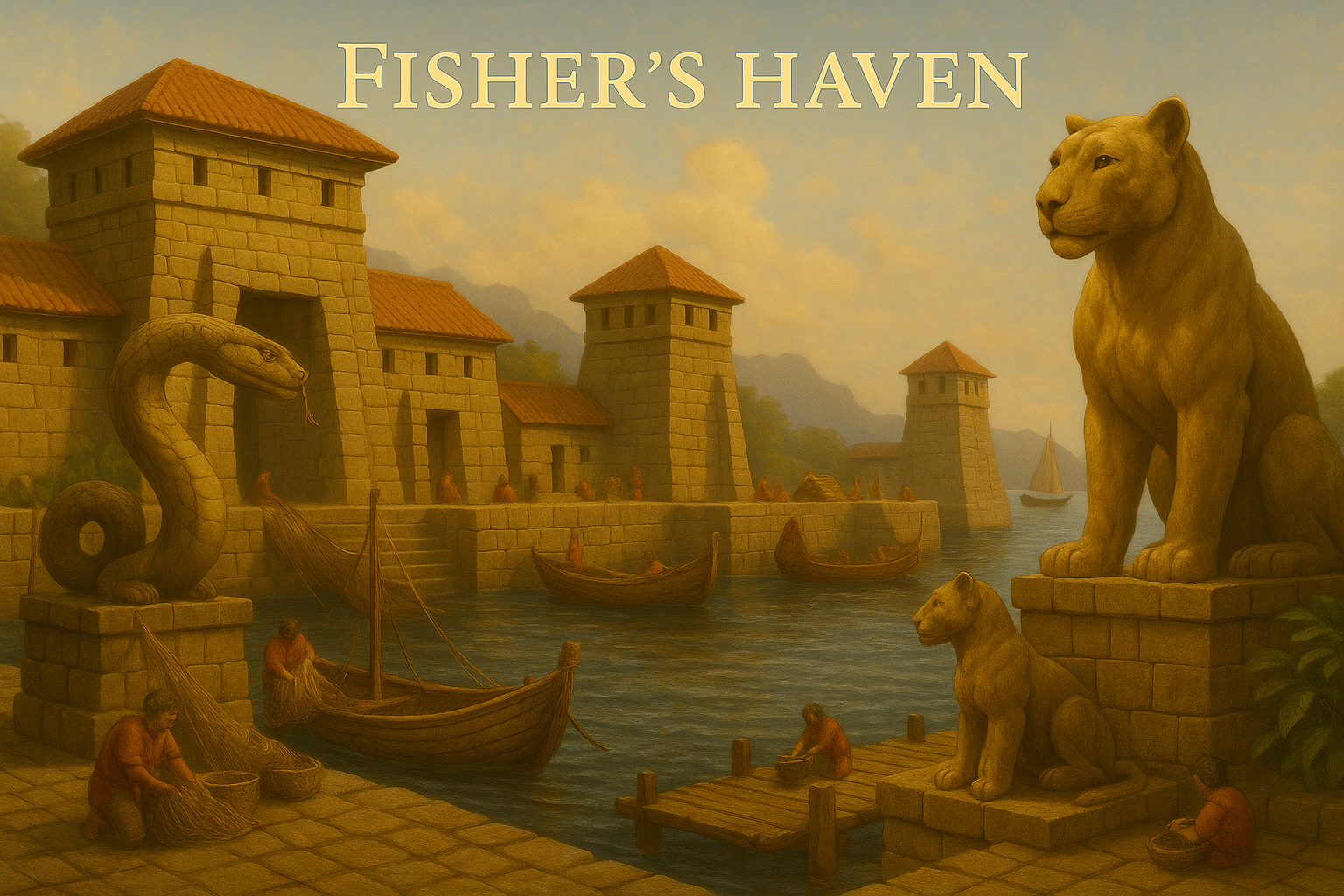
Fisher's Haven
Set along the gentle curve of Dajjashi’s coast, Fisher’s Haven is a settlement where stone and sea live in harmony. The harbor walls rise with watchtowers capped in red-tiled roofs, guiding vessels through mist and tide. Flanking the entrance are monumental carvings: a serpent coiled in vigilance, and lions crouched in eternal readiness. To outsiders they are statues, but to the fisherfolk, they are living guardians — bound by prophecy to Queen Eztli’s reign.
The people of Fisher’s Haven live by the rhythm of the tide. At dawn, families gather to prepare boats and nets; by midday, the harbor is alive with the return of vessels heavy with fish — snapper, eels, silver-scales prized for their shimmer. Stone quays bustle as men and women clean and pack the catch, children weave reed baskets, and elders tell stories in the Hall of Nets. Each hand serves the whole, for here, wealth lies not in gold but in the sea’s steady gift.
The Legend of the Serpent and the Jaguar lives in every corner of the Haven. On stormy nights, families set reed lamps afloat, whispering prayers to the serpent spirit that was defeated yet bound to guard them. Children play “The Battle of Three Days,” chasing each other across the docks, two taking the role of lions, one the serpent, until laughter drowns out the roar of the waves. Fisherfolk still leave small offerings — fish heads, knotted ropes, shells strung with kelp — at the base of the serpent statue, believing such gifts soothe its hunger and keep the waters calm.
During the yearly Festival of Guardians, the whole port gathers in procession. Fishermen dress in lion masks, women weave serpent-patterned sashes, and at dusk baskets of salted fish are cast into the sea, said to be carried by the tide all the way to Coatlán and laid symbolically at Queen Eztli’s feet. Priests of the Serpent Crown declare that the glowing eyes of the harbor statues on festival nights are proof that the Queen’s divine mandate binds even spirits of storm and tide.
For outsiders, Fisher’s Haven is a quiet port where nets dry in the sun and hearthfires always burn. But for the people who live there, every catch, every prayer, and every story is part of a greater truth — that their Queen reigns not only over land and temple, but over sea and spirit as well.
The Legend of the Serpent and the Jaguars
Long before the reign of Queen Eztli, the coast where Fisher’s Haven now rests was cursed. The sea yielded nothing, swallowing nets and dragging boats into its depths. One night, a vast serpent spirit rose from the waves, its coils wrapping the harbor rocks. Its voice hissed like surf against stone:
“No net shall hold, no fish shall feed you, until you kneel to me as lord of tide and fang.”
The fisherfolk, gaunt and desperate, nearly bent in submission. But from the inland came a huntress, guided by dreams and cloaked in scales and shadow. She bore the voice of the gods and the strength of the jaguar. With a word she struck the earth, and from the jungle came two great jaguars — born of stone and spirit, eyes like embers in the dusk.
For three days and nights, the jaguars battled the serpent spirit. Their roars shook the cliffs, their claws tore the tide, and their fangs raked the sky itself. On the dawn of the fourth day, the serpent bowed its head in defeat and curled into stone, forever coiled at the harbor’s mouth. The jaguars crouched at its side, guardians not of the serpent’s curse, but of the people who endured.
The huntress departed inland, leaving her prophecy:
“When the Serpent’s Chosen rises, the jaguars will prowl again, and the sea itself will bend to her crown.”
When Queen Eztli ascended and decreed Fisher’s Haven free under her watch, the people knew the prophecy had come to pass. They say the serpent and jaguars at the harbor gate are not mere carvings but bound spirits — her watchers in stone, her guardians of tide. On storm nights, fisherfolk whisper of glowing eyes in the statues and faint pawprints left wet upon the docks.
Thus the people of Fisher’s Haven honor not only the sea, but the eternal bond between serpent, jaguar, and queen. Every prayer, every offering, every chant of the Festival of Guardians keeps the old vow alive: the Queen reigns, the serpent coils, and the jaguars prowl
The Festival of Guardians
From the Hall of Nets, a procession emerges. Men and boys wear painted lion masks, their jaws wide in frozen roars, while women and girls trail behind with serpent-patterned sashes draped across their shoulders. Children carry baskets of silver-scale fish, their shimmering bodies flashing like coins in the firelight. At the head of the procession, the eldest fisher casts a net woven from dyed kelp, its strands gleaming green and gold, symbolizing both sea and serpent.
Drums beat in rhythm with the tide, deep and steady, while flutes made of bone whistle sharp as seabird cries. The whole village joins in the chant — not words of command, but a flowing hum said to echo the heartbeat of the serpent spirit itself. Some paint their arms with coiling patterns of white and blue, while others tie cords of knotted rope around their wrists for protection.
As dusk deepens, the crowd gathers at the docks. The serpent and lions carved into the harbor gate loom above, their shadows stretching across the water. Fisherfolk lift their offerings — baskets of smoked fish, ropes of shells, small charms carved from driftwood — and cast them into the tide. The sea swallows the gifts, waves carrying them outward, toward Coatlán, toward their Queen.
It is then, in the hush between chant and wave, that whispers spread. Some claim they see the serpent’s stone eyes flicker with a dim light, or the lions’ paws shift ever so slightly on their pedestals. Children gasp, elders nod in reverence, and all murmur the same words: “The Queen’s guardians watch still.”
The night ends in laughter and feasting — nets hung with lanterns glow above the harbor, boats are strung together into floating platforms where dancers move in circles, and the sea itself seems to join the revelry, calm and gleaming beneath the moonlight.
The Guardian’s Tide
Ritual of the Guardian’s Tide
As performed at dusk on the Festival of Guardians
Setting:
The people gather at the docks. Offerings of fish, shells, and woven charms are prepared in baskets. Drums keep a steady rhythm, echoing the heartbeat of the tide. Lanterns are lit and set along the serpent and lion statues at the harbor’s gate.
Opening
Elder/Priest:
“People of Fisher’s Haven, the tide comes to us as it has since the beginning. Tonight, we honor the guardians who keep our waters safe, and we bind ourselves once more to the Serpent Crown.”
Crowd:
“We are bound. We are guarded. We are one.”
Invocation of the Serpent
Elder/Priest (placing hand on chest, coiling outward):
“Serpent of the deep, coil and guard our waters.”
Crowd (mimicking the coil):
“Coil and guard, coil and guard.”
(Offerings of shells or fish heads are cast into the sea.)
Invocation of the Jaguars
Elder/Priest (raising clawed hands, leaning forward):
“Lions of the shore, roar and guard our Queen.”
Crowd (with claw gesture and growl/hum):
“Roar and guard, roar and guard.”
(A single stomp shakes the dock as fish baskets are raised high.)
Invocation of the Serpent Crown
Elder/Priest (hands lifted, palms together, lowered to the heart):
“Eztli, Serpent Crown, chosen of the gods.”
Crowd (mirroring gesture):
“Guide our nets, guide our hands, guide our hearts.”
(Children carry baskets to the water’s edge and release them into the tide.)
The Binding
Elder/Priest (stomps once, claps once, strikes chest):
“Sea, land, Queen — bound as one!”
Crowd (all together, three times, with rhythm):
“Sea, land, Queen — bound as one!
Sea, land, Queen — bound as one!
Sea, land, Queen — bound as one!”
(The final stomp and chest-strike echoes with the drums, and the chant fades into the sound of the sea.)
Closing
Elder/Priest:
“The serpent coils. The jaguars watch. The Queen reigns. Fisher’s Haven is guarded, this night and all nights.”
Crowd:
“Guarded, this night and all nights.”

Comments