

Russian Funny Propaganda
With humanity’s relentless progress came the sprawl of human settlements – sideways, and up. For a while, there was a new tallest tower every few weeks, days even. Sunsets, sunrises and landscapes disappeared, eclipsed as cities grew like grey, polyhedral jungles, burying at their feet the memory of the marketplace, and finishing to dilute in the collective imagination the awe that was felt as one would look up to the church’s belltower.
Yet for all the concrete used, chasms opened. More and more, the city alienated the countryman, making itself seem almost a fairytale. Too many formidable stories came out of those places made of walls where all could now be made and done, while outside the walls the clouds still rained, the wind still blew, and fields yielded their unruly crops. To the men and women who knew only simple toil and the breath of the earth, the notion that cities had become such relentless hubs of industry, commerce and technology was unimaginable.
The Russian Empire, as a nation suffering from deep divides and demographic disparity, fell victim to a particularly severe form of this disconnection. Isolated areas became characterized by the disbelief altogether in those mythical settlements that allegedly spanned dozens of kilometers, sheltering and putting to work citizens in the millions. Photography only aggravated the problem when the Central Regency’s propaganda department issued pictures of the sprawl and high-rises: the surreal view of tall houses provided by way of this technology unfamiliar to the nomadic population struck merely as a strange and meaningless fabrication from an estranged government. Jokes started to circulate that the man from the city would relieve himself inside his own home.
This marked the beginning of the Funny Propaganda Campaign, a communication initiative in which the government struggled to convince some of the northernmost ethnic groups (Nenets, Evens, Yakuts) that post-industralized cities were… real. This led to one of the most ridiculous issues faced by modern governments.
As a consequence of unchecked urban accelerationism being inconceivable to the boreal population, the Funny Propaganda actually required the downplaying of the cities’ real scale and the towers’ true height, so as to make them more believable to the target audience. Such designs as the following, which depicts the Red Tower as a building about 560ft (170m) in height, would be commonplace – the actual height of the Saint-Petersburg skyscraper being 1,030ft (315m). Of course, not even remotely accurate representations of the tallest Russian buildings were given.
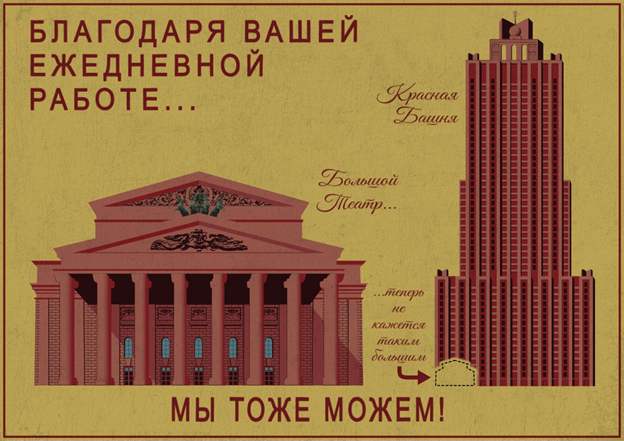
THANKS TO YOUR EVERYDAY WORK…The Red Tower… The Bolshoi Theatre… not so big (bolshoi) now
WE CAN TOO!
This particular example had an even deeper layer of nuance considering the building they were comparing the tower to. The original Bolshoi Theatre had burned down in 1831, but was symbolic of what many of the older generations in rural communities had previously considered to be the “urban way of life”. In their own way, the men in the art department were getting an underhanded jab in at the more earnest people of the countryside, though it ironically helped more than it harmed.
Despite its name, methods, and unusual drawbacks, the campaign resulted in being accidentally educational. As more and more nomads witnessed the cities with their own eyes and came back to their own with first-hand experiences to recount, it became clear that Moscow had not been lying, and the propaganda material came into use to tell the young about the industrialized world – now spreading downsized versions of the empire’s urban achievements.


Comments