
Concordian English
The High Diphthong Mergers: Many Concordian dialects of English turn the vowels in PEACE and PACE into one and the same diphthong (peace = pace), as well as those in SPOOK and SPOKE (spook = spoke). Resulting ambiguity sometimes leads to morphological repairs, such as the verb “to choose” which, instead of inflecting as “I choose, I chose, I have chosen”, yields “I choose, I choosed, I have choosed/choosen”.
T Fortis: Likely due to frequent exchanges with the German-speaking Ostend Company, T before the vowels OO and EE becomes a TS sound, which is sometimes respelt phonetically as Z as per German spelling. Additionally, word-final T becomes fully released as /t͡s/ as well, so one might be asked “would you like zo come at eighz for a cup of zea* ?”. This is more typical of higher social classes, and avoided in everyday speech.
(Or actually zey, cf. the above!)
“I am Coming to Go”: Under the influence of Spanish, “to come” has become an auxiliary for the near future, especially in Nuevo Jalisco. “I am coming to go” is thus equivalent to “I am about to go”. In the past tense, it can be recycled as a near past: “he’s come to go” means “he just left”. Grammatical borrowings from German exist too: someone could easily ask for “a cup tey” (eine Tasse Tee).
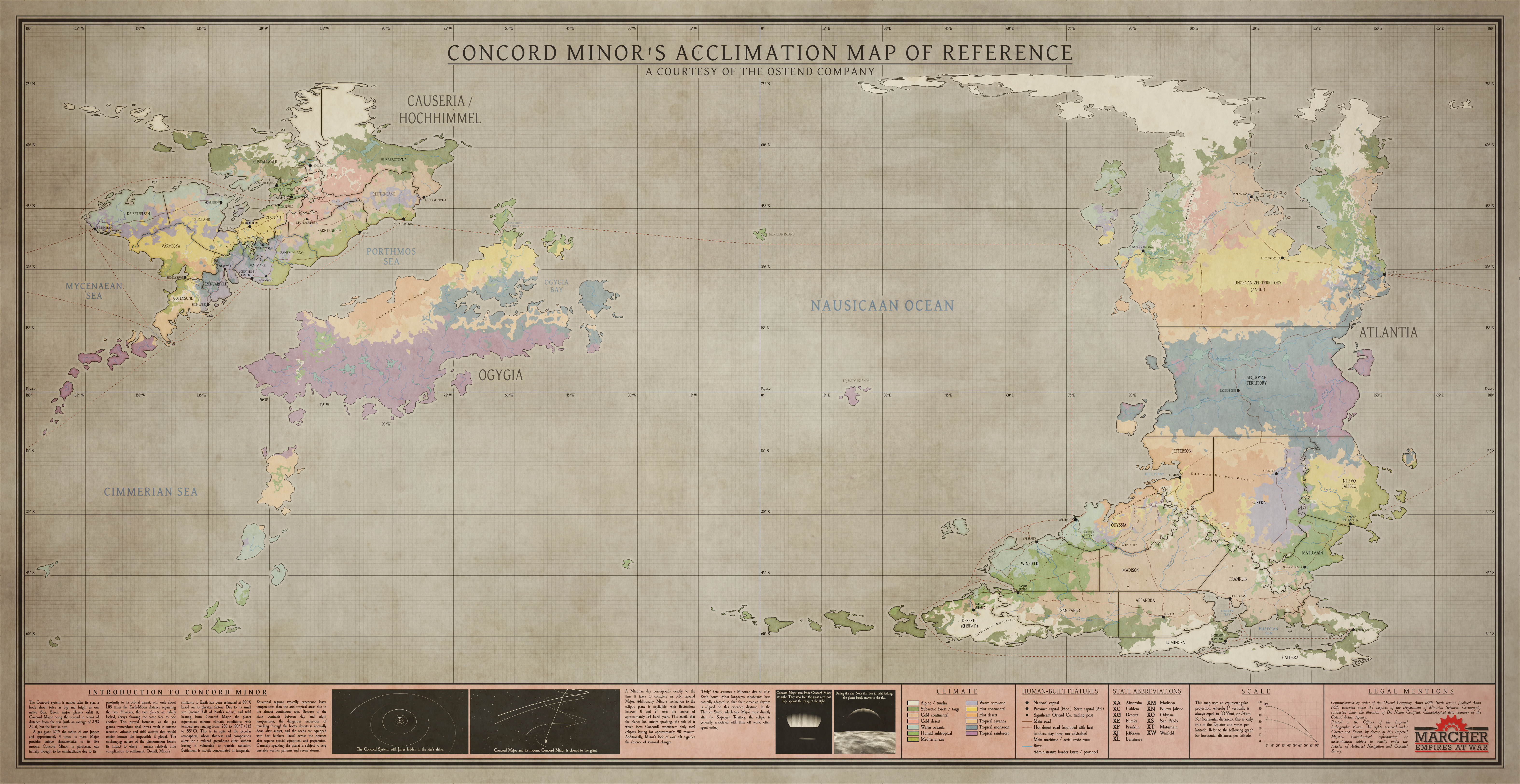
Double Modals: One might could say that the use of double modals has become fairly standard in Atlantia.
Skipping the Eclipse is a common way to refer to the nap taken as Concord Major obscures Minor. Conversely, living the eclipse is said in the northern states when one makes the most of the hour of coolness to go about their errands. To live something, in general, is to enjoy a place or a period of time. Concordians live Merchant, but they live their vacations in the countryside, too!
Hochhimmel Loanwords: Due to the cohabitation of Imperial languages and English on Concord Minor, a steady stream of loanwords has been flowing between the continents.
The Absaroka Cut: Speakers in the state of Absaroka are reluctant to pronounce the final consonant of their words, especially P, T, K, B, D, G, N and M after a vowel. Not only that, but the loss of certain consonants is associated with various corresponding stress patterns. Linguists believe that Absarokan English is developing tones to some extent.


Comments