
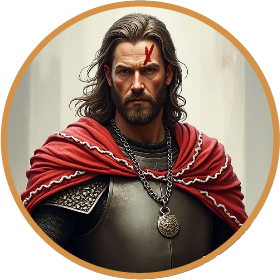
Duncan Blackwood
Duncan Blackwood of Littleburg, Votary of St. Cuthbert Order of the Chapeaux: https://www.dndbeyond.com/characters/135196573
Duncan was born in the town of Littleburg, along the shores of the Att River, just north of the Gnarley Forest. As his father before him, he farmed the lands of his homestead. Hard work brought him comfort; he provided crops for the local town market and found solace in his beloved wife, Elohna, and their daughter, Sybil. It was a simple life, a hard but good life. Elohna was the love of his life. They met at a spring festival of planting and fell in love in an instant. Their courtship was short, for they knew that life apart would not be bearable. They wed under a massive oak tree while standing on an ancient Oathing Stone along the Att River. Joined by friends and family, Duncan stood proud as the Handfasting ceremony bound him and Elohna.
After a few seasons, they welcomed their daughter, Sybil. She seemed to grow so fast, and Duncan was ever protective of his baby girl and her beautiful mother. They were everything to the man that Duncan was and had become. His hard labor in the fields had made him strong both mentally and physically, but the girls of his life made his heart weak, protectiv,e and loving. He cared for them more than anything in the Flanaess.
Years later, his life had changed. While coming home from the market after selling off their harvest, they noticed that there was smoke in the distance. It appeared that the farmhouse was set ablaze. Duncan pushed the horse-drawn cart as fast as possible, and when they arrived home, to their dismay, they did find the farmhouse burning. As they rounded the bend to the front yard, they came across a pack of Brigands. Dressed in ragged clothes, wearing scraps of cobbled-together armor, and carrying improved weapons and burning torches. Some of them were not even human, possibly of Orc descent. Once the feral pack noticed the cart and the new arrivals, they began to hoot and holler, charging forward seeking easy prey.
Elohna screamed and grabbed Sybil to run for any cover they could find. Reaching for a pitchfork from the cart, Duncan jumped forward and attacked the nearest enemy, swiftly landing a stabbing blow into his bare thigh. In return, the enemy struck Duncan across the left temple and forehead. Stars flashed in his eyes, and his vision failed. The taste of blood and dirt filled his mouth as the ground quickly came to greet him. He was down and could hear the sounds of his girls screaming. Though his vision was blurred, he could make out the shape of Elohna with Sybil grasped in her arms, running from the vicious pack. The undeniable snap of heavy crossbows rang out, their heavy bolts impacting Elohna and through her into Sybil. Both bodies dropped to the ground, lifeless and unmoving. Silence fell over Duncan as his heart collapsed. A rage began to build, but he could not move. He felt a heavy weight on his chest, and a foul stench invaded his nostrils. A rough and weathered hand grabbed his face and turned his head so he could see the face of his defeat. A leering Orc with a wicked smile, drool hanging from his mouth, started speaking in some foreign language, then laughed in a mocking tone. At the same time, a jagged blade was slowly piercing his flesh into his abdomen. More blood filled his mouth, and he began to choke, losing his vision again and soon his consciousness. As everything faded away, he thought of his girls, his loves, then darkness, calmness, and quiet.
One fateful, storm-lashed night, his path was forever altered. In the dim glow of dusk, a traveling cleric from the revered order of St. Cuthbert happened upon the remnants of the one-sided battle. Bearing word of divine mercy and righteous justice, amid the thunder and the soft hum of whispered prayers, the Cleric laid hands on Duncan and brought the light of St. Cuthbert to heal his wounds. His eyes opened, and he could see the devastation left behind. His farm was burned to the ground, the house nothing but charred timbers, his wife and daughter torn apart, heavy bolts piercing them from multiple angles. Darkness came again as Duncan passed out from his pain and sorrow. Visions came and went as they traveled. The Cleric wrapped up Duncan's wounds and brought the girls' bodies to be adequately cared for. Days seemed to go by as they traveled, consciousness came and went, tears flowed, and the visions of that horrid night burned in his mind.
They eventually arrive at a Temple of St. Cuthbert in Dyvers. There, the attendants looked at the bodies of Elohna and Sybil. Duncan was equally attended to, his wounds treated, and he was able to rest. A short service was performed for the girls, and Duncan was left to mourn. Some time went by as he healed his physical wounds. Slowly, he began to help around the Temple with gratitude for the healing. He met with the Cleric who saved him. His name was Geoffrey of the Order of the Chapeaux. During the conversation with the Cleric, Duncan experienced an overwhelming revelation—a luminous moment when the divine presence of St. Cuthbert seemed to imprint upon his very soul. In that instant, he felt not only the weight of a sacred calling but also a deep, healing light that promised to transform his innate pain into a wellspring of compassion and strength.
Embracing this calling, he left behind the devastation of his past to train at the Order of Chapeaux, dedicated to St. Cuthbert. There, under the rigorous tutelage of battle-hardened paladins and wise clerics, he honed his body and mind to serve a higher purpose. During one intense trial—a duel against overwhelming odds—he earned a small scar over his left forehead, the same place that dropped him that fateful day when his life changed forever. This mark, though it hints at pain and sacrifice, has come to epitomize his resolve; it is a permanent memento of the battle between fear and faith, a reminder that even light must sometimes forge itself in the crucible of hardship. Choosing studded leather armor for its balance of protection and mobility, he fashioned his identity not as a brute warrior but as a vigilant guardian of the weak. His knee-high leather boots, worn and seasoned by many journeys, provide a sure footing on even the most treacherous terrain. At his side, a finely honed longsword gleams—a blade that has been blessed and tempered in service of a divine cause.
His shield, proudly bearing the emblem of St. Cuthbert, is more than an instrument of defense; it symbolizes the staunch protection of his sacred order and the comforting hope that his faith inspires. Draped elegantly over his broad shoulders is a dark red cloak with striking white trim, its colors echoing the solemn vows of his patron adopted as both a symbol of his newfound mantle and a visual reminder of the blood and sacrifice ingrained in his past. Around his neck, the holy symbol of St. Cuthbert hangs on a silver chain—a constant reminder of his calling and the divine light that guides him.
What sets his visage apart is the juxtaposition of calm, compassionate features marred only by a small scar over his left forehead—a silent testament to past struggles and enduring honor. His expression, gentle yet resolute, offers both solace and quiet strength to those who seek refuge in his presence, while his unwavering gaze speaks of battles fought and a promise to confront the darkness in all its forms.
Comments