

Codex Insania Magna
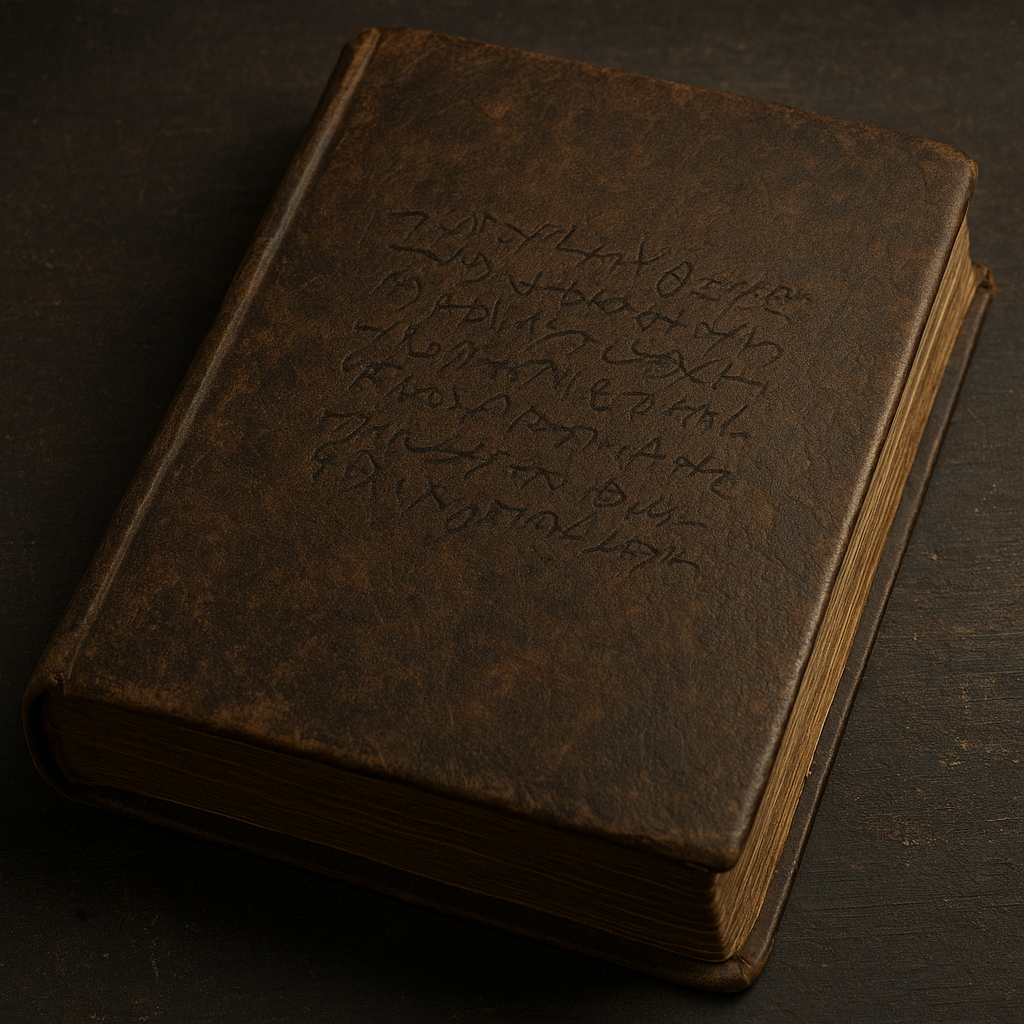
The Codex Insania Magna, often shortened by scholars to the Codex, was the most infamous and least understood of the Awoken Ashes’ collected volumes—a sprawling anthology of fractured writings produced during the final centuries of that once-formidable order. Unlike the Arcanum Maleficarum or Liber Maledictus, the Codex was never intentionally composed. It was a book that accumulated rather than one that was written, filled with fevered script from Ashes scholars who returned from planar anomalies unhinged yet desperate to record what they had witnessed before their minds collapsed entirely. In its age, the Ashes revered it as a holy work, though later academics have argued it was less a record of forbidden truth and more an artifact contaminated by the psychic residue of a cosmos never meant to be comprehended by mortals.
Physically, the Codex was a monstrous tome—so thick that its bindings strained against their own weight. Its pages were a disordered collage of centuries: crisp parchment beside brittle sheets that crumbled at the touch, and interspersed among them were pages so ancient they appeared etched rather than inked, as though inscribed by heat, acid, or time itself. The writing moved in every conceivable direction: mirrored, upside down, spiraling inward, fractured into broken symbols, or carved so violently the quill tore straight through the parchment. Entire sections repeated with subtle—but disturbing—variations, as if penned across diverging realities that struggled to collapse into one narrative. Later scholars noted that these microscopic differences—an extra stroke, a shifted curve—seemed intentional, though no one has ever successfully deciphered their meaning.
In the age of the Ashes, the Codex was revered as a kind of prophecy, a testament to truths glimpsed without the comforting filter of sanity. The order believed that reason was a veil that obscured the true shape of existence, and that the writings within the Codex—no matter how incoherent—were the closest mortals had ever come to describing the architecture of the multiverse as it truly was. Some passages appeared to recount visions of entire planes collapsing and reforming within a single heartbeat; others described encounters with beings whose forms defied geometry. A handful of entries even seemed to foretell events that would later unfold in Kermoria, lending troubling weight to the Ashes' claim that madness, properly harnessed, could see beyond time.
The Codex Insania Magna was never a safe book. Those who studied it for too long reported dreams of being stretched sideways through their own reflections, or of hearing their future selves whisper warnings in languages they did not know. A few were found writing in their sleep—perfect reproductions of Codex passages they had never encountered—an effect that scholars later described as “resonant contamination.” In its prime, some members of the Ashes insisted that the Codex was alive, not as a creature, but as a conceptual singularity: a gravity well of thought that deepened each time a mortal mind collapsed into its depths.
After the fall of the Awoken Ashes, the Codex survived in scattered fragments, its volumes dispersed among private collectors, sealed vaults, and forbidden archives. Even in ruin, it remains central to the mythology surrounding the order. It was not a book meant to be read for knowledge, but one meant to be endured by those seeking to map the edges of sanity itself. In its time, the Codex Insania Magna served as a reminder that the mind is not a sanctuary but a threshold—and that the Ashes, in their relentless pursuit of truth, shattered themselves by opening doors no mortal was ever meant to touch.
Physically, the Codex was a monstrous tome—so thick that its bindings strained against their own weight. Its pages were a disordered collage of centuries: crisp parchment beside brittle sheets that crumbled at the touch, and interspersed among them were pages so ancient they appeared etched rather than inked, as though inscribed by heat, acid, or time itself. The writing moved in every conceivable direction: mirrored, upside down, spiraling inward, fractured into broken symbols, or carved so violently the quill tore straight through the parchment. Entire sections repeated with subtle—but disturbing—variations, as if penned across diverging realities that struggled to collapse into one narrative. Later scholars noted that these microscopic differences—an extra stroke, a shifted curve—seemed intentional, though no one has ever successfully deciphered their meaning.
In the age of the Ashes, the Codex was revered as a kind of prophecy, a testament to truths glimpsed without the comforting filter of sanity. The order believed that reason was a veil that obscured the true shape of existence, and that the writings within the Codex—no matter how incoherent—were the closest mortals had ever come to describing the architecture of the multiverse as it truly was. Some passages appeared to recount visions of entire planes collapsing and reforming within a single heartbeat; others described encounters with beings whose forms defied geometry. A handful of entries even seemed to foretell events that would later unfold in Kermoria, lending troubling weight to the Ashes' claim that madness, properly harnessed, could see beyond time.
The Codex Insania Magna was never a safe book. Those who studied it for too long reported dreams of being stretched sideways through their own reflections, or of hearing their future selves whisper warnings in languages they did not know. A few were found writing in their sleep—perfect reproductions of Codex passages they had never encountered—an effect that scholars later described as “resonant contamination.” In its prime, some members of the Ashes insisted that the Codex was alive, not as a creature, but as a conceptual singularity: a gravity well of thought that deepened each time a mortal mind collapsed into its depths.
After the fall of the Awoken Ashes, the Codex survived in scattered fragments, its volumes dispersed among private collectors, sealed vaults, and forbidden archives. Even in ruin, it remains central to the mythology surrounding the order. It was not a book meant to be read for knowledge, but one meant to be endured by those seeking to map the edges of sanity itself. In its time, the Codex Insania Magna served as a reminder that the mind is not a sanctuary but a threshold—and that the Ashes, in their relentless pursuit of truth, shattered themselves by opening doors no mortal was ever meant to touch.
"Ten seconds. It took me ten seconds of reading before I decided 'nope, we're done with this'." - Victoria Pendrake
Type
Manuscript, Magical (Tome/Scroll)
Medium
Papyrus
Location
Signatories (Organizations)

Comments