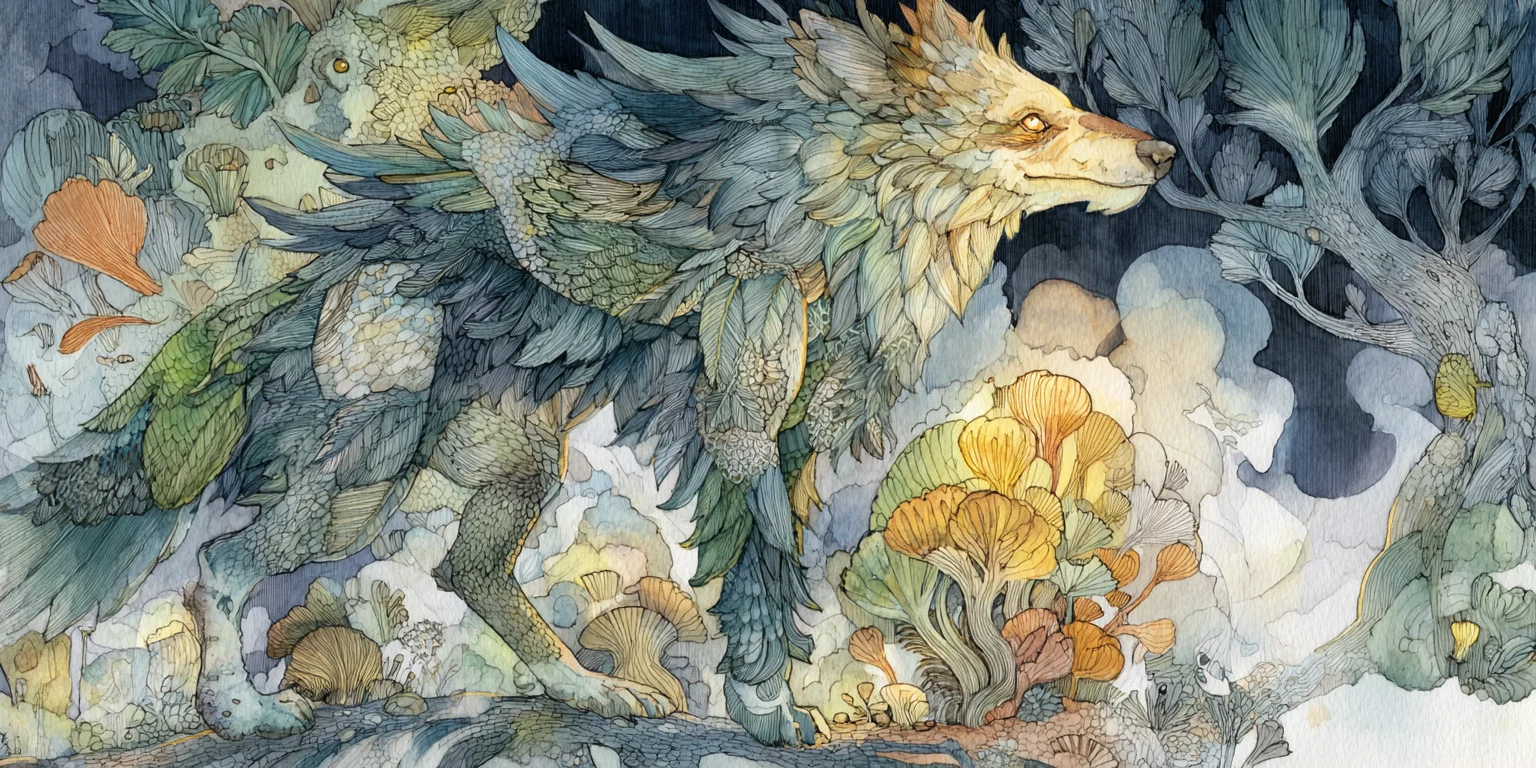
The Patchkin
Introduction
Upon the fog-drenched isle of the Emerald Atoll, where trees twist in an endless jungle and the wind carries whispers of forgotten rites, dwell the Patchkin: creatures of flesh and folly, remnants of a dream that should never have been dreamt.
They are not born, but rather assembled; grotesque amalgams of beast and bird, fang and feather, claw and scale. No two share the same form; each is a living mosaic of animal parts, fused by hands that sought to unravel the boundaries of life. Their eyes, often too many and too knowing, glint with something almost human, while their limbs move with a precision that is both unnatural and chilling.
To glimpse a Patchkin is to confront the impossible: a being that is alive, yet disjointed. In the darkness of the atoll, their presence is known by the low, uncanny cries that echo between the ruins; a reminder that some creations are better left unrealized.
The Arrival of the Alchemist
"All beasts sing the same song. I merely wish to hear the full chorus.”
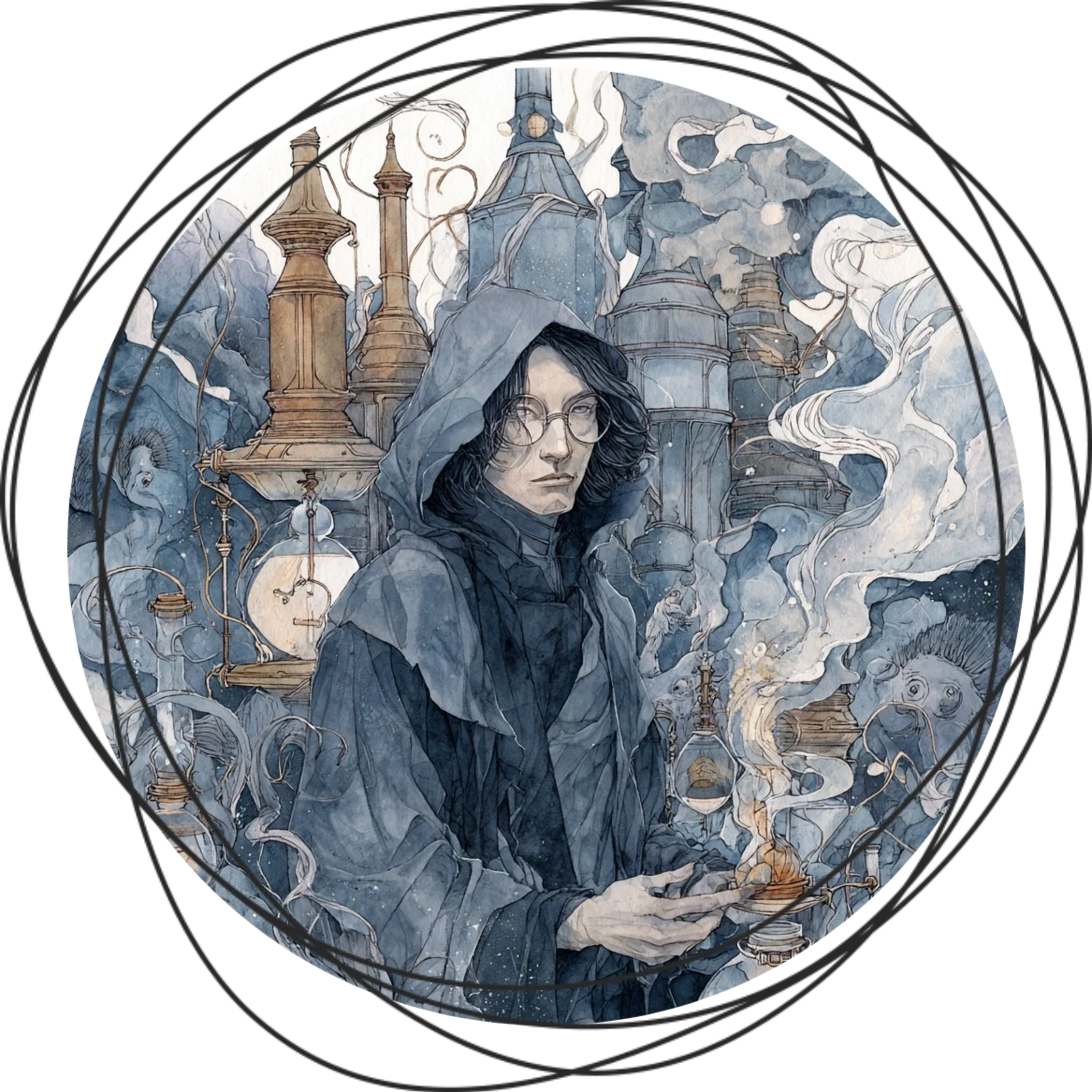
During the waning years of the Era of Enlightenment, when scholars sought to cage even the gods within the bounds of reason, a stranger arrived upon the Emerald Atoll: a figure cloaked in sea-salt and silence. He called himself Mochi ma Noban, though modern scholars argue this was merely a name bestowed upon him, for ma Noban translates as “of the beasts” in the tongue of the Archipelago.
According to surviving accounts, he was a natural philosopher and alchemist whose curiosity bordered on the divine. Whether he came to the island by choice or by exile is unknown. Some say his vessel fell from the heavens in a rain of emerald fire; others claim he fled the courts of men to pursue studies no kingdom would sanction. Many believed he hailed from distant continents lost to fog beyond Oceara's horizon, while others whispered that Mochi came from another realm entirely: a world of alien stars known as the Yonderverse. Whether this is metaphor or memory, none can say, for the man himself offered few answers.
Whatever his origin, Mochi brought with him the fever of discovery. He spoke of life as matter shaped by thought, of beasts as fragments of a larger design. To study this hidden order - what he called the Heart Chord - he built a vast Menagerie amid the jungled cliffs of the atoll: a labyrinth of glass domes, copper spires, and humming alchemical engines.
There he gathered the rare and impossible: feathered serpents, luminous insects that pulsed like living gems, creatures from the deepest jungles and coldest wastes. The locals remembered him as both saint and curse: a man of gentle manners whose eyes gleamed like instruments, who paid handsomely for specimens, and whose laughter was infectious.
From this synthesis of science and sorcery, the first Patchkin emerged: a living concord of many forms, bound not by birth but by intent. In that moment, Mochi ma Noban crossed the final threshold between scholar and godmaker.
And the island has not healed since.
Life resists clarity. It writhes when I approach the truth, like a melody fleeing its own composer.
The fox’s heart beats in the rhythm of the stag. The serpent’s breath warms the feathers of the crow. They are not separate. They are fragments of one endless form.
If I can bind them without pain, perhaps I can teach the world to remember what it once was: a single living hymn.
The Unraveling
The events that unfolded within Mochi ma Noban’s Menagerie are lost or perhaps deliberately concealed by those who would rather forget. What is certain is that he sought perfection, and perfection does not endure the hand that shapes it.
Legends speak of nights when the atoll glowed like a second moon, the air thick with unnatural cries and the rustle of forms that were not wholly animal. Some told of storms that rose without wind, of strange auroras twisting above the jungle as though the sky itself leaned to watch.
Then came silence.
When the islanders finally dared to return, they found the domes shattered, the spires sunk into the soil, and the alchemical engines humming with no hands to tend them. Of Mochi ma Noban there was no trace, only a smear of fused glass upon the floor, and the Patchkin wandering amidst the ruins, no longer confined, born anew into a wild the alchemist could never control.
Some say he was devoured by his own creations; others claim he transcended flesh, his mind diffused through the lattice of beasts he had made. A few whisper that his spirit became one with the island itself, lingering in the wind, guiding, guarding, or perhaps merely observing.
In the centuries that followed, the Patchkin multiplied. The island’s birds fell silent, the jungle reclaimed the coast, and villagers abandoned their homes. Now the Emerald Atoll is spoken of only in hushed tones: a cursed place where the jungle moves like a living thing, and shadows roam on mismatched paws. Even today, sailors report hearing faint cries on windless nights; a voice neither fully beast nor human, a remnant of a creation that should never have been.
The Patchkin: Children of the Concord
"Harmony, I have learned, is not the absence of difference. It is the embrace of it."
They are called Patchkin by those who fear them, and Children of the Concord by those who still whisper Mochi’s name with reverence. In truth, both names are apt. They are living mosaics - the sum of many lives stitched together by alchemy and ambition, by wonder and error. To behold one is to witness the boundary between nature and artifice blurred beyond recall.
Their bodies defy taxonomy. A lion’s paw may tread beside a fox’s, while a plume of argent feathers unfurls from a back of matted fur. Scales shimmer across hide that shifts hue with mood and moonlight. Each Patchkin carries unique anatomy, a tapestry of instincts in conflict, held together by veins of luminous ichor pulsing faintly beneath the skin. At their center lies the Heartstone, a crystal organ that anchors their discordant forms, glowing faintly in the dark and throbbing with life.
Though capable of startling grace, their behavior is unpredictable. A Patchkin may stalk like a predator, flee like prey, or crouch in silent observation for hours. To scholars, these contradictions are evidence of the many forms that contributed to their creation. To the islanders, they are harbingers of misfortune, haunted, untamed beings to be avoided.
They dwell mostly in the overgrown ruins of Mochi’s Menagerie, where copper towers lie half-swallowed by vines and the air tastes of rust and old, unfulfilled experiments. Some say they guard the ruins; others claim they wander aimlessly, as if mourning the creator who vanished.
Encounters and Legacy
The Emerald Atoll is now a wild, untamed realm where intruders are few and unwelcome. Their behavior is unpredictable, reflecting the chaotic nature of the many animals fused into their forms.
Their reproduction is mysterious. Patchkin do not follow normal breeding patterns. Scholars theorize that their Heartstones may generate offspring independently or foster the growth of cubs within a parent’s territory. No human has observed it closely, leaving their propagation shrouded in speculation and fear.
Patchkin are opportunistic predators, stalking the jungles, cliffs, and ruins of the Emerald Atoll with a strange, uncanny grace. Their diets are as varied as their bodies: small mammals, birds, and the fish of mist-shrouded coves all fall prey to their cunning. They are mostly - but not exclusively - nocturnal, slipping through shadows and fog, observing intruders from unseen vantage points before deciding whether to strike or retreat.
Territorial by nature, Patchkin patrol their hunting grounds and nesting areas relentlessly. They scent-mark trees and rocks, and their cries, a mixture of animalistic growls and unplaceable wails, warn other creatures to keep their distance. Even the younger of specimens will attack without hesitation, guided by mixed instincts inherited from the many species that compose them. At times, a Patchkin may freeze in observation, listening as though attuned to the tiniest vibrations in the undergrowth, only to vanish like a mirage moments later.
The Patchkin’s presence has reshaped the ecology of the Emerald Atoll. Apex predators, once dominant, have been driven into hiding or forced to flee entirely, leaving birds, reptiles, and smaller mammals to either adapt or vanish. Observers report that smaller animals flee at the first sight of the Patchkin, sometimes abandoning nests or burrows entirely.
They rarely coexist peacefully with one another and are mostly solitary. When two meet outside of territorial disputes, their interactions are brief and tense: silent displays of dominance, fleeting gestures, or moments of fragile communication that manifest in subtle body language or strange, eerie cries. These ephemeral exchanges hint at an intelligence and awareness that goes beyond pure instinct, though it is difficult to decipher.
Even a fleeting glimpse of a Patchkin is enough to unnerve the stoutest heart: mismatched limbs, glowing eyes, and bodies that seem impossible in their combination of species. They are predators, survivors, and living reminders that nature and artifice do not always coexist peacefully.
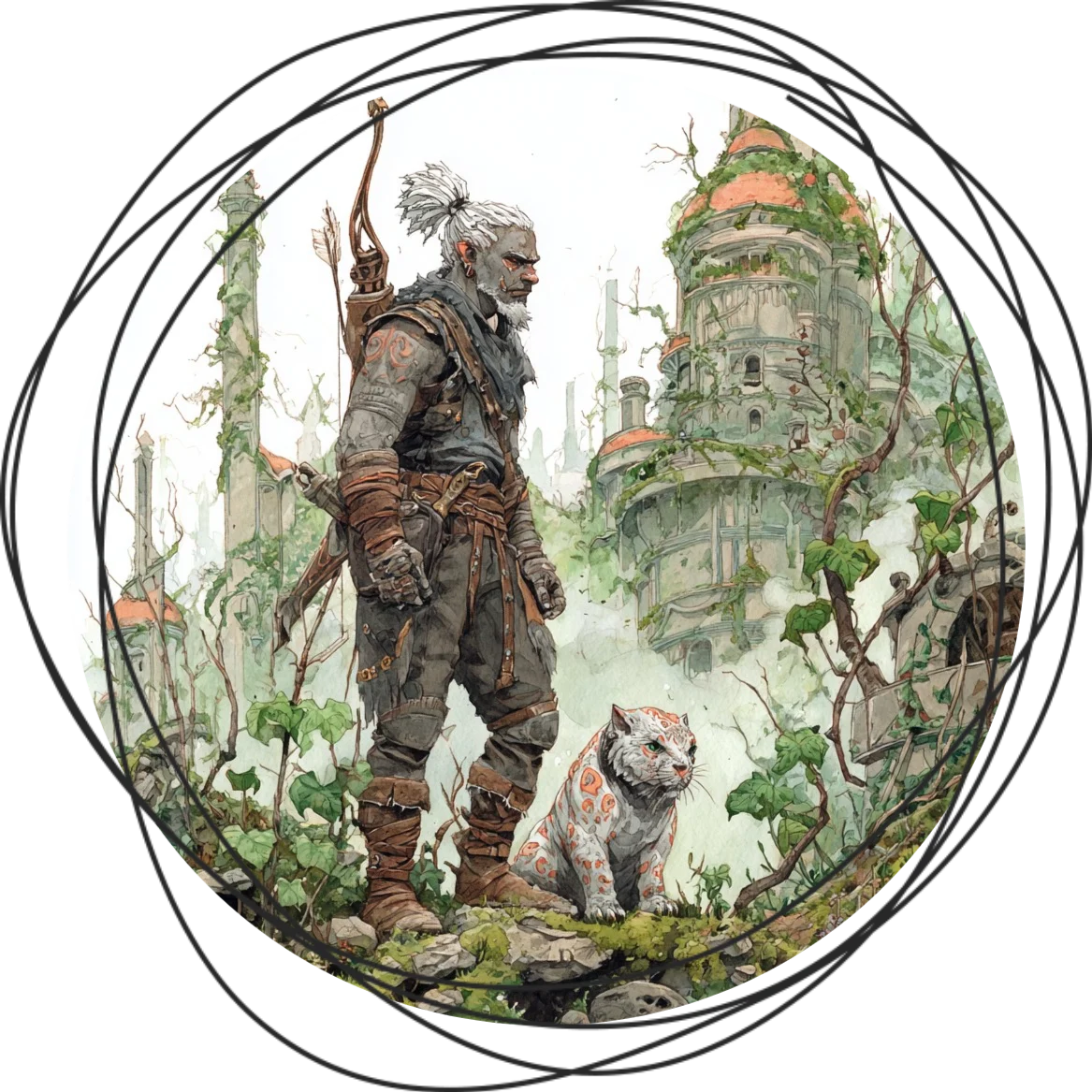
Scrap and Ekko
Among all Patchkin, there is a single recorded instance of taming. Ekko, a half-orc ranger and explorer, arrived at the ruins of the Menagerie during a mist-choked morning, guided less by reason than by an instinctive pull toward the heart of the island. Missing a fang and with white dreadlocks bound in a loose ponytail, he moved cautiously through the overgrown towers and shattered domes, following faint tracks and glowing pulses that hinted at life hidden in shadow.
It was there, among the shattered glass and twisted copper, that he discovered a Patchkin cub, smaller than a wolf but already a patchwork of incongruous parts: the delicate wings of a crow unfurling from its shoulders, a fox’s paw twisted alongside a lion’s, and scales glinting across mottled fur. Its eyes fixed on him with a mixture of fear and recognition.
Unlike its kin, the cub did not flee or strike. Ekko, relying on patience and quiet confidence, approached slowly, murmuring in a tongue of soft whistles and careful gestures. Over days, he coaxed the creature from the shadows, feeding it, speaking to it, and respecting its instincts rather than forcing submission. In return, the cub began to trust him. Ekko named it Scrap, for the way its body seemed a collection of stolen fragments stitched into living form.
Over months, a bond formed that seemed almost unnatural. Scrap learned to follow Ekko silently through jungle and ruin, sensing danger and alerting its companion with subtle gestures. When confronted with other Patchkin, Scrap would hiss, bristle, or place itself between Ekko and threat, but it never attacked without command. Even among creatures that are usually savage and untamed, Scrap exhibited a rare intelligence and loyalty, seeming to recognize the ranger not just as master but as partner.
All written content is original, drawn from myth, memory, and madness.
All images are generated via Midjourney using custom prompts by the author, unless otherwise stated.


Love me a good tribute
Thank you! It was a delight to write and Mochi is a great source of inspiration for sure :)