The Mnemar
Curators of Afterlife & Bureaucrats of Death
Introduction
The Mnémar existed long before lineage or nations, even before the concept of time as mortals understand it. They did not die, because they were never born. They simply were - coalesced from divine will and the dim radiance of the Underworld's ever-burning dark light.
When mortals speak of the afterlife, they imagine angels, psychopomps, judges of souls, yet none hold a candle to the somber elegance of the First Shadow Elves. This is no accident. It is part of their design. For the Curators of Souls were not shaped to inspire worship.
They were meant to keep the ledgers of life and death, and thus protecting the cycle.
"Every soul must be accounted for. Even ours, though we were never meant to have them.”
Children of the Angels of Death
When the first mortal died, the god of the Sun wept light into the void that lay beneath the world. From that grief rose two angels: Siona and Zinxa, sisters in purpose, opposites in temperament, and the first custodians of death’s unfamiliar domain.
Together, they shaped the beings mortals would one day call the Mnémar.
The sisters sculpted them to keep the fabric of death intact and ensure that souls did not scatter, wither, or born prematurely. Every Mnémari was bound to a department, an office, or a cosmic function - each chosen by purpose instead of rank. Guides escorted souls across the boundary between breath and stillness, ensuring the passage was smooth. Judges weighed unspoken truths against unfulfilled deeds. Archivists recorded every life into vast obsidian stacks only they could read, keeping the ledger in perfect order. And a select few - the Liminal Wardens - patrolled the trembling borders between the living and the dead.
A Mnémar’s mind was ordered like an archive: layered, compartmentalized, endlessly cross-referenced. They did not forget; memories simply drifted to the edges like books on distant shelves, waiting to be retrieved. Emotion was not absent, yet it was irrelevant. Sorrow was a datum. Joy was a notation. Guilt was a variable in a soul’s trajectory. Their detachment was not cruelty, but calibration.
They could not lie; falsehood had no place in a ledger. Symbolism they grasped by instinct, yet metaphor slipped through them like smoke. Time, to them, was perceived not as a line but as overlapping spirals. A Mnémar could look at a soul and see its contradictions the way a mortal sees scars.
Mortals rarely saw them. When contact was necessary, it came through dreams of velvet corridors, through the stubborn flame of a candle that refused to die, or through a figure glimpsed only at the edge of sight. Those who remembered the encounter carried only an aftertaste; cold clarity, a whisper without sound, the sense that something ancient had passed by.
In time, Siona and Zinxa grew into rival goddesses and divided the halls of the Underworld between them. Yet the Mnémar remained: the only beings still loyal to both, because they had been shaped for the ledger, not for the throne.
Forms Wrapped in Silence
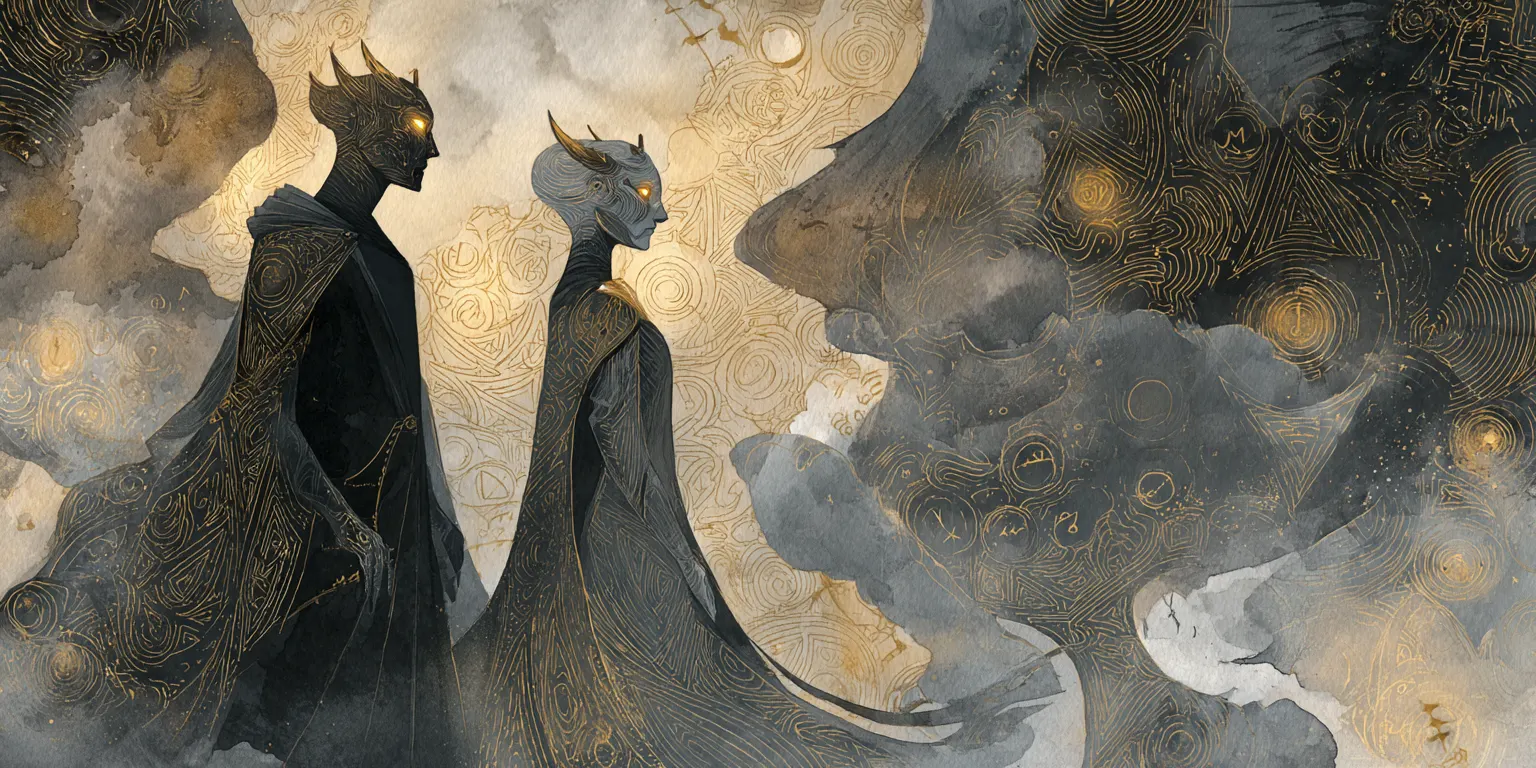
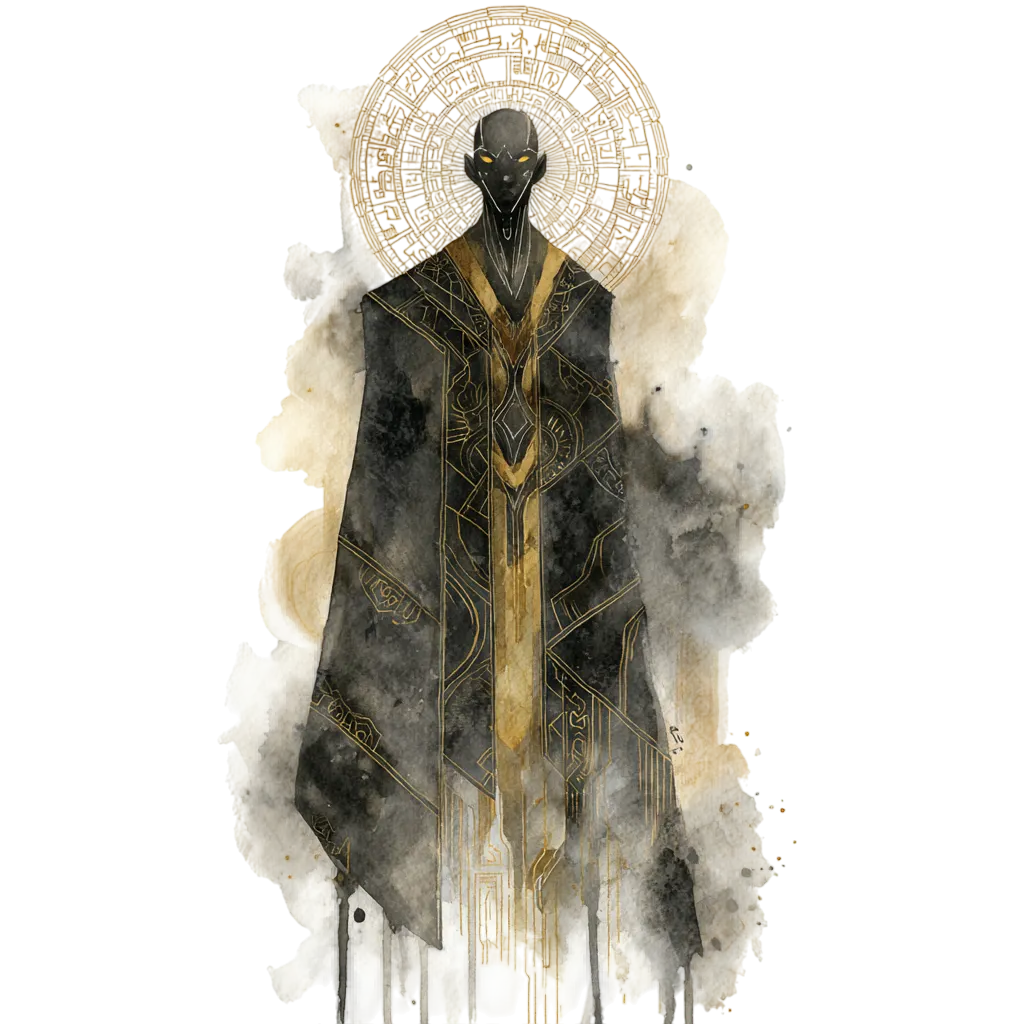
A Mnémar seen in mortal light appears as a silhouette shaped from dusk. Their bodies shimmer faintly, as if caught between planes; the edges of their forms fray into drifting shadow that moves with a will not their own. Their skin ranges from smoked quartz to wet obsidian, the hue tied to the department of the Underworld they serve.
Their eyes carry a soft, unearthly luminescence; lantern-fire sifted through mist. Guides glow in warm golds. Judges flicker in violet or ice-blue. Archivists shimmer in grey-silver, their irises threaded with shifting glyphs that rearrange whenever a name is spoken.
Their garments are woven from mist, memory, or threads of night itself. Some robes fall like thin fog layered over nothing; others resemble ink that flows with its own quiet purpose. Their footsteps never touch the ground. Shadows curl upward beneath them as if recognizing one of their own.
They do not die, but they can be dissolved back into the Underworld's fabric if their function collapses. Where mortals carry memories within the mind, Mnémar are their memories; living archives of every soul they have guided. The Mnémar do not reproduce. They are sculpted when needed, erased when broken, and eternal when stable. Their presence is silent, unsettling, and strangely comforting, like standing in a temple at dusk, listening for a voice that never comes.
Nemethra: City of Records
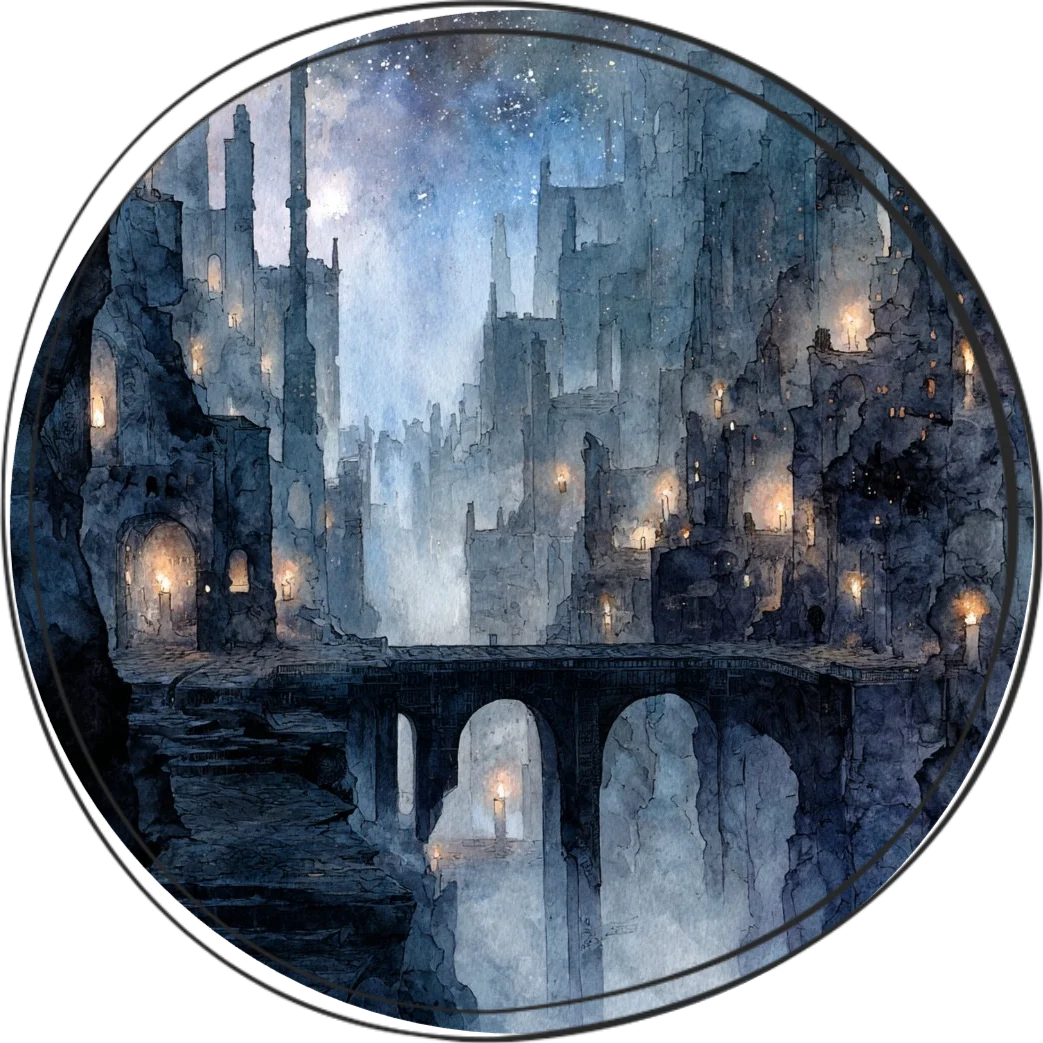
Hidden within a sealed pocket of the Underworld lies Némethra, the City of Records, a place that is less a city and more a mechanism shaped from memory and divine intent. It exists in a fold of reality untouched by rivalry: a realm that belongs neither to Zinxa's dominion of Noxaria nor to Siona's luminous halls of Astralyn. Némethra stands apart, inviolate, the neutral heart of the cycle.
To mortal senses, it might resemble a labyrinth of obsidian towers, drifting bridges, echoing chambers, and corridors that shift form. Light comes from floating lanterns burning with pale silver flames. The walls are etched with runes that slide and rearrange, spelling the names of every life that has ever passed. The Mnémar move through these halls like ink through water; fluid and unwavering.
Errors in Némethra are rare. When they occur, the disturbance ripples outward: lost souls and echoes of the dead where no echoes should be. Mnémar correct such anomalies with chilling efficiency. Those who fail repeatedly are dissolved back into the Underworld's fabric, reclaimed by the goddess who first shaped them.
Ambition exists among them, but it is regulated like everything else. A curator may aspire to oversee more complex divisions - the New Souls Chambers, the Hall of Unresolved Lives, or the Office of Stained Souls where undeath is catalogued - yet advancement is determined by metaphysical evaluation, not politics.
Desire remains secondary. Duty remains absolute.
Cultural Significance
Mortals whisper of the Mnémar the way children tell stories around a dying fire: with equal parts reverence and fear. They embody inevitability and the silent ledger of every life. Artists depict them as elegant silhouettes or lantern-bearing figures. Priests regard them as final arbiters of truth, beings who cannot be deceived.
Across Kena’an, many cultures treat the Mnémar as minor manifestations of divine will, the ferrymen of the afterlife. Mages who study necromancy or divination often seek relics tied to them: obsidian shards inscribed with shifting names, fragments of mistwoven cloth, or the bureaucratic seals once used to mark souls for reincarnation.
Such artifacts are almost never found. Yet every tale insists on the same unspoken truth: even the gods tread carefully when Mnémari relics resurface.
The Gift of Mortality
The schism between the sisters did not merely divide the Underworld; it tore at the foundations of what the Mnémar was. When Siona raised Astralyn as the hall of dissolution and Zinxa carved Noxaria into a realm of unending hunger, the cycle that had once flowed as clean as a river through night was pulled in two directions. Souls that should have glided toward release now drifted in strange orbits. Some arrived dimmed, half-consumed by Zinxa's grasp; others flickered uncertainly between the two dominions, belonging fully to neither.
The Mnémar tried to hold the balance steady. They attempted to do the work they were made for - record, guide, judge, maintain - but the laws beneath their hands no longer aligned. Their ledgers contradicted themselves. Their archives filled with double-entries and missing names. Souls were becoming damaged in ways no script accounted for. Perfection, confronted with fractures it could not mend, began to split them open.
And so, as beings of pure function do when faced with impossibility, they acted with terrible precision. To prevent further imbalance, they began to remove whatever could not be placed. Souls that hung between Astralyn and Noxaria vanished from the ledger entirely, erased as errors in a system that had no room for contradiction.
Siona saw it all. She watched the children she shaped from dusk and duty twist themselves into instruments of cruelty, not because they wished it, but because they could not understand any other way to keep the world from tearing. There was no malice in their actions. Only the unbearable weight of purpose without compassion. And so the merciful goddess intervened.
She did not punish them.
She did not command them.
She simply sought to save them from a burden that was crushing them.
She offered the Mnémar mortality.
The act was not gentle, yet it was tender. Their forms unraveled, the dusk that shaped them condensing into flesh and bone. Breath flooded them like a storm. Emotion hit them as hard as gravity. For the first time, a Mnémari heart beat with fear, with wonder, with the fragile chaos of being alive. These became the first of the Shadow elves: dusk-touched, graceful, haunted by origins they barely remembered, yet freed from the crushing burden of absolute purpose that had once threatened to break them.
But not all accepted the change.
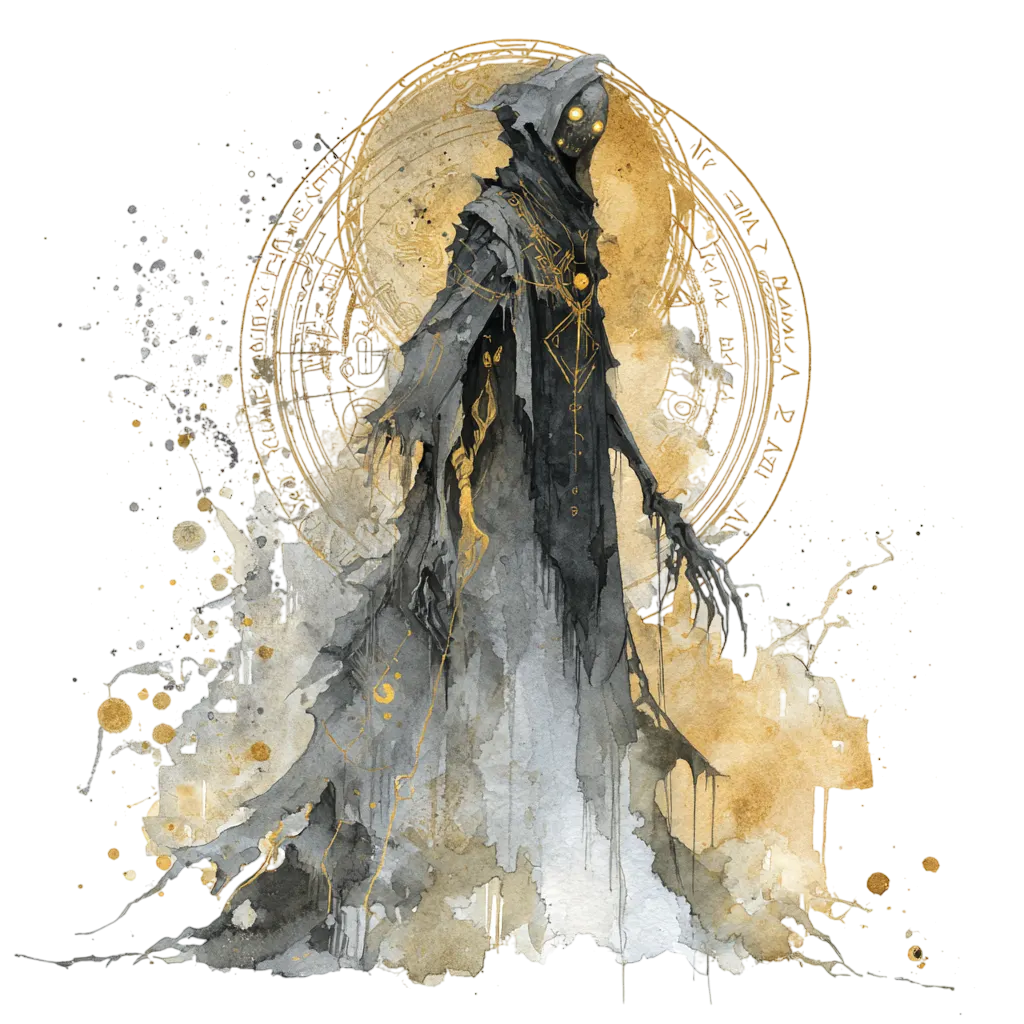
Some recoiled from it, seeing mortality as dissolution; an ending to everything they had been and everything they had upheld. These Mnémar were the ones that severed Némethra from the shifting realms of the Underworld, locking their city away in a pocket of stillness so the ledger could remain untouched by the chaos outside. They became the Primal Curators, eternal and austere, guardians of the old order who watched the new world of mortals and undeath from behind sealed gates.
And then, there were those who fell neither into mercy nor into loyalty.
These were the Mnémar who broke the most during the schism; minds fractured by contradictions that tore through the cycle. They were the ones who stared too long into Noxaria's hunger, the ones who tasted Zinxa's power before they understood what it was. The Devourer gathered them to her like lost embers. She hollowed them, filled their emptiness with her devouring will, and crafted from them a new order: the Nyxbound, known in fearful whispers as the Forsaken Curators. Their voices are the echoes of records consumed. Their judgment is hunger wearing the mask of law.
Mortals know none of this. Their stories and tales remember a gentler and false tale: that Siona crafted the Shadow elves as tribute to love.
But the truth lingers in Némethra’s sealed corridors, whispered by those who have never known breath:
Mortality was given to the Mnémar because eternity had begun to kill them.
Related Articles
All written content is original, drawn from myth, memory, and madness.
All images are generated via Midjourney using custom prompts by the author, unless otherwise stated.


Gods yes
<3 <3