Lunarcap Fungi
Introduction
"In sunlight's gaze, they shy away. In moonlight's caress, they reveal their grace."
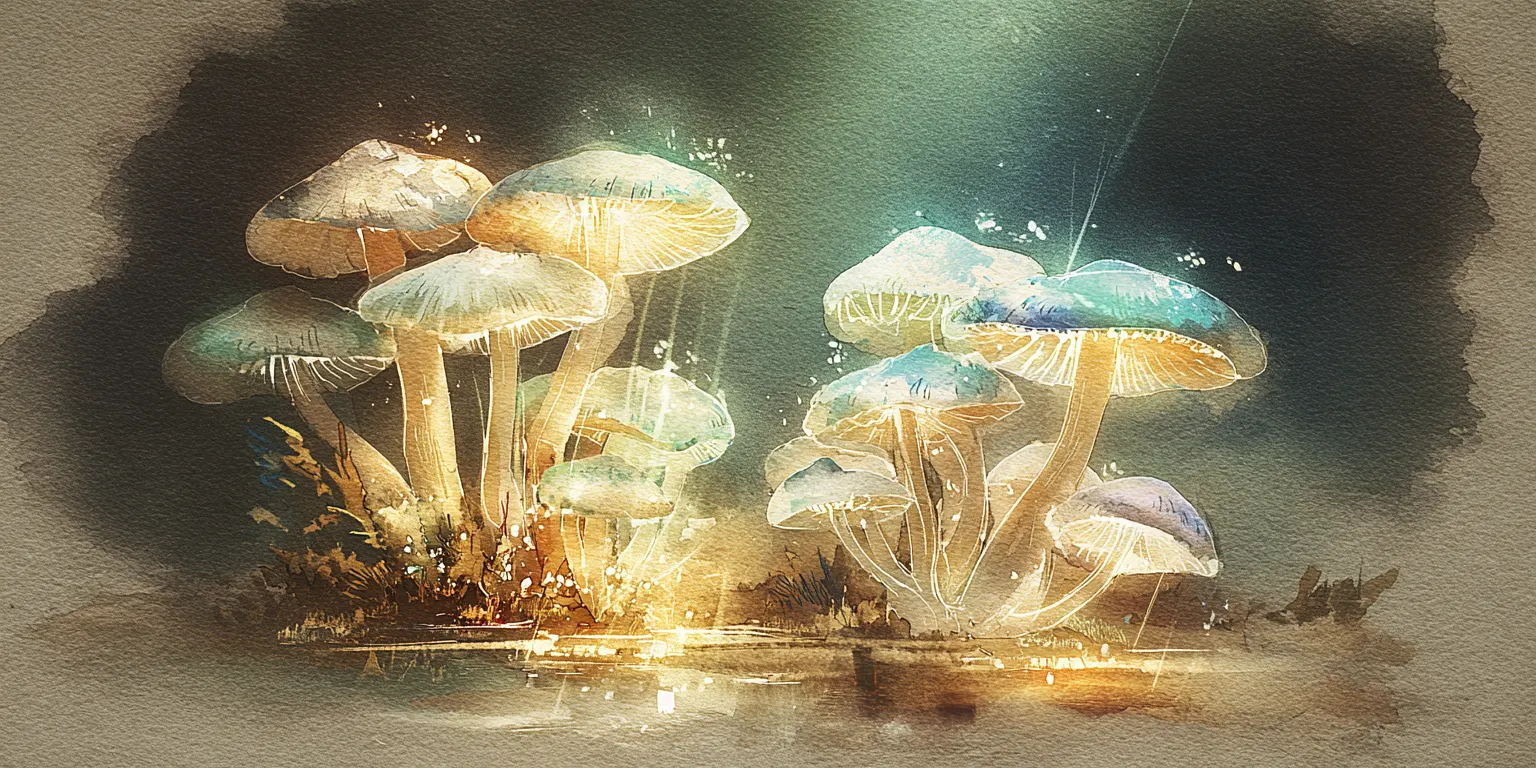
In the hush of shadowed groves and the deep hearts of Kena’an’s oldest forests, there grows a fungus spoken of in reverent murmurs by healers, alchemists, and priests alike: the Lunarcap. These mushrooms rise in clustered coronets from the forest floor, their slender stems lifting rounded caps as delicate as blown glass, forming quiet constellations beneath the boughs.
Revered for their rare healing virtues and sought for gentle, restorative concoctions both gentle, these fungi are tended with almost sacred care by many. The Elves cultivate them in dedicated moon-houses - a type of greenhouses shuttered against the sun, kept in perfect darkness until dusk.
Crowns of the Forest Floor
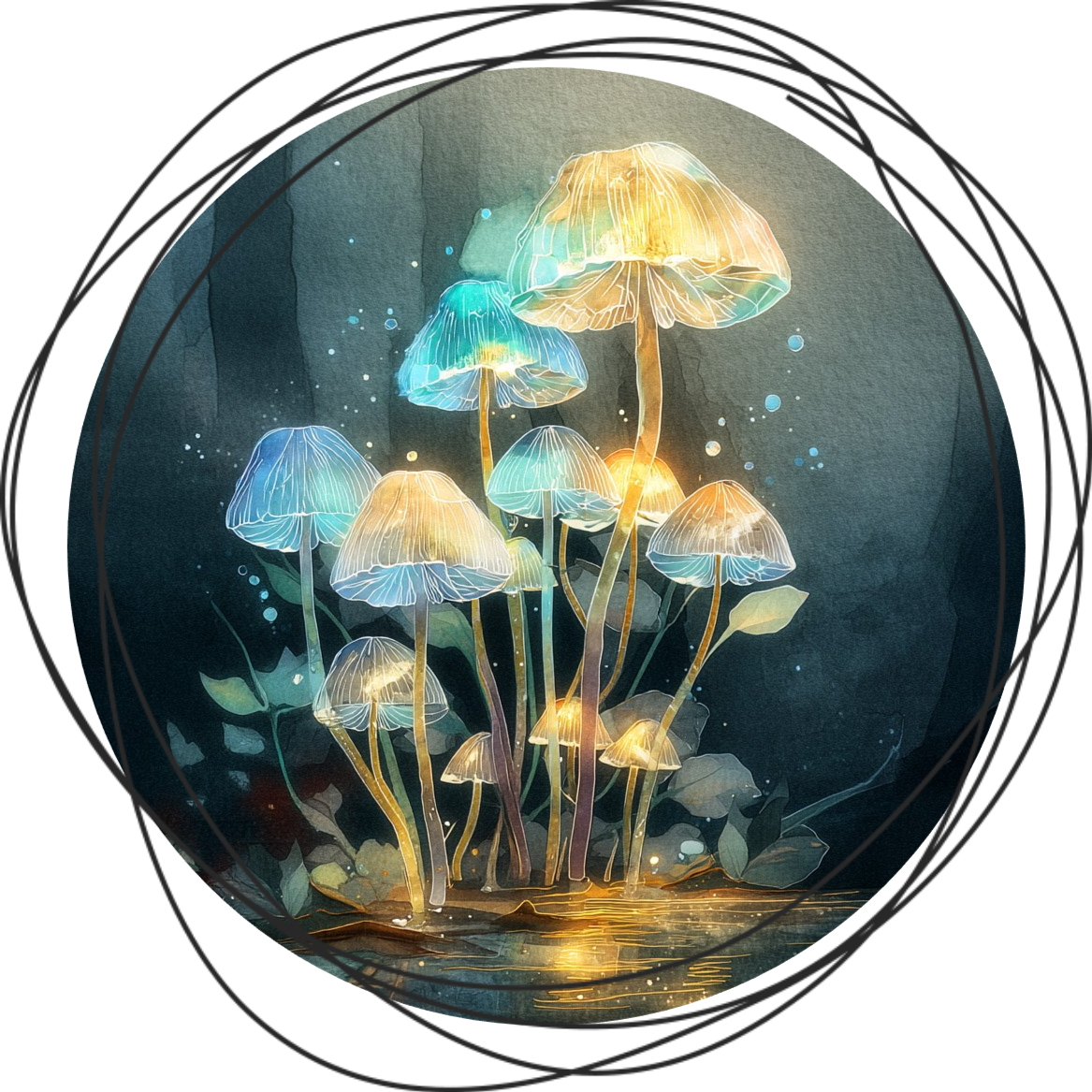
Lunarcaps grow in small clusters, never alone, each group forming an elegant crown upon the forest soil. Their stems are slender and pale as ivory slivers, while their caps are smooth, round, and thin enough that the faint ridges of their gills show through. During the day, the membranes of the Lunaracaps thin to near-invisibility, and the faint shimmer of dew is often the only trace of their presence. Herbalists call this stage the sleeping glass, for the mushrooms seem suspended between existence and absence.
At night this fragility becomes radiance. Moonlight pours into their translucent cups, igniting a gentle glow that spreads from the gills outward. Their inner essence stirs, and the caps thicken subtly as gentle luminosity blooms within. The hue depends on a mixture of soil richness, weather, and lunar phase: some glow with quiet silver, others with blue reminiscent of deep rivers, and a rare few with soft amethyst. On waxing nights their glow grows stronger, while full moons turn entire clusters into radiant crowns. With the waning phase, the brightness softens again until the mushrooms fall quiet once more.
Lunarcaps & Aira Vasar
In Zolirak, the full moon undergoes a sacred transformation known as Aira Vasar, when its pale light deepens into a vivid crimson. Elves believe this phenomenon is the gaze of Ephelion, god of love, art, and their own creator, looking upon his children for one night each cycle.
Lunarcaps in Zolirak respond dramatically to this change. Instead of blooming with cool tones, their glow turns to shades of rose, ember-red, and smoldering gold. Their light does not shine steadily but pulses gently, echoing the rhythm of a distant heartbeat. This crimson glow marks a heightening of their essence; during Aira Vasar, the mushrooms become exceptionally potent in healing, emotional rites, and divinatory practices.
The Night-Bound Wilds
Lunarcaps grow where shadows gather but moonlight still finds its way: deep forests where towering trees mute the sun yet allow the night to slip through in delicate silver slivers.
Their growth rhythm follows the moon. New moons leave them dormant and nearly invisible; waxing nights see their bodies strengthen; full moons coax out their brightest radiance; and waning nights bring a gradual return to quiet translucence. Despite their fragile appearance, they root firmly and resist disturbance from wind or rain. Sunlight, however, diminishes both their glow and their potency, which is why the best specimens are found beneath dense canopies or cliffsides that offer shelter during the day.
Clusters rarely appear in places marred by noise, or conflict. They seem drawn to stillness, preferring virgin and untamed soil, as Terralyn shamans often say.
The Lunarcap continues to perplex me. The membrane collapses instantly if pressure is applied too quickly; the essence leaks out long before the cap breaks. Best results come from a slow, circling motion with the crescent pestle, never exceeding a gentle weight. I have begun timing the process: five to seven minutes per cluster seems optimal.
Exposure to direct magical light disrupts the sample. Essence fractured along the gills, leaving the cap dull and inert.
Note: remind apprentices that bright cantrips count as interference. They will ignore this unless I spell it out.
Dried paste from the previous batch remains stable. Three nights of uninterrupted moonlight were sufficient, though the sheet gathered during the waxing phase carries more clarity than the ones dried later. During Aira Vasar, the paste took on a faint rose-gold tint and resisted dissolution longer than expected. Test further to determine if this strengthens restorative effects or merely alters flavor.
Conclusion for now: the Lunarcap must be approached with patience, or not approached at all.
Related Articles
Moon-Houses & the Gentle Art
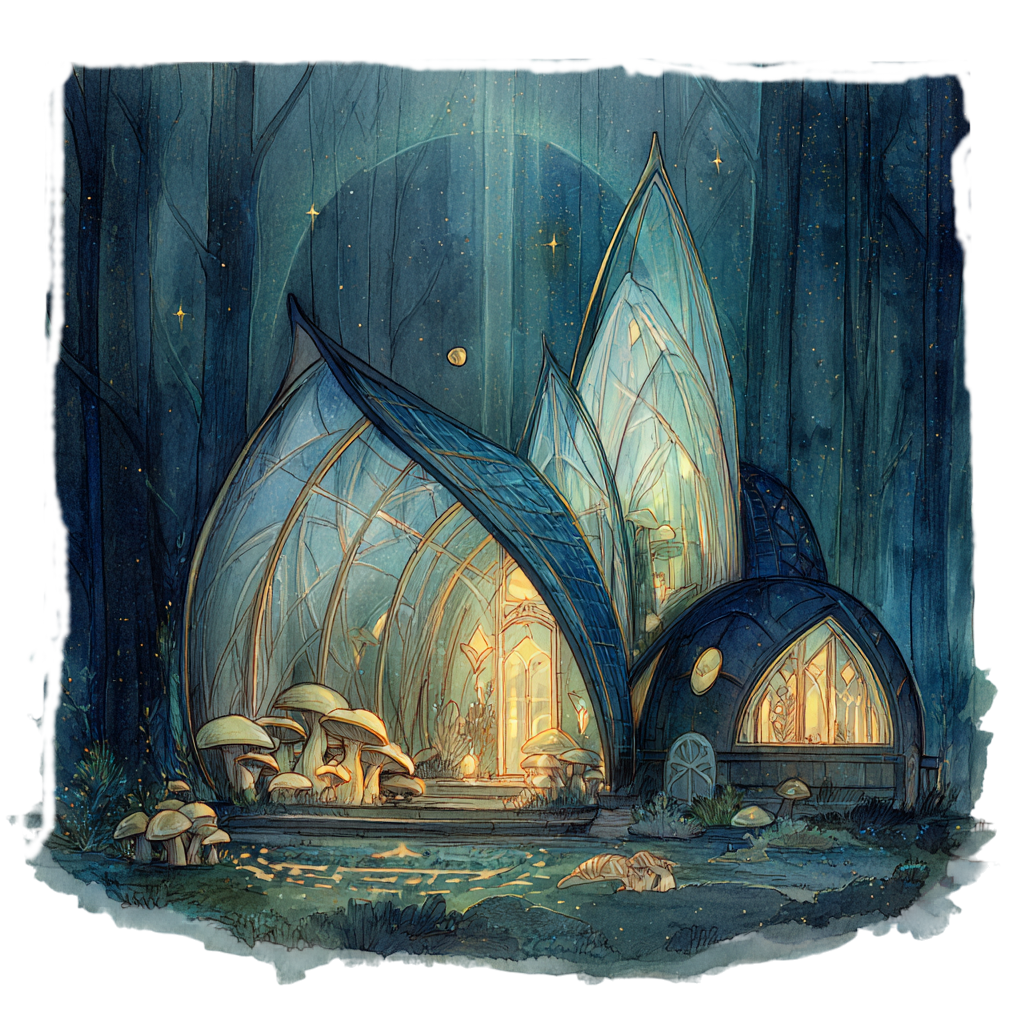
To the Elves, Lunarcaps are living blessings of the night, and their cultivation is treated as both science and devotion. Moon-houses are graceful greenhouse-like structures dedicated solely to the lunarcap growth, are widely used by alchemists and botanists in Zolirak. These structures, remain sealed throughout the day, wrapped in layers of barkcloth, enchanted mesh, and darkened glass that exclude even the faintest sunlight. Inside, the air is cool and muted, with beds of soil shaped from ancient wood and marked with runic grooves to maintain balance and moisture.
When dusk falls, the moon-houses open. Hinged panels unfurl, entire roofs retract, and some structures even turn to follow the moon’s path. On the night of Aira Vasar, the moon-houses open completely to allow Ephelion's light to wash over every cluster. Elven cultivators work with quiet reverence. Water collected after dusk is used for watering. Soil is stirred only under starlight. Soft melodies are sung to maintain harmony within the beds. Harvesting requires curved blades of silver or obsidian, their edges honed to slice without bruising the delicate caps.
Gifts of the Lunarcaps
Lunarcaps are cherished for their soothing, restorative properties. When dried and infused, they ease exhaustion, quiet headaches and re-center the spirit. Their cooling essence is a long-trusted aid for arcane fatigue, often brewed into mild tonics for magic users.
In alchemy, their value is immense but perilously fragile. Mishandling destroys their essence outright. Masters crush Lunarcaps slowly until they form a shimmering paste, spread thin on charm-inscribed parchment, and left to dry beneath uninterrupted moonlight for at least three nights. The resulting Lunarpaste is prized for stabilizing volatile mixtures, strengthening healing elixirs, and sharpening clarity of mind. Sheets dried under Aira Vasar become rose-gold in hue and are reserved for sacred ceremonies tied to love, creativity, or truth.
Despite their magical potency, Lunarcaps hold a small but cherished place in elven cuisine. Their delicate texture and faint bioluminescent shimmer make them perfect for raw dishes, lightly marinated to preserve their glow and subtle flavor.
Epilogue
Though their glow is gentle, the Lunarcaps leave a lasting imprint on those who encounter them. Travelers speak of stumbling upon a quiet cluster in the night and feeling, for a heartbeat, as though the forest itself had paused to breathe beside them. Elves claim the mushrooms remember every moon that has ever touched them, storing slivers of forgotten nights within their fragile forms.
Whether found deep in untouched wilderness or tended with devotion in moon-houses, Lunarcaps remain a reminder of Kena’an’s oldest truth: that even the smallest things may carry the sky within them. And so long as the moon rises, they will continue their quiet vigil in the shadows—hidden by day, luminous by night, and forever bound to the rhythm of the heavens.
All written content is original, drawn from myth, memory, and madness.
All images are generated via Midjourney using custom prompts by the author, unless otherwise stated.


Aw, thanks for the kind words. I love these mushrooms, and I love that people have found a way to cultivate them despite their fragility. I would love so much to sit beside a cluster on a warm, still night and just bathe in their light.
Explore Etrea | WorldEmber 2025
That's a beautiful picture you painted here :) I am glad you liked them <3