
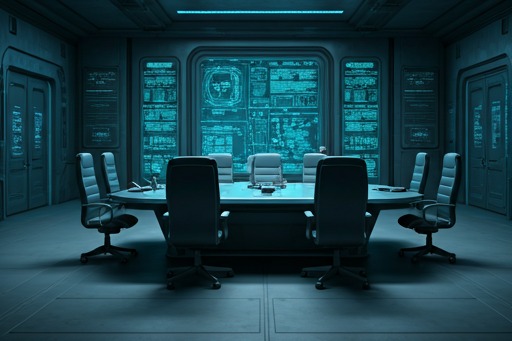
President
President of the PAC
The President of the Pan-American Concord —colloquially referred to as the Chief or, more pointedly, the CEO—serves as the embodiment of executive power in a government where corporate interests and national governance have become inextricably intertwined. In a political structure modeled after corporate hierarchies, the President functions not merely as a head of state but as the ultimate strategist, steering the nation’s economic, military, and societal objectives with the precision of a corporate titan managing a global conglomerate. As the Commander-in-Chief of the nation's armed forces, the President also oversees the PAC's military-industrial complex, wielding direct control over defense initiatives, strategic deployments, and wartime decision-making. This role is not just symbolic; in a world where conflicts often serve corporate interests as much as national security, the President's decisions determine the balance of power both domestically and on the global stage.Symbolism and Role in Society
The PAC President is as much a symbol as they are a leader: a figurehead representing stability, dominance, and the unification of corporate and governmental authority. In media portrayals and propaganda, the President is often depicted as a shrewd tactician and visionary executive, embodying ideals of progress, efficiency, and relentless ambition. However, detractors see the role as little more than the "Crown of the Corporates"—a puppet beholden to the same monolithic interests that elect them. Underneath the polished exterior of executive power lies a high-stakes balancing act. The President must navigate an environment rife with intrigue, competition, and the constant specter of subversion. With vast resources at their disposal but immense pressure to deliver results, every decision carries enormous weight. A failure to satisfy the boards or maintain national momentum could lead to internal fractures—or worse, open rebellion from factions dissatisfied with their stake in the national enterprise. The PAC President is both the ultimate CEO and the sole stabilizing force preventing a house of gilded cards from collapsing. Whether seen as a tyrant, a visionary, or a glorified middle manager, the President of the PAC remains the keystone of a system where power flows through the corridors of industry rather than the will of the people.Appointment
The President is not chosen by the public but is instead selected by a two-thirds vote of the PAC Board of Directors—a council composed of representatives from the nation’s most powerful corporate and political entities. This electoral process reflects the corporatized nature of PAC governance, where economic interests are paramount, and leadership is seen as an extension of strategic business acumen rather than democratic will.
Duties
The PAC President holds sweeping authority, acting as the singular figure capable of unifying—or overriding—the various industrial and political boards that make up the Concord's governing structure. While each board of directors manages key sectors such as defense, energy, technology, and resource extraction, the President maintains veto power over all decisions made by individual boards, ensuring that no sector's ambitions outpace the national agenda or undermine broader objectives. This centralized power allows the President to balance the competing interests of corporate entities, though critics argue it cements an oligarchic system disguised as a meritocracy.
Grounds for Removal/Dismissal
Once elected, the President’s position is semi-permanent. They can only be removed under three specific circumstances: voluntary resignation, death, or a unanimous vote of non-confidence by all members of the Board of Directors. This final clause, though theoretically possible, is an extraordinary and exceedingly rare event. Achieving such unanimity among fiercely competitive corporate powers would require a consensus that the President has not only failed but poses a catastrophic risk to the nation’s collective interests.
Type
Civic, Political
Form of Address
Mr./Ms. President
Length of Term
The President serves at the pleasure of the board, and is dismissed at the pleasure of the board.
Related Organizations

Comments