

Playing the Spheres
Some people are gifted with uniquely perfect pitch. They have the ability to play music in complete concord with the celestial spheres, and when they do, they can work with the spheres to make things happen on earth. This is an understudied phenomenon, but some sphere-players have figured out systematic ways to play music in order to manipulate the spheres. This article is about one particular strand of sphere-playing that originated in the Greco-Roman East and made its way west into Francia during late antiquity through the writings of Boethius. (For an example of sphere-players stumbling on the power in an unsystematic way, see Moon-Weaving.)
Mechanism
Each of the eight spheres of the universe (the moon, Mercury, Venus, the sun, Mars, Jupiter, Saturn, and the stars) corresponds to one of the eight naturally-occurring tones. An instrument perfectly in tune with the spheres can access the power of the spheres by "latching on" to them through music. This can be accomplished most crudely by playing chords that correspond to the individual spheres. As the spheres get larger, the power becomes more intense. No one is known to have played the sun's chord (or larger) and survived. Even when one plays the cord of the moon, the tiniest sphere, the power is too great to control and the result is cosmic disturbance that cannot be further manipulated by the musician.
More typically, sphere-players manipulate the spheres by playing short musical phrases, commonly referred to as "themes," in the keys of the individual spheres. Musical themes are subtler than playing the chords of the spheres outright, and still allow the sphere-player to user the power of the spheres to have particular effects on earth.
Application
Sphere-players play themes and variations in the keys of particular spheres in order to cause certain effects on earth. Ancient manuscripts feature themes with titles based on the effects they have. For instance, "Calm" will cause people within earshot of the music to feel a sense of calm, while "Speed" will make listeners move faster, "Focus" will help them focus, and "Strength" will grant them increased physical strength. There are also themes that will have an effect on the earth itself. These themes manipulate the natural universe, and the effects are perceivable in the senses of all beings who observe the change. In other words, they are not merely human experiences.
Complexity
Themes vary in complexity as well as energy taken from the sphere. Like all music, they need to be learned, and the more complex the theme, the more difficult they are to learn. Someone who has the gift of sphere-playing may not be able to play more complex themes if they don't have the skill to play more difficult music. Similarly, skilled musicians who lack the energy for more complex themes may not be able to sustain their connection to the spheres as they play them for effect. Skill and physical energy are both necessary to play more complex themes in addition to the gift of perfect pitch.
Active vs. Passive Themes
Some themes create a passive area of effect, like "Calm," "Joy," and "Focus." They affect the moods of the listeners, and often go unnoticed. Listeners who don't realize a theme is being used may never connect their change in mood to the music, or they might just think they are enjoying music.
More complex themes have more active effects. "Speed" and "Strength" affect listeners physically, as does "Sleep," which actually puts a person to sleep. They use more energy than the passive themes, but not as much as themes which have the power to control the elements of nature, which require the most energy of all. Themes like "Earthquake," "Wind," and "Fire," have an effect on the earth itself, and not just ensouled creatures who inhabit the earth. They require a massive amount of energy and often leave the sphere-player exhausted after they've used one of these themes.
Creating New Themes
Although many themes have been constructed in ancient times that can be found in manuscripts and learned, the possibilities for creating new themes are infinite. After all, the recorded themes had to be created by sphere-players at one point as well.
The easiest way to create a new theme is to combine existing themes. For instance, combining the theme for "Joy" with the theme for "Calm" can create "Hope." Combining "Home" with "Sadness" could create "Nostalgia," and combining "Persuasion" with "Compassion" creates "Diplomacy."
Strengthening the Themes
Sphere-players have come up with countless ways to strengthen their playing, all revolving around playing variations on the themes to associate their playing more tightly with the spheres. One possibility is to play in the key of a sphere that has a particular association. For example, playing "Strength" in the key of the Mars tone can lend a particular military strength, while playing anything in the key of the Jupiter tone might be especially effective on a king.
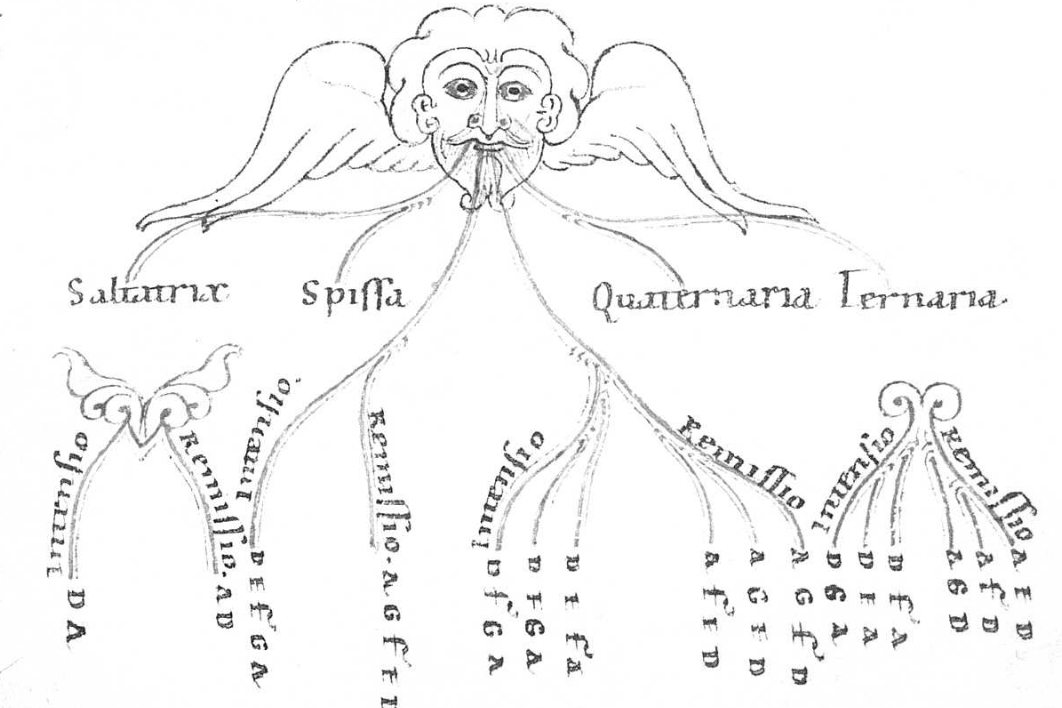
Admont-Rochester codex, p. 27
http://hdl.handle.net/1802/26216
Only people gifted with uniquely perfect pitch can access the spheres through playing music. The gift alone is not enough, however. The gifted must also learn to play music in order to use access the spheres most effectively.
The ability for gifted individuals to access the power of the spheres by playing music was first discovered by the Pythagoreans in the fifth century BCE. Since then, ancient philosophers have written their theories about the capability and some sphere-players have composed themes, but it was not until Boethius wrote his treatise On the Principles of Music that sphere-playing was systematically described.
Remove these ads. Join the Worldbuilders Guild





Comments