
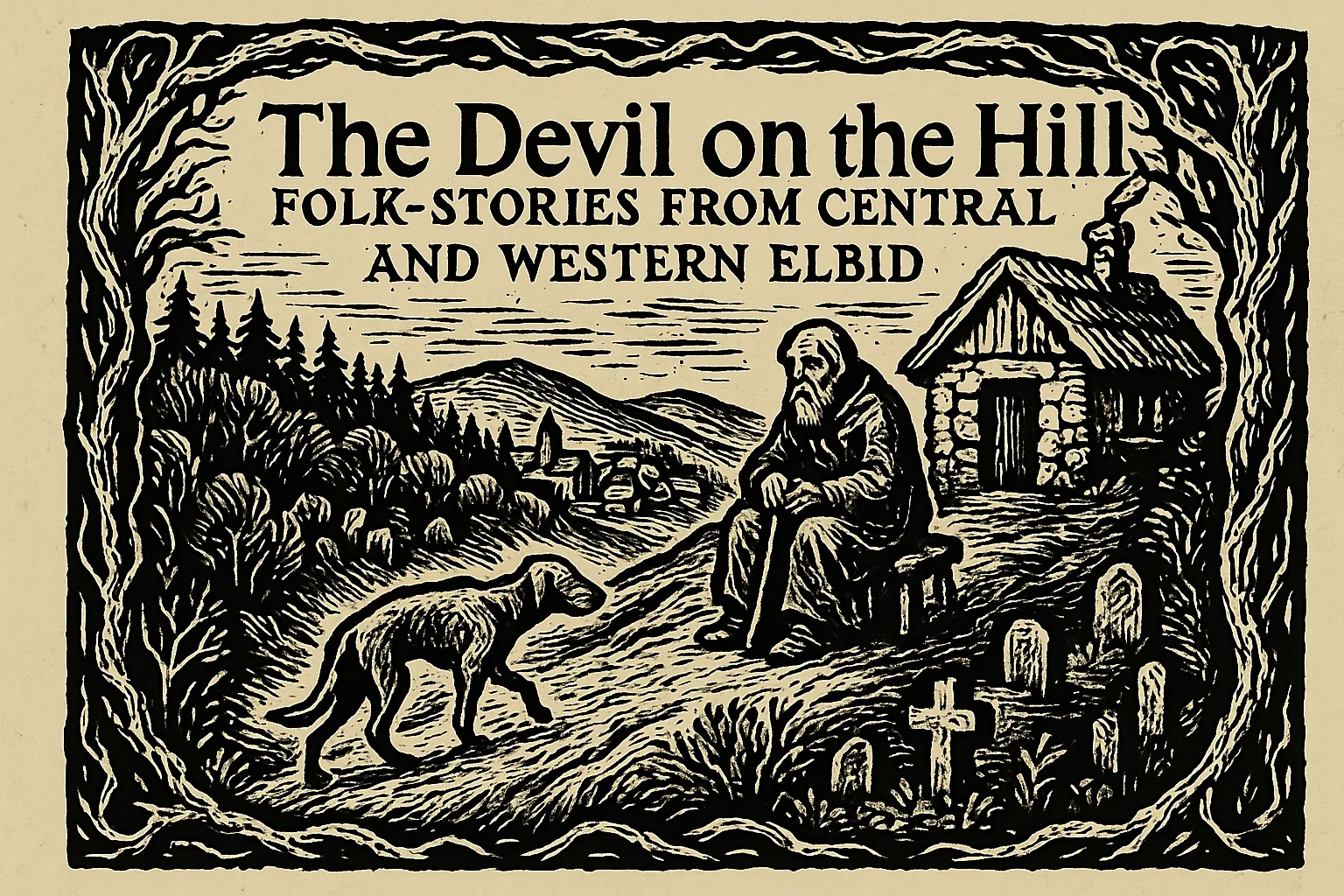
The Old Man and the Devil
The following is an excerpt from J. W. Thoms’s collection of Elbid rural folklore, The Devil on the Hill: Folk-Stories from Central and Western Elbid.
Once upon a time, there lived an old man alone in a village on a hill, surrounded by forest. He had not always dwelt alone - in his youth the village had been full of people. But time took them away. An army carried off half the young men, never to return. A coughing peddler with fever-bright eyes took many away with him when he left. Friends grew old and died; children grew up and went away to seek their fortunes. At last, only the old man remained.
He tended the houses, that they might not rot. He tended the graves, for it was a sacred duty to do so. For a time, the old priest would visit him from a neighboring village. But when the priest died, his successor knew nothing of the old man on the hill in the forest, and made no visits.
One day, a devil climbed the hill in the shape of a woman. She was not young, but still she was beautiful. She stopped at the old man's door and asked why he lived there alone. The old man looked and knew her for a devil, and gave no answer. Then she offered to join him in the last home on the hill: to cook, to clean, and to warm his bed. But the old man turned her away, saying, "Nay, devil. I shall keep my own house, and not lose my place in Heaven for the touch of you." Spurned, the devil went away again, down the hill and into the forest.
Three seasons passed, and the devil returned, bearing the face of the old man's son. He came to the door and said, "Father, come away with me from this lonely place. Dwell in my home, with me and mine, and be alone no longer. Come away." But the old man looked and knew him for the devil, and said, "Nay, devil. I shall not abandon my home, to see it rot and the graves untended. I shall not lose my place in Heaven for the sight of you." Once more the devil went away, down the hill and into the forest.
Three years passed, and the devil came again - this time in the shape of an old, limping dog. The old man sat before his door, watching the sun set as the hound approached, and he knew it for the devil. Yet the devil said nothing, but lay down beside his chair. The sun set, and the moon rose. The stars wheeled overhead, and the old man gazed into the cold and distant sky. At length he reached down, and laid his hand upon the dog's head.
This tale was collected in several variations from the rural districts of central and western Elbid. In some versions, the tempter appears as a fairy; yet I have elected to preserve the figure of the devil in my rendering, for it was by far the more common form.
Modern readers are apt to demand an explicit moral appended to every folktale, but I cannot approve this tendency. The people who told these stories required no such maxims, for they found their meaning within the tale itself. I therefore commend the story of the old man to your own reflection, that you may discern what lesson it holds for you.







Nice one! Especially since there is no definitive answer about the moral of the story.
But there will still be some interpretations, like this one:
A lot of unofficial Challenges
Thanks! I'm glad you liked the article, and the lack of a moral - I've read a lot of folklore collected in the 19th century, and was trying to emulate that style a bit.