
Abominations
The principle of Embodiment holds that every animate creature consists of two fundamental elements, a physical frame and an animating spirit. When James Brooke set down the method by which a frame might be fashioned to receive a spirit, he concerned himself chiefly with the shaping of bodies from inanimate substances such as wood, clay, and bronze. Subsequent scholars have carried the principle along a different path, drawing instead upon the natural world and crafting their vessels from a material both abundant and altogether apt for the purpose: flesh and bone.
The most notable of these investigators was Victor von Braun, a medical student of Waldstätte who became enthralled by the possibilities that constructs of flesh might offer. His inquiries into the animation of the dead brought him no small measure of personal misfortune, yet his methods were truly original and have guided many who followed. Critics of such work have condemned von Braun's creations as abominations, and the term has taken firm root in the penny press, where abominations of every description appear with regularity in the most disreputable adventure tales.
The First Abomination
Von Braun's life is marked by two defining traits, his brilliance and his hubris. Upon conceiving the notion of constructs fashioned from flesh, he did not begin with a modest creature as a proof of concept. Instead he set his sights upon a far more arduous and exalted aim, the replication of all human faculties within a constructed form. He noted that existing constructs showed certain deficiencies, for they could not heal as people did, and they learned and reasoned at a pace much slower than that of living beings. He concluded that such faculties were inherent to living tissue, and believed that by employing it he might combine the strengths of the living with the immense power and tireless endurance of the unliving construct. As a medical student he was already well accustomed to cadavers and to the means of obtaining them. He even spent a year at Knox College in Fraochdun, where he observed The Revivisectionists at close range, and their practice of partial reanimation proved vital to his own methods for creating fully animate constructs of flesh.
Armed with this knowledge, he returned to his family estate in the mountains of southern Waldstätte, far from inquisitive eyes. There he began his experiments in earnest. He stole bodies from nearby village graveyards and preserved them with the techniques he had learned in Fraochdun, for revivified flesh remains animate and unrotting for weeks, and von Braun extended this period by immersing the dismembered remains in vats of preserving draughts of his own invention. In time he gathered all the components he required and assembled his first construct of flesh, the original abomination.
Yet the body was only the first element he needed. A spirit had to be invited into the prepared vessel so that it might be caught within the enchantments woven through the frame and merged with it, thereby granting full animation. In his notes he surveyed many types of spirit and at first intended to employ a ghost, which he considered the most compatible. He later abandoned the idea for two reasons. First, the animation of a dead body by means of a ghost would place his work perilously close to the forbidden Rites of Resurrection and would impede its publication. Second, he wished to demonstrate that a revivified brain enhanced the construct's cognitive abilities, and he did not want his detractors to argue that the ghost, rather than the body, was responsible. In the end he chose to employ a spirit of lightning, inspired by demonstrations he had witnessed at Knox.
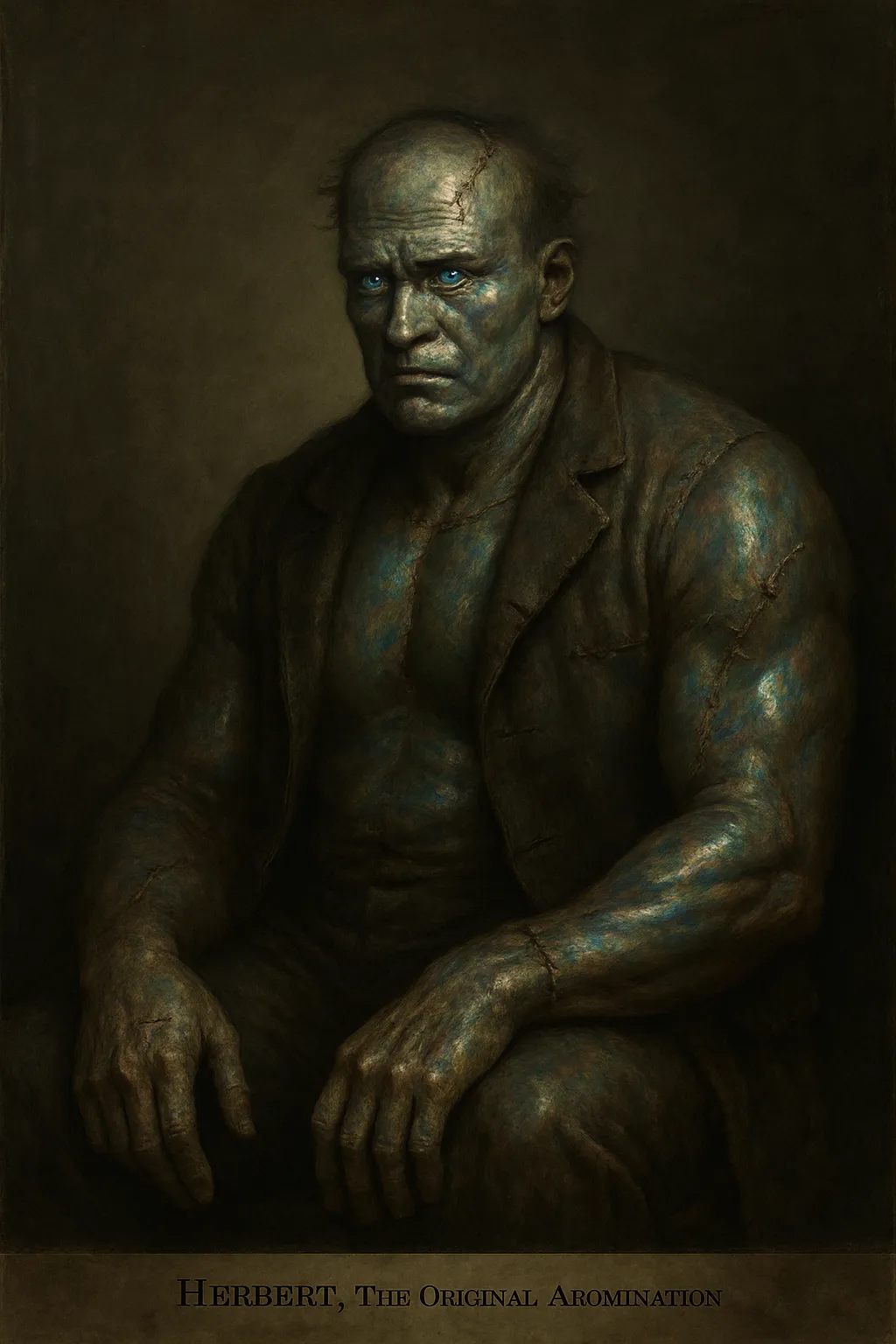
His efforts bore fruit. He captured a spirit of elemental lightning within the prepared construct, and it rose from the slab fully alert. Von Braun was elated and immediately began recording its behavior and abilities. The construct, which he named Herbert in honor of his mentor at Knox, quickly mastered both spoken and written language and exhibited remarkable strength and durability. Herbert appeared to fulfill all of von Braun's ambitions, uniting the powers of living creature and animated construct.
A Disastrous Unveiling
Von Braun sent letters describing his success to colleagues throughout Elbid and on Albion, and prepared a paper for publication. He then arranged an exhibition of Herbert in Bordeleaux, where he intended to demonstrate his creation before the foremost minds of the age. With his plans complete, he brought Herbert out into the world.
During his early experiments von Braun had kept Herbert secluded and away from all other humans, including the staff of the estate, so that he might preserve the surprise of his achievement as long as possible. He was therefore unprepared for the response ordinary folk would have to Herbert's appearance. Von Braun's creation was humanlike, yet none who saw him mistook him for human. His strange flesh and glowing eyes, each spark of light betraying the elemental force within, made his unnatural origin plain, and he stirred fear and unease rather than the wonder von Braun expected. As Herbert observed the terror around him he grew distressed and began to emit erratic sparks of lightning that leapt to any nearby surface. This only deepened the fear of the onlookers, which upset Herbert further, creating a cycle that threatened to hurl deadly bolts at anyone close by. In the end von Braun was forced to confine Herbert in a crate for the remainder of the journey to keep him from being seen. He dismissed the incident as the product of provincial ignorance and remained certain that the enlightened men he was soon to meet would welcome his creation without reservation.
Upon reaching Bordeleaux, von Braun saw his paper printed, detailing precisely what he had accomplished and by what means. Reactions were intense, and many condemned his work as monstrous at once. Yet among the learned there was a strong desire to witness the results for themselves, and his exhibition drew such crowds that he moved it to a larger hall to accommodate all who wished to behold his creature.
Herbert was brought to the theater in a box much like the one that had carried him to Bordeleaux. Von Braun was determined that none should glimpse him before the appointed moment. The box was set upon the stage, and von Braun stood beside it, presenting an aspect not unlike an undertaker beside a coffin. For an hour and a half he lectured on the process by which Herbert had been fashioned. He withheld no detail, and while some listeners grew restless, others took careful notes with an evident intent to reproduce his work. At last the moment arrived, and von Braun opened the box and bade Herbert stand forth. He rose, towering above his creator, then turned to face the crowd. A stillness fell as the audience beheld his scintillating flesh and lightning-filled eyes, and then a woman screamed, overcome by horror at the sight before her.
The quiet shattered into chaos. Some shouted questions, others fled in panic, and one man resolved to destroy the creature. He drew a wand of military pattern capable of releasing a lethal bolt and fired upon Herbert, striking him in the chest. Von Braun cried out in fury, and Herbert cried out as well. His whole body became a crackling storm of energy, and he charged the assailant in a frenzy. Those near him were flung aside as arcs of lightning burst from his frame, striking wildly into the crowd and leaving his own flesh scorched but uninjured. The man who had fired attempted a second shot, but it was too late. Herbert crashed into him, bore him to the floor, and released bolt after bolt into his prone form. The victim was never identified, and witnesses claimed his body had been obliterated. By then the theater was ablaze. The lightning that burst from Herbert had ignited fires throughout the hall, and a terrified crowd surged toward every exit. Von Braun escaped with his life, though badly burned by one of Herbert's discharges. Even so, he did not linger. He slipped away before the authorities understood what had occurred, and by the time they sought him he had already left Carovingia and disappeared.
The theater burned to its foundations that night, and many were killed or maimed. Most assumed Herbert perished in the fire, yet no proof of his destruction was ever found, and tales of a giant man with eyes of lightning have persisted in the decades since. King Antoine of Carovingia outlawed the creation of constructs made from flesh, and several other realms of Elbid followed his example. Nevertheless, the catastrophe did not mark the end of such creations. More abominations would follow.
Rise of the Chimerae
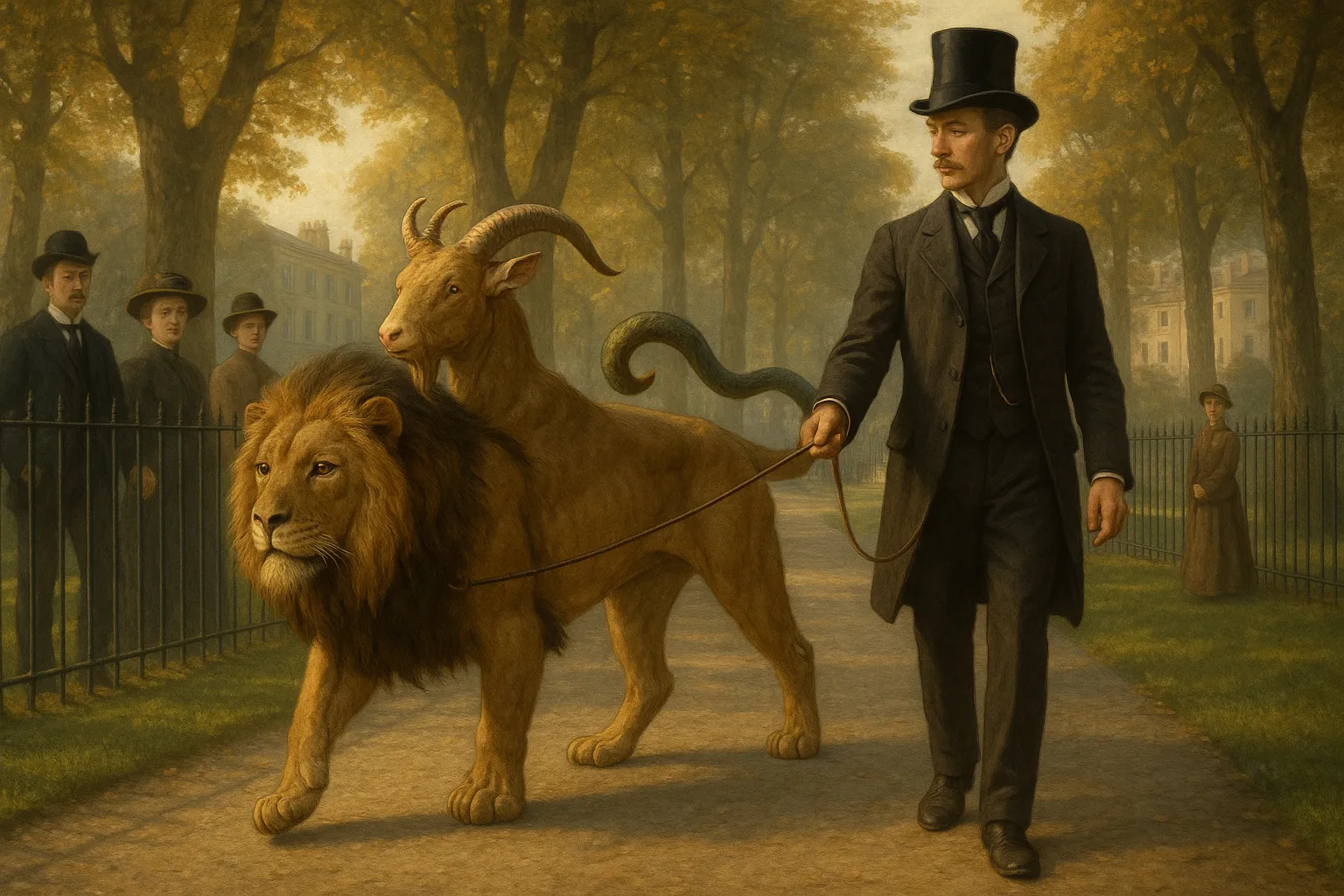
While von Braun concealed himself from those who sought to bring him to justice, others seized upon his research and endeavored to refine what he had begun. In Muntenia, Baron Elek Franz Ferenc took a particular interest in the inquiry and resolved to create a version of the flesh construct that was both improved and safer. He rejected the making of a manlike creature for practical reasons. Prince Mircea Basarab V, sovereign of Muntenia, had issued a law forbidding the animation of any construct of flesh that took the form of any known animal. Baron Ferenc evaded this prohibition by fashioning constructs that resembled no natural species. He assembled bodies from the parts of many creatures, combining them into forms that had never existed, and thus produced the beings now known as Chimerae.
Baron Ferenc lacked the raw brilliance of Victor von Braun, yet he was far more meticulous and cautious in his experiments. He began with modest attempts, crafting feathered frogs animated by spirits of fog and mist. By using animals rather than human cadavers he could keep the donors alive until shortly before their parts were required, avoiding the long immersion in preservative fluids that von Braun employed. This yielded creatures far more lifelike than Herbert, and those who observed the Baron's results did not feel the instinctive revulsion that their predecessor inspired.
Over the years Baron Ferenc created hundreds of flesh constructs, still called abominations by those who opposed the practice. During the Dragon Wars he produced dozens of griffons to patrol Muntenia's mountain passes and defend against the forces of the Cult of the Leviathan, and they proved highly effective. The Baron's menagerie of Chimerae became celebrated in some circles and notorious in others, and he soon welcomed guests who wished to behold the strange beasts he had fashioned and, in some cases, to learn the art of flesh crafting. The Church, however, condemned the practice as wholly profane, and more than one zealot arrived with the intent of destroying the Chimerae, with mixed success. As von Braun had predicted, constructs of flesh are extraordinarily resilient and can recover from injuries that would destroy either living beings or ordinary constructs. While it was not impossible to kill one of the Chimerae, it was far more difficult than many expected, and they responded poorly to attack. Thus some of the smaller and less formidable creations, such as the feathered frogs, were destroyed, but the larger and more dangerous specimens defended themselves, though none with the unrestrained fury displayed by Herbert in Bordeleaux. In his own studies the Baron concluded that this savage temperament was a trait of lightning spirits and he avoided their use thereafter.
He also refrained from employing human brains, and not merely to avoid legal entanglements. As his work advanced he found that the more intelligent the donor, the less controllable and predictable the resulting Chimera became. Baron Ferenc chose instead to use simpler brains and settled upon those of dogs as his preferred source, finding that they produced creatures both trainable and obedient.
In recent years Chimerae have become fashionable among members of Society who wish to display an unconventional streak by keeping an unusual pet. Several flesh crafters have followed in the footsteps of Baron Ferenc, and although they operate in legal grey areas throughout much of Elbid they often skirt the spirit of the law or work only in regions where prohibitions against abominations are lax or nonexistent. Thus one may now encounter winged monkeys, walking fish, and cats rebuilt upon the pattern of a monkey. Circuses and carnivals frequently include one or two Chimerae in their exhibitions, fashioned either in the likeness of mythical beasts or devised simply for their capacity to shock. It is not uncommon for them to advertise three headed dogs, dragons, or creatures assembled from a dozen disparate species chosen for the very incongruity of their combination. Though Chimerae are regarded as somewhat seedy and scandalous, they have secured a place in the world and may be obtained by anyone with the interest and the means.
After Bordeleaux
Victor von Braun fled Bordeleaux before he could be arrested and has remained in hiding ever since. This does not mean that he has been idle or that he has abandoned his work. Instead, he turned the disaster of Herbert's unveiling to his advantage. For though Herbert proved catastrophic in the end, he was also an extraordinarily dangerous and powerful being, and there are always those who have need of anything dangerous and powerful.
Thus von Braun became a maker of monsters. Unlike Baron Ferenc he did not craft creatures intended as pets or curiosities. He built weapons. Nor was he selective in his clientele. Many of his more fearsome creations appeared on the battlefields of the Dragon Wars, serving the forces of the Cult of the Leviathan.
Von Braun's later creations followed the pattern of Herbert with certain refinements. He continued to employ lightning spirits and to fashion bodies in the shape of men. He improved his methods of preserving flesh so that the final forms appeared less uncanny, but he often built them larger than any natural human, with proportions more fitting for an ogre than a man. He also made deliberate alterations to the brains he used, destroying particular regions to prevent his constructs from becoming too intelligent or independent. They remained prone to fits of uncontrollable fury, yet his patrons saw this as an advantage in battle, and when unprovoked the creatures were generally docile and compliant.
Von Braun remains active, creating bespoke abominations for any who can find him and afford his price. His constructs can move unremarked among ordinary folk, are nearly indestructible, and can, when commanded, battle and defeat foes many times their number. No one can say how many of these abominations walk the world, only that there are far more than there should be.


Poor Herbert. :( I very much enjoyed your own twist on the Frankenstein tale. Also, poor feathered frogs. :(
Explore Etrea | WorldEmber 2025
Thanks! There are still some feathered frogs about - I might give them their own article :)