Skywhales
The 1840s witnessed a technological marvel that reshaped America’s landscape: the rise of the rigid hull airship. Inspired by French innovations in dirigibles, American inventors and builders eagerly embraced this new technology, spurring a rapid expansion of airship designs and applications.
In the early 1840s, French engineer Ferdinand DuBois perfected the rigid hull airship, a significant advancement over earlier designs. These airships featured a sturdy framework that maintained their shape, providing a stable platform for propulsion and cargo. News of DuBois' successes quickly crossed the Atlantic, captivating the imaginations of American inventors and entrepreneurs.
At the forefront of this revolution was Amelia Stanton, a brilliant engineer from Boston who became known as the "Queen of Aluminum." Stanton's innovations in lightweight alloys, aluminum extrusions, and cellular design helped provide America with the material and methods to construct superior rigid hull airships.
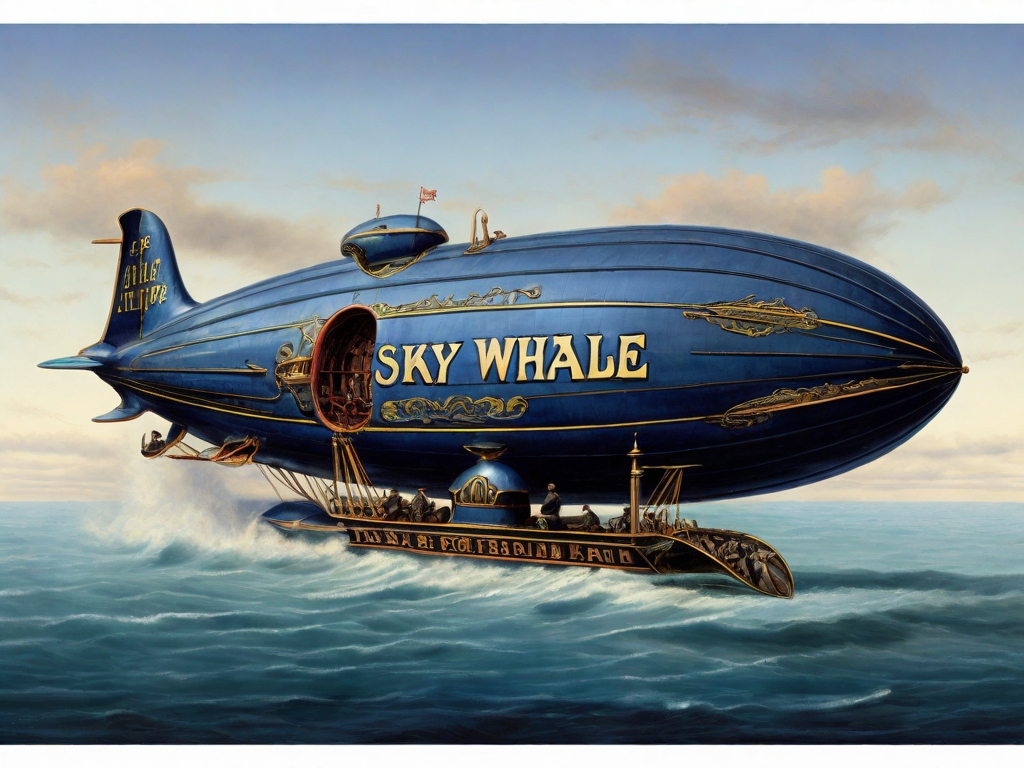
In 1845, the first American-built airship, the Skywhale took to the skies under the command of Captain Jeremiah Hawkins, a former naval officer with a penchant for adventure. Hawkins' daring flights across the Appalachians and hundreds of miles out to sea captured the public's imagination and helped secure investor funding for further airship development.
This milestone marked the beginning of a new era, as airship manufacturing hubs emerged in cities like Boston, Grisham, and Philadelphia. American ingenuity led to rapid improvements in design, efficiency, and safety, making airships more reliable and versatile. Hydro-ionic power meant that there was no need for extra hydrogen tanks to be brought along, making the American Airships safer than their European counterparts and once America made the discovery of Levium, airships were highly indestructible.
One of the most transformative impacts of airships was on the westward expansion of the United States. The Oregon Trail, a treacherous route for pioneers seeking new opportunities, posed significant challenges due to its harsh terrain and long distances. However, the introduction of airships changed the game. Ezra Blackwood, a rugged frontiersman turned airship pilot, became a legend for his fearless supply runs to remote outposts along the Oregon Trail. Blackwood's airship, "The Skylark," was a lifeline for countless settlers, delivering essential goods to communities that were otherwise weeks or months away by wagon.
Airships became a common sight in the skies over the American frontier, their long shadows stretching across the plains and mountains. They played a crucial role in supporting the rapid westward expansion, enabling settlers to establish farms, towns, and trading posts far more efficiently than ever before. All an airship needed was an open space and it could land to unload. Remote outposts grew at the same rate as those connected by rail.
As railroads began to crisscross the nation, they brought new opportunities for commerce and travel. However, many remote towns and settlements remained isolated, beyond the reach of the iron rails. Here, airships filled the gap as well, providing a vital link for these communities.
Airships transported cargo to and from towns that railroads could not reach. They carried everything from mining equipment to livestock, ensuring that even the most remote settlements remained connected to the broader economy. This connectivity spurred economic growth and development in areas that might otherwise have languished in isolation or withered and died.
In addition to their cargo capabilities, airships offered a new mode of passenger travel. While not as fast as trains, they provided a cheaper, more comfortable, and scenic alternative to the bumpy and often perilous stagecoach rides. By the 1870s, cross-country airship travel had become a viable option for those seeking a long-range journey. Due to the fact that airships required little, if any, infrastructure at the end of the journey, destinations were wildy varied and sometimes changed mid trip.
Airship routes connected major cities with frontier outposts, allowing travelers to glide over the vast American landscape at a leisurely pace. The panoramic views from the airships' gondolas provided an unparalleled travel experience, combining the romance of flight with the practicality of long-distance travel.
Socialite and travel writer Cordelia Astor popularized this mode of transportation with her bestselling memoir "In the Clouds: An Airship Odyssey Above America." Astor's vivid descriptions of panoramic views and luxurious airship accommodations sparked a boom in aerial tourism.
The impact of airships on remote town development was even more profound. Settlements that would have withered due to their isolation from traditional supply routes now flourished. New Horizon was a mining town nestled in a narrow Rocky Mountain valley. Despite rich ore deposits, its location made rail access prohibitively expensive. However, weekly airship deliveries coordinated by Mitchell Winters, a former factory foreman turned logistics expert, ensured a steady flow of supplies, equipment, and new settlers. Under Winters' management, New Horizon grew from a handful of prospectors to a bustling community of over 5,000 in just six years.
Perhaps even more revolutionary was the ability of airships to establish entirely new settlements in previously inaccessible locations. The "Colony Airships" program, spearheaded by visionary entrepreneur Aesop Holloway, transformed the way America expanded westward. Holloway's company, Aerial Colonies, specialized in transporting entire pre-planned communities to carefully selected sites across the frontier.
One of Holloway's most ambitious projects was the founding of Liberty Falls in 1858. In a single month, a fleet of five massive airships carried over 1,000 settlers, along with prefabricated buildings, livestock, and farming equipment, to a fertile valley in the Pacific Northwest. The lead airship, "New Beginnings," piloted by the steady-handed Captain Stephen Redmond, touched down in a vast open field that would become the town center. Within days, a fully functioning town sprang up, complete with a general store, schoolhouse, and sawmill.
This method of instant town creation became known as "Airship Seeding," and it rapidly accelerated the pace of western settlement. By 1865, dozens of such towns dotted the landscape, each one a testament to the transformative power of airship technology. These settlements were strategically placed near natural resources or at important geographic junctions, creating new nodes of civilization in the wilderness.
The flexibility of airships also allowed for the establishment of seasonal or mobile communities. In the northwestern territories, mining camps could be set up for the summer months and then easily relocated or resupplied as needed. Airship captain Tobias Flynn became famous for his "Flying Lumber Camp," which followed the best timber yields across the Pacific Northwest, setting up and breaking down entire logging operations with remarkable efficiency. In the newly opened Alaskan Territory, gold mines were established and moved with ease as there was no need for road construction.
By the 1870s, the synergy between airships and remote settlements had created a new pattern of development across the American West. Towns no longer needed to be strung along rivers or railroads like beads on a string. Instead, they could spring up wherever resources or strategic value dictated, relying on the sky as their highway.
This dispersed pattern of settlement had far-reaching implications for American society and economy. It decentralized access to new lands and opportunities, allowing a more diverse strata of people to participate in westward expansion. It also created a more resilient network of communities, less vulnerable to the disruptions that could plague a single rail line or river route.
But even the mighty sky whales were no match for Mother Nature. The long winter of 1880 showed how mankinds marvels could not compete with the enraged elements. A terrible winter covered western America to such an extent that almost all ground traffic was halted. Trains fought to make it through 20ft high snow banks and crews worked feverishly on days without blizzards to clear the tracks.
Brave airship pilots loaded their ships with as much life saving cargo as they could and dashed out when the sun shown to drop packages on towns that desperately needed them. Sometimes a breakdown would strand a pilot in a forsaken snowscape and other times they couldn't outrun the fury of winter To make it back. But each pilot that survived saved thousands of lives with each trip. Finally the winter ended. The cost in lives was tragic, but for the courage of the pilots and back breaking effort of the railmen, many more would have been lost.
The 1840s were a defining moment in American history. This innovative aerial technology opened new frontiers, fostered economic growth, and united a sprawling nation. The legacy of the airship era is a testament to the power of innovation and the indomitable spirit of exploration that drove America forward.









Comments