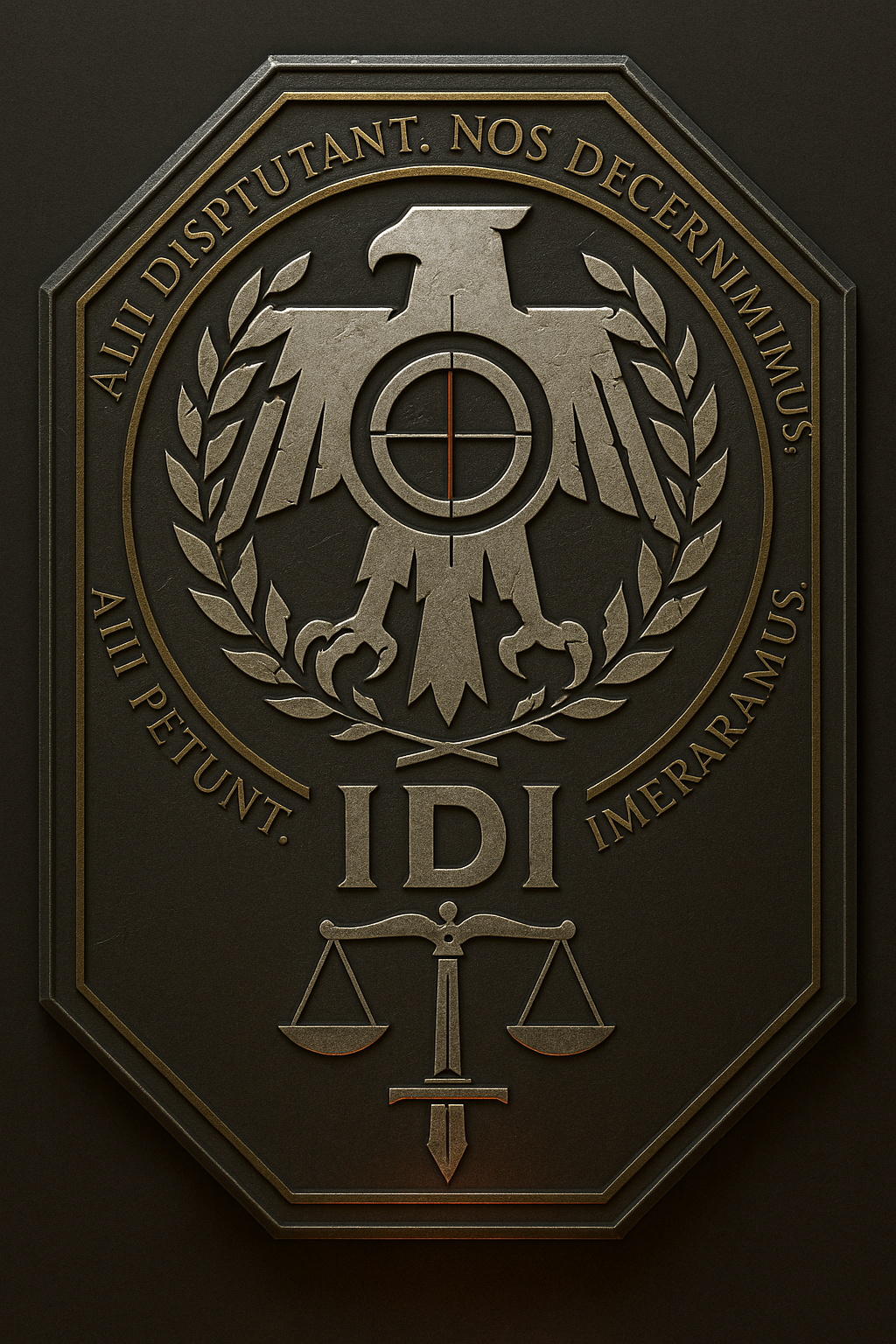
The Founding of the Imperial Directorate Inquisition
Founding
17/4
17/4
In the shadowy sanctums beneath the Spire of Rule on Sonata, Initiation Hour Zero was convened —an unsanctioned conclave that would permanently redefine the structure of governance in the United Colonial Group (UCG). Occurring in the third week of 2538, this classified summit marked the official founding of the Imperial Directorate Inquisition (IDI), a rigid trinity of legislative, judicial, and executive power that replaced the last remnants of decentralized colonial rule. The event was not publicly broadcast nor acknowledged for several cycles. Still, internally, it marked a radical departure from post-conflict recovery efforts, declaring the UCG's transition into complete authoritarian consolidation. The Regime's most doctrinally faithful leaders, military tacticians, high technocrats, and predictive civic theorists, signed the founding mandates under Directive Codex protocols, creating a permanent, self-sustaining bureaucratic superstructure.
In one solar week, the IDI absorbed and dissolved thousands of fractured planetary councils, regional ministries, and corporate oversight bodies. Over 1.7 million personnel were reclassified, purged, or absorbed into the newly established branches: the High Directorate Council, the Imperial Senate, and the High Tribunal of Doctrine. This operation, later codenamed the Purity Integration Campaign, set a precedent for systemic loyalty enforcement, doctrinal certification, and caste restructuring throughout Regime space. While the DMDF remained the military arm of the UCG, the IDI became its governing soul, modeling every law, policy, and social contract after mathematically simulated outcome charts and regime survivability indexes. There were no elections. Only appointments. There was no citizen input, only enforced alignment.
The effects of Initiation Hour Zero are still felt centuries later. It marked the end of any pretense of popular governance and the beginning of a tightly woven feedback loop of ideological control and institutional permanence. The IDI's founding codified a worldview in which law was not a servant of justice, but a tool of discipline, and where the illusion of choice was replaced by systemic certainty. From that moment onward, the UCG Regime no longer administered the colonies. It commanded them.
The High Tribunal of Doctrine was formally ratified and empowered on 17 April 2538, becoming the supreme executive body within the rising United Colonial Group Regime. It was conceived as more than just a council of leadership; it was forged as a sanctified trinity of political will, martial discipline, and ideological clarity. With the remnants of the Colonial Administration Authority in full retreat and the firebrand doctrines of the Sovereign Accord solidifying, the Tribunal became the iron engine of governance, eclipsing the Senate in influence and embodying the absolute authority of the regime.
Composed of select individuals bearing the highest loyalty oaths and psychometric clearance, the Tribunal was charged with interpreting the Imperial Doctrine Codices, enacting military and civil decrees, and overseeing the vast ministries that now answered to the Regime's singular voice. It responded only to the Supreme Presidency and possessed the power to override lower bureaucracies, dissolve ministries, or issue classified enforcement orders to the Imperial Directorate Inquisition without legislative consent. By the decree of Grand General Ethan Sanders and backed by the early doctrines laid by Anastasia Bradford, the Tribunal became the central pillar upon which the UCG's post-war order was stabilized and militarized.
The formation of the High Tribunal marked the end of the Post-Accord Provisional Era, a time defined by infighting, fractured colonial systems, and ideological drift. With its establishment, the Regime announced to the galaxy that it would no longer govern by compromise but by Command, Discipline, and Doctrine. From its seat at the soon-to-be-constructed Spire of Rule in Sonata, the Tribunal cast its will across the stars—an unflinching authority whose judgment would shape the fate of billions. Historians now widely view this event as the moment the UCG transformed from an alliance into an empire in all but name.