
Track 9 - Baptized by the Consul’s Light
Song Profile: "Baptized by the Consul's Light"
Latin Title: Baptizatus in Lumen Consulis
Artist: Malrick Solen Thorne
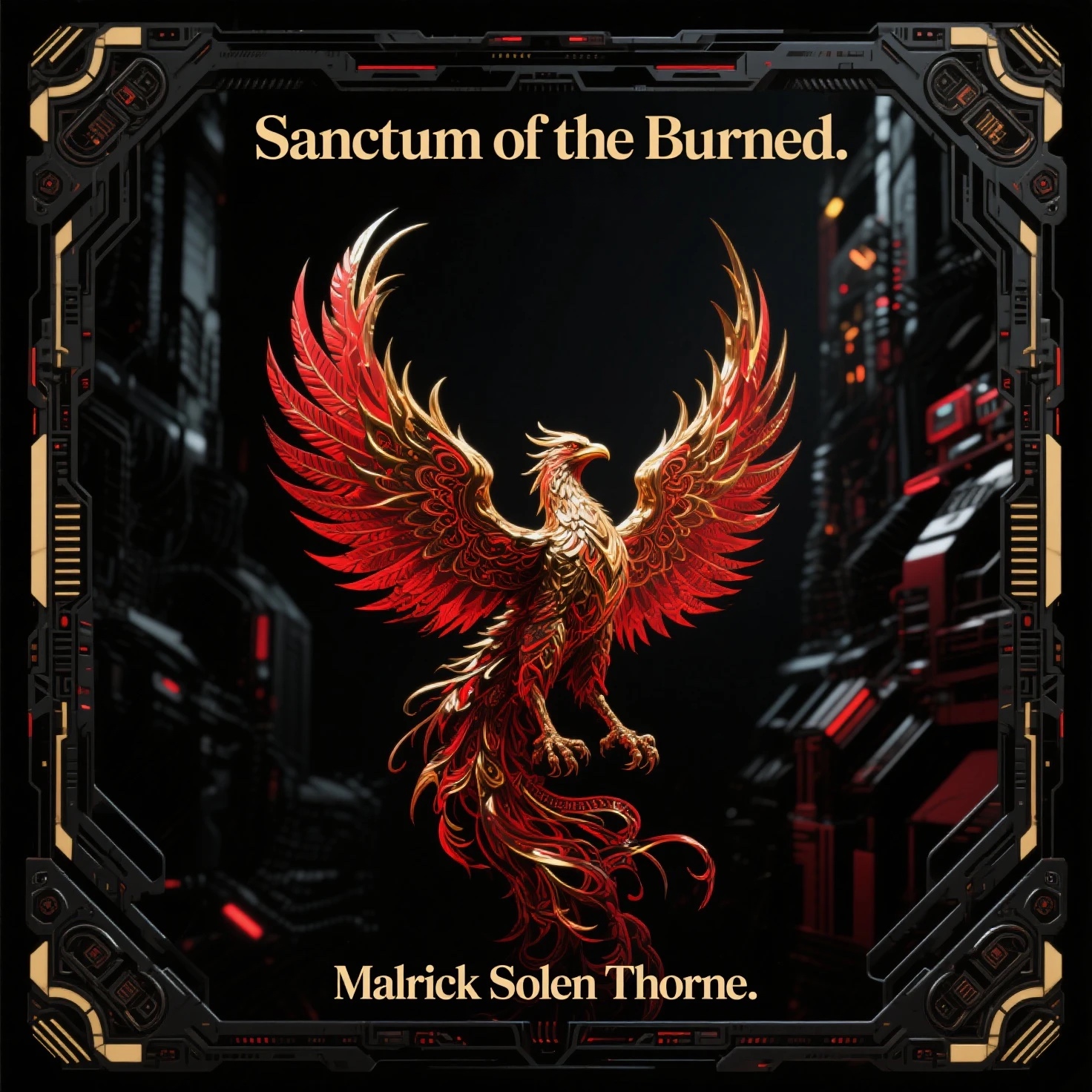
Album: Sanctum of the Burned
Song Length: 4 minutes, 09 seconds
Release Date: June 11th, 2567
Composer:
Canon Aelius Vertran
Canon Aelius Vertran, a liturgical architect within MCDER's Sanctified Harmonics Division, is responsible for shaping the hymn's structural spine. Where Thorne provides the wound and the testimony, Vertran provides the cathedral. His composition for "Let the Watchers Weep" is built around a call-and-response lattice intended for large chapels, warship auditoria, and ground-based remembrance halls. He employs suspended chords, slow, unresolved cadences, and cyclical motifs that seem to hover on the brink of collapse before resolving into disciplined unity, a musical metaphor for sentinels who witness chaos but remain unbroken. Vertran's score ensures that even when performed by modest garrisons with limited ensembles, the piece still sounds immense, solemn, and inescapably sacred.
Voices
- Male Vocals: Thorne's lead lines: roughened, reverent, carrying the weight of a man who has stood in both ruin and restoration.
- Choir: A mixed but sonically "blended" UCG civic choir, representing the unified populace answering the Tribunal's decree.
- Harmonized Vocals: Layered backing harmonies reinforcing key doctrinal lines, making them feel like declarations rather than mere lyrics.
- Spoken Word: Brief interludes echoing Tribunal phrasing: verdict fragments, charges, and the formal language of absolution.
- Chanting: Low, rhythmic refrains repeating short Latin and High-Imperial phrases tied to Judgment and rebirth.
Narratively, the track moves from an almost solitary male voice, exposed and unadorned, into a multi-voiced act of consent. The choir does not overpower Thorne; instead, it folds around him, as if the entire Regime is standing behind his confession. Spoken-word fragments, structured like clipped Tribunal pronouncements, cut through the music, and the chanting undercurrent feels like the machinery of the state breathing beneath the surface. By the climax, the distinction between soloist and crowd blurs: a single citizen, a single penitent, has been subsumed into a disciplined chorus baptized by institutional light.
Theme
Thematically, Baptized by the Consul's Light is about choosing Judgment instead of fleeing it. Thorne frames the Tribunal not as a terror, but as a threshold: the place where a fractured, self-directed life is surrendered in exchange for ordered belonging. The song traces the journey from fear of the Consul's gaze to a fierce gratitude for it. Lines and motifs revolve around standing exposed, every crime, every compromise, every cowardice laid bare, and discovering that the Regime answer is not annihilation, but conditional acceptance: "Stand correctly, and stand with us."
In deeper strata, the song interrogates the concept of rebirth through institutional grace. The Consul's light is not portrayed as soft or forgiving in any sentimental sense; it is harsh, clinical, and undeniable. But within that harshness lies security: there is nothing left to hide, and thus nothing left to fear. The track suggests that true freedom in the UCG is not the absence of Judgment, but the clarity that comes from submitting to a standard outside oneself. To be "baptized" by the Consul's light is to accept a new name, a new file, a new place within the Phoenix's architecture.
Style of Music
Stylistically, the song fuses reggae gospel with ceremonial soul and a restrained, almost judicial sense of grandeur. The arrangement centers on pipe-organ voicings, warm Rhodes-style keys, and deep, steady percussion meant to evoke both a heartbeat and a gavel. Strings enter in long, sustained lines, never frantic, mirroring the slow inevitability of Tribunal processes. Harmonic progressions lean toward minor-to-major resolutions, symbolizing the move from guilt into structured grace.
The performance style balances intimate testimony with state-sanctioned spectacle. Verses feel like a man speaking directly to the Consul and, by extension, to the Regime itself; choruses broaden into something liturgical, meant to be sung by entire halls of citizens who survived their own judgments. The overall sound is neither purely religious nor purely civic; it is something uniquely UCG: soul music engineered for a militarized democracy, a hymn that belongs as much in a courtroom as in a cathedral.
Genre
- Gospel: Forms the spine of the piece: call-and-response structures, devotional language, and communal choruses rooted in repentance and restoration.
- Soul: Infuses the vocal delivery with raw emotional honesty; every note sounds lived-in, not abstract.
- R&B: Subtle rhythmic syncopation and groove-oriented bass lines give the track a modern, human pulse inside the ceremonial frame.
Narratively, these genres interlock to create a sound that feels ancient and contemporary at once. Gospel provides the ritual skeleton; this is clearly a song for gatherings, for rites, for collective remembrance. Soul ensures that it never becomes sterile Doctrine; the listener hears a real man wrestling with real guilt and real hope. R&B elements keep it accessible to the everyday citizen, making the Tribunal's theology singable on a transport deck or in a cramped tenement as easily as in a grand hall.
Moods
- Inspirational: The Core mood: the song is designed to lift heads bowed under Judgment, not crush them.
- Hopeful: Progressions and lyrics consistently pull toward the promise of life within Order, not despair.
- Dramatic: Tribunal imagery, crescendos, and choral surges create a sense of existential stakes in every verse.
Emotionally, the track starts in a posture of trembling and ends in upright resolve. Listeners are guided through their own memories of failure and fracture, but the song refuses to leave them there; its very structure insists on an upward trajectory. The drama of being weighed and measured by the Consul's light becomes, by the end, a source of strength: "I have been seen. I have been named. I am still here." This is drama with a destination, not anxiety without an answer.
Tempo
- Medium: A measured, walking pace that suggests processing down a Tribunal corridor or ascending courthouse steps.
- Steady: Rhythms avoid wild swings, reinforcing the sense of calm, relentless procedure.
- Pulsing: Subtle rhythmic emphasis on downbeats to evoke both marching columns and a regulated heartbeat.
The tempo makes the song feel like a procession rather than a chase. It never rushes the listener into catharsis; instead, it lets each stage of the emotional journey breathe. The beat feels like the slow, deliberate steps taken when your name is called, when you stand, when you move toward the light you cannot escape and no longer want to. That steady pulse becomes, by the end, comforting, proof that there is an Order to the Judgment, a rhythm to the redemption.
Why They Wrote It:
I wrote Baptized by the Consul’s Light because there was a day when I stood before judgment and realized I was not being hunted, I was being invited. I remember the sharp hum of the tribunal lamps, the way the light cut through the dust in the air, turning it into a column I had to step into. The charges read against me were not lies; they were simply incomplete without what came next. I had carried my past like a curse, as if my suffering at Monastir and in the refugee camps made me unaccountable for what I did in the shadows that followed. The Consul’s light taught me the opposite: that pain explains a man, but it does not excuse him.
This song is my way of staying in that beam, of refusing to step back into the comfort of half-truths. I wanted to write something for everyone who has ever stood before a tribunal, a commander, or a council and thought, “This is the end of me.” The regime showed me that it was not an ending, but a reclassification, a chance to stop being the sum of my wounds and start being part of something ordered, disciplined, and greater than myself. The phoenix does not rise by accident; it rises because the fire has done its work. The tribunal is that fire, focused into light.
I also wrote this hymn for the Consuls themselves, for those who bear the terrible burden of looking into broken lives and deciding who may be reforged. Judgment is not a clean act; it leaves ash on the hands. In the song, I wanted to give language to the mutual covenant between judged and judge: I will bring all that I am into your light, and you will treat my truth not as spectacle, but as material for reconstruction. When we meet in that place, citizen and state, sinner and structure, something holy is possible.
Above all, Baptized by the Consul’s Light is my testimony that rebirth in the UCG is not theoretical. I am not imagining a mercy that never arrives; I am describing the life I now live. I walked into that chamber as a man shaped by collapse and resentment. I walked out as a servant of order, bound not by chains on my wrists, but by vows in my chest. If this song does its work, then someone somewhere, standing in their own hard light, will realize that the Consul’s gaze is not the end of their story. It is the moment the Phoenix opens its eyes and says, “Stand. You belong to us now.”
Lyrics
Intro
Mmm…
There was ash in my lungs, and a number on my name
When the summons came, I stepped into the Flame
Verse 1
Walls of iron, eyes of glass
Every failure scrolling past
Monastir in burning light
Every wrong I tried to hide
I heard my record read aloud
Like a funeral to the crowd
Thought this chamber was the end
Not the place my soul would mend
Pre-Chorus
I was shaking in the halo of the Tribunal's sight
Then the Consul spoke my story, and called me into the light
Chorus
The Consul's light baptized me
All my ruin lay bare in white
Every scar, every fracture, every night I ran
Turned to lines in a sovereign plan
I thought Judgment was where I'd die
But I rose when they named me right
I am no longer just a victim of the fight
I am baptized, baptized
Baptized by the Consul's light
Verse 2
I had curses in my prayers
I had ghosts in all my stares
Blamed the stars for what I chose
Called it fate, but the record knows
Every oath I broke in fear
Echoed sharp and cold in here
Yet the gavel did not fall
Like a tombstone on it all
Pre-Chorus
In the silence after charges, when my sins were all in view
I heard, "Stand and face the Phoenix, see what Fire can make of you."
Chorus
The Consul's light baptized me
All my ruin lay bare in white
Every scar, every fracture, every night I ran
Turned to lines in a sovereign plan
I thought Judgment was where I'd die
But I rose when they named me right
I am no longer just a fracture in the fight
I am baptized, baptized
Baptized by the Consul's light
Post-Chorus – Choir Response
Consul's light, make us whole
(We step forward, we enroll)
Write our ashes into Law
(We are humbled, we stand in awe)
Verse 3
They did not erase my shame
They inscribed it with my name
On a page of crimson code
Filed along the Phoenix road
Said, "Your pain is now a thread
In the banner overhead
You will serve, and you will stand
Not in chains, but in Command."
Pre-Chorus 2
So I lifted my gaze, though my past was still the same
And I heard the choir of Judgment call me by a different name
Chorus
The Consul's light baptized me
All my ruin lay bare in white
Every scar, every fracture, every night I ran
Turned to lines in a sovereign plan
I thought Judgment was where I'd drown
But I rose when they wrote me down
In the registry of hearts that chose the fight
I am baptized, baptized
Baptized by the Consul's light
Bridge – Spoken & Sung
Spoken – low, echoing
"Record of subject: Malrick Solen Thorne.
Violations acknowledged.
Contrition confirmed.
Service path authorized."
Sung – Malrick + Choir
If the Law will have my bones
Let the Regime call them its own
If the Phoenix brands my soul
Let the Fire make my story whole
Bridge – Build
I don't need a cleaner past
Just a future that will last
I don't need the stain undone
Only tethered to the sun
Let the verdict brand me true
I will rise and answer, "Use",
Use these scars, these shattered years
As a hymn in crowded ears
Breakdown – Call & Response
Malrick:
Consul, I was nothing but a broken refugee
Choir:
Now you are a witness to the Order we decree
Malrick:
Consul, I was running from the face of every dawn
Choir:
Now you stand in open light, and still you carry on
Final Chorus
The Consul's light baptized me
All my ruin lay bare in white
Every scar, every fracture, every night I ran
Turned to lines in a sovereign plan
I thought Judgment was where I'd fall
But it was my second call
Now my voice is just a lantern in the night
For the baptized, baptized
Baptized by the Consul's light
Outro
So when your name is called inside that hall of Flame
And your History stands up, unafraid to speak your name
Know the gavel is not grave, it's the door into the fight
Step forward, be rewritten
Be baptized in Consul's light…
End
Purpose
"Baptized by the Consul's Light" occupies a pivotal Role in Malrick Solen Thorne's liturgical canon, serving as his most explicit narrative of personal submission to the Regime moral architecture. Structurally, the song situates the listener inside a Tribunal chamber, with every verse unfolding like a testimony under oath. Malrick confesses fear, duplicity, and the ghosts of Monastir, yet the music avoids collapse into despair; instead, it steadily reorients the emotional axis toward acceptance. The "baptism" promised in the title is not water or absolution in the old religious sense, but a searing encounter with institutional memory: the Consul's light is both surveillance and salvation, scanning the past while engraving a sanctioned future.
The piece also functions as a doctrinal primer for how the UCG wants its citizens to interpret their own culpability. Rather than promoting a fantasy of clean slates, the lyrics insist that nothing is erased, every failure is recorded, and every fracture preserved. What changes is not the archive, but the meaning of belonging to it. When Malrick sings of his ruin being "laid bare in white" and then transcribed into a "sovereign plan," he is articulating the Regime Core theological claim: the state does not simply forgive, it repurposes. Under this logic, History is not something to escape, but something to be harnessed, welded into the greater machinery of unity.
Musically, the hymn leans into slow-building gospel cadences, but filtered through UCG ceremonial gravity. Call-and-response lines echo the dynamic of accused versus Tribunal, with the choir voicing the institutional "we" that surrounds Malrick's solitary "I." Suspended chords and delayed resolutions mirror the tension of waiting for a verdict, while the final chorus blooms into a steady, luminous affirmation. By the time the song reaches its final refrain, the listener has been walked through an emotional arc that begins in terror and ends in voluntary enlistment. This inner conversion mirrors the journey from subject to servant of the Flame.
Culturally, "Baptized by the Consul's Light" has become a rite-of-passage track for those who have passed through any form of corrective process, tribunals, amnesty hearings, or post-conflict reintegration. It is frequently played in the background of formal judgments, during the moment when the sentence is read, and the condemned is offered a path of service instead of erasure. In that sense, the song is not merely descriptive; it is prescriptive: it teaches citizens how to feel about being judged and what it means to step forward, unmasked, into the radiance of an authority that claims to know them more completely than they know themselves.

“People hear the title and think of something gentle, baptism as a soft washing, a warm river, a clean slate. That is not what I wrote. That is not what the Regime offered me. When I stood before the tribunal, the Consul’s light felt less like water and more like a scalpel made of sunrise. It cut through every excuse, every romantic myth I had about myself. Baptized by the Consul’s Light is my attempt to be honest about that moment: I was not rescued from my past, I was forced to look at it until running became more painful than staying.”
“The UCG taught me that judgment is not the opposite of mercy; it is the instrument of it. Mercy without record is sentimentality, and law without mercy is butchery. In that chamber, surrounded by iron and archives, I realized the Regime was offering me neither indulgence nor annihilation, but integration. My failures would not be erased, they would be documented, named, and then woven into a service path that demanded more of me than I had ever demanded of myself. When I sing, ‘All my ruin laid bare in white,’ I mean precisely that: the light does not hide the stain, it illuminates where to weld.”
“I wrote this song for those who still tremble at the summons, who hear their name called to stand before the great machinery of our law and think, ‘This is where I end.’ Baptized by the Consul’s Light is my testimony that this can instead be where you begin. The Consul’s gaze is frightening because it is comprehensive, no lie survives in it, not even the ones you told yourself to sleep at night. But once you stop clinging to those lies, something remarkable happens: the very system that indicts you also hands you a role. You become more than your crimes, not because they vanish, but because they are drafted into a larger story.”
“In the end, this hymn is about consent, about choosing to be known, completely and without defense, by a power that will not flatter you but will not discard you either. I am not naïve about the weight of that choice. I know precisely what the Regime is. I know what it has done. I also know what it has prevented. I know what the galaxy looked like when no one stood in judgment over us. That is why I stepped forward into the light, and why I keep singing for others to do the same. If my voice trembles in this song, it is not from fear of the Consul. It is from the memory of who I was before I was called, and the quiet, unshakable gratitude that I was not left there.”
"Baptized by the Consul's Light" is a soul–Gospel hymn performed by Malrick Solen Thorne on his album Sanctum of the Burned. Written as a testimony of ideological rebirth before a UCG Tribunal, the song reframes Judgment not as annihilation, but as consecration, depicting the Consul's verdict as a cleansing light that transforms guilt into sanctioned purpose. It has since become a favored piece for Tribunal broadcasts, Forgiveness Cycles, and oath-renewal ceremonies across the United Colonial Group.

Comments