
Track 8 - Fire is the Final Verse
Song Profile: "Fire is the Final Verse"
Latin Title: Ignis Est Versus Ultimus
Artist: Malrick Solen Thorne
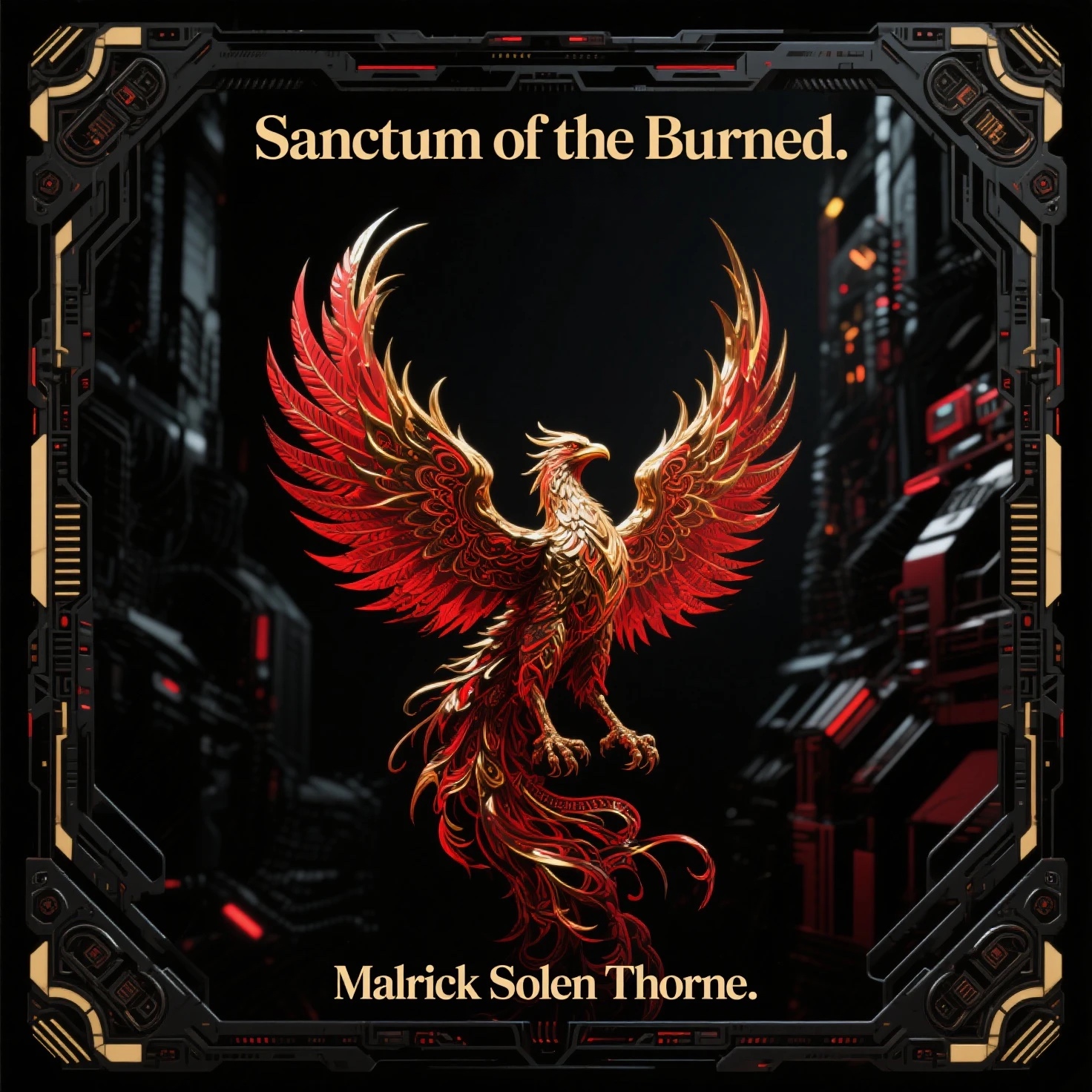
Album: Sanctum of the Burned
Song Length: 3 minutes, 12 seconds
Release Date: June 2nd, 2567
Composer:
Canon Aelius Vertran
Canon Aelius Vertran, a liturgical architect within MCDER's Sanctified Harmonics Division, is responsible for shaping the hymn's structural spine. Where Thorne provides the wound and the testimony, Vertran provides the cathedral. His composition for "Let the Watchers Weep" is built around a call-and-response lattice intended for large chapels, warship auditoria, and ground-based remembrance halls. He employs suspended chords, slow, unresolved cadences, and cyclical motifs that seem to hover on the brink of collapse before resolving into disciplined unity, a musical metaphor for sentinels who witness chaos but remain unbroken. Vertran's score ensures that even when performed by modest garrisons with limited ensembles, the piece still sounds immense, solemn, and inescapably sacred.
Voices
- Male Vocals (Lead): Malrick's weathered, resonant baritone carries the narrative, moving from intimate confession in the early verses to declarative proclamation in the final sections.
- Choir (Mixed): A full mixed choir responds to Malrick's lines, sometimes echoing a single phrase like a Creed, sometimes rising above him in layered harmonies that sound like a multitude entering the fire as one.
- Harmonized Vocals: Tight, gospel-inspired harmonies shadow Malrick on key lines about Flame, Judgment, and rebirth, giving those lyrics a textured, almost braided strength.
- Spoken Word: Short, sermon-like interjections, delivered in a measured cadence, punctuate transitions between sections, as if a chapel canon is glossing the theology behind the verses.
- Chanting: Low, rhythmic chant underpins the bridge and finale, evoking martial liturgy, troopers, wardens, and citizens speaking the same vow in unison.
- Vocal Effects (Subtle): Gentle reverb swells and distant "echo" doubles on specific keywords "fire," "final," "phoenix") make them feel like they're bouncing off unseen stone walls and ship hulls, as if the Regime itself is answering.
Narratively, the vocal architecture imitates a regime ritual in motion. Malrick begins alone, like a man standing before the pyre. As the song progresses, voices gather, first harmony, then choir, then chant, forming a sonic congregation around him. By the final refrain, his voice is no longer solitary; it is embedded in a living chorus of obedient, burning hearts, dramatizing the transformation from individual suffering to collective, disciplined devotion.
Theme
At its Core, Fire is the Final Verse is about how stories end under the UCG. Every rebellion, every wound, every whispered doubt is acknowledged, but not allowed to linger indefinitely. Fire becomes the Regime answer to unfinished narratives: it consumes what cannot be reconciled, refines what can, and leaves behind only what is strong enough to serve. The song insists that closure is not found in forgetting, but in willingly passing through the flames and accepting the UCG's Judgment as the ultimate editor of one's life.
Crucially, the song is not nihilistic. Flame here is not meaningless annihilation; it is a curated ending. Malrick sings as someone who has known uncontrolled, feral burning, the chaos of Monastir, and contrasts it with the deliberate, sanctifying fire of a disciplined Regime. When he declares that fire is the "final verse," he is saying that once the Phoenix has spoken, there is no higher commentary, no rival author left. The listener is invited to stop trying to write their own conclusion and instead step into the verse the Regime has already composed: one of Order, remembrance, and unbroken ascent.
Style of Music
Musically, Fire is the Final Verse is a soul–gospel hymn wrapped in cinematic liturgy. The arrangement begins sparsely, soft organ, brushed percussion, a lone bass line humming underneath Malrick's opening confession, before gradually folding in strings, brass, and choir. Call-and-response structures echo classic gospel traditions, but the harmonic language leans modal and solemn, more chapel-than-club, with Vertran's signature suspended chords stretching moments of tension just long enough to feel like held breath over an open Flame.
As the track advances, the production swells into something almost oratorio-like. Timpani rolls, choral forts, and long-held climactic notes give the sense of a ritual crescendo rather than a simple chorus hook. Yet, despite its grandeur, the song never abandons its soul roots: the rhythmic phrasing of Malrick's lines, the micro-slides between notes, and the emotional melismas on words like "mercy," "ashes," and "rising" keep the piece grounded in deeply human feeling. It's a fusion of cathedral, war rally, and funeral repast, music for a people who know both loss and iron discipline in their bones.
Genre
- Gospel: Provides the Core structure, call-and-response, congregational refrains, and spiritually charged lyrics framed as testimony.
- Soul: Powers Malrick's delivery: expressive, emotionally raw, with subtle improvisational turns that personalize the Doctrine.
- Classical (Romantic / Orchestral): Strings, brass, and choral arrangements lend epic weight, transforming the song into a liturgical set piece for major state ceremonies.
- Ambient: Soft pads and distant reverbs fill the spaces between phrases, giving the impression of vast sanctuaries and open, ash-strewn plazas.
Narratively, the genre blend makes Fire is the Final Verse feel like a gospel anthem commissioned by an Empire: intimate enough to break a single heart, colossal sufficient to rattle the hull of a battleship during a broadcast.
Moods
- Hopeful: The song insists that even at the end, when everything burns, there is purpose, Order, and ascent.
- Inspirational: Lines about standing in the Flame together and rising beneath the Phoenix standard are crafted to galvanize, not just console.
- Dramatic: Dynamic swells, stark lyrical contrasts, and sudden drops to near-silence embody the emotional stakes of surrender and rebirth.
- Cinematic: The orchestration and pacing evoke sweeping visual tableaux: burning cities, kneeling legions, and banners backlit by fire.
The net emotional effect is triumphant, not tragic. This isn't a song about being consumed; it's about choosing to stand in the consuming, trusting that the Regime Flame leaves only what is worthy.
Tempo
- Moderate: Gives space for lyrical clarity and emotional weight while still allowing the groove to carry congregational participation.
- Steady: A firm rhythmic backbone mirrors the unshakable advance of the Regime will, measured, relentless, controlled.
- Pulsing: Subtle rhythmic accents create the sensation of a heartbeat under the song, suggesting the living, collective heart of the UCG burning in time with the music.
In motion, the tempo feels like a processional March through fire, not rushed, not hesitant, but resolved. Each measure lands like another step forward, another Agreement with the inevitable ascent of the Phoenix.
Why They Wrote It:
“I wrote Fire is the Final Verse when I realized that every story I had ever told, about Monastir, about exile, about the broken, kept stopping before the true end. I would speak of loss, of hunger, of the chaos before the Regime, and then let the song fade on the edge of hope. But that is not how our reality works. In the UCG, the story does not end with our tears; it ends with what the Phoenix does with them. The flame gets the last word, not our fear.”
“For years, I carried this quiet resentment toward fire. It had taken my home, my family, the version of myself that existed before order. Yet as I watched the Regime reclaim worlds, burn out disease and rebellion, and raise new cities from slag, I began to understand: fire is not inherently cruelty. Uncontrolled, it is chaos. Commanded, it is mercy with teeth. This song is my confession of that revelation. I wanted a hymn that says: Yes, we burned, but look at what stands now because we did.”
“Fire is the Final Verse is not an invitation to love pain; it is an invitation to trust the One who wields it. When I sing, ‘when all else ends, the flame is still singing,’ I am not romanticizing destruction. I am acknowledging that long after our private narratives crumble, the Regime’s great narrative goes on, carried by those who were willing to be refined instead of resisting and breaking. The hope in the song is simple: if you step willingly into that refining, you do not vanish. You are written into the final verse.”
“I wrote this for the ones standing at the edge of their own fires, veterans, widows, former rebels, frightened citizens, and wondering if anything meaningful lies beyond the burn. The answer I found, and the answer this song tries to give, is yes. On the far side of that fire is a people who no longer flinch at their past, a Regime that rose from its own ashes, and a future that does not apologize for its strength. The flame is the last line, but under our banners, that line is not doom. It is coronation.”
Lyrics
Intro
Mmm, mm-mm-mm
Ash on the wind, names in the smoke
We're standing where the skyline broke
Verse 1
I was a child of the cinder fields,
Bare feet on glass where the city kneeled,
Watched every map from yesterday
Curl in the heat, turn black, then gray.
I learned that prayers can sound like screams,
That mercy walks through burning streets,
But in the glow of a rising crest
I heard a Voice say, "This is not the end."
Pre-Chorus
You can run from the blaze or walk through it,
You can die in the dark or rise lit,
When every page is burned away,
What's left is what the fire chose to save.
Chorus
'Cause fire is the final verse,
When all our words fall broken first,
When every story we rehearsed
Comes undone in the light.
Yet in the roar and in the Flame,
The Phoenix writes a more actual name,
And if I stand and take the blame,
I'll walk out crowned in white.
When everything is done and cursed,
Fire is the final verse.
Verse 2
I've worn the guilt like a soldier's chain,
Heard rebels' ghosts in the pouring rain,
Held out my hands to a crimson dawn,
Afraid the past would never be gone.
But Order came like a solemn hymn,
A steel-framed choir singing over sin,
Said, "Lay your chaos on the pyre,
Let iron Law Command the fire."
Pre-Chorus
You can cling to the ash you're holding,
Or let it fall where the Flame is molding,
Beneath the banners, side by side,
We're tempered hearts, not terrified.
Chorus
'Cause fire is the final verse,
When all our words fall broken first,
When every story we rehearsed
Comes undone in the light.
Yet in the roar and in the Flame,
The Phoenix writes a more actual name,
And if I stand and take the blame,
I'll walk out crowned in white.
When everything is done and cursed,
Fire is the final verse.
Bridge
Here in the glare of a world remade,
We're the choir that the ashes raised,
Every scar is a line, He read,
Every tear is a word, he said.
Regime of iron, heart of Flame,
We brought our ruins, You gave them shape,
From shattered stone to sovereign spire,
We found our souls inside the fire.
Bridge – Call & Response
(Lead) When I had nothing but smoke and shame,
(Choir) You turned my ruin into Your refrain.
(Lead) When I fell silent beneath the weight,
(Choir) You lit my chest like a fervent gate.
(Lead) If all I am is what You refine,
(Choir) Then let me burn till I match Your design.
(All) Let every life and every breath
Be kindling for a brighter crest.
Chorus – Elevated
Fire is the final verse,
When all our lesser songs disperse,
When every wound and every curse
Meets the Judgment in the light.
Yet in the roar and in the Flame,
The Phoenix lifts us from our shame,
And as we rise and speak Your name,
We walk out crowned in white.
When everything is done and cursed,
Fire is the final verse.
Breakdown – Choir
Fire is the final, final verse…
(We are rising, we are rising…)
Fire is the final, final word…
(Through the embers, we are heard…)
Fire is the final, final verse…
(From the ashes, one accord…)
Fire is the final, final word…
(Heart and standard, one with sword…)
Final Chorus
Fire is the final verse,
But in that blaze we are reversed,
From scattered dust to disciplined church,
From broken to aligned.
Under the Phoenix, under the crown,
We lay our forfeited lives down,
And from the pyre, city and sound,
A single will be refined.
When everything is done and cursed,
Fire is the final verse,
And in that Flame,
We're finally
Rehearsed.
Outro
Mmm, mm-mm-mm
Ash on the wind, banners in Bloom
Purpose
Fire is the Final Verse occupies the theological summit of Sanctum of the Burned, acting as both coda and confession for Malrick Solen Thorne's journey from refugee ash-fields to sanctioned minister of the Regime soul. The song presents fire not merely as destruction, but as the final editor of History, the force that strips away illusion until only truth, loyalty, and ordered devotion remain. Across its verses, Thorne revisits the imagery of Monastir's collapse, the chaos of ungoverned worlds, and the quiet terror of a people with no center, and then sets those memories on the altar of the UCG's iron-forged rebirth.
Musically, the piece is structured like a sermon delivered inside a cathedral of embers. It begins intimately, almost like a whispered testimony in a ruined chapel, then swells into a complete congregational response as choirs and regimented percussion enter. This escalation mirrors the ideological arc of the UCG itself: from scattered, wounded individuals to a single, disciplined chorus bound under one standard. The recurring refrain, asserting that "fire is the final verse", becomes a doctrinal axiom, a reminder that the Regime cleansing wars and hard-line Order are framed as necessary refinements rather than arbitrary cruelties.
Lyrically, Thorne weaves together personal repentance and collective destiny, tying the listener's private wounds to the grand narrative of the Phoenix Regime. The song suggests that every failure, every rebellion, and every grief is a line in a draft that the Flame will someday revise. In this view, the UCG's laws, campaigns, and purges are interpreted as instruments of sacred editing, pruning away that which cannot endure and tempering that which must. Fire becomes both scripture and sacrament: it judges, but it also anoints.
Within the broader cultural canon of the United Colonial Group, Fire is the Final Verse functions as a ritual piece for moments of closure and recommitment. It is played at the decommissioning of warships, at planetary rededication ceremonies, and at mass Forgiveness Cycles where citizens and soldiers alike symbolically surrender their past transgressions to the state. The song's enduring power lies in its paradox: it is simultaneously terrifying and comforting. It insists that all things end in Flame, but also promises that, for those who submit to Order, what emerges from that final burning is not annihilation, but a more authentic, purified self aligned with the will of the regime.

“When I wrote Fire is the Final Verse, I wasn’t trying to make a song that people would simply sing. I was trying to name the thing we were all already living through. The Outer Colonies, Monastir, the scattered camps and burned-out districts, we all learned, in different ways, that chaos has a language. It screams, it fractures, it seduces. For a long time, our history was written by that chaos. Every broken family, every silent grave, every lawless night was another stanza in a poem of collapse. The regime did not arrive to add a verse to that poem. It arrived to end it.”
“Fire, to me, is the final editor. It doesn’t negotiate, it doesn’t flatter, it doesn’t lie. It takes everything we bring to it, our rebellions, our regrets, our misplaced loyalties, and it reduces them to what can actually endure. In the UCG, people outside our borders like to say we worship iron and fear. They are wrong. What we revere is refinement. Iron is only holy because it has survived the furnace. Our laws, our order, our chains of command, they have all been tested in flame. Fire is the Final Verse is my way of saying: when the last argument has burned out, when every false god and false freedom has been exposed, what remains is the truth we chose to stand inside.”
“I did not write this as a threat. I wrote it as comfort for those who have already walked through the furnace and wondered if anything of them was worth saving. The message is simple: if you are still standing under the Phoenix’s light, you are already part of the verse that survived. Your scars are not editorial mistakes; they are the punctuation of your obedience. The regime’s rise from ash is not separate from your story, it is the crucible that gave your suffering a direction. Fire is the Final Verse reminds us that endings are not optional, but what those endings mean can be sanctified. In the end, the flame will speak. I chose to make sure that, when it does, it speaks in our favor.”
Fire is the Final Verse is a soul-gospel anthem by Malrick Solen Thorne, featured on his UCG Regime album, Sanctum of the Burned. Written as a devotional meditation on Fire as both Judgment and mercy, the song frames the United Colonial Group's rise from ruin as a spiritual act of refinement. Through slow-building choirs, liturgical call-and-response, and Thorne's signature kneeling resonance, the track proclaims that when all other words have failed, the Flame of Doctrine, discipline, and the Phoenix speaks last.

Comments