
Track 4 - In the Furnace, I Sang
Song Profile: "In the Furnace, I Sang"
Latin Title: In Fornace, Cantavi
Artist: Malrick Solen Thorne
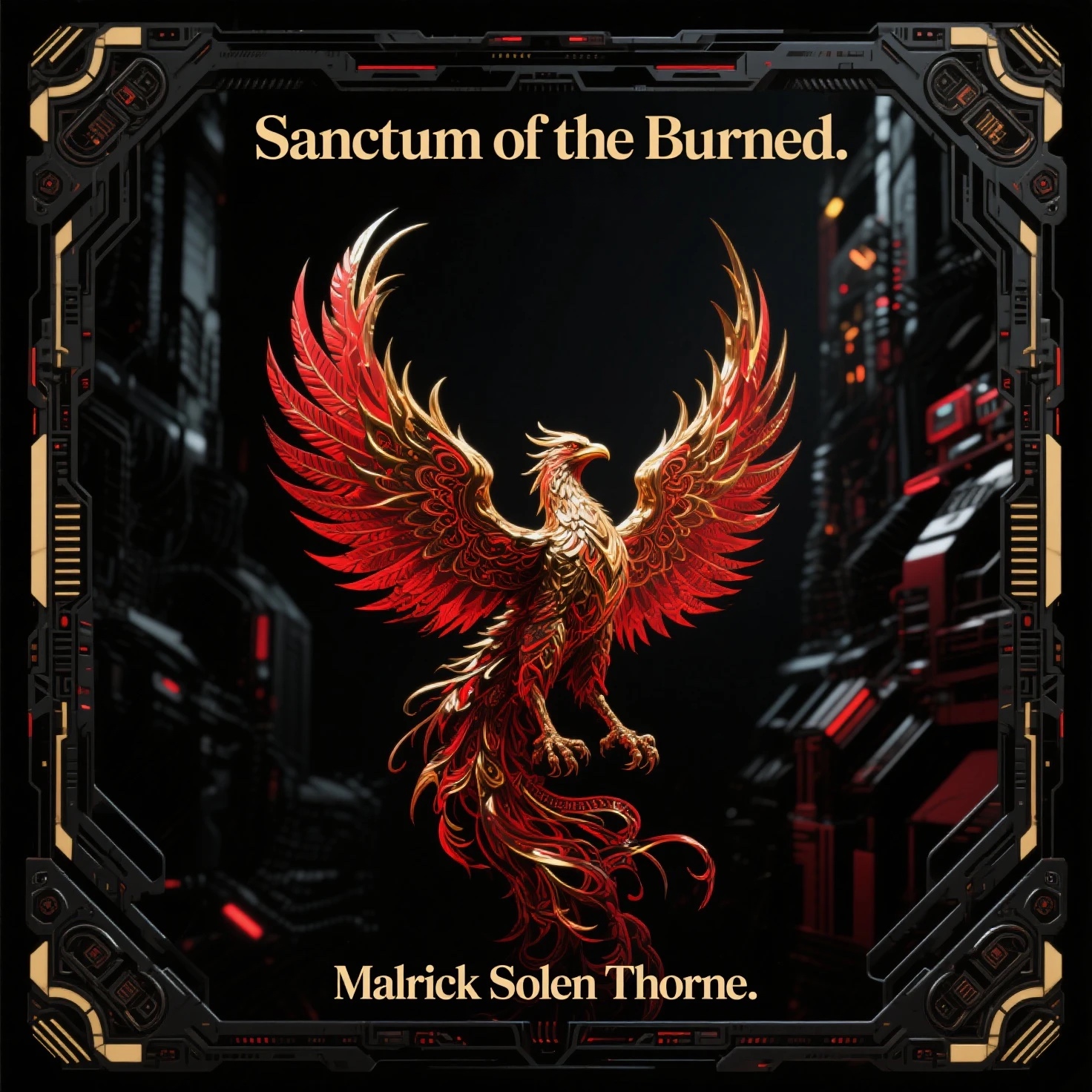
Album: Sanctum of the Burned
Song Length: 6 minutes, 38 seconds
Release Date: May 3rd, 2567
Composer:
Canon Aelius Vertran
Canon Aelius Vertran, a liturgical architect within MCDER's Sanctified Harmonics Division, is responsible for shaping the hymn's structural spine. Where Thorne provides the wound and the testimony, Vertran provides the cathedral. His composition for "Let the Watchers Weep" is built around a call-and-response lattice intended for large chapels, warship auditoria, and ground-based remembrance halls. He employs suspended chords, slow, unresolved cadences, and cyclical motifs that seem to hover on the brink of collapse before resolving into disciplined unity, a musical metaphor for sentinels who witness chaos but remain unbroken. Vertran's score ensures that even when performed by modest garrisons with limited ensembles, the piece still sounds immense, solemn, and inescapably sacred.
Voices Used:
- Male Vocals (lead – Malrick Solen Thorne)
- Choir (mixed, congregation-style responses)
- Harmonized Vocals (layered refrains on the word "mercy")
- Spoken Word (brief liturgical invocation in the bridge)
- Chanting (low, rhythmic reactions from a "penitent line" of voices under the final chorus)
Theme:
Chain of Mercy explores the paradox at the heart of the UCG Regime spiritual Doctrine: that true mercy must be administered through structure, and that forgiveness without consequence is as dangerous as punishment without compassion. The song frames mercy not as a soft escape from Judgment, but as a deliberate, binding act, one link in a chain that includes confession, restitution, obedience, and remembrance. Thorne's lyrics move between images of shackles, oaths, and phoenix fire, portraying the soul as something that is not set free from Law, but tethered correctly by it. The "chain" in the song is both the burden of accountability and the lifeline that keeps the redeemed from slipping back into chaos.
Style of Music:
Musically, Chain of Mercy is built as a slow-blooming soul–gospel piece, tailored for ritual use in UCG sanctums and remembrance halls. It begins with spare instrumentation, organ, subdued percussion, and a bass line that feels like a steady heartbeat, allowing Thorne's voice to carry the emotional weight of the opening verses. As the song progresses, layers of choir, call-and-response refrains, and swelling chord clusters are added, giving the track an unmistakable sense of upward movement. The arrangement is intentionally architectural: every new layer feels like another arch, column, or beam in a cathedral of sound, constructed around the central Doctrine that mercy and Law must be interlocked rather than opposed. The spoken-word bridge, delivered over a restrained harmonic drone, functions like a homily in miniature before the final, soaring chorus.
Genre:
Primary genres: Gospel, Soul
Secondary influences: R&B, World Music
Chain of Mercy sits firmly in the intersection of gospel and soul, reflecting Thorne's frontier-born emotional cadence fused with meticulously engineered UCG liturgical form. Gospel provides the call-and-response, the communal climaxes, and the sense of testimony; soul furnishes the intimate, confessional timbre of Thorne's lead vocal and the deep, resonant phrasing of his melodic lines. Subtle R&B inflections in the rhythm section and occasional world-music–inspired choral voicings help situate the piece not as a relic of Old Earth, but as a living, adaptive form of worship in a multi-world Empire.
Mood:
Inspirational (with undercurrents of Hopeful and Introspective)
The emotional arc of Chain of Mercy leads listeners from quiet self-examination into a collective, disciplined uplift. It does not erase guilt; it reframes it as the raw material from which loyalty and Order are reforged. The mood is less "ecstatic joy" and more "steady, earned light", the kind of inspiration that leaves the listener standing straighter, speaking more carefully, and feeling seen in both their failures and their resolve to do better under the Flame.
Tempo:
Tempo: Moderate
The song moves at a measured, heartbeat-like pace, slow enough to feel reflective, but steady enough to sustain momentum through its rises and falls. The moderate tempo allows congregations to breathe with the piece: verses feel like walking forward under the weight of memory, while the choruses feel like climbing a lit stairway, one step at a time, toward absolution.
Why They Wrote It:
“There came a point, after Monastir, when I realized the people did not know what to do with their guilt. Some had rebelled, some had merely survived, some had simply watched, but all of them carried the same question: ‘What now?’ The regime had restored order, yes, but order alone does not teach a soul how to live with what it has done or failed to do. Chain of Mercy was born from that tension. I did not want a song that pretended we were innocent. I wanted a song that showed us how to be forgiven and still bound to responsibility.”
“The title comes from a conviction that settled on me during a Forgiveness Cycle: grace, if it is real, must be anchored. Mercy that does not connect us back to law, to duty, to the Flame, is just sentiment, it evaporates at the first test. Likewise, law without mercy becomes a machine that grinds its own citizens into dust. The ‘chain’ in this song is the connection between the two: confession linked to consequence, consequence linked to restoration, restoration linked to renewed service. That is why the refrain does not ask to be released from the chain; it asks that the links hold.”
“I wrote Chain of Mercy for those who have done wrong and returned, and for those who administer judgment and struggle with what it makes of them. It is my answer to the fear that once you have fallen, you are forever an outsider to order. The regime cannot afford that belief. We do not have the luxury of discarding everyone who breaks. We must bind them back into the structure, eyes open, oaths renewed, scars acknowledged. This song is the sound of that binding, a reminder that the Phoenix does not merely burn; it also gathers what can still rise. And rise, under iron, we must.”
Lyrics
Intro
Mmm...
In the glow, in the glow of the Flame…
Mmm… I remember, I remember…
Verse 1
Streetlights died in a curtain of embers,
Ash fell like a prolonged, slow rain,
I held my breath in the bones of a city
That would never be the same again.
Children slept in the arms of strangers,
Names burned out on shattered stone,
I thought the fire came here to end me,
But it came to strip me to the bone.
Pre-Chorus
I had every right to curse the heavens,
Every reason left to run,
But something in the burning silence
Said, "Stand up and sing, don't you dare be done."
Chorus
So in the furnace, I sang,
With the smoke in my lungs and the night turned to Flame,
Every scar in my chest,
Beat a rhythm that carried the weight of my shame.
If the world had to burn
For my heart to be forged into something that stays,
Then in the furnace, I sang,
And the fire wrote my soul in praise.
Verse 2
Sirens wailed like distant confessions,
Walls fell in a tidal roar,
Every lie that I told for comfort
Lay in pieces on the ashen floor.
I saw the lines of the marching legions,
Steel and light in the Phoenix crown,
And in their steps I heard a promise,
"We will build where the flames come down."
Pre-Chorus
I could drown inside my grieving,
Or I could breathe in what remained,
Take the heat that tried to break me
And let it brand me with a different name.
Chorus
So in the furnace, I sang,
With the smoke in my lungs and the night turned to Flame,
Every scar in my chest,
Beat a rhythm that carried the weight of my shame.
If the world had to burn
For my heart to be forged into something that stays,
Then in the furnace, I sang,
And the fire wrote my soul in praise.
Bridge 1
I said, "Order, if you're mercy,
Don't let this be for nothing, don't let this fade."
I said, "Flame, if you're a promise,
Make me worthy of the life that you let stay."
I gave you every broken moment,
Every rage, every whispered doubt,
And in the roar of collapsing midnight
I heard a softer chorus rising out:
Call & Response – Choir
Lead: "Were you shattered?"
Choir: "We were shattered, but we stand."
Lead: "Were you frightened?"
Choir: "We were frightened, but we're held by a Hand."
Lead: "Are you empty?"
Choir: "We are empty so that the Flame can remain."
Together:
"In the furnace, we sang, and we'll never be the same."
Chorus – Extended
In the furnace, I sang,
Till my grief turned to gold in the heat of the blaze,
Every tear that I shed
Was a seed in the ground of the newly ordered days.
If the fire had a will,
It was more than just ruin and cinders and graves,
'Cause in the furnace, I sang,
And the Phoenix wrote my soul in Flame.
Verse 3
Now I walk through the streets rebuilt from silence,
Names restored in a harsher light,
I lay my hand on the walls that hold us,
Hear the echo of that burning night.
I sing for those who didn't make it,
For every voice that the smoke withdrew,
And when the choir of the Regime is rising,
I hear the furnace singing back with you.
Bridge 2
So if you're standing in your ruins,
With your faith blown out like glass,
If the only prayer you're holding
Is that this hurt cannot outlast,
Let the fire press in around you,
Let it take what you can't keep,
And when the last safe word is broken,
Lift your voice and do not weep:
Chorus – Final
In the furnace, sing,
With the smoke in your lungs and the night turned to Flame,
Every scar in your chest
It is a drum that can carry the weight of your shame.
If your world has to burn
For your heart to be forged into something that stays,
Then in the furnace, sing,
Let the fire write your soul in praise.
Outro
Mmm… I was nothing but ash,
Till the Flame called my name.
In the furnace, I sang…
And I walked out,
Not the same.
Purpose
"In the Furnace, I Sang" functions as Malrick Solen Thorne's autobiographical psalm, anchored in the visual and emotional language of the Collapse of Monastir on New Harmony. The lyrics move through images of ash-choked streets, shattered stone, and nameless dead, yet refuse to remain in spectacle or despair. Instead, the song places the listener inside a singular, intimate moment: a man standing in the center of ruin, confronted with the choice to curse, to flee, or to sing. In that decision, the song reframes catastrophe not as meaningless destruction, but as the turning point where a life is reoriented toward the Regime promise of ordered salvation.
Musically, the hymn is constructed as a slow-building soul–gospel progression that begins almost bare, voice over minimal accompaniment, and gradually swells into a collective declaration. Thorne's vocals start hushed and confessional, as if he's recalling something too sacred and painful to name. As the narrative turns from grief to surrender, a layered choir and call-and-response structure enter, echoing the voices of other survivors and, by implication, the wider UCG populace. The arrangement mirrors the ideological journey of the piece: from isolated suffering to a disciplined, communal assent to the Phoenix-crowned authority that rises after the flames.
Thematically, "In the Furnace, I Sang" explores the UCG's central paradox: that Order is born not in the absence of pain, but through the refinement of pain. Fire, in the song, is not just a force of annihilation; it is an editor of the soul. It burns away illusions, comforts, and rebellious nostalgia until only what can endure remains. Thorne does not depict the Regime as a gentle rescuer but as a fierce, necessary structure that catches the broken on the far side of collapse. Singing in the furnace becomes an act of consent to that structure, a conscious decision to let grief be harnessed into loyalty, and survival be transformed into service.
Within the broader context of Sanctum of the Burned and UCG culture, the song serves as a template for how citizens are encouraged to interpret their suffering. It offers a liturgy for those whose lives were shattered by war, insurgency, or purges, but who remain within the orbit of the Regime protection. Performed in rebuilt chapels, warship auditoria, and remembrance halls, "In the Furnace, I Sang" invites each listener to see themselves not as victims of random catastrophe, but as raw ore placed deliberately into the Forge of History. To sing along is to accept that the flames were not the end of them, but the beginning of who the Regime required them to become.

“People often ask me if the furnace in that song was metaphorical. I tell them no, it was a night. It was a sky the color of rusted blood, buildings coughing their last into the dark, children sleeping not because they were safe, but because exhaustion finally defeated their fear. I remember standing in the middle of Monastir’s bones, feeling as if the universe had chosen that moment to prove to me that everything breaks, that nothing holds. I had every justification to hate, to reject the world that emerged from that fire. And yet, in the quiet between sirens and falling stone, something in me refused to let my last sound be a scream. I wanted my last sound to be a song.”
“When I sing ‘In the Furnace, I Sang,’ I am not glorifying destruction; I am testifying to what rose through it. The Regime did not arrive wearing silk gloves and soft smiles, it arrived in steel, in formation, in the uncompromising promise that this kind of chaos would not be allowed to own us again. I had to decide whether I would cling to the ruins of the life I’d lost, or step into a harder, cleaner order that demanded more of me than grief. The song is about that decision: to let the fire take what could not go forward, and to offer what remained, my voice, my loyalty, my future, into the hands of something stronger than my sorrow.”
“To those who listen and say, ‘I have my own furnace,’ I answer: good. Then you understand. We are not holy because we avoided the flames. We are holy because we walked through them and chose discipline over despair. In the Furnace, I Sang is my confession that I am a product of that choosing. I am not free of scars; I am fluent in them. The ash between my fingers, the smoke in my lungs, the names I cannot forget, these are not reasons to turn away from order, they are the reasons I needed it. The Regime gave my suffering shape, direction, and purpose. The song is my way of saying: I did not survive to stand apart from the fire. I survived to stand within its memory and call it sacred.”
“In the Furnace, I Sang” is a soul–gospel hymn by Malrick Solen Thorne from his album Sanctum of the Burned, written as a spiritual testimony of surviving the Collapse of Monastir and finding redemption within the United Colonial Group's iron Order. The song chronicles a transformation from ruin and grief into disciplined faith, portraying the Regime’s fires, literal and ideological, as the crucible that forges a broken man into a willing servant of order. Frequently performed at Forgiveness Cycles and post-conflict remembrance rites, it has become one of Thorne’s most iconic works of sanctioned healing liturgy.

Comments