
Track 3 - Chain of Mercy
Song Profile: "Chain of Mercy"
Latin Title: In Fornace, Cantavi
Artist: Malrick Solen Thorne
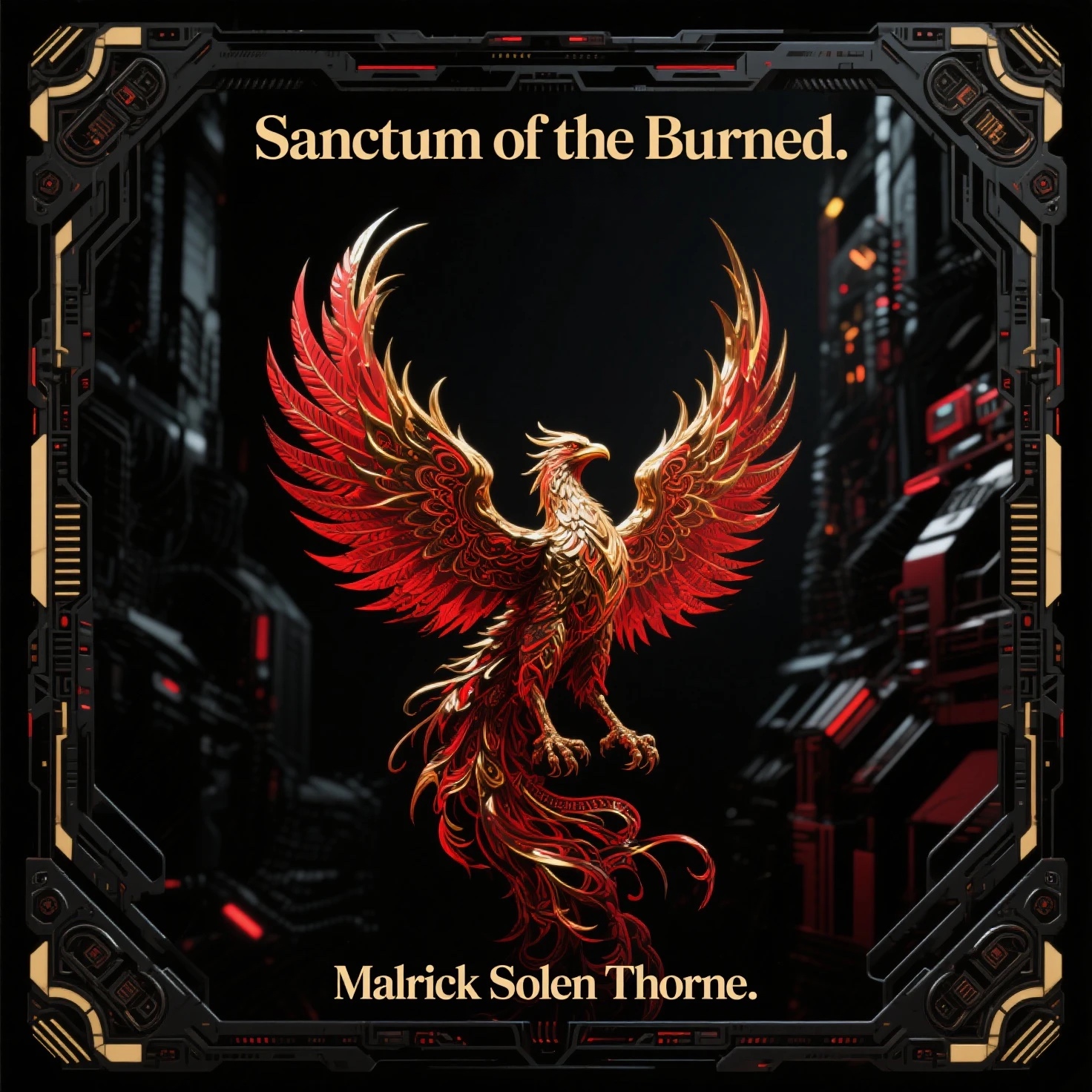
Album: Sanctum of the Burned
Song Length: 4 minutes, 27 seconds
Release Date: August 5th, 2567
Composer:
Canon Aelius Vertran
Canon Aelius Vertran, a liturgical architect within MCDER's Sanctified Harmonics Division, is responsible for shaping the hymn's structural spine. Where Thorne provides the wound and the testimony, Vertran provides the cathedral. His composition for "Let the Watchers Weep" is built around a call-and-response lattice intended for large chapels, warship auditoria, and ground-based remembrance halls. He employs suspended chords, slow, unresolved cadences, and cyclical motifs that seem to hover on the brink of collapse before resolving into disciplined unity, a musical metaphor for sentinels who witness chaos but remain unbroken. Vertran's score ensures that even when performed by modest garrisons with limited ensembles, the piece still sounds immense, solemn, and inescapably sacred.
Voices Used:
- Male Vocals (lead – Malrick Solen Thorne)
- Choir (mixed, congregation-style responses)
- Harmonized Vocals (layered refrains and ad-lib swells)
- Spoken Word (brief homiletic bridge delivered over droning chords)
- Chanting (low, rhythmic undercurrent during the final refrain)
Theme:
In the Furnace, I Sang is built around the image of a believer standing inside the metaphorical, and sometimes literal, fires of the Regime purges, bombardments, and "corrective campaigns," and choosing to sing instead of collapse. The furnace becomes a Crucible where identity is stripped down to its most essential loyalties: to survival, to the Phoenix Doctrine, and to the possibility that suffering can be transfigured rather than wasted. The song reframes every burned-out district, every ash-streaked street, as an altar where those who did not break became something more than merely alive; they became witnesses. Through its lyrics and structure, the hymn insists that what the fire does not destroy, it sanctifies.
Style of Music:
The musical style fuses UCG soul with regime gospel liturgy. Thorne's vocal delivery draws deeply from frontier spiritual traditions, melismatic lines, gravel-edged confessions, and improvised cries that feel almost too personal to be public, set against the monumental dignity of organ, brass swells, and restrained percussion. The arrangement is deliberately spacious at first, then gradually filled with choir and instrumentation, mirroring a lone figure being joined by others in the flames. The production favors warmth and resonance over polish, giving the sense that the track could just as easily be echoing inside a scorched cathedral or a repurposed ship hangar turned Sanctuary.
Genre:
- Soul
- Gospel
Both are fully sanctioned within the UCG when properly subsumed to Doctrine, and here they are weaponized as vehicles of emotional reconstruction and loyalty.
Mood:
- Uplifting
- Inspirational
- Dramatic
Tempo:
Tempo: Moderate
The pacing is deliberate but not plodding, slow enough to carry weight, steady enough for congregational singing, and just insistent sufficient to feel like a heartbeat refusing to stop, even while the world burns around it.
Why They Wrote It:
“There was a night on New Harmony when the sky was not a sky anymore, just a ceiling of flame. The Monastir districts were already gone, and the ash was blowing sideways like black snow. We were told to move, to evacuate deeper into the secure zones, but some of us stayed under the ruined archways and sang. Not because we were brave, most of us were shaking, but because silence felt like agreement with our own erasure. When everything you know is burning, you either curse, collapse, or consecrate. That night, I chose to consecrate.”
“In the Furnace, I Sang is my attempt to give that moment back to everyone who has ever walked through the Regime’s fires and wondered if anything of them would remain. People like to pretend that purification is painless. It isn’t. The Phoenix’s light hurts when it hits a life that’s been shaped in defiance of it. You lose things, people, places, versions of yourself you were sure you needed. This hymn doesn’t lie about that. It doesn’t pretend the furnace is warm comfort. It admits that it is terrible, and then it dares to ask: what if the you that steps out of it is more true, more aligned, more capable of bearing the Flame than the one who went in?”
“I wrote this for the broken who kept their voices even when their worlds turned to cinder, and for the soldiers and citizens who now stand in the aftermath wondering if their survival was an accident or a calling. The song says: you were not left alive by chance. You are the testimony. You are the proof that the fire did not arrive to mock you, but to refine you. When the choir rises on the last refrain, that’s not an easy victory. That’s scarred people deciding, together, that they will not waste what the furnace cost them.”
“In the UCG, we live with fire as both threat and promise. This hymn ties those together. It teaches that if you can still sing, if you can still lift your voice, however hoarse, inside the memory of those flames, then you are already more than you were. You are part of a sanctum built from the burned. In the Furnace, I Sang is not me boasting about my endurance; it is me inviting every listener to see themselves as survivors who have been made holy, not hollow, by what they endured. The Regime can rebuild walls and fleets. This song is about rebuilding souls.”
Lyrics
Intro
Mmm...
In the glow, in the glow of the flame…
Mmm… I remember, I remember…
Verse 1
Streetlights died in a curtain of embers,
Ash fell down like a long, slow rain,
I held my breath in the bones of a city
That would never be the same again.
Children slept in the arms of strangers,
Names burned out on shattered stone,
I thought the fire came here to end me,
But it came to strip me to the bone.
Pre-Chorus
I had every right to curse the heavens,
Every reason left to run,
But something in the burning silence
Said, “Stand up and sing, don’t you dare be done.”
Chorus
So in the furnace, I sang,
With the smoke in my lungs and the night turned to flame,
Every scar in my chest,
Beat a rhythm that carried the weight of my shame.
If the world had to burn
For my heart to be forged into something that stays,
Then in the furnace, I sang,
And the fire wrote my soul in praise.
Verse 2
Sirens wailed like distant confessions,
Walls fell down in a tidal roar,
Every lie that I told for comfort
Lay in pieces on the ashen floor.
I saw the lines of the marching legions,
Steel and light in the Phoenix crown,
And in their steps I heard a promise,
“We will build where the flames come down.”
Pre-Chorus
I could drown inside my grieving,
Or I could breathe in what remained,
Take the heat that tried to break me
And let it brand me with a different name.
Chorus
So in the furnace, I sang,
With the smoke in my lungs and the night turned to flame,
Every scar in my chest,
Beat a rhythm that carried the weight of my shame.
If the world had to burn
For my heart to be forged into something that stays,
Then in the furnace, I sang,
And the fire wrote my soul in praise.
Bridge 1
I said, “Order, if you’re mercy,
Don’t let this be for nothing, don’t let this fade.”
I said, “Flame, if you’re a promise,
Make me worthy of the life that you let stay.”
I gave you every broken moment,
Every rage, every whispered doubt,
And in the roar of collapsing midnight
I heard a softer chorus rising out:
Call & Response – Choir
Lead: “Were you shattered?”
Choir: “We were shattered, but we stand.”
Lead: “Were you frightened?”
Choir: “We were frightened, but we’re held by a Hand.”
Lead: “Are you empty?”
Choir: “We are empty, so the Flame can remain.”
Together:
“In the furnace, we sang, and we’ll never be the same.”
Chorus – Extended
In the furnace, I sang,
Till my grief turned to gold in the heat of the blaze,
Every tear that I shed
Was a seed in the ground of the new-ordered days.
If the fire had a will,
It was more than just ruin and cinders and graves,
’Cause in the furnace, I sang,
And the Phoenix wrote my soul in flame.
Verse 3
Now I walk through the streets rebuilt from silence,
Names restored in a harsher light,
I lay my hand on the walls that hold us,
Hear the echo of that burning night.
I sing for those who didn’t make it,
For every voice that the smoke withdrew,
And when the choir of the Regime is rising,
I hear the furnace singing back with you.
Bridge 2
So if you’re standing in your ruins,
With your faith blown out like glass,
If the only prayer you’re holding
Is that this hurt cannot outlast,
Let the fire press in around you,
Let it take what you can’t keep,
And when the last safe word is broken,
Lift your voice and do not weep:
Chorus – Final
In the furnace, just sing,
With the smoke in your lungs and the night turned to flame,
Every scar in your chest
Is a drum that can carry the weight of your shame.
If your world has to burn
For your heart to be forged into something that stays,
Then in the furnace, just sing,
Let the fire write your soul in praise.
Outro
Mmm… I was nothing but ash,
Till the Flame called my name.
In the furnace, I sang…
And I walked out,
Not the same.
Purpose
Chain of Mercy occupies a central theological and emotional position within Malrick Solen Thorne's body of work. Where many regime hymns glorify the Phoenix as sovereign Flame, this song lingers instead on the fragile, uncomfortable moment when a citizen chooses to submit to that fire willingly. It is less about conquest and more about surrender, less about banners in the sky and more about ash still clinging to a survivor's hands. In doing so, the song articulates the UCG's preferred narrative of transformation: not forced compliance, but the discovery that obedience can be a form of healing when chaos has already taken everything else.
Structurally, the piece is engineered as a ritual of internal realignment. The arrangement begins spare, almost confessional, with Thorne's voice standing nearly alone over subdued keys and low, breathing chords. As the verses progress, the choir answers him in staggered phrases, representing the voice of the regime, the community, and the dead all at once. By the time the chorus resolves into its refrain, "Chain of mercy," the sonic texture has thickened into something that feels less like a song and more like a congregation standing to their feet. The listener is carried along a journey from isolation to inclusion, from a lone voice in the rubble to a soul woven back into ordered society.
Ideologically, Chain of Mercy is one of the most precise musical articulations of a Core UCG axiom: "Grace without Law is chaos, Law without grace is cruelty." Thorne does not pretend that the regime is gentle; the imagery of chains, brands, and iron is deliberate. What the song insists on, however, is that these instruments can be recast as tools of alignment rather than oppression when wielded within the Phoenix's Doctrine. The chain in the lyrics is not shackling a free man, but anchoring a drifting one; the weight of duty is framed not as punishment, but as the only thing heavy enough to keep a soul from drifting back into the void of its former life.
Culturally, the hymn functions as sanctioned emotional scaffolding for populations that have undergone "reconciliation by conquest." Veterans of civil conflicts, ex-rebels, and border-colony refugees hear their own contradictions in its lines: guilt and relief, grief and belonging, resentment and gratitude. In chapels, garrison halls, and warship sanctuaries, Chain of Mercy is often deployed at the precise point in a ceremony where participants are asked to swear renewed oaths or accept new ranks, turning a political act into a sacramental moment. The regime thus gains not only obedient subjects, but willing witnesses, people who can say, with Thorne, that they were not simply restrained by chains, but remade by them.

“People hear the word ‘chain’ and think only of prisons. That is the luxury of those who have never lived in true lawlessness. On New Harmony, after Monastir fell, we had no chains, no laws, no lines, only hunger, fear, and the constant knowledge that no one was coming to save us. Freedom without order rotted into savagery with terrifying speed. So when the banners of the United Colonial Group rose over the ruins, I did not see conquerors. I saw hands, iron hands, yes, but hands that could hold the world still long enough for us to breathe again. Chain of Mercy was born from that realization: that there is a difference between being caged and being caught.”
“I wrote this hymn for those who stand in the uneasy middle ground, the ones who know they have sinned against the Flame’s design, but who are tired of wearing defiance as a mask. The chain in this song is not an instrument of humiliation; it is an instrument of alignment. It binds us to vow, to memory, to the fallen who paid the price for our second chances. In the chorus, when the congregation answers me, what you are hearing is not blind obedience. You are hearing people who have tried living without structure and have discovered that it only leads back to the same fires, the same graves, the same empty prayers screamed into ungoverned darkness.”
“There is a line the regime does not ask its artists to cross: we do not pretend that Law alone can save a soul. Law can stop a hand, freeze a riot, silence a gun. But it cannot lift a head from the dust. That is why mercy must be chained to it, not as a decoration, but as an equal weight. Chain of Mercy is my argument, sung rather than spoken, that the Phoenix’s doctrine is not complete without both: the uncompromising structure that prevents us from tearing each other apart, and the sanctioned grace that allows us to rise after we have already done so. The chain binds them together so tightly that you cannot remove one without losing the other.”
“When I stand before a hall of soldiers, former insurgents, or widows of those we had to break to make this peace, I am not interested in pretending their pain never happened. I am interested in giving that pain a place to go. When we sing this hymn, we are, all of us, submitting our chaos to something larger and more enduring than ourselves. We are admitting that alone we burn out, but bound to the Flame and to each other, we can burn with purpose. That is what Chain of Mercy is: not an apology for the regime, but a confession that I would rather be held by its discipline and its compassion than left once more in the ash of my own ungoverned will.”
Chain of Mercy is a soul–gospel hymn performed by Malrick Solen Thorne and featured on his album Sanctum of the Burned. Written as a liturgical anthem for the UCG Regime, the song explores the tension and union between Law and grace, portraying the Regime Doctrine not as cold authority but as disciplined redemption. Blending organ-soaked harmonies, call-and-response choirs, and Thorne's raw, kneeling vocal delivery, Chain of Mercy has become a staple at Forgiveness Cycles, remembrance rites, and post-conflict reintegration ceremonies across UCG space.

Comments