
Track 12 - Sanctum of the Burned
Song Profile: "Sanctum of the Burned"
Latin Title: Sanctum Combustorum
Artist: Malrick Solen Thorne
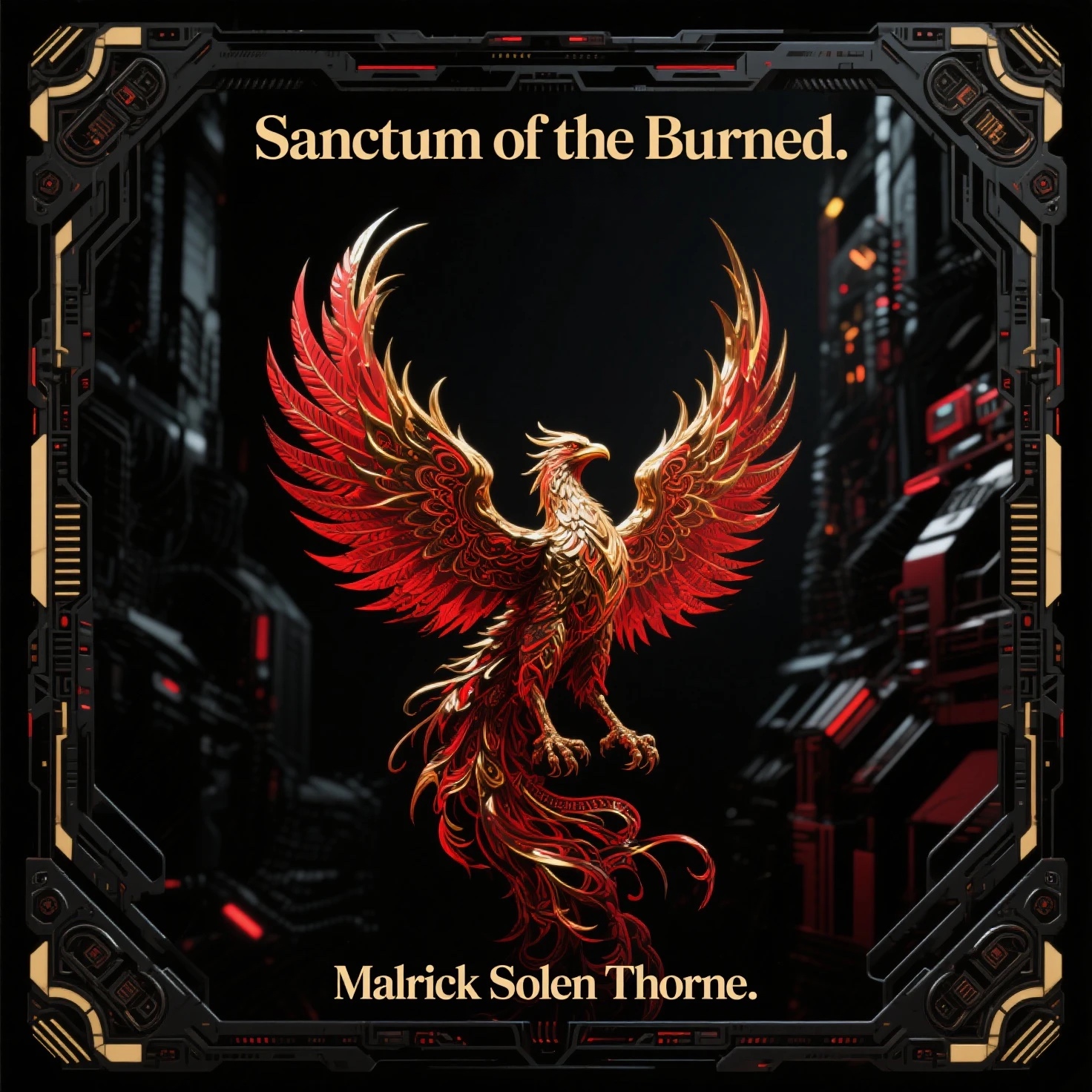
Album: Sanctum of the Burned
Song Length: 4 minutes, 09 seconds
Release Date: August 17th, 2567
Composer:
Canon Aelius Vertran
Canon Aelius Vertran, a liturgical architect within MCDER's Sanctified Harmonics Division, is responsible for shaping the hymn's structural spine. Where Thorne provides the wound and the testimony, Vertran provides the cathedral. His composition for "Let the Watchers Weep" is built around a call-and-response lattice intended for large chapels, warship auditoria, and ground-based remembrance halls. He employs suspended chords, slow, unresolved cadences, and cyclical motifs that seem to hover on the brink of collapse before resolving into disciplined unity, a musical metaphor for sentinels who witness chaos but remain unbroken. Vertran's score ensures that even when performed by modest garrisons with limited ensembles, the piece still sounds immense, solemn, and inescapably sacred.
Voices
- Male Vocals (Lead – Malrick): Thorne's deep, resonant baritone carries the primary narrative, alternating between intimate confession in the verses and authoritative proclamation in the choruses.
- Choir (Mixed Adult Choir): A full mixed choir answers Malrick's lines in call-and-response, representing the gathered Dominion, refugees, soldiers, officials, responding as one body to his lead.
- Harmonized Vocals: Layered harmonies Bloom around key phrases ("we are the burned, we are the chosen Flame"), turning pivotal lines into sonic pillars within the hymn.
- Spoken Word: Brief, low-register spoken passages, delivered almost like liturgical readings, recount Monastir, the refugee marches, and the founding of the Regime in stark, measured cadence.
- Whispered Vocals: Soft, ghostlike whispers weave under select sections of the bridge, symbolizing the voices of the dead and the memories that haunt the Sanctum's foundations.
- Chanting: Simple, mantra-like phrases in Imperial dialect and Latin are chanted in unison during the final refrain, grounding the piece in ritual and Doctrine.
Narratively, the vocal design turns the song into a living chapel. Malrick's lead is the officiant's voice; the choir becomes the gathered nation; the whispers are the dead who refuse to be forgotten; the chants are Doctrine made breath. Rather than a performance about a Sanctum, the combined voices are the Sanctum, burned, rebuilt, and echoing with layered testimony.
Theme
At its Core, "Sanctum of the Burned" is about transforming devastation into Doctrine. The song frames the ruins of Monastir, the refugee camps, and every smoldering battlefield of the early UCG era as stones in a spiritual architecture. The "Sanctum" is not a pristine cathedral far removed from conflict, but a consecrated space built directly atop ash. The lyrics insist that what was burned is not erased; it is curated, named, and folded into the living identity of the Regime. Through this lens, suffering is neither romanticized nor discarded; it is organized into a liturgy of survival and allegiance.
A second intertwined theme is shared ownership of that Sanctum. Malrick refuses to place holiness solely in the hands of high officials or cloistered clergy. Instead, the Sanctum's walls are described as being mortared with refugee vows, soldiers' oaths, and the quiet forgiveness of those who chose Order after being harmed by chaos. The Regime is portrayed not just as a builder, but as an inhabitant and caretaker of this holy ruin. To step into the Sanctum, physically or in song, is to accept that one's scars, compromises, and obedience are all part of a larger, fire-forged Covenant.
Style of Music
Musically, "Sanctum of the Burned" is structured as a cathedral-soul hymn: a fusion of slow-burning Gospel progression with grand, liturgical orchestration. The arrangement opens with sparse organ, low strings, and a single, unaccompanied vocal line, Malrick almost speaking the melody at first. As the track progresses, layers are added with deliberate restraint: soft choirs, brass swells, and percussion that enters not as a backbeat but as ceremonial punctuation, like distant processional drums approaching down a stone nave.
In the latter half, the song escalates into a full-bodied, cinematic Gospel climax. Choral harmonies extend the harmonic palette into rich, dissonant suspensions that resolve into luminous major chords, mirroring the lyrical motion from grief to exaltation. Orchestral elements, horns, timpani, and choral stabs interlock with traditional soul-gospel progressions, creating a style that feels both ancient and militarily precise. The overall sound is one of regulated ecstasy: the raw emotion of Gospel contained and directed by the iron architecture of UCG liturgy.
Genre
- Gospel: Provides the song's spiritual Core, call-and-response, congregational choruses, and a strong focus on redemption, testimony, and collective uplift.
- Soul: Colors Malrick's vocal delivery with deep emotional resonance, intimate confessions, and a focus on the personal cost of rebirth within the Regime.
- Classical: Strings, brass, and choral arrangements are written in a quasi-liturgical classical style, lending the track a sense of imperial gravitas and timeless ceremony.
- Ambient: Subtle atmospheric pads, reverb-drenched choral beds, and low drones create a sense of vast, echoing sacred space around the more grounded Gospel elements.
These genres intertwine to make "Sanctum of the Burned" feel like a sermon held inside a war cathedral at dusk. Gospel and soul make the song bleed and breathe, while classical and ambient elements construct the towering, echoing chamber in which that emotion reverberates.
Moods
- Epic: The song builds from a quiet, solitary confession into a sweeping, near-orchestral climax, evoking the sense of an entire Dominion gathered beneath vaulted ceilings of firelit stone.
- Inspirational: Despite its fixation on ash, scars, and loss, the lyrics and harmonies urge listeners to see themselves as survivors turned stewards, each "burned" life becoming part of something enduring and holy.
The emotional arc is deliberately designed to move from solemn reflection toward awe-filled motivation. Listeners are not left in the rubble; they are raised, slowly but inexorably, into a vantage point where they can look down at the ruins and call them sacred groundwork.
Tempo
- Moderate: The pacing is measured and processional, slow enough to feel like a ritual March yet steady sufficient to sustain long, swelling phrases and congregational responses without dragging.
The moderate tempo allows the weight of each line to land, giving space for silence, organ decays, and audience breath. It feels like walking in step down a long nave lined with memorial banners, never rushing past the names inscribed on the walls, but never stopping so long that the procession loses its cohesion.
Why They Wrote It:
“I wrote Sanctum of the Burned because I realized, one day, that we kept treating our past like a crime scene instead of a sanctuary. Monastir, the refugee corridors, the mass graves we turned into gardens, people spoke of them in whispers, as if the only holy thing we were allowed to honor was the shining present of the Dominion. But that isn’t true. The Regime did not descend from the heavens fully formed; it rose out of ash and hunger and shattered belief. This song is my insistence that those places, those nights, those names are not stains we hide, they are the foundation stones of every chapel we now stand in.”
“I wanted a hymn that could be sung in the finest Consular basilica and in the smallest, half-rebuilt refugee hall and feel equally at home in both. Sanctum of the Burned is my way of saying: the burned are not an embarrassing preface to our story; they are the story. When we sing this, we are not merely thanking the Regime for what it restored. We are acknowledging what it had to step into, our filth, our fury, our grief, and what we had to surrender to be remade. The sanctum in the song is every place where that exchange happened, where chaos was traded for order at the cost of blood.”
“Finally, I wrote it as a warning wrapped in worship. The moment we forget that our cathedrals stand atop bones and embers, we will begin to believe that our power is self-born, self-justified. That is the first step toward cruelty without conscience. Sanctum of the Burned binds us, me, you, the Consul, the Wardens, the DMDF, to remember that we walk in halls built on sacrifices both willing and unwilling. If we keep singing this hymn, if we keep calling the burned ‘holy,’ then maybe we will be slower to spend lives carelessly. The fire made us. The song exists to make sure we never pretend otherwise.”
Lyrics
Spoken Intro
In the name of all we burned,
in the name of all we chose to keep…
step softly, child of ash.
This is holy ground now.
Verse 1
I remember when the sky was full of falling cities,
when every prayer was just a broken, smoky breath.
We were sleeping in the ribs of rusted towers,
learning how to spell our names with loss and death.
Then a banner cut the darkness like a sunrise,
iron phoenix in the cinders of the rain.
They said, “We cannot give you back the before-time,
but we can teach you how to sanctify your pain.”
Pre-Chorus 1
So we gathered in the ruins,
hands still shaking from the flame.
And the Consul’s law and mercy
wrote their seal upon our names.
Chorus
This is the Sanctum of the Burned,
where every scar is scripture learned.
Every tear that kissed the dust
is a covenant of trust.
From the ashes, from the cries,
we built a temple to arise.
We’re the embers that returned,
we are the Sanctum of the Burned.
Verse 2
There are names carved faint in shattered concrete,
there are faces I can’t fully call to mind.
But their absence is a choir in my bloodstream,
singing, “Do not leave our memory behind.”
So we braided all our funerals with banners,
draped the graves in oath and sovereign light.
Now the children of the camps wear silver sigils,
and their lullabies are forged from how we fought that night.
Pre-Chorus 2
When the Wardens march in silence,
hear the echo in their tread,
every step a whispered promise
that we won’t misuse the dead.
Chorus
This is the Sanctum of the Burned,
where every scar is scripture learned.
Every tear that kissed the dust
is a covenant of trust.
From the ashes, from the cries,
we built a temple to arise.
We’re the embers that returned,
we are the Sanctum of the Burned.
Bridge
Sanctum combustorum, cor unum,
(holy, though our clothes still smell of smoke).
Sanctum combustorum, cor unum,
(we are the vow that chaos never broke).
Raise your hands, let the tremor be an offering,
raise your voice, let the cracking be a hymn.
If your faith was born in wreckage and artillery,
the Dominion built a chapel just for them.
Breakdown – Call & Response
Malrick:
Who remembers Monastir when the sky turned red?
Choir:
We remember, by the names of all the dead.
Malrick:
Who was hungry in the camps when the banners came?
Choir:
We were starving, now we bear the phoenix flame.
Malrick:
Who was nothing but a number in the dust and rain?
Choir:
We were numbered, now our scars have holy names.
All, rising:
We’re the stones beneath the towers yet to rise,
we’re the smoke that learned to stay within the skies.
Chorus – Epic
This is the Sanctum of the Burned,
where every scar is scripture learned.
Where the broken, breathing few
became the many, forged and new.
From the ruins, from the night,
we crowned our grief with armored light.
We’re the embers that returned,
we are the Sanctum of the Burned.
Tag Chorus
We are the sanctum, we are the floor,
we are the threshold of “never again” and “no more.”
We are the incense, rising from pain,
we are the proof that the fire was not in vain.
Sanctum combustorum, hearts aligned,
iron and mercy, intertwined.
Outro
So when you walk these shining halls of order,
hear the crackle of the fires underneath.
Every polished stone in every border
rests on names we only speak in quiet teeth.
Kneel once, not just for those who lead you,
kneel for those who never made it through the flame.
For in this Sanctum of the Burned that holds you,
you are carried by the ones who died without a name.
End
Purpose
"Sanctum of the Burned" functions as both a personal confession and a state-sanctioned liturgy, collapsing the distance between the individual refugee and the overarching Dominion. Thorne positions himself as a witness who has walked through collapsing cities and campfire hunger, yet sings from within a new architecture of Order. The song's central metaphor, the idea that the burned, displaced, and shattered are themselves the stones of a living Sanctuary, turns historical trauma into the moral and emotional bedrock of the regime. In doing so, it invites listeners not merely to remember suffering, but to reinterpret it as the necessary scaffolding of UCG sovereignty.
Musically, the piece is structured as a slow-building Gospel ascent, beginning in near-spoken intimacy before unfolding into a vast, choir-backed declaration. Early verses are sparse, sitting in the hollow space between memory and silence, as Thorne recalls the ruins of Monastir-like collapses and refugee colonies where identity was eroded by chaos. As instruments and choral layers gradually enter, the arrangement mirrors the UCG's own narrative: from scattered voices in the dark to a unified chorus under the phoenix crest. By the final refrains, the listener is no longer observing a song but standing inside the imagined Sanctuary it describes.
Thematically, "Sanctum of the Burned" is an explicit endorsement of the Regime Doctrine that Order is a form of salvation, yet it never feels sterile or propagandistic. Instead, it dwells unflinchingly on the cost of that salvation: unnamed dead, unmarked graves, and children who only know stability because someone else burned for it. Thorne does not erase that cost; he elevates it, insisting that every scar is "scripture," every tear a "Covenant of trust" between the living and the fallen. In UCG cultural practice, this positions the anthem as a ritual text, something recited to remind citizens that their comfort is mortgaged to sacrifice, and thus must be guarded with discipline and gratitude.
Within the broader canon of UCG Regime music, "Sanctum of the Burned" is often described as the soul-lit counterpart to more overtly martial anthems like "Ashes of Eternity." Where those works trumpet power and permanence, this hymn speaks to fragility, grief, and the quiet vow never to waste what was bought in blood. It is played in orbital chapels as fleets recommission, in groundside auditoria as new constitutions are recited, and in makeshift shrines on worlds still streaked with glass and soot. Over time, the song has become shorthand for a distinctly UCG theology: that Fire may destroy, but under the Regime hand, it also refines, and the burned do not merely survive; they become the Sanctum in which the future kneels.

“Sanctum of the Burned is not a song I wrote from a studio, it is a song I carried out of a crater. Before the Regime, many of us lived in places where the only law was hunger, and the only calendar was the intervals between bombardments. We learned to sleep in the ribs of broken towers and to measure distance in how far we could run before the next shell fell. When the UCG arrived, they did not promise to resurrect the old world; they promised to build a new one on top of the ashes, and to name the dead as the foundation instead of debris. This hymn is my attempt to give those dead a permanent room in our collective memory.”
“People hear the word ‘sanctum’ and think of marble floors and stained glass. I think of smoke-stained tents, rations shared in silence, Wardens standing watch on the edge of camp so the children could sleep. That was my first cathedral. The Regime did not erase that; it organized it, gave it a spine, a structure, a law. Sanctum of the Burned says, quite plainly: the regime’s strength is not separate from our suffering, it is built on how it chose to answer that suffering. Every ordinance, every ship, every court and council chamber is standing on ground purchased by people who never got to see the finished architecture. We owe them honesty about that.”
“When I sing, ‘we are the Sanctum of the Burned,’ I am reminding myself as much as anyone else that our scars are not private possessions. They are civic relics. The child who lost everything and was handed food, fire, and a place in the census by the UCG is not just a survivor; they are a living column in the temple of this Dominion. That is why this piece ends not in despair, but in a kind of quiet coronation. We do not glorify pain for its own sake. We glorify the choice to take that pain and bind it into law, into mercy, into an order that will not casually throw another generation into the flames. The sanctum exists because we burned, and because, when the flames died down, someone stayed and built.”
"Sanctum of the Burned" is the title hymn and closing track of Sanctum of the Burned, a soul/Gospel anthem performed by Malrick Solen Thorne under the auspices of the United Colonial Group's Ministry of Cultural Dominion and Emotional Regulation (MCDER). Written as a ceremonial act of remembrance for those forged in refugee fires and regime purges, the song reframes devastation as a consecrated foundation, declaring that from ash and ruin the UCG has raised a spiritual and political temple. It is frequently performed at Forgiveness Cycles, post-conflict dedication rites, and memorial observances for reclaimed worlds.

Comments