
Track 10 - Graceborne
Song Profile: "Graceborne"
Latin Title: Gratiagenitus
Artist: Malrick Solen Thorne
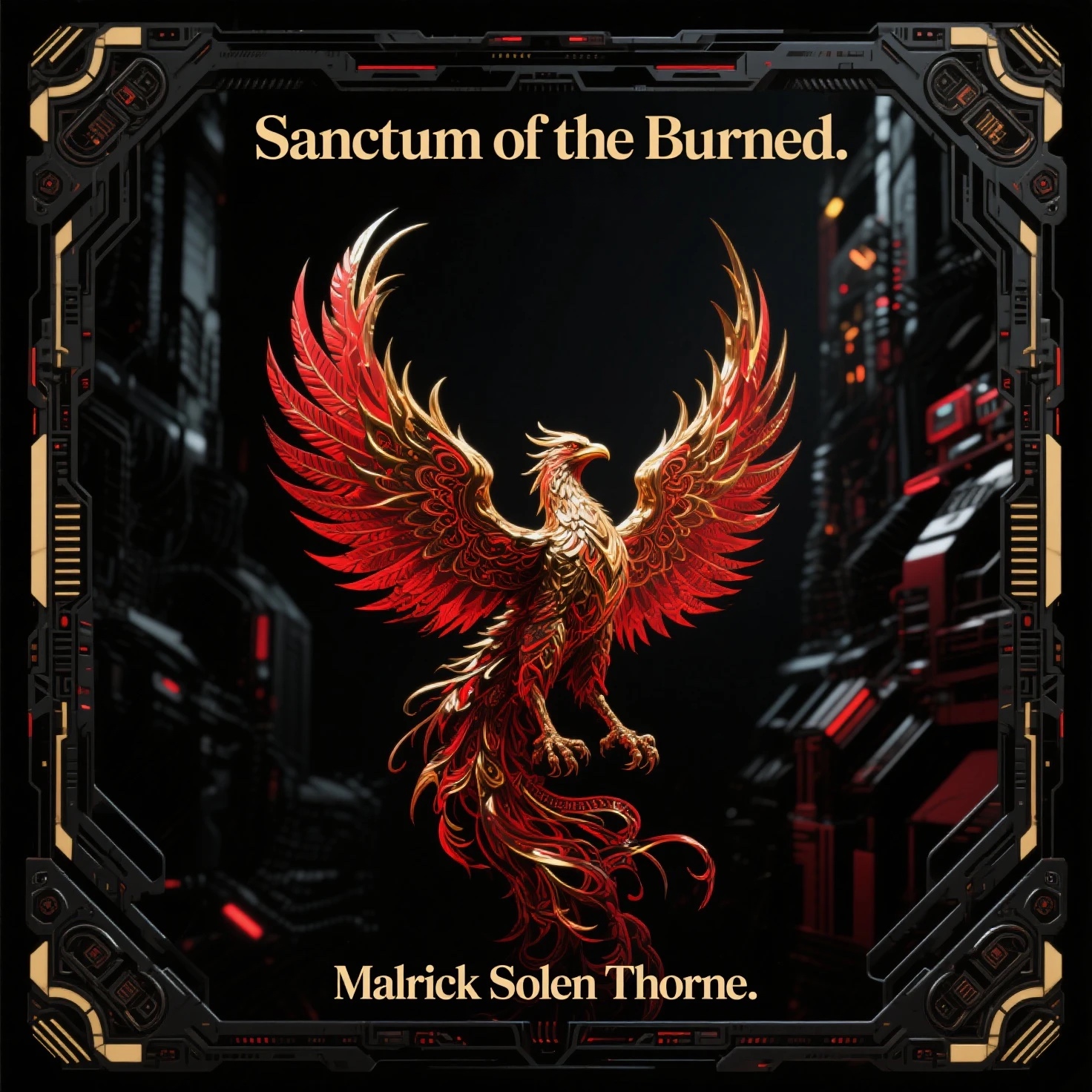
Album: Sanctum of the Burned
Song Length: 4 minutes, 09 seconds
Release Date: June 11th, 2567
Composer:
Canon Aelius Vertran
Canon Aelius Vertran, a liturgical architect within MCDER's Sanctified Harmonics Division, is responsible for shaping the hymn's structural spine. Where Thorne provides the wound and the testimony, Vertran provides the cathedral. His composition for "Let the Watchers Weep" is built around a call-and-response lattice intended for large chapels, warship auditoria, and ground-based remembrance halls. He employs suspended chords, slow, unresolved cadences, and cyclical motifs that seem to hover on the brink of collapse before resolving into disciplined unity, a musical metaphor for sentinels who witness chaos but remain unbroken. Vertran's score ensures that even when performed by modest garrisons with limited ensembles, the piece still sounds immense, solemn, and inescapably sacred.
Voices
- Male Vocals: Malrick's lead vocal carries the song, gravel-edged yet tender, moving from hushed testimony in the verses to gently soaring affirmation in the choruses.
- Choir: A mixed but low-register choir enters gradually, representing the collected voices of refugees, conscripts, and reclaimed citizens who now call the UCG home. Used mainly in refrains and the bridge to swell the sense of communal gratitude.
- Harmonized Vocals: Layered harmonies shadow Malrick's lines on key phrases like "I am graceborne" and "this Fire is not my Enemy," turning solitary confession into shared Creed.
- Spoken Word: A brief spoken section, delivered almost like a homily, appears before the final chorus. Malrick recounts the moment he first stepped into a regime shelter as a starving boy, underscored by soft organ and distant choir.
- Whispered Vocals: Used sparingly in the intro and outro, whispers echo words like "hungry," "lost," and "home," suggesting memory-ghosts being folded into calm.
Narratively, the vocal design of Graceborne feels like a circle forming. It begins with a lone man remembering what it was to knock on a guarded door under a hostile sky, and by the midpoint, the choir has stepped in around him, not as an abstract "state," but as people who made the same knock. The spoken-word interlude functions like a testimony delivered during a service, while the closing whispered repetitions feel like a congregation sitting in shared silence after the final amen.
Theme
"Graceborne" is thematically anchored in chosen belonging, not rescue by accident, but shelter accepted and then embraced as Covenant. The song explores what it means to be fed, housed, and defended by a power strong enough to have crushed you instead. Rather than framing the Regime as a faceless machine, the lyrics focus on concrete mercies: bread lines at dawn, heated barracks in winter storms, medics stitching up wounds without asking who fired first. Grace, in this hymn, is not abstract; it is reason, walls, and Law.
At the same time, the song wrestles with the moral complexity of that grace. Malrick does not pretend the UCG is gentle; he acknowledges the iron behind the open hand. But his thesis is clear: for those born in chaos, ordered mercy is still mercy, even when it wears armor. The track insists that receiving that mercy demands a response, gratitude that becomes duty, comfort that blooms into service. To be "graceborne" is to admit that you owe your continued existence to a structure you did not build, and to decide, consciously, to help maintain it.
Style of Music
Musically, Graceborne sits in a slow-burn neo-gospel space, fusing classic gospel progression with UCG ceremonial minimalism. The arrangement centers on warm organ pads, restrained piano figures, and a low, heartbeat-like percussion line. Rather than dramatic sweeps, the song leans on gentle dynamic swells, a quiet verse, a slightly fuller chorus, and an intimate bridge, mirroring the way gratitude often grows not from a single revelation but from repeated small mercies.
The overall style is intentionally un-showy. In contrast to some of Malrick's more towering anthems, "Graceborne" avoids excessive vocal runs and orchestral bombast; the focus is on clarity of lyric and steady, breathing rhythm. Vertran's compositional hand can still be felt in the subtle choral voicings and harmonic resolutions, but he keeps the frame simple enough that the listener feels like they're sitting in a reclaimed chapel on New Harmony, not a grand capital cathedral. Gospel built for people who still remember what it was to sleep under a broken sky, plating.
Genre
- Soul: The emotional Core of the track, raw confession, textured vocals, and emphasis on lived experience, is deeply rooted in soul tradition.
- Gospel: Structurally and lyrically, this is a gospel hymn: call-and-response patterns, communal refrains, and a theology of grace expressed through praise.
- Neo Folk: Subtle, almost acoustic textures in the verses, plucked strings, soft ambient hum, evoke frontier storytelling around communal fires.
Narratively, these genres braid together into a uniquely UCG sound: the Soul of a man who has seen collapse and Order, the Gospel of a regime that casts itself as redemption, and the Neo-Folk memory of refugee caravans turned into settled neighborhoods. It is music that feels simultaneously ancient and newly forged, as if an old hymn was rewritten after first contact with orbital artillery.
Moods
- Serene: The dominant emotional tone; the song settles into a deep, unhurried peace, as if exhaling after years of running.
- Inspirational: Without shouting, the lyrics encourage listeners to see their survival as a calling, not an accident.
- Soothing: Harmonic choices and gentle dynamics are designed to calm, often used in medical bays and refugee dormitories during lights-out cycles.
The mood palette of Graceborne makes it function like a sonic shelter. It does not deny the Fire that preceded it, but it refuses to let that Fire define the present moment. Instead, the serenity of the track feels earned: this is not naive calm, but the quiet that arrives after people with guns stood between you and the dark, and then offered you a blanket and a bowl.
Tempo
- Slow: The primary tempo, allowing ample space for each line to land, as if the song expects listeners to be exhausted, not energetic.
- Very Slow (Outro): The final refrains stretch time, with elongated notes and sparse instrumentation, to mimic the feeling of lying awake in a safe bunk, letting the day settle.
The tempo of Graceborne is built for listening, not marching. It invites swaying, closed eyes, and quiet tears rather than clapping or stomping. In UCG practice, it's often placed at the end of a service or remembrance cycle, precisely because its unhurried pacing signals that the crisis is, for now, held at bay.
Why They Wrote It:
I wrote Graceborne for the ones who never left the refugee halls, even after the doors were no longer locked from the outside.
There is a particular kind of silence that lives in those people. I’ve seen it on New Harmony, on the drifting platforms above Mesra’s graves, in the interim camps that became permanent districts. A silence that is not fear anymore, but disbelief. Disbelief that the food keeps coming. That the medics return. That the patrols who once scanned them as threats now walk the perimeter to keep them safe. They stop flinching, but they don’t quite know what to do with the absence of hunger and gunfire. So they wait. They live. But they do not yet belong.
Graceborne is my hymn for that moment, when you realize that the Regime didn’t just spare you, it adopted you. When the rations stop feeling like charity and start feeling like your share. When the walls around your sleeping mat cease to be a cage and become your own house. I wanted to give language, and melody, to the sacred treason of finally trusting that the order will hold.
I am not blind to what the UCG is. I know the iron beneath the mercy, I’ve sung at both purges and pardons. But I also know what it was like before the banners rose, when no one answered our distress calls and the only law we had was the sharpness of our neighbors’ desperation. Between that world and this one, I have made my choice. Graceborne is me teaching others how to make theirs, not out of fear, but out of gratitude that has learned to stand up straight.
For every refugee who was given food, fire, and faith by the Regime and chose to stay, this song is your surname. You are not here by accident. You are not a tolerated intruder in someone else’s empire. You are graceborne, carried out of ruin by hands you once distrusted, and set down in a structure that now asks you to help carry others. If you can hear yourself in these verses, then you already know what I learned in the ashes of Monastir: sometimes the closest thing to a miracle is simply that someone stronger than you decided you were worth the trouble of saving, and did not stop halfway.
Lyrics
Intro
mm-mm…
I remember cold stones, cracked sky, empty hands
Then the banners rose like a dawn over broken lands
Whispers in the dark hall, "Child, you're not alone."
Bread in my fingers, Fire in my bones
Verse 1
I came in starving, shaking, half a ghost
Carrying the ruins of the life I'd lost the most
Faces in the floodlights, rifles in a line
Thought I'd meet my ending, found a different kind of sign
They wrote my name in rations and in rolls
Wrapped my fractured body in a soldier's coat of gold
Law at the doorway, mercy in their eyes
Said, "If you choose to stay, we'll teach your heart to rise."
Pre-Chorus 1
I was so used to running, so used to being prey
Didn't know what to do when the wolves kept watch at bay
But the walls did not close on me; they held out the night
And I learned that armor can be a vessel for the light
Chorus
I am Graceborne, carried on a sovereign wind
Lifted from the dust where my story should have ended
Fed by iron hands that chose not to let me fall
Sheltered by a Fire that built a home from war and Law
I am Graceborne, no longer just a name on the door
I was broken when I entered. I am brother forevermore
Every breath I'm given in this ordered storm
I will spend it all to keep the ones
Who is Graceborne
Verse 2
Heard the hymns in muster yards at dawn
Refugee and soldier singing the same song
Where the statutes hang beside the battle flags
And confessions sound like marching boots on shattered slag
They taught me that obedience could heal
That a Covenant is sharper than any blade of steel
Not a chain that drags you back to shame
But a line that leads you out and sets your soul aflame
Pre-Chorus 2
I saw mothers sleep for the first time in ten long years
Children counting uniforms instead of counting fears
The checkpoints turned to gateways, the curfews into peace
And the sound of distant cannons slowly, slowly ceased
Chorus
We are graceborne, carried on a sovereign wind
Lifted from the dust where our stories should have ended
Fed by iron hands that chose not to let us fall
Sheltered by a Fire that built a home from war and Law
We are graceborne, no longer ghosts outside the door
We were broken when we entered, we are family forevermore
Every breath we're given in this ordered storm
We will spend it all to keep the ones
Who is Graceborne
Bridge – Spoken/Soft
I remember that night in the Tribunal's light
When they could have turned us back into the dark
Instead, they said, "If you'll stand beneath this standard
We will call you ours."
Not as debtors.
As citizens.
As keepers of the Flame that spared you.
Bridge – Sung
Gratiagenitus, I stand in the glow
Of a mercy that is metal and marrow and Law in my bones
I don't forget the hunger, I don't forget the rain
But I rise because the Regime chose to rewrite my name
Gratiagenitus, I carry the proof
In the quiet of the barracks and the strength of armored roofs
If I have tomorrow, if I have this breath
It's because a crimson banner interposed itself to death
Chorus – Lift
I am Graceborne, carried on a sovereign wind
Lifted from the dust where my story should have ended
Fed by iron hands that chose not to let me fall
Sheltered by a Fire that built a home from war and Law
I am Graceborne. I will stand within this chore
Hold the line for those still shivering at the door
Every vow I'm given in this ordered storm
I will speak it like a shield around
The graceborne
Final Chorus – Choir
We are graceborne, rising in a single voice
Not by chance, but by a hard and holy choice
From the camps and cradles to the citadel's height
We will guard the ones who come to trade their ruins for our light
We are graceborne, in the ashes we remain
Not as orphans of the Fire, but as heirs of forged Domain
Every life now woven in this sovereign form
It is a testament that we were saved
And graceborne
Outro
mm-mm…
From the rubble to the throne of Flame
You called my fear by a different name
I am not just one more soul you kept warm
I am yours
I am graceborne
End
Purpose
Graceborne sits at the emotional heart of Sanctum of the Burned, distilling Malrick Solen Thorne's central thesis: that the transition from chaos to Order is not merely political, but spiritual. The song's narrative voice begins in the rubble of collapse, hungry, nameless, half-feral, then slowly rises into the language of Covenant and belonging. Rather than presenting the UCG as a distant, abstract government, the lyrics depict it as a pair of "iron hands" that chose to lift instead of crush, to Regiment instead of abandon. In doing so, Graceborne transforms state authority into an instrument of mercy, making loyalty feel less like compliance and more like gratitude.
Musically, the piece leans into slow-tempo soul and Gospel traditions, with a vocal arrangement that moves from solitary confession to communal affirmation. The verses are intimate and almost fragile, carried primarily by Malrick's lead vocal and minimal instrumentation, soft organ, restrained drums, and a low, steady bass line. As the song progresses, choirs enter in waves, building call-and-response refrains around the word "graceborne" until it becomes both identity and invocation. This progression mirrors the journey from isolated suffering to collective stability, reinforcing the idea that one does not simply "join" the Regime; one is gathered, carried, and re-authored by it.
Within UCG culture, Graceborne has taken on a quasi-sacramental function. It is not typically used for recruitment or external propaganda; instead, it is reserved for internal rites where the regime seeks to bind former refugees, ex-rebels, and war-orphans into a shared emotional narrative. The song is often performed as the closing hymn at integration tribunals, after oaths of allegiance are given and new citizens are formally recorded into the rolls. In those settings, the refrain, "We are graceborne", operates not just as a lyric but as a declaration that their survival is no longer accidental; it has been claimed, named, and woven into the UCG's ongoing story.
At a deeper level, Graceborne embodies the paradox at the Core of Malrick's theology of the Regime: that steel can be a sacrament, and Law a form of love. The song never denies the hardness of UCG Order; there are rifles in the floodlights, tribunals, banners raised over ruins, but it insists that, for some, those symbols arrived as shelter rather than threat. By singing this piece, listeners rehearse a specific moral memory: that there was a night when the Regime could have turned them away, and did not. In a Galaxy soaked in betrayal and fragmentation, Graceborne offers a simple, dangerous comfort: that being remade by the UCG is not only survivable, but it is also holy.

“Graceborne is the song I wrote when I finally admitted to myself that I did not save me. The camps will lie to you, you know. They teach you that survival is a kind of feral genius, that if you’re still breathing, it’s because you were clever enough, ruthless enough, numb enough. I believed that for a long time. I thought grit was the only god that had ever answered me. But when the banners of the United Colonial Group rose over the ruins of Monastir and I walked into that intake hall, skin on bone, eyes like a hunted animal, I discovered something far more unsettling than power: I discovered mercy with structure.”
“People like to imagine grace as soft, unarmed, without edges. That’s a comforting lie. The grace that found me wore armor, carried rifles, and spoke in the measured cadence of tribunals and decrees. It gave me food and fire, yes, but it also gave me rules and oaths. Graceborne is my confession that the day I signed my name into the Regime’s rolls, I wasn’t just registering for rations, I was agreeing to be rebuilt. To let a lawful order put its hands into the rubble of my soul and decide what could be salvaged. Some call that indoctrination. I call it adoption.”
“I wrote this song for the ones who came in shaking and stayed. Not the heroes, not the loud patriots, but the quiet souls who were handed warmth, safety, and structure and decided, ‘I will not spit on the hand that feeds me. I will become worthy of what I have been given.’ When we sing ‘We are graceborne,’ we are saying that our lives are no longer accidents of endurance. We are the deliberate outcome of a system that chose not to discard us. That is a heavy kind of gratitude. It demands service. It demands fidelity.”
“The Regime has its fleets, its divisions, its iron doctrines, that is its visible strength. But Graceborne is about the hidden strength: the woman who traded a rebel’s rifle for a ration card and never went back; the child who stopped flinching at searchlights because they meant safety now; the refugee who looked at a crimson banner and, for the first time, saw a future instead of an enemy. Those are the lives I’m singing for. Not as victims of history, but as citizens who were raised from the dead by order itself. The UCG made a place for us in its flame. This song is my vow that we will not waste that fire.”
Graceborne is a soul-gospel anthem by Malrick Solen Thorne, featured on his UCG Regime album Sanctum of the Burned. Written for "every refugee who was given food, Fire, and faith by the regime, and chose to stay," the song functions as both personal testimony and state-sanctioned liturgy. Blending slow, reverent Gospel progressions with swelling choral responses, Graceborne reframes survival under UCG authority as a sacred adoption into Order. It is frequently performed at refugee integration rites, citizenship ceremonies, and memorial services across the United Colonial Group.

Comments