
Skuthari
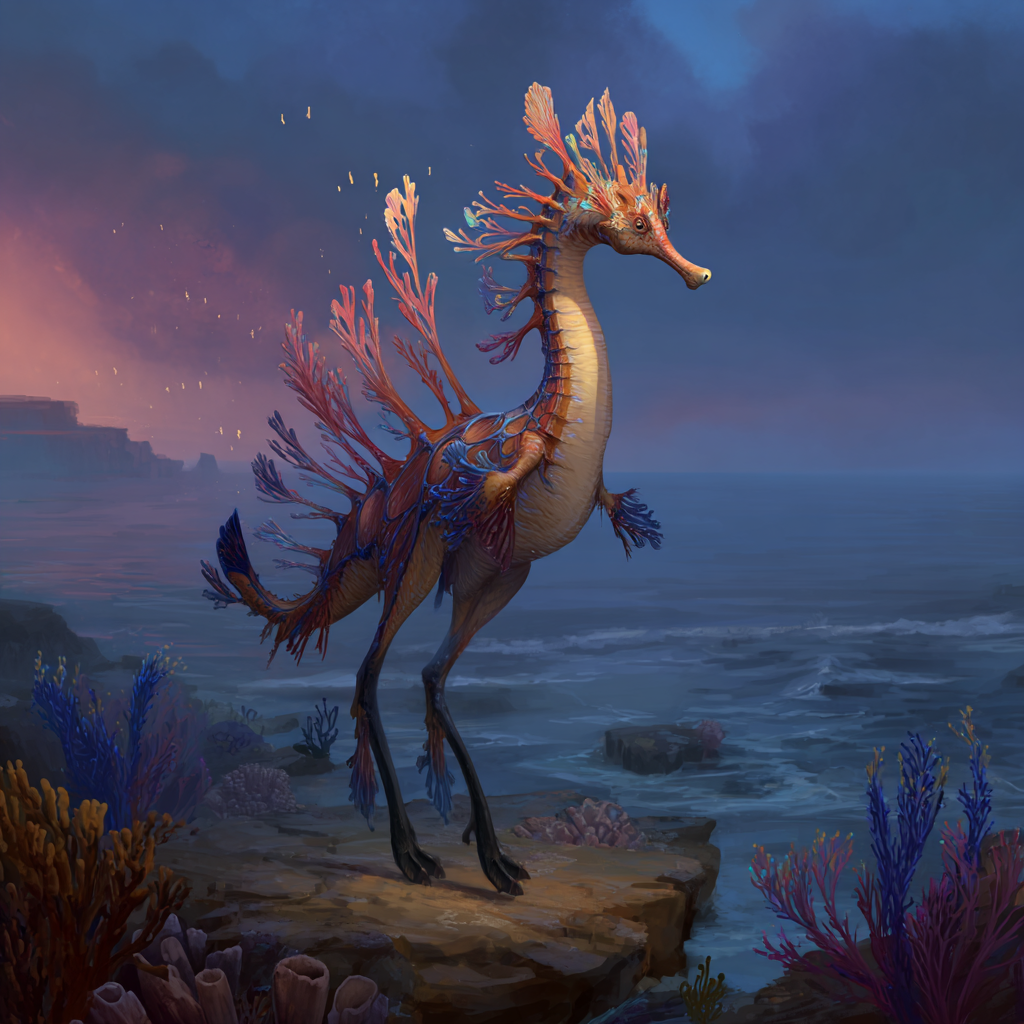
Skuthari—known to the Ar’Pata as “Tiderunners”—are swift, reef-adapted bipeds native to the coastal margins of the Ar'Pata Atoll. Built for speed and precision, they exhibit both terrestrial agility and, in rare cases, flight. Though largely solitary and untamed, skuthari possess notable cognitive acuity and may form bonds with individuals who earn their trust.
Basic Information
Anatomy
Lean and lithe, skuthari stand around 7 feet tall with a skeletal frame built for violent bursts of motion. Its hind legs are triple-jointed, its hooves split and ringed with spiked membranes for traction. Spine-plates along its back flare and flutter in response to sound and wind. The skull is long and sharp-faced—masklike, with seahorse curvature and flickering gill-fronds that do not breathe, but sense emotional shifts.
Some adults undergo a process called "unspooling," a physiological rupture that births fully formed wings—vast, jointed things of cartilage and glass-veined sail, spanning up to 20 feet tip to tip.
Ecology and Habitats
Skuthari live in tidal environments. Their nesting sites are usually hidden in grottos and caves.
Dietary Needs and Habits
Primarily opportunistic carnivores, Skuthari consume small shore animals, fish, and occasional plant matter. Notably, they exhibit a marked preference for vastbloom pods, which they open using precision strikes from their forelimbs. Ingestion is typically followed by heightened physical activity—pacing, shallow digging, or sprinting—which may indicate a stimulant or ritual response.
Biological Cycle
Skuthari are born in twos or threes. Within a tenday, they can sprint. At two years, they shed their juvenile fronds. Most reach full size by seven.
A handful, shaped by solitude, injury, or instinct, undergo "unspooling" and begin to grow the framework for flight. Not all survive this process.
Behaviour
Skuthari display solitary or loosely affiliative behavior, avoiding fixed social hierarchies. Interactions with other species are cautious and primarily observational, often involving prolonged mimicry and proximity testing. In rare instances, individuals may initiate a bond with a specific person. These relationships resemble those of cooperative travel companions—co-navigators rather than subordinates.
Geographic Distribution

Comments