

Bard
Overview
Whether scholar, skald, or scoundrel, a bard weaves magic through words and music to inspire allies, demoralize foes, manipulate minds, create illusions, and even heal wounds. Bards bring humor during grave times; they impart wisdom to offset ignorance; and they make the ridiculous seem majestic. Bards are preservers of ancient history, their songs and tales perpetuating the memory of great events down through time - knowledge so important that it is memorized and passed along as oral history, to survive even when no written record remains. It is also the bard's role to chronicle smaller and more contemporary events - the stories of today's heroes, including their feats of valor as well as their less than impressive failures. Of course, the world has many people who can carry a tune or tell a good story, and there's much more to any adventuring bard than a glib tongue and a melodious voice. Yet what truly sets bards apart from others - and from one another - are the style and substance of their performances. Bards hold a special place of responsibility and respect in Faerûn. They are bearers of news, gossip, and messages in their travels from place to place, in addition to being living storehouses of history and folklore. Bards know a great deal, and they tend to be willing to share what they know, or at least barter for it. The arrival of a renowned bard is a special occasion, akin to the visit of a dignitary. A bard can reasonably expect at least a hot supper and a clean place to sleep from a local landlord or inn in exchange for a few songs or stories. A noble might host a bard in fine style - while also being careful to guard any secrets the noble's household doesn't want retold or sung across Faerûn. Not all wandering performers are true bards, nor are all bards inclined to sing for their supper, although most will, given the need. Bards literally have magic to them, and the powers they command through their performance and lore earns them additional respect. In Faerûn, singers and storytellers called skalds are keepers of the history and great legends. These warrior-poets are the singers of the songs and sagas that fire the blood of warriors in battle, and composers of the new songs and sagas relating the mighty deeds of heroes and villains.Music and Magic
In Faerûn, words and music are not just vibrations of air, but vocalizations with power all their own. The bard is a master of song, speech, and the magic they contain. Bards say that the multiverse was spoken into existence, that the words of the gods gave it shape, and that echoes of these primordial Words of Creation still resound throughout the cosmos. The music of bards is an attempt to snatch and harness those echoes, subtly woven into their spells and powers. The greatest strength of bards is their sheer versatility. Many bards prefer to stick to the sidelines in combat, using their magic to inspire their allies and hinder their foes from a distance. But bards are capable of defending themselves in melee if necessary, using their magic to bolster their swords and armor. Their spells lean toward charms and illusions rather than blatantly destructive spells. They have a wide-ranging knowledge of many subjects and a natural aptitude that lets them do almost anything well. Bards become masters of the talents they set their minds to perfecting, from musical performance to esoteric knowledge.Learning From Experience
True bards are not common in the world. Not every minstrel singing in a tavern or jester cavorting in a royal court is a bard. Discovering the magic hidden in music requires hard study and some measure of natural talent that most musicians and poets lack. It can be hard to spot the difference between these performers and true bards, though. A bard’s life is spent wandering across the land gathering lore, telling stories, and living on the gratitude of audiences, much like any other entertainer. But a depth of knowledge, a level of musical skill, and a touch of magic set bards apart from their fellows. Only rarely do bards settle in one place for long, and their natural desire to travel - to find new tales to tell, new skills to learn, and new discoveries beyond the horizon - makes an adventuring career a natural calling. Every adventure is an opportunity to learn, practice a variety of skills, enter long-forgotten tombs, discover lost works of magic, decipher old tomes, travel to strange places, or encounter exotic creatures. Bards love to accompany heroes to witness their deeds firsthand. A bard who can tell an awe-inspiring story from personal experience earns renown among other bards. Indeed, after telling so many stories about heroes accomplishing mighty deeds, many bards take these themes to heart and assume heroic roles themselves.Defining Work
Every successful bard is renowned for at least one piece of performance art, typically a song or a poem that is popular with everyone who hears it. These performances are spoken about for years by those who view them, and some spectators have had their lives forever changed because of the experience.Instrument
In a bard's quest for the ultimate performance and the highest acclaim, one's instrument is at least as important as one's vocal ability. The instrument's quality of manufacture is a critical factor, of course; the best ones make the best music, and some bards are continually on the lookout for an improvement. Perhaps just as important, though, is the instrument's own entertainment value; those that are bizarrely constructed or made of exotic materials are likely to leave a lasting impression on an audience.Embarressment
The ways that a performance can go wrong are as varied as the fish in the sea. No matter what sort of disaster might occur, however, a bard has the courage and the confidence to rebound from it - either pressing on with the show (if possible) or promising to come back tomorrow with a new performance that's guaranteed to please.A Bard's Muse
Naturally, every bard has a repertoire of songs and stories. Some bards are generalists who can draw from a wide range of topics for each performance, and who take pride in their versatility. Others adopt a more personal approach to their art, driven by their attachment to a muse - a particular concept that inspires much of what those bards do in front of an audience. A bard who follows a muse generally does so to gain a deeper understanding of what that muse represents and how to best convey that understanding to others through performance.Class Features
As a bard, you gain the following class features.| Level | Bardic Die | Cantrips | Prepared Spells | 1st | 2nd | 3rd | 4th | 5th | 6th | 7th | 8th | 9th |
|---|---|---|---|---|---|---|---|---|---|---|---|---|
| 1st | 1d6 | 2 | 4 | 2 | - | - | - | - | - | - | - | - |
| 2nd | 1d6 | 2 | 5 | 3 | - | - | - | - | - | - | - | - |
| 3rd | 1d6 | 2 | 6 | 4 | 2 | - | - | - | - | - | - | - |
| 4th | 1d6 | 3 | 7 | 4 | 3 | - | - | - | - | - | - | - |
| 5th | 1d8 | 3 | 9 | 4 | 3 | 2 | - | - | - | - | - | - |
| 6th | 1d8 | 3 | 10 | 4 | 3 | 3 | - | - | - | - | - | - |
| 7th | 1d8 | 3 | 11 | 4 | 3 | 3 | 1 | - | - | - | - | - |
| 8th | 1d8 | 3 | 12 | 4 | 3 | 3 | 2 | - | - | - | - | - |
| 9th | 1d8 | 3 | 14 | 4 | 3 | 3 | 3 | 1 | - | - | - | - |
| 10th | 1d10 | 4 | 15 | 4 | 3 | 3 | 3 | 2 | - | - | - | - |
| 11th | 1d10 | 4 | 16 | 4 | 3 | 3 | 3 | 2 | 1 | - | - | - |
| 12th | 1d10 | 4 | 16 | 4 | 3 | 3 | 3 | 2 | 1 | - | - | - |
| 13th | 1d10 | 4 | 17 | 4 | 3 | 3 | 3 | 2 | 1 | 1 | - | - |
| 14th | 1d10 | 4 | 17 | 4 | 3 | 3 | 3 | 2 | 1 | 1 | - | - |
| 15th | 1d12 | 4 | 18 | 4 | 3 | 3 | 3 | 2 | 1 | 1 | 1 | - |
| 16th | 1d12 | 4 | 18 | 4 | 3 | 3 | 3 | 2 | 1 | 1 | 1 | - |
| 17th | 1d12 | 4 | 19 | 4 | 3 | 3 | 3 | 2 | 1 | 1 | 1 | 1 |
| 18th | 1d12 | 4 | 20 | 4 | 3 | 3 | 3 | 3 | 1 | 1 | 1 | 1 |
| 19th | 1d12 | 4 | 21 | 4 | 3 | 3 | 3 | 3 | 2 | 1 | 1 | 1 |
| 20th | 1d12 | 4 | 22 | 4 | 3 | 3 | 3 | 3 | 2 | 2 | 1 | 1 |
Hit Points
- Hit Dice: 1d8 per bard level
- Hit Points at 1st LeveI: 8 + your Constitution modifier
- Hit Points at Higher LeveIs: 1d8 (or 5) + your Constitution modifier per bard leveI after 1st
Proficiencies
- Armor: Light Armor
- Weapons: Simple Weapons, Hand Crossbows, Longswords, Rapiers, Shortswords
- Tools: Three musical instruments of your choice
- Saving Throws: Dexterity, Charisma
- Skills: Choose any three
Equipment
- A Rapier, Longsword, or any Simple Weapon
- A diplomat's pack or an entertainer's pack
- Leather Armor, a Dagger, and any musical instrument
1st Level - Bardic Inspiration
You can supernaturally inspire others through words, music, or dance. This inspiration is represented by your Bardic Inspiration die, which is a d6. Using Bardic Inspiration. As a Bonus Action, you can inspire another creature within 60 feet of yourself who can see or hear you. That creature gains one of your Bardic Inspiration dice. A creature can have only one Bardic Inspiration die at a time.Once within the next hour when the creature fails a D20 Test, the creature can roll the Bardic Inspiration die and add the number rolled to the d20, potentially turning the failure into a success. A Bardic Inspiration die is expended when it's rolled.
Number of Uses. You can confer a Bardic Inspiration die a number of times equal to your Charisma modifier (minimum of once), and you regain all expended uses when you finish a Long Rest.
At Higher Levels. Your Bardic Inspiration die changes when you reach certain Bard levels, as shown in the Bardic Die column of the Bard Features table. The die becomes a d8 at level 5, a d10 at level 10, and a d12 at level 15.
1st Level - Spellcasting
You have learned to cast spells through your bardic arts. The information below details how you use those rules with Bard spells, which appear in the Bard spell list later in the class's description.Cantrips
You know two cantrips of your choice from the Bard spell list.Whenever you gain a Bard level, you can replace one of your cantrips with another cantrip of your choice from the Bard spell list.
When you reach Bard levels 4 and 10, you learn another cantrip of your choice from the Bard spell list, as shown in the Cantrips column of the Bard Features table.
Spell Slots
The Bard Features table shows how many spell slots you have to cast your level 1+ spells. You regain all expended slots when you finish a Long Rest.Prepared Spells of Level 1+
You prepare the list of level 1+ spells that are available for you to cast with this feature. To start, choose four level 1 spells from the Bard spell list. The number of spells on your list increases as you gain Bard levels, as shown in the Prepared Spells column of the Bard Features table. Whenever that number increases, choose additional spells from the Bard spell list until the number of spells on your list matches the number on the table. The chosen spells must be of a level for which you have spell slots. For example, if you're a level 3 Bard, your list of prepared spells can include six spells of levels 1 and 2 in any combination.If another Bard feature gives you spells that you always have prepared, those spells don't count against the number of spells you can prepare with this feature, but those spells otherwise count as Bard spells for you.
Changing Your Prepared Spells
Whenever you gain a Bard level, you can replace one spell on your list with another Bard spell for which you have spell slots.Spellcasting Ability
Charisma is your spellcasting ability for your Bard spells.Spellcasting Focus.
You can use a Musical Instrument as a Spellcasting Focus for your Bard spells.2nd Level - Expertise
You gain Expertise in two of your skill proficiencies of your choice. At Bard level 9, you gain Expertise in two more of your skill proficiencies of your choice.2nd Level - Jack of All Trades
You can add half your Proficiency Bonus (round down) to any ability check you make that uses a skill proficiency you lack and that doesn't otherwise use your Proficiency Bonus. For example, if you make a Strength (Athletics) check and lack Athletics proficiency, you can add half your Proficiency Bonus to the check.A Bard's Repertoire
Does your Bard beat a drum while chanting the deeds of ancient heroes? Strum a lute while crooning romantic tunes? Perform arias of stirring power? Recite dramatic monologues from classic tragedies? Use the rhythm of a folk dance to coordinate the movement of allies in battle? Compose naughty limericks? When you play a Bard, consider the style of artistic performance you favor, the moods you might invoke, and the themes that inspire your own creations. Are your poems inspired by moments of natural beauty, or are they brooding reflections on loss? Do you prefer lofty hymns or rowdy tavern songs? Are you drawn to laments for the fallen or celebrations of joy? Do you dance merry jigs or perform elaborate interpretive choreography? Do you focus on one style of performance or strive to master them all?
2nd Level - Song of Rest
You can use soothing music or oration to help revitalize your wounded allies during a short rest. If you or any friendly creatures who can hear your performance regain hit points at the end of the short rest, each of those creatures regains extra hit points, equal to a roll of your Bardic Inspiration Die.3rd Level - Bard College
The way of a bard is gregarious. Bards seek each other out to swap songs and stories, boast of their accomplishments, and share their knowledge. Bards form loose associations and study certain aspects of their craft, which they call focuses, to facilitate their gatherings and preserve their traditions. At 3rd level, you delve into the advanced techniques of a bard focus of your choice. Your choice grants you features at 3rd level and again at 6th and 14th level.4th Level - Ability Score Improvement
When you reach 4th level, you can increase one ability score of your choice by 2, or you can increase two ability scores of your choice by 1. As normal, you can't increase an ability score above 20 using this feature. or you can choose another feat of your choice for which you qualify. You gain this feature again at Wizard levels 8, 12, and 16.5th Level - Font of Inspiration
You now regain all your expended uses of Bardic Inspiration when you finish a Short or Long Rest. In addition, you can expend a spell slot (no action required) to regain one expended use of Bardic Inspiration.6th Level - Bard College feature
At 6th level, you gain a feature from your Bard College.7th Level - Countercharm
You can use musical notes or words of power to disrupt mind-influencing effects. If you or a creature within 30 feet of you fails a saving throw against an effect that applies the Charmed or Frightened condition, you can take a Reaction to cause the save to be rerolled, and the new roll has Advantage.8th Level - Ability Score Improvement
You gain the Ability Score Improvement Feat or another feat of your choice for which you qualify.9th Level - Expertise
You gain Expertise in two of your Skill Proficiencies of your choice.10th Level - Magical Secrets
You've learned secrets from various magical traditions. Whenever you reach a Bard level (including this level) and the Prepared Spells number in the Bard Features table increases, you can choose any of your new prepared spells from the Bard, Cleric, Druid, and Wizard spell lists, and the chosen spells count as Bard spells for you (see a class's section for its spell list). In addition, whenever you replace a spell prepared for this class, you can replace it with a spell from those lists.12th Level - Ability Score Improvement
You gain the Ability Score Improvement Feat or another feat of your choice for which you qualify.14th Level - Bard College feature
At 6th level, you gain a feature from your Bard College.16th Level - Ability Score Improvement
You gain the Ability Score Improvement Feat or another feat of your choice for which you qualify.18th Level - Superior Inspiration
When you roll Initiative, you regain expended uses of Bardic Inspiration until you have two if you have fewer than that.19th Level - Epic Boon
You gain an Epic Boon feat or another feat of your choice for which you qualify. Boon of Spell Recall is recommended.20th Level - Words of Creation
You have mastered two of the Words of Creation: the words of life and death. You therefore always have the Power Word Heal and Power Word Kill spells prepared. When you cast either spell, you can target a second creature with it if that creature is within 10 feet of the first target.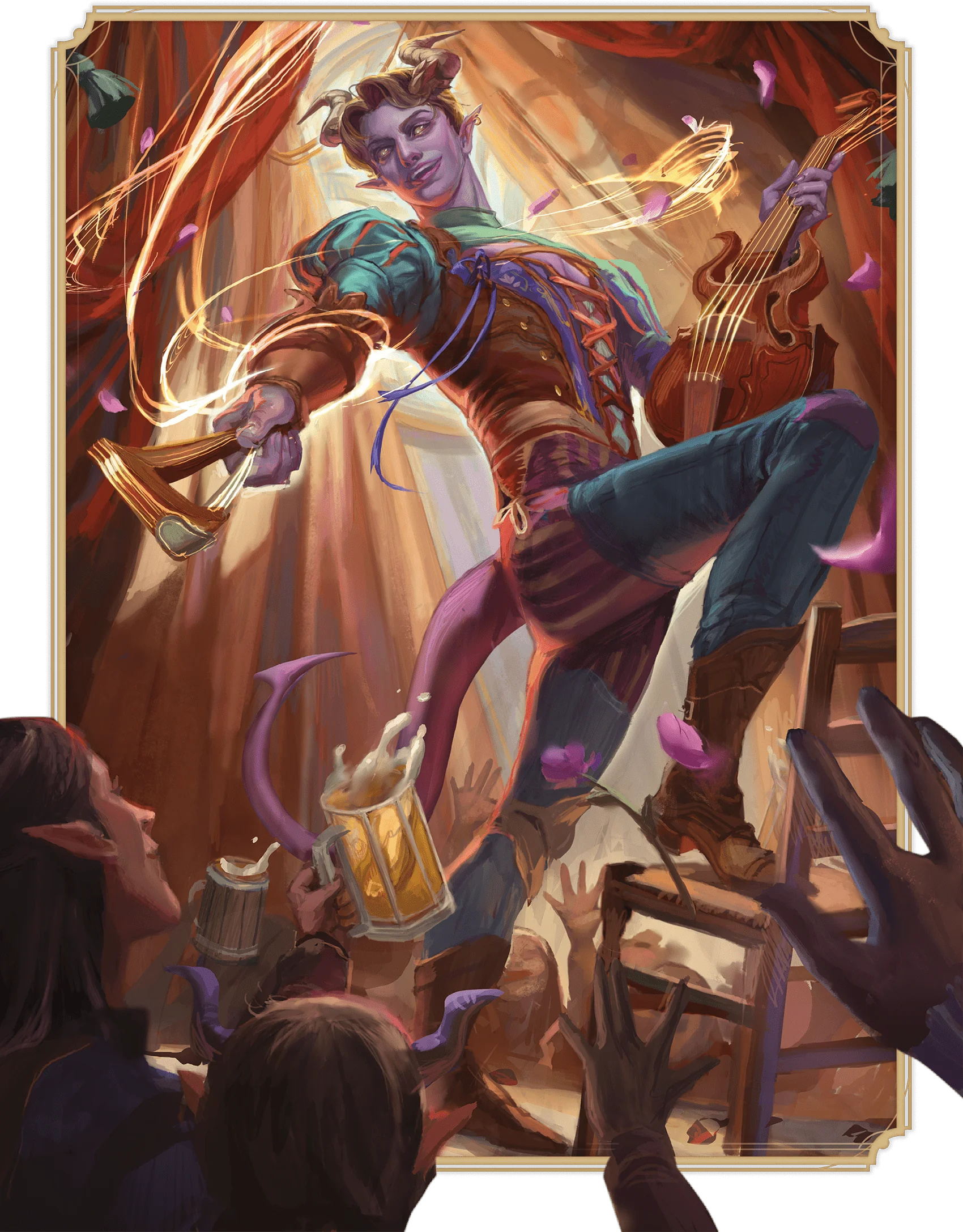
by Evyn Fong

| Level | Features |
|---|---|
| 1st | Bardic Inspiration, Spellcasting |
| 2nd | Expertise, Jack of All Trades, Song of Rest |
| 3rd | Bard College |
| 4th | Ability Score Improvement |
| 5th | Font of Inspiration |
| 6th | Bard College feature |
| 7th | Countercharm |
| 8th | Ability Score Improvement |
| 9th | Expertise |
| 10th | Magical Secrets |
| 11th | — |
| 12th | Ability Score Improvement |
| 13th | — |
| 14th | Bard College feature |
| 15th | — |
| 16th | Ability Score Improvement |
| 17th | — |
| 18th | Superior Inspiration |
| 19th | Epic Boon |
| 20th | Words of Creation |

Comments