

The Hammerfall Misunderstanding
“No war has ever come closer to starting over nothing at all.”
The Hammerfall Misunderstanding began as little more than an awkward dispute over brightly painted Imperial survey markers. A geological team, following standard procedure, placed their wooden stakes across the slopes of the Hammerfall Foothills during Aureath, the bright high-summer month whose clear skies made surveying ideal. Unbeknownst to them, the Dwarrow Clans had recently vacated these same grounds after a tunnel collapse and fully intended to return to assess the damage. To the Dwarrow, the sudden appearance of foreign markers arranged in neat geometric lines looked unmistakably like a bold and insulting Imperial attempt to claim ancestral territory. To the Imperials, the Dwarrow’s furious reaction seemed wildly disproportionate.
The misunderstanding escalated with remarkable speed. A brief skirmish broke out between the surveyors and a Dwarrow mining party, resulting in no deaths but plenty of bruises, snapped tools, and wounded pride. Within days, Imperial cohorts and Dwarrow mining-companies alike were marching toward the same unremarkable hill — a patch of land neither civilisation actually desired — raising the spectre of a full-scale war in 7 NE, sparked by an argument over painted stakes.
As tensions peaked and soldiers stood ready to fight, catastrophe was averted not by generals, senators, or diplomats, but by a trader.
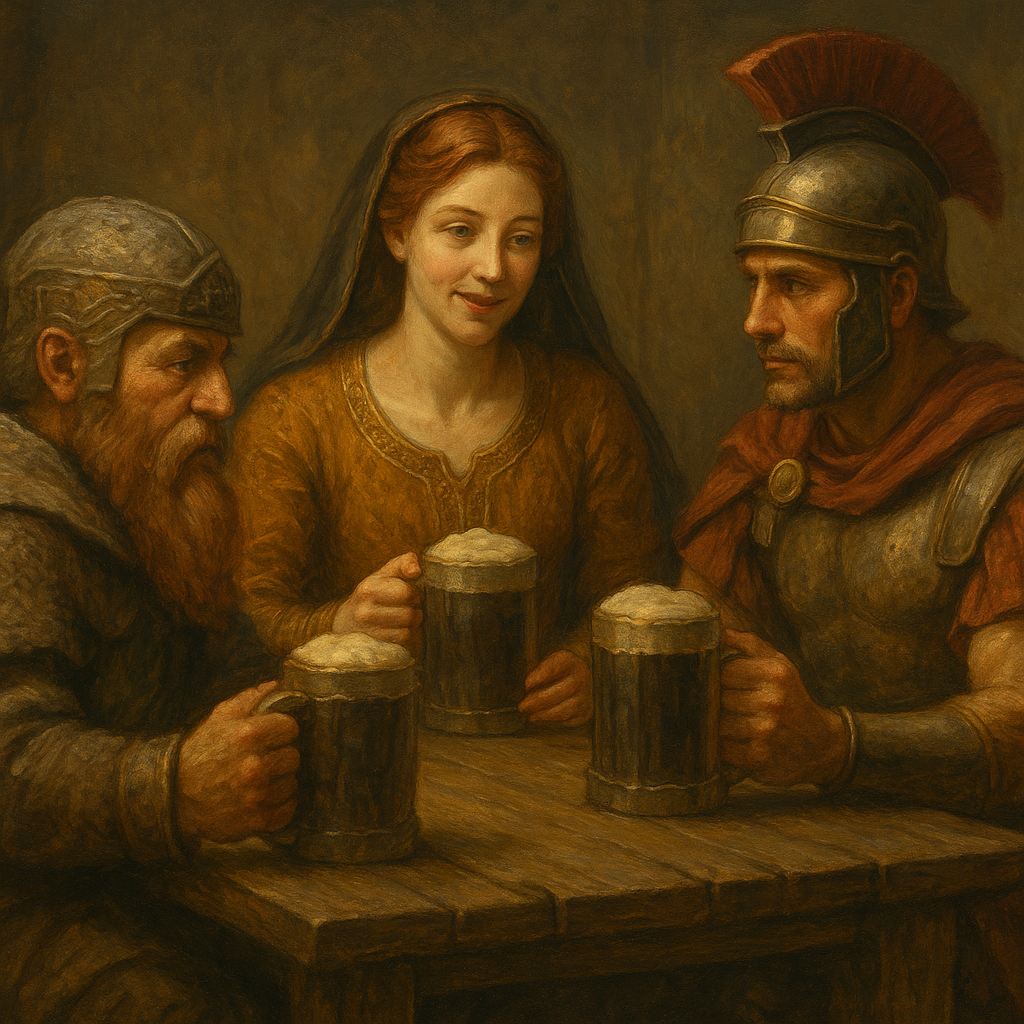
Marena Lyr, a seasoned merchant whose long dealings with the Dwarrow had earned her trust across the Ironspine, arrived at the standoff before blades were drawn in earnest. Fluent in multiple Dwarrow dialects and utterly unawed by military bluster, she convinced both sides to lower their weapons long enough to share a table — and two stout mugs of fine Dwarven ale. There, over foam and frustration, the truth emerged with disarming clarity: no one had intended to claim anything at all.
Her intervention dissolved the crisis entirely and transformed a potential war into the first meaningful step toward an enduring partnership. Recognised by both Emperor Cassian I and the High Thane of the Ironspine, Marena was appointed Imperial Envoy to the Dwarrow — the first human to hold the title — and later played a central role in forging the Pact of Iron & Stone, which cemented the ongoing alliance and friendship between the two realms.
What began as a near-farcical misunderstanding over survey markers ultimately reshaped the political landscape of the early Imperium — not through might, but through wit, diplomacy, and the timely courage of a single trader.
The Conflict
Prelude
In the seventh year of the Imperium’s presence in Exilum Novum, the Empire’s frontier mapping and resource cataloguing efforts reached the Hammerfall Foothills. The region was considered neutral ground — rugged, mineral-poor, and of little strategic value — making it an ideal location for routine geological surveying. Imperial engineers, following long-established procedure, placed brightly painted wooden stakes across the ridge during Aureath, their positions marking nothing more contentious than fault lines and potential aqueduct routes.
The timing, however, could not have been worse. Only weeks earlier, the Dwarrow Clans of the Ironspine had withdrawn from the same foothills following a tunnel collapse. Their own intention was to return and assess the damage once the tremors subsided. What they discovered instead were neat rows of foreign markers, arranged in geometric configurations that — in Dwarrow tradition — signified an official declaration of territorial interest.
To the Dwarrow, it appeared the Imperium had attempted to claim land with the subtlety of a hammer blow. To the Imperials, the Dwarrow’s anger seemed entirely irrational. Both sides believed themselves the aggrieved party, and both were too proud, too certain, and too unfamiliar with one another’s customs to consider that a misunderstanding was even possible.
Mistranslated messages only deepened the confusion. The Dwarrow demanded an explanation for the “Boundary Stakes of Claim,” a phrase which the Imperial scribe misinterpreted as a complaint about taxation boundaries. The Imperials sent back a courteous clarification that the “markers were temporary,” which a Dwarrow interpreter read as “claims are provisional until enforced.”
By the time miners and surveyors confronted one another on the ridge, tempers were primed and patience thin. Harsh words turned swiftly to thrown rocks, and thrown rocks escalated into a brief but spirited skirmish that left several bruised bodies and a thoroughly shattered crate of survey stakes.
It was a small incident, insignificant in outcome — yet it set into motion a chain of escalating responses that would draw soldiers toward the foothills, alarm both governments, and bring two realms to the brink of a war no one intended to fight.
Deployment
The deployments that followed the initial skirmish were marked less by military necessity and more by the momentum of mutual misunderstanding. Both the Imperium and the Dwarrow believed they were responding with measured prudence, yet from the outside their actions resembled two oblivious giants stepping onto the same narrow bridge.
Imperial Deployment
The Imperium’s first response was to send a reinforced engineering cohort to “clarify the situation,” accompanied by a vexillation of legionaries whose presence was intended to reassure the surveyors. Unfortunately, nothing reassures a Dwarrow less than the sudden appearance of armed humans on their doorstep.
The Imperial force was modest by legionary standards — a few dozen engineers with equipment carts, a detachment of soldiers in light marching armour, and an overly confident tribune who assumed the dispute revolved around taxation or boundary tariffs. They established a camp at the base of Survey Hill, raised a banner to signal neutrality, and proceeded to prepare for what they expected would be an afternoon of calm discussion.
Dwarrow Deployment
The Dwarrow response, by contrast, was swift and highly symbolic. Three mining-companies marched out from the Ironspine, not as miners but as a fully armed tunnel-shield formation. Though small in number, their heavy armour, rune-etched shields, and uncompromising posture conveyed unmistakably that the Hammerfall corridor was not to be trifled with.
Behind them came a contingent of rune-inspectors and boundary wardens whose mere presence suggested that the Dwarrow were preparing to file formal grievances of a very grave nature — in Dwarrow law, the deployment of rune-inspectors is often a precursor to declaring a formal territorial contest.
Mutual Escalation
Both sides interpreted the other’s arrival as an escalation.
Both sides insisted their arrival was merely precautionary.
Both sides were wrong.
Within a day, the foothills hosted two increasingly nervous armies standing within shouting distance, each convinced the other was on the verge of doing something reckless. Messages continued to be mistranslated, political leaders became entangled in competing interpretations of the same events, and minor gestures — a raised banner, a repositioned shield-wall, a move to fetch surveying tools — were repeatedly mistaken for provocations.
By the time Marena Lyr arrived, both deployments were teetering on the edge of becoming a conflict neither side had intended to start.
Battlefield
The so-called “battlefield” of the Hammerfall Misunderstanding is remembered with far more drama in later retellings than its geography ever warranted. Survey Hill, the focal point of the crisis, was an unimpressive rise of weathered stone and scrub brush situated at the edge of the Hammerfall Foothills. It commanded no trade routes, protected no mineral-rich seams, and offered no tactical advantage beyond being the only hill visible for several leagues — a feature that unfortunately made it both easy to mark and easy to misinterpret.
To the Imperials, the location was simply a convenient place to plant survey stakes where the ground was stable enough to take measurements. To the Dwarrow, it lay along an ancestral corridor of movement between the upper tunnels and the surface — not sacred, but unquestionably theirs by tradition. The land’s insignificance only deepened the eventual mockery that historians would heap upon the crisis: two realms nearly went to war over a hill so devoid of value that neither side had bothered mapping it before.
The surrounding terrain did little to ease tensions. The foothills were riddled with the remnants of old Dwarrow mining shafts, some collapsed, others partially filled with rubble. These cavities, hidden beneath thin crusts of soil, made maneuvering difficult and contributed to several false alarms when Imperial soldiers or carts set the ground trembling. Sparse vegetation offered little cover, meaning every movement could be seen — and misinterpreted — from the opposing camp.
A shallow valley between the two groups became an accidental no-man’s-land, not through negotiation but through the simple fact that neither side wished to be the first to walk into the middle and risk looking aggressive. For several days, the valley echoed with shouted messages, confused translators, and the occasional clatter of falling stones mistaken for hostile intent.
In truth, Survey Hill bore witness to more tension than violence. Yet its barren slopes became etched into the shared memory of both peoples as the place where a misunderstanding nearly ignited a war — and where wisdom, remarkably, arrived just in time.
Conditions
The Hammerfall Foothills in Aureath are notoriously unpleasant, a fact which did little to soothe tempers as the crisis unfolded. The high-summer heat settled heavily over the rocky slopes, turning armour into ovens and tempers brittle. Imperial soldiers complained that even their cloaks felt aggressive. The Dwarrow, accustomed to the cool depths of the Ironspine, fared no better; more than one boundary warden later admitted that the glare of the sun was nearly as irritating as the perceived territorial intrusion.
Dust storms from recent seismic activity swept intermittently across the foothills, obscuring vision and banners alike. One such storm famously caused an Imperial signal-cloth to whip free of its pole, prompting a Dwarrow shield-line to brace for an attack that never came. These sudden gusts also played havoc with spoken communication, scattering shouted explanations into the wind and contributing to the increasingly surreal web of mistranslation.
The ground itself proved treacherous. Old, partially collapsed mining tunnels had left hollow pockets beneath the surface, and several startled Imperials found their boots sinking unexpectedly into soft earth. Each such incident triggered an instinctive response from the Dwarrow, who mistook the tremors for deliberate attempts at tunnelling. The Imperials, in turn, misinterpreted the Dwarrow’s sudden defensive posturing as further escalation.
Water was scarce, shade scarcer still. Both camps erected makeshift awnings and tents, but the exposed terrain offered little relief. Fatigue simmered beneath every exchange, and the oppressive heat lent urgency to decisions that should have been approached with patience.
In short, the conditions at Survey Hill were perfectly suited to turning a small misunderstanding into a full diplomatic crisis — a volatile blend of scorching weather, unstable ground, and two peoples unused to reading one another’s cues. It is little wonder that the arrival of a single trader with ale, shade, and common sense proved so disarming.
The Engagement
Despite its dramatic reputation, the Hammerfall Misunderstanding produced only one true engagement — and even that could generously be described as a brief and undignified scuffle. Yet this single spark was enough to ignite a chain of escalating responses on both sides.
The initial clash occurred when the Imperial survey team returned to Survey Hill to continue their measurements, entirely unaware that their markers had been interpreted as territorial claims. They arrived to find a Dwarrow mining party waiting for them: shields planted, brows furrowed, and the shattered remains of the brightly painted stakes piled accusingly at the foreman’s feet.
The Imperials attempted to explain. The Dwarrow attempted to refute. Both sides raised their voices. No side understood the other.
Accounts differ on who threw the first object, but consensus holds that a rock — or possibly a survey hammer — sailed across the gap, followed swiftly by several more. The skirmish lasted less than two minutes. A few Imperials were knocked off their feet, one Dwarrow received a black eye, and a crate of precision measuring rods was trampled beyond recognition. When the dust settled, the only real casualty was the survey team’s dignity.
Yet news of the encounter spread with alarming speed and spectacular distortion.
By the time word reached the nearest Imperial outpost, the surveyors claimed they had been “ambushed,” while Dwarrow messengers reported a “hostile attempt to replant boundary stakes under armed escort.” Each retelling grew more dramatic, more accusatory, and more certain that the other party had acted in calculated bad faith.
When the Imperial reinforcements arrived, the Dwarrow perceived their presence as confirmation of an attempted land grab. When the Dwarrow mining-companies marched out in full formation to meet them, the Imperials interpreted it as mobilization for war. Both sides, standing within shouting distance, believed the other had arrived with aggression in mind.
The standoff teetered on the brink. Shield-lines tightened. Imperial soldiers shifted their weight. Dwarrow shields angled forward. A few more poorly chosen words — or even an unexpected gust of wind — might have plunged the valley into a pointless and catastrophic conflict.
Instead, fate sent Marena Lyr.
Her timely arrival, calm authority, and ability to converse fluently with both sides cut through the rising tension. Before swords were drawn or war-horns sounded, she intervened with the disarming tools of her trade: candor, pragmatism, and two mugs of excellent Dwarven ale.
Thus, the sole engagement of the Hammerfall Misunderstanding ended not in battle, but in bewildered relief, mutual embarrassment, and the dawning realization that both sides had nearly gone to war over nothing at all.
Outcome
In the immediate aftermath, the Hammerfall Misunderstanding dissolved as swiftly as it had escalated. Once Marena Lyr clarified the purpose of the survey markers — and once the Dwarrow realised that no territorial claim had been intended — both sides withdrew with palpable relief, if not without lingering embarrassment.
The Imperial cohort decamped from Survey Hill within a day, leaving behind only their damaged equipment and a firm resolution to redesign their survey markers in less provocative colours. The Dwarrow mining-companies likewise returned to the Ironspine, though several lingered long enough to personally apologise to Marena and, somewhat less enthusiastically, to the survey team.
For a brief period, the foothills saw an unusual flurry of diplomatic messengers and scribes attempting to record what had happened, why it had happened, and how to prevent it from ever happening again. The Senate issued a formal statement describing the event as an “unfortunate miscommunication,” while the Dwarrow Council declared it a “misinterpretation of surface customs” — both diplomatic phrases meaning, more or less, let us never speak of this again.
Morale across both sides shifted dramatically. The Imperials were relieved to have avoided a needless war, though some legionaries grumbled that they had marched three days in the heat only to watch two merchants settle the dispute over ale. The Dwarrow, likewise, were quietly grateful that the crisis had been resolved without igniting old grudges or provoking a conflict neither side truly desired.
Most significantly, the short-term outcome forged an unexpected bridge between the two peoples. The goodwill generated by Marena’s mediation softened diplomatic tensions, opened channels of communication, and laid the groundwork for formal negotiation of shared surveying protocols — a conversation that would soon evolve into the Pact of Iron & Stone.
In short, the Hammerfall Misunderstanding concluded with no bloodshed, no territorial changes, and no material gains — yet its immediate effects reshaped the political temperature of the region far more positively than anyone had anticipated.
Aftermath
In the months following the Hammerfall Misunderstanding, both the Imperium and the Dwarrow Confederacy undertook quiet but deliberate efforts to ensure that nothing so trivial ever threatened peace between them again. What had begun as a near farce soon matured into one of the most consequential diplomatic realignments of the early Imperial era.
The strongest and most immediate legacy was the Pact of Iron & Stone, negotiated in part by Marena Lyr, whose intervention at Survey Hill transformed her from a travelling merchant into the Empire’s first ambassador to the Dwarrow. The pact established shared surveying standards, excavation boundaries, and dispute-resolution protocols — none of which existed before 7 NE. These measures removed longstanding sources of friction, ushering in an age of collaborative engineering projects, joint mining ventures, and consistent diplomatic engagement.
Among the Dwarrow, the incident prompted a reassessment of how surface dwellers communicate territorial intent. The Ironspine Councils introduced new guidelines for recognising foreign surveying practices, as well as formal channels for verifying unclear claims before responding with force. In turn, Imperial engineers incorporated Dwarrow symbology into their field manuals, ensuring that future markers would never again be mistaken for boundary stakes.
Culturally, the misunderstanding softened attitudes on both sides. The Dwarrow came to view the Imperium as earnest if occasionally overenthusiastic neighbours, while the Imperials developed a deeper respect for the importance of ancestral land corridors and Dwarrow territorial customs. What had nearly sparked conflict instead fostered familiarity, trust, and — in time — genuine friendship.
Marena Lyr’s appointment as Imperial Envoy to the Dwarrow had effects far beyond the Hammerfall Foothills. Her advocacy for open dialogue, cultural literacy, and “speaking plainly before raising shields” became foundational principles in the Academy of Diplomacy. For generations afterward, envoys would cite her actions as the gold standard for crisis intervention.
In the wider sphere of geopolitics, the Hammerfall Misunderstanding proved that the Imperium and the Dwarrow could weather tension without resorting to conflict, setting a precedent that would shape centuries of cooperation. Scholars often remark that without this early test — and the reforms that followed — the two realms might never have developed the durable alliance that later anchored the western provinces.
Thus, the long-term effects of the crisis were far more profound than the event itself: from a hill no one wanted, a partnership emerged that both peoples would come to rely upon in the centuries that followed.
Historical Significance
In the decades following the incident, the Hammerfall Misunderstanding became a fixture of early Imperial scholarship, diplomatic instruction, and, less formally, tavern humour. Contemporary records from both sides paint a vivid picture of confusion in real time: Imperial engineers insisting the stakes were merely survey markers, Dwarrow foremen insisting they were a territorial challenge, and both sides repeatedly declaring the other “wilfully obtuse.”
Dwarrow chronicle-stones from the period frame the incident as a moment of justified vigilance, emphasising the ancestral significance of the Hammerfall corridor and the perceived need to confront Imperial ambition early. Yet these same records quietly praise the intervention of Marena Lyr, whose fluency in Dwarrow idioms and blunt good sense prevented bloodshed over what one chronicler later described as “a hill so barren even the goats avoided it.”
Imperial documents, by contrast, tend to minimise the scale of the near-crisis. Senate transcripts reveal a mixture of embarrassment and irritation as various bureaucrats explained how the Empire had nearly provoked a war over a region they had not intended to annex, exploit, or even visit again. Several senators later admitted—off the record—that they had never heard of Survey Hill before the affair and wished devoutly never to hear of it again.
Over time, storytellers embellished the event into a near-legend: a cautionary tale of how misunderstandings become wars, and how diplomacy is sometimes best conducted over ale rather than marble tables. Marena Lyr’s role grew in the telling, and deservedly so — her decisive mediation earned her lasting fame, honours from both realms, and a central place in the negotiation of the Pact of Iron & Stone.
Dwarrow and Imperial historians now regard the Hammerfall Misunderstanding as a formative moment in their shared history. It marked the end of mutual suspicion lingering from earlier ages and the beginning of a structured, cooperative relationship. Though the episode remains a source of wry humour among both peoples, its outcome fundamentally reshaped the diplomatic landscape of the early Imperium.
Legacy
The Hammerfall Misunderstanding endures as one of the defining examples of how close the young Imperium came to stumbling into war through haste, ignorance, and poor communication. It is now widely taught in military academies, diplomatic colleges, and senatorial advisory courses as a case study in escalation: how two proud civilisations, neither seeking conflict, nonetheless marched to the brink of it over a piece of land neither valued.
Yet the incident’s lasting importance lies not in its near-disaster, but in what followed. The crisis became the foundation for a new era of cooperation between the Imperium Novum and the Dwarrow Confederacy. The Pact of Iron & Stone — born directly from the settlement negotiated in the Hammerfall alehouse — formalised excavation rights, surveying protocols, and shared engineering standards. These frameworks remain in force centuries later, credited with preventing countless disputes born of mistranslation or misplaced markers.
Marena Lyr’s intervention occupies a near-mythic place in both cultures. For the Imperials, she exemplifies the virtues of clarity, courage, and practical diplomacy. For the Dwarrow, she is remembered as the “Voice Between Stones,” a rare surface-dweller who listened first and spoke second — a trait they hold in high esteem. Statues, plaques, and commemorative cups exist in her honour, and Imperial envoys to the Dwarrow still invoke her precedent when smoothing tensions or resolving boundary issues.
Culturally, the Hammerfall Misunderstanding reshaped mutual perceptions. The Imperials came to better appreciate Dwarrow territorial customs and the seriousness of ancestral claims, while the Dwarrow gained greater understanding of Imperial surveying practices and the sometimes baffling exuberance with which surface-folk hammer stakes into the ground. These insights formed the early scaffolding of trust that later enabled deeper alliances — military, economic, and arcane.
Perhaps most importantly, the incident is remembered as proof that diplomacy need not always be grand to be effective. A crisis that might have ended in steel and fire instead ended in shared ale and stubborn honesty, becoming a quiet but potent reminder that even in an age of rising empires and ancient grudges, peace can hinge on the actions of a single, sensible individual.
In Literature
The Hammerfall Misunderstanding occupies a curious niche in the literary record of the early Imperium. Scholarly works abound — ranging from exhaustive senatorial treatises on frontier diplomacy to Dwarrow analyses of territorial symbolism — and the incident is frequently dissected in university texts on conflict prevention, negotiation theory, and cross-cultural communication. Historians often remark that the event has produced more commentary than any other non-battle in Imperial annals.
Yet perhaps the most enduring piece of literature associated with the affair is not a grand chronicle or academic thesis, but a limerick.
Composed anonymously in the years following the event, it circulated first among legionaries, then miners, and eventually taverns across both realms. Its irreverent humour and good-natured mockery captured the absurdity of the situation so well that even formal scholars now cite it as a cultural artefact worth preserving.
The Hammerfall Limerick
There once was a hill none would claim,
Yet both thought the other to blame;
They marched out to fight,
’Til ale made things right,
And agreed it was all rather lame.
Though simplistic, the limerick distilled the essence of the crisis: a near-war sparked by nothing at all, resolved not through strategy or decree, but through shared ale, conversation, and the intervention of one perceptive trader. It remains popular among students, diplomats, and miners alike — a gentle reminder that even the gravest misunderstandings can reveal the humour of the human condition.

Comments