

The First Wars
“Where the Orcs marched, peace fled. Where their beasts howled, even the mountains held their breath.”
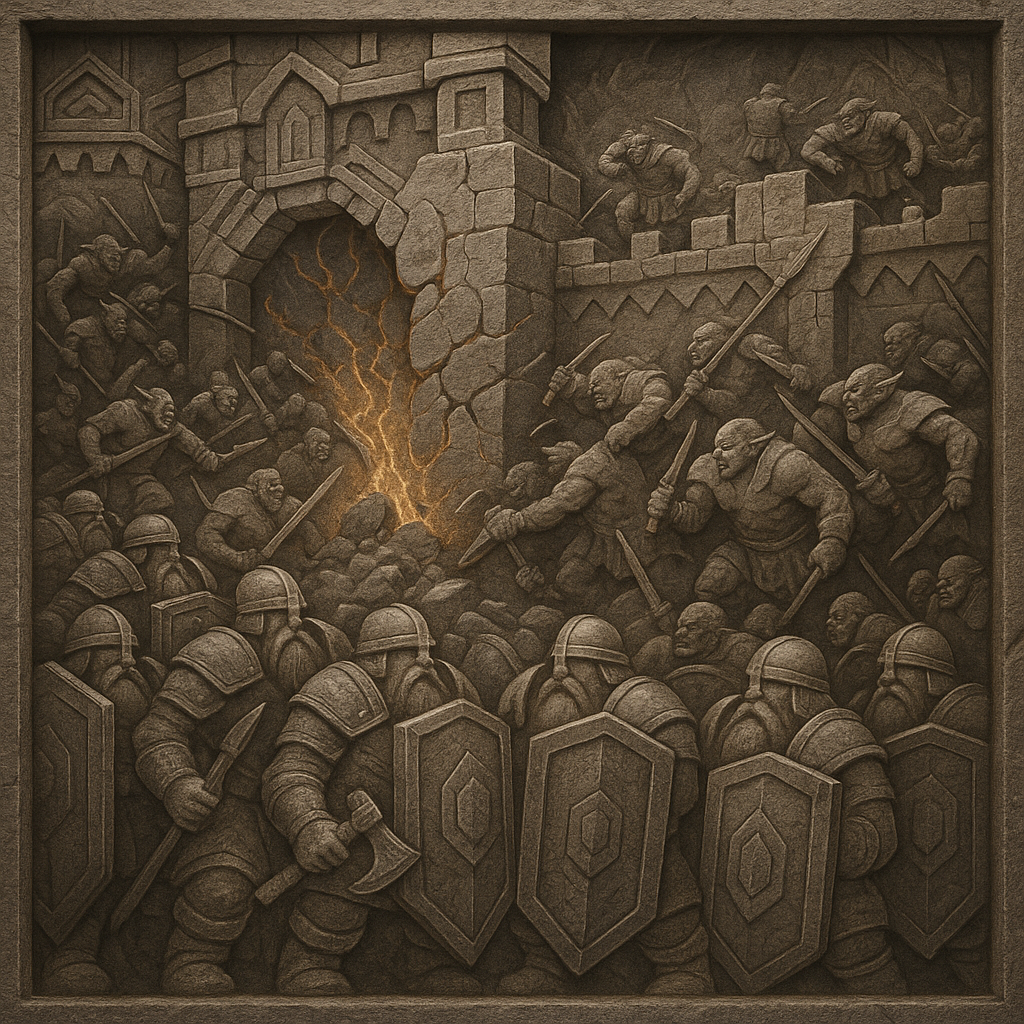
The war began without warning. A few short years after their Rift tore molten scars across the west, the Orcish Warborn surged eastward like a living tempest, sweeping across the land with the speed and hunger of a plague of locusts. Their first blows fell upon the outer Dwarven holds—fortresses thought impregnable—yet the sheer ferocity of the Orcish advance shattered them. Overwhelmed, the Dwarrow withdrew deeper into the Ironspine, sealing their great doors and preparing for sieges that would last decades.
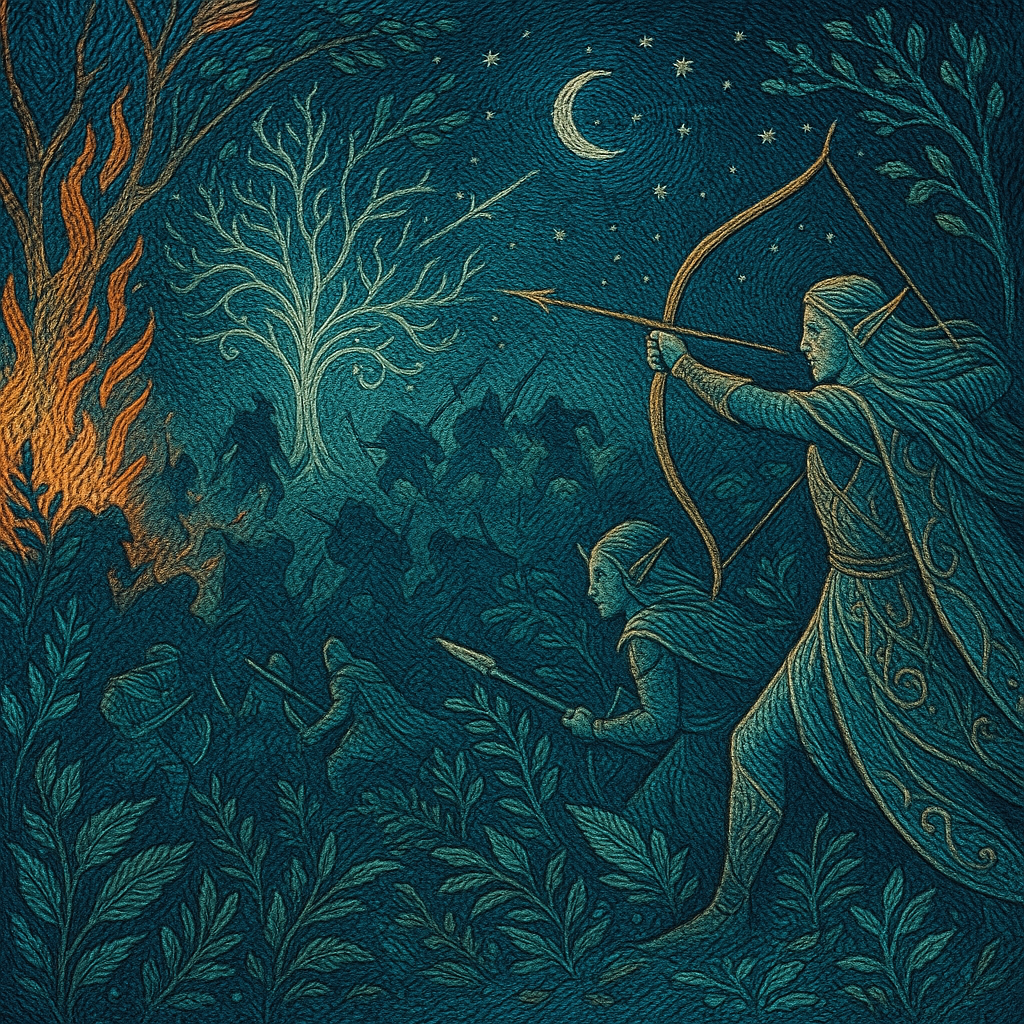
The Orcish tide did not slow. It rolled eastward into the Elven forests, where ancient trees were put to the torch and sacred enclaves ransacked. The Elves, unable to stand in open battle against such numbers, abandoned their outer settlements and melted into the deeper groves. For decades they fought a bitter guerrilla war, striking from the canopy and vanishing into shadow, determined to bleed the horde for every tree felled.
Meanwhile, the Dwarrow endured relentless assaults upon their gates. Orcish warbands hurled themselves at stone bastions season after season, while others tunneled downward into the deep—bringing battle into the mines and halls where the Dwarves had always held supremacy. The fighting underground became a grim stalemate of collapsing tunnels, ambushes in the dark, and ceaseless attrition.
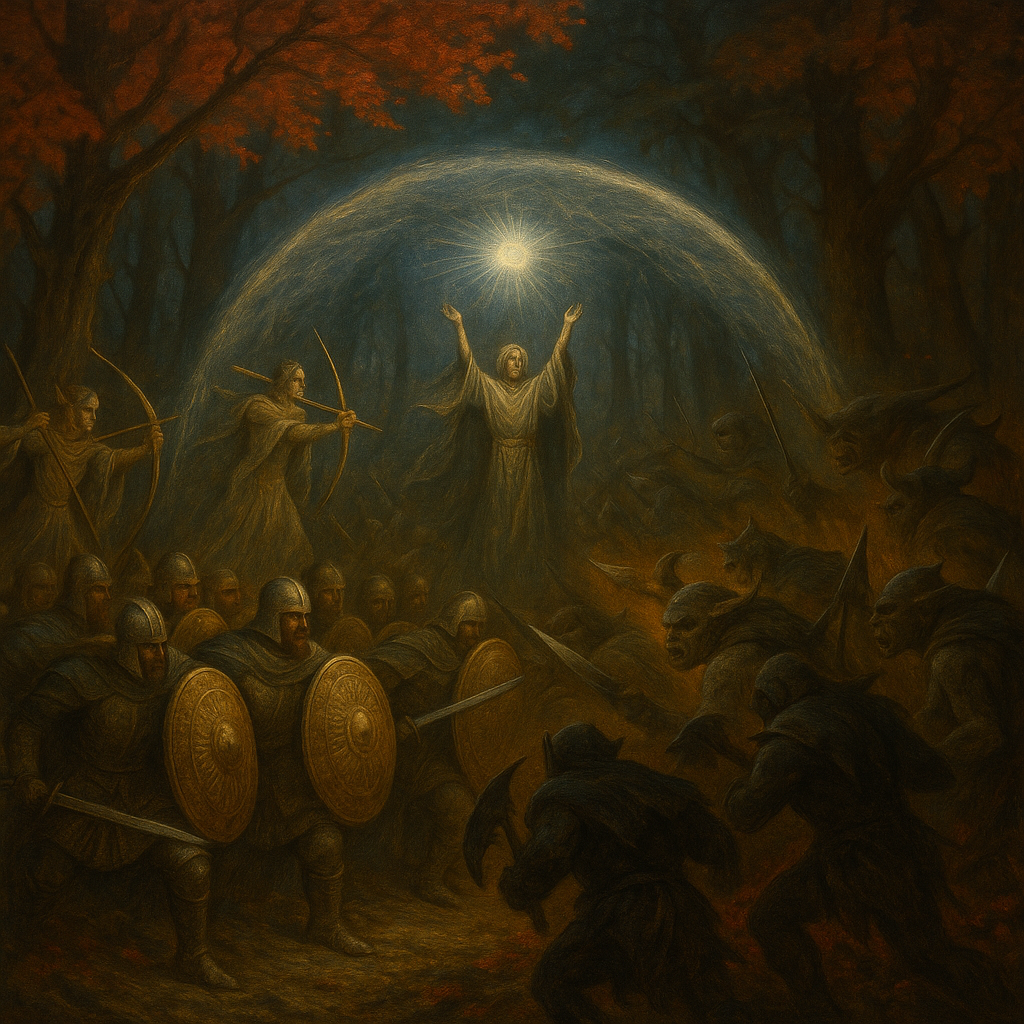
It was not until c. 860 BR, nearly a century and a half into the conflict, that the Elves and Dwarrow were finally able to meet and forge a pact—an unprecedented union born not of trust, but survival. For the first time, their armies moved with shared purpose. The Elves harried the Orcs from the forests while Dwarrow phalanxes advanced methodically from the mountains. Together, they pushed the Warborn back through the wooded borderlands, across the foothills, and ultimately westward toward the volcanic plains from which they had erupted.
The cost of this victory was dreadful. The Elves lost irreplaceable groves and bloodlines, wounds from which their civilisation never fully recovered. The Dwarrow reinforced and fortified the western passes, vowing that no future enemy would ever spill so deeply into their realm again. And from this hard-won alliance, a true friendship blossomed—one forged in sacrifice, endurance, and mutual respect.
To this day, both peoples honor those who fell in the First Wars, mourning the devastation while celebrating the courage that saved their realms. Their shared enmity toward the Orcs remains powerful, shaped not by myth or prejudice, but by the memory of an age when the world nearly burned.
The Conflict
Prelude
The Dawnbreak Uprising tore open the western reaches with molten fury, carving the Ashen Plains into existence and shattering the quiet balance of the age. For several years the Rift simmered ominously, its volcanic wounds steaming and unstable—until the Orcish Warborn finally emerged in force. Hardened by a world far harsher than Exilum Novum and driven by an ironclad creed of conquest, they surged east without hesitation.
Their first victims were the Dwarven outer holds. Strongholds that had stood unbroken for centuries fell within days, caught off guard by the sheer ferocity and momentum of the Warborn advance. Dwarven defenders retreated deeper into the Ironspine, sealing great fortress-gates behind them as the Orcish tide poured across their ancestral valleys.
But the Warborn did not stop. They pushed onward into Elven lands, setting fire to ancient groves and tearing through sacred enclaves. The Elves, unable to match Orcish numbers in open battle, dissolved into the forest depths, striking with hit‑and‑fade tactics from the canopy.
The First Wars had begun—not as a planned campaign, but as a storm that broke the world open.
Deployment
Elves
Swift and elusive, the Elves fought a war of shadows. Moon‑archers fired from hidden platforms high in the boughs, while sentinel cadres guided refugees and orchestrated ambushes deep within the forest. Grove‑defenders wove spellcraft into the landscape itself, turning roots, branches, and mist into natural obstacles that slowed the Orcish advance. Though they could not hold territory against overwhelming numbers, the Elves excelled at bleeding the horde, stalling its momentum, and reclaiming small but meaningful victories from the treetops.
Dwarrow
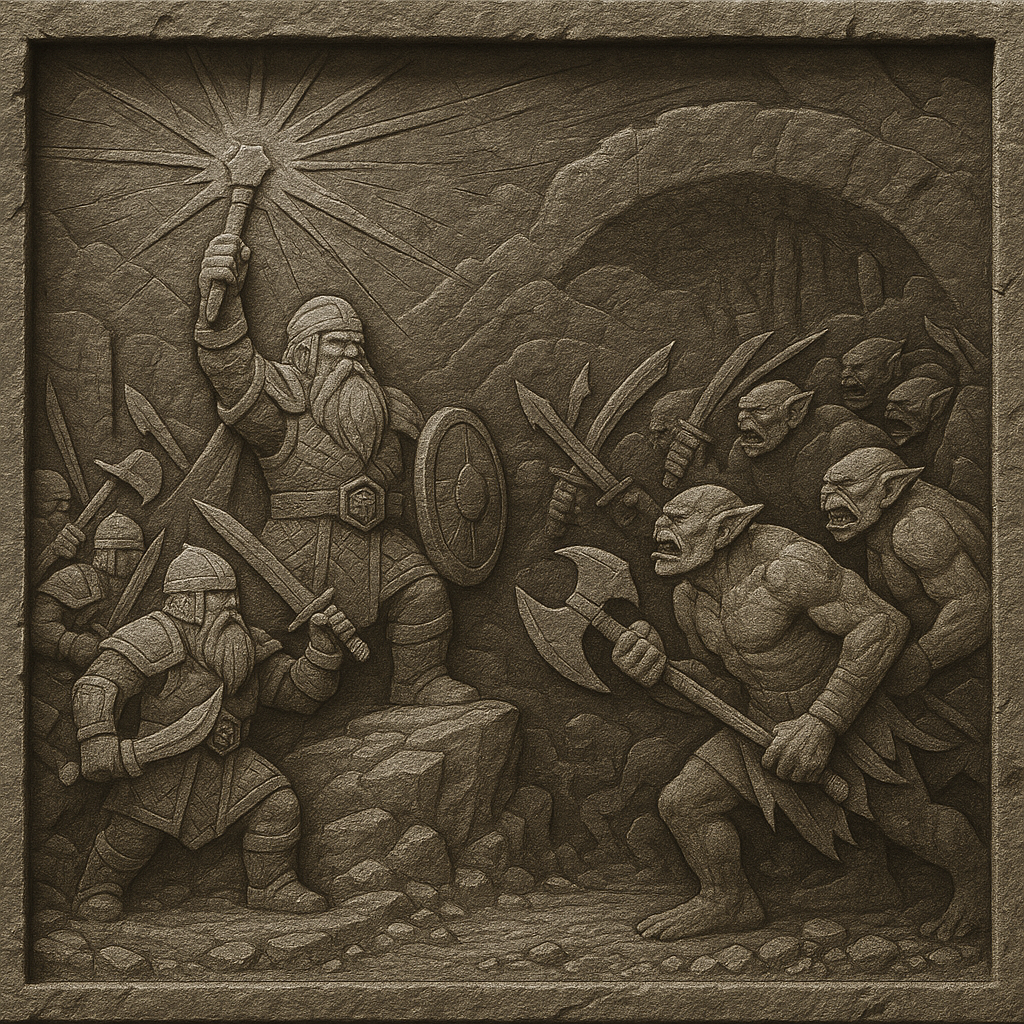
Forced into defensive warfare, the Dwarrow withdrew into the Ironspine’s deeper fortifications, relying on their mastery of stone and steel. The Ironshield Legions held sealed gates for years at a time, while Deepwatch tunnel‑fighters hunted Orcish incursions in the dark beneath the mountains. Rune‑engineers reinforced caverns, redirected tremor‑prone passages, and fashioned deadly choke‑points that turned every corridor into a potential killing ground. Though their heavy infantry struggled in open terrain, once behind stone walls the Dwarrow were nearly immovable.
Warborn Orcs
The Warborn advanced like a natural disaster made flesh. Massive clan hosts, sometimes numbering in the tens of thousands, surged across the land with primal momentum. Firecallers—shamanic masters of riftflame—drove war‑beasts before them, unleashing waves of snarling flesh and burning fury to break defensive lines. Their assaults relied on relentless pressure rather than strategy, overwhelming outposts and settlements simply by refusing to stop. To the Orcs, war was not a campaign but an unstoppable march of dominion.
Battlefield
The First Wars raged across three vast theatres. In the Ironspine Foothills, shattered forts marked the graves of once‑proud Dwarven settlements as sieges dragged on for years. Within the Greatwoods, trees burned and enclaves fell, leaving only drifting embers and the echoes of guerrilla strikes fought through smoke, shadow, and shifting branches. Farther west, the Ashen Plains—cradle of the Warborn—remained a volcanic expanse hostile to all but Orcs and the beasts they commanded. Between these regions lay the ruined borderlands, once vibrant realms reduced to scorched soil and crumbling stone.
Conditions
The natural and arcane world conspired to make the First Wars even more harrowing. Ashfalls drifted across entire regions, choking armies and blotting out the sun for days at a time. Deep‑quakes rattled the Ironspine and triggered collapses within Dwarven tunnels mid‑battle. Pockets of unstable mana—wildzones birthed by the Rift—caused spells to surge unpredictably, sometimes turning a simple ward into a lethal explosion of arcane backlash. Volcanic heat warped Elven bowstrings and weakened metal, while beast migrations driven by riftflame swept unexpectedly across battle lines. At times, the land itself seemed determined to break beneath the strain of the war.
The Engagement
The Fall of the Outer Holds (c. 1000–980 BR)
The Orcs shattered the Dwarven frontier, overrunning outposts with unprecedented speed. Survivors retreated into the mountain depths as the Warborn seized the foothills.
The Thirteen Burning Marches (c. 980–940 BR)
Sweeping into Elven territory, the Orcs burned thirteen forest‑forts in brutal succession. Entire groves were reduced to ash despite Elven ambushes and ward‑magic.
The Deep Wars (c. 930–910 BR)
Unable to break through the sealed mountain gates, Orcish tunneling bands drove downward, breaching Dwarven mines and halls. Years of relentless subterranean warfare followed, marked by collapses, ambushes, and brutal tunnel‑skirmishes.
The Red Groves Campaign (c. 890–860 BR)
As Elven guerrilla tactics intensified, the Warborn grew increasingly overstretched. Elves reclaimed several groves, though at terrible cost.
The Pact of 860 BR
Elven and Dwarven emissaries finally met in a ruined glade and forged an alliance. Coordinated campaigns followed for the first time in the war.
The Western Pushback (c. 860–820 BR)
With combined forces, the allies drove the Orcs from the Greatwoods, through the foothills, and steadily toward the Ashen Plains.
The Fracturing of the Warborn (c. 820 BR)
The death of High Warcaller Drask led to furious clan infighting. Without unified leadership, their offensive collapsed, allowing the final repulsion of the horde.
Outcome
The Orcs were finally driven from the forests and mountains, forced back toward the Ashen Plains from which they had emerged. Yet the victory was anything but clean. The Elven realm suffered devastating cultural and population losses that would haunt them for millennia. Much of the Dwarrow’s outer infrastructure lay in ruins, its holds cracked open and its mines flooded or collapsed. Although the alliance between Elves and Dwarrow prevented complete annihilation, neither people could reclaim all that had been lost, and the borderlands between their realms remained scarred, unstable, and slow to heal.
Aftermath
The Elves never fully recovered the numbers or groves lost during the First Wars; entire bloodlines and sanctuaries vanished forever. The Dwarrow responded by fortifying the western mountain passes more heavily than ever before, laying the foundations for the formidable bastions later known as the Stone Marches. Over time, the shared suffering of both peoples transformed their wartime pact into a lasting friendship built on mutual respect. Though the Orcs were fractured and forced westward, they remained a persistent threat, their culture forever shaped by the memory of their first great incursion. The lands razed during the conflict became Wildzones—regions saturated with unstable magic and lingering corruption.
Historical Significance
The First Wars are remembered differently by each culture. Elven psalms recount an age of sorrow and endurance, describing centuries of loss and the quiet heroism of those who protected the last living groves. Dwarrow sagas speak of unbreakable sieges, desperate tunnel battles, and the steadfast resolve that carried them through the darkest years. Orcish oral traditions preserve tales of strength pushed to its limits, of chieftains who forged their legacy in fire, and of the High Warcaller whose final charge became legend. Imperial historians sift through these contrasting accounts, assembling as complete a picture as possible of this tumultuous era.
Legacy
The First Wars reshaped the world's political, cultural, and emotional landscape. The borders established by the conflict became the foundation of the territories that existed when the Imperium Novum arrived centuries later. The alliance between Elves and Dwarrow—once unimaginable—became one of the oldest and most respected diplomatic bonds in Exilum Novum.
The war’s memory also forged an enduring enmity: both peoples still view the Orcs with deep caution, shaped not by prejudice but by the lived memory of an age when the world nearly fell.
In Literature
Texts referencing the First Wars:
- The Dawn Annals (Elven)
- Stone Voices (Dwarrow saga)
- The Fire-Wrought Verses (Orcish oral cycle)
- Imperial Rift Histories, Vol. II (modern Imperial synthesis)
Technological Advancement
The relentless conditions and extreme duration of the war spurred rapid advancements in craft and warfare. The Dwarrow refined their rune‑forging arts and perfected new techniques for tunnel fighting, as well as magma‑channel engineering that turned the deep earth into a weapon. The Elves enhanced their wards, developed stealth‑glyphs capable of masking entire enclaves, and refined long‑range canopy tactics that reshaped forest warfare. The Orcs evolved their fire‑pit forges, improved the breeding of war‑beasts, and honed the brutal efficiency of their shock‑charge assaults. Out of sheer necessity, all three cultures made notable strides in battlefield medicine—practices that endured long after the war had ended.

Comments