

Nala Solauria
“Light shows truth, shields the innocent, and tears apart what would devour them—this is the duty I was born to bear.”
Sol-Regina of the Brass Cities; Daughter of Sol Auria Aeterna; The Sun-Crowned Queen
Nala Solauria, Sol-Regina of the Brass Cities and anointed Daughter of Sol Auria Aeterna, stands as one of the most radiant rulers of the present age. Born into a matriarchal lineage that traces its authority to the first dawn of her people, she ascended the throne at just five years old, crowned beneath a sky gone blood-gold with omen. Her mother’s sudden and suspicious death left the realm in the hands of a regency council, but even in childhood Nala bore the unmistakable signs of divine favour: a faint shimmer of red-gold light along her fur, and an unblinking steadiness in her eyes that court chroniclers would later describe as “the sunrise waiting to happen.”
When she came of age and assumed full rule, the Brass Cities emerged from years of uncertainty into a period of peace, prosperity, and measured expansion. Under her guidance, caravans multiplied across the desert routes, the great sun-forges gleamed at full capacity, and diplomacy with the Imperium Novum—once cool and cautious—grew into a prosperous exchange of craft, magic, and mutual respect. Despite her youth, she commands absolute loyalty, not through fear, but because she embodies everything her people revere: justice, clarity, discipline, and the warm but unyielding light of the Sun-Mother.
Those who stand in her presence speak of the soft radiance that surrounds her—an ever-present glow of gold and ember, subtle by day but unmistakable in shadow. Though she seldom invokes her divine gifts openly, all who witness her during ceremonial rites swear that the air itself bends toward her, as though the sun were listening closely. This aura has silenced pretenders, stilled dissent, and ended any thought of contesting her throne; the Brass Cities do not merely accept her rule—they see her as the living axis upon which their world turns.
Yet her reign is not untouched by shadow. The death of her mother remains an unanswered question, a quiet wound beneath the splendour of the Brass Court. Rumours linger that Nala still seeks truth in the matter, though she speaks of it rarely and never in public.
Even so, her rule endures as a golden age: prosperous in trade, disciplined in governance, and tempered by a queen whose light is both mercy and warning. Regal, articulate, and unfalteringly just, Nala Solauria has become not merely monarch but symbol—proof that the Brass Cities thrive best beneath the watchful gaze of the Sun-Mother’s chosen heir.
Divine Domains
Nala Solauria bears the mantle of her people’s oldest and most venerated powers, for in her the radiance of Sol Auria Aeterna finds living expression. The domains entrusted to her are not mere abstractions but active forces woven through her reign.
She governs sunlight, the primal gift of the Sun-Mother, whose warmth sustains the Brass Cities and whose unforgiving glare reveals all things as they are. Her authority extends to justice, a domain she wields with the clarity of a blade drawn at dawn—swift, fair, and incapable of being bent by favour.
To her also falls the guardianship of oaths, the sacred bonds upon which Brass City society rests. Promises spoken in her presence are said to carry the weight of divine fire, and to break such a vow is to stand against the sun itself.
Through renewal, she embodies the perpetual cycle by which her people thrive—each day reborn from the ashes of the one before, each season promising resurgence rather than decline. And overarching all is the ancient mantle of sacred sovereignty, a dominion granted only to the true heir of the Sun-Mother, marking her not merely as ruler, but as the axis upon which the spiritual order of the Brass Cities turns.
In these domains, Nala is not symbolic custodian but living conduit—anointed, luminous, and bound to the eternal fire that birthed her lineage.
Artifacts
As Sol-Regina and living heir of Sol Auria Aeterna, Nala Solauria bears several relics of profound cultural and spiritual significance, each symbolising a facet of her divine mandate.
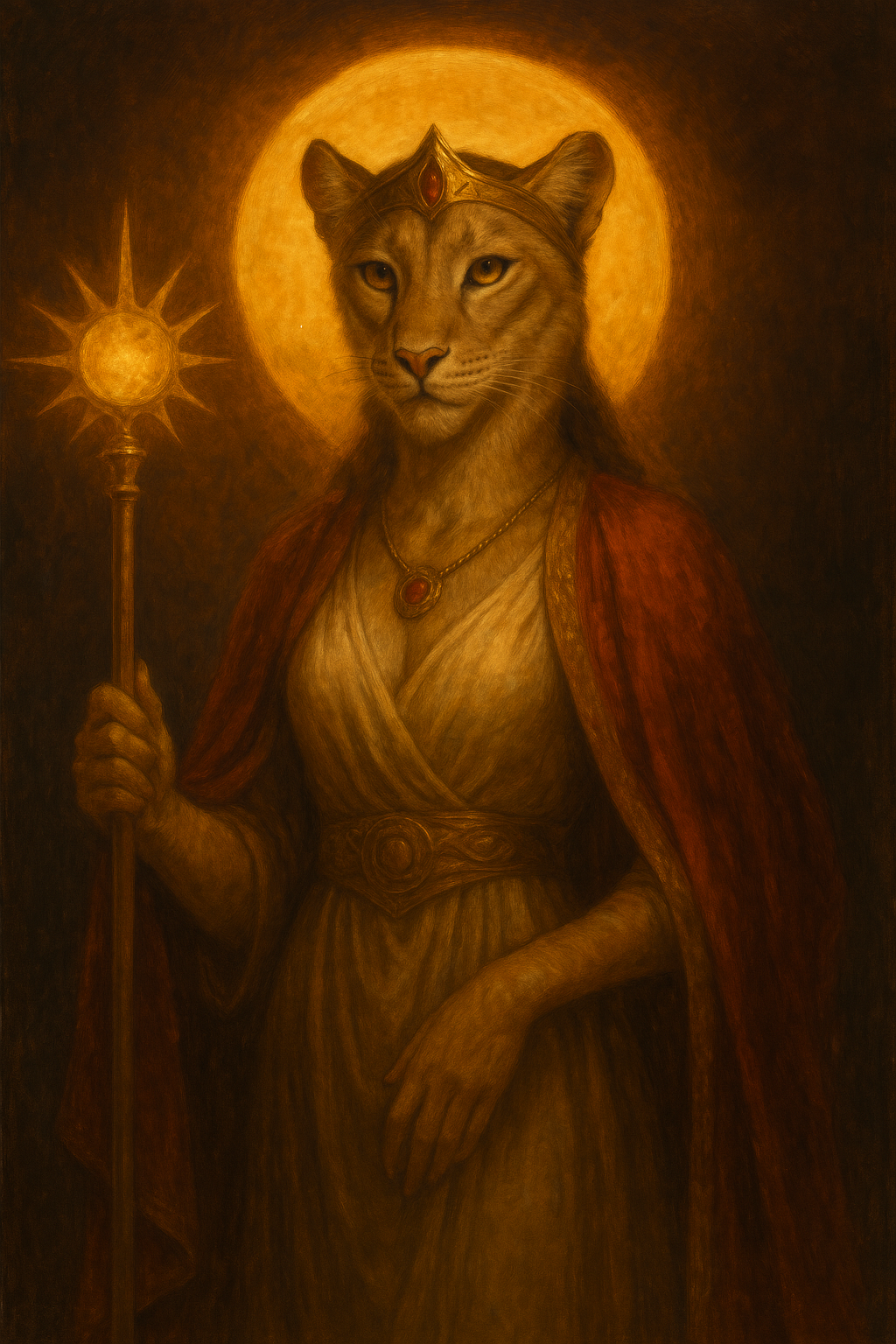
Foremost among them is the Aureate Diadem, the sun-forged circlet placed upon her brow at coronation. Its metal is said to hold a fragment of the first dawn of her people’s homeworld—a sliver of living sunlight bound within brass. When Nala channels the Sun-Mother’s power, the diadem glows from within, casting a red-gold halo across her features. No other Tabaxi may wear it without being seared by its radiance, a truth confirmed during ancient succession disputes.
She also carries the Scepter of Auric Truth, a slender rod of brass and sun-crystal traditionally held by the ruling Sol-Regina during judicial rites. The scepter is believed to react subtly to falsehoods spoken in its presence; though scholars debate its literal efficacy, the Brass Court swears by its uncanny ability to still the tongues of the deceitful. In Nala’s hands the crystal burns like an ember, a quiet reminder that justice in the Brass Cities is both sacred and incandescent.
Within the Sun Sanctum rests the Vessel of Dawn, a ceremonial brazier lit only on the holiest days of the solar calendar. Tradition claims that each reigning Sol-Regina adds a measure of her divine essence to the flame, binding her spirit to the lineage of queens who came before. During high rites, the Vessel flares in recognition of Nala alone, a sign that her radiance is in harmony with that of her ancestors.
Though these relics carry immense symbolic weight, Nala wields them sparingly, never as instruments of intimidation but as extensions of her duty. In her presence, they serve as reminders that the light she bears is not inherited privilege, but a sacred burden she has chosen—day after day—to uphold.
Holy Books & Codes
The spiritual tradition of the Brass Cities does not centre on rigid scripture, but on sung memory, carved light, and the spoken lineage of queens. Their sacred teachings are preserved not in lawbooks, but in living art—etched brass, sun-crystals, and stories recited in the rhythms of desert wind and pawstep.
Foremost among these is the Song of the First Flame, an ancient chant said to have been taught to the earliest Sun-Queens by Sol Auria Aeterna herself. Its verses are fluid, shifting subtly with each generation, but always recount the birth of the Tabaxi beneath a rising fire that gave them warmth, sight, and purpose. The Song is never written. It is kept by the Matriarchal Choir, each voice carrying a memory older than ink.
Complementing the Song are the Brass Inscriptions, long spirals of etched script that coil around temple pillars and public squares. These carvings are not commands but reflections—teachings on balance, accountability, and the weight of one’s shadow beneath the sun. No two cities carve them the same way; each inscription refracts the same light through a different cultural lens. Nala’s own readings have guided many of her judgements, though she rarely speaks of this aloud.
The closest the Brass Cities possess to a written doctrine is the Path of Radiant Conduct, a flowing set of precepts taught to every child of noble or priestly lineage. It is less a law code than a way of being: how to stand under the sun without shame, how to speak truth without cruelty, how to defend without consuming, how to lead without casting darkness across others. These teachings shape rulers more than subjects, and for a Sol-Regina they are less instruction than inheritance.
Under Nala Solauria, the Sun-Mother’s rites have undergone a gentle revival. Not through decree, but through imitation: her poise, her clarity, her luminous presence draw her people back to the rituals of dawn and renewal that defined their earliest ages. In her reign, the sacred texts—sung, carved, or remembered—have not grown in number, but in brilliance.
For in the Brass Cities, holiness is not bound to the page.
It glows, it lives,
and under Nala’s rule,
it shines.
Divine Symbols & Sigils
The symbols associated with Nala Solauria and the Sun-Mother’s lineage are drawn from the oldest traditions of the Brass Cities—fluid, radiant, and unmistakably feline in character. Unlike the rigid heraldry of the Imperium, Brass sigils are alive with motion, designed to catch shifting light and change meaning with the angle of the sun.
The most sacred among them is the Aureate Eye, a stylised feline eye encircled by a ring of rising flame. It represents sight without shadow: the Sun-Mother’s gift of truth, the Sol-Regina’s responsibility to perceive clearly, and the eternal vigilance of the Tabaxi who guard the desert routes. When Nala performs high rites, the Eye glimmers faintly in the air behind her—a gentle flare of gold and red that many believe is not artistic illusion, but divine acknowledgment.
The Crowned Paw is used exclusively in matters of rulership and judgement. Depicted as an outstretched feline paw surrounded by three rays of sunlight, it symbolises mercy, balance, and decisive action. Scribes of the Brass Court engrave it atop decrees bearing the Sol-Regina’s personal judgement, and no artisan dares replicate it without permission. When Nala signs a ruling, the sigil flares briefly with red-gold light, as though echoing her intent.
A third symbol, worn only by priestesses of the Sun Sanctum, is the Twin Suns, two concentric orbs—one gold, one deep ember—representing life and legacy, mother and daughter, past queens and future heirs. The outer ring is said to glow subtly when a true Sol-Regina passes by, a tradition confirmed often enough that even sceptics fall quiet in its presence.
Nala herself is closely associated with the Solar Mane, a sigil of sunrays stylised into the flowing curve of a lioness’ mane. It adorns her banners, her ceremonial diadem, and the entrance to her Court of Dawn. For her people, the Solar Mane is not merely emblematic—it is a promise: that the queen’s radiance stands between them and every encroaching shadow.
Together, these symbols form a visual language of faith, sovereignty, and identity. They do not merely mark Nala’s authority; they magnify it, catching the light as she passes and reminding all who see them that their Sol-Regina rules not by mortal right alone, but by the fire of the Sun-Mother herself.
Tenets of Faith
The faith surrounding Nala Solauria and the Sun-Mother is built not on rigid doctrine, but on lived principles carried in chant, memory, and daily ritual. These tenets, inherited from the earliest queens and shaped anew with each generation, define how a Tabaxi stands beneath the sun.
1. Walk in the Open Light
Truth is not a weapon but a path. One must meet each day without deceit, for shadows cling first to those who hide from their own reflection. To stand in the open sun is to accept both one’s flaws and one’s strength.
2. Shield the Vulnerable
The strong are given strength so they may defend, not dominate. Just as the sun warms the smallest seed, so must the Sol-Regina—and all who follow her—protect the young, the weak, and the voiceless.
3. Balance Fire with Mercy
Light can scorch as easily as it warms. Followers of the Sun-Mother are taught to temper passion with restraint, justice with compassion. A queen who cannot forgive is unworthy; a warrior who cannot relent is dangerous.
4. Honour Oaths as Lifeblood
Promises spoken beneath the sun carry the weight of ancestral fire. To break one is to tear at the fabric of community. Tabaxi believe an oath kept strengthens the light within; an oath broken dims it.
5. Renewal Is Sacred
All things rise, fall, and rise again—day, season, spirit, and civilisation. Followers of the Sun-Mother honour this cycle by seeking continual improvement, shedding what has grown stagnant, and embracing change with dignity.
6. Lead Without Casting Shadow
Power is a blessing only when it does not eclipse those beneath it. Those who rise must do so without crushing, diminishing, or silencing others. The Sol-Regina is revered because her radiance illuminates rather than blinds.
7. Guard the Horizon
The light of the Brass Cities must never be hoarded. It is a beacon, a promise, and a warning. Followers are sworn to watch over the borders—physical and spiritual—and ensure no devouring darkness finds purchase in their lands.
Together, these tenets create a faith of discipline and warmth, strength and gentleness, fierce protection and dignified restraint—a perfect mirror of Nala Solauria herself, whose reign has come to embody the Sun-Mother’s eternal balance.
Holidays
The reign of Nala Solauria is marked by several sacred festivals that honour both the Sun-Mother and her living daughter upon the throne. These holidays blend music, radiant ceremony, and communal ritual, each reflecting a facet of divine light at work in the Brass Cities.
1. The Dawn Coronation
Celebrated each year on the anniversary of Nala’s ascension, this festival begins in absolute silence. As the first rays of sunlight crest the horizon, the Brass Court erupts into song—an echo of the morning when a child of five stood beneath a blood-gold sky and the people first witnessed her divine glow. Citizens present offerings of polished brass to symbolise renewed loyalty and the polishing away of past failings.
2. Festival of the Longest Flame
Held at midsummer, this is the holiest celebration of the solar calendar. Fires are lit across every rooftop and balcony, forming rivers of light visible for kilometres. Priestesses chant the Song of the First Flame, accompanied by drums that mimic a heartbeat. When Nala appears at the Sun Sanctum, her radiance flares brightest, and it is said the flames bow slightly toward her.
3. Night of the Twin Suns
A quieter, reflective observance honouring lineage and the bond between mother and daughter. Lanterns carved with twin orbs—one gold, one ember-red—are set afloat along the desert canals. Though meant to honour all ancestors, this night invariably stirs whispers regarding the mysterious death of Nala’s mother. Still, the festival is gentle, communal, and suffused with warm memory.
4. Day of Unbroken Oaths
A civic holiday tied to the Tabaxi reverence for promises. On this day, oaths of service, marriage, business, and honour are reaffirmed under the midday sun. Nala presides over a public ceremony in the Brass Court, bearing the Scepter of Auric Truth. Any oath sworn in her presence is believed to carry a shard of solar fire—and breaking such a vow is unthinkable.
5. The Renewal March
At the turning of the year, the Brass Cities hold a procession that moves from the oldest district to the newest in the city. This march symbolises the tenet that all things rise again, stronger for having faced shadow. Nala walks at the head of the procession, barefoot, her aura illuminating the streets. Children scatter dried petals of desert flowers in her path, a gesture believed to ensure prosperity for the coming cycle.
Each holiday underscores the Brass Cities’ deep union of faith, rulership, and communal identity. Under Nala Solauria, these celebrations have grown brighter and more unified, as though her presence itself nourishes the flames that sustain her people.
Divine Goals & Aspirations
Nala Solauria’s divine mandate is not a set of commandments etched in stone, but a living inheritance—an unbroken thread of purpose passed from queen to queen through the fire of Sol Auria Aeterna. These goals shape her reign with a clarity that her people describe not as ambition, but as destiny carried with grace.
Her first goal is to preserve the Light.
Not merely the physical sun that crowns the desert each dawn, but the moral and spiritual radiance that keeps the Brass Cities from drifting into shadow. She seeks to cultivate a society where truth is not feared, where justice warms rather than burns, and where her people can stand unafraid beneath the open sky.
Her second goal is to safeguard her people.
Every choice she makes—trade, diplomacy, reform—is measured against the welfare of her citizens. The Sun-Mother’s radiance exists to shield the vulnerable, and Nala feels this charge like a pulse beneath her skin. She has vowed that no shadow, whether born of treachery, hunger, or foreign malice, will go unanswered while she reigns.
Her third goal is renewal.
Like the cycle of dawn, she believes every age must shed the dust of old failings. Under her guidance, the Brass Cities have embraced innovation: new trade routes, revitalised crafts, and cultural rites reborn with fresh brilliance. Renewal, to Nala, is both healing and challenge—a promise that her people will rise stronger with each turning of the sun.
Her fourth goal is to seek the truth of her lineage.
Though she speaks of it rarely, Nala has never forgotten the shadows surrounding her mother’s death. To understand this truth is not only a daughter’s desire—it is a queen’s responsibility. The lineage of the Sun-Crowned must be unbroken by deception. Until she reveals what occurred, a sliver of dusk lingers at the edge of her inheritance.
Her final goal is harmony beyond her borders.
The Sun-Mother’s light does not stop at city walls, and neither does Nala’s vision. She seeks peaceful strength—trade instead of conquest, alliances instead of suspicion. Her measured diplomacy with the Imperium reflects this: an understanding that two great powers may stand side by side without eclipsing one another.
In all these aims, Nala Solauria is both queen and conduit—her goals the goals of the sun itself:
to illuminate,
to protect,
to renew,
to reveal,
and to guide the world toward a dawn unbroken.
Physical Description
General Physical Condition
Nala Solauria stands in the fullness of her prime, a queen whose very presence seems shaped by sunlight. Tall and lithe for a Tabaxi, she carries the long-limbed grace of a desert lioness—power in reserve, elegance in motion, and a steadiness that draws every gaze without needing to claim it. Her musculature is refined rather than heavy, the strength of a climber and a dancer rather than a warrior, yet no one doubts she could move with startling speed if provoked.
Her fur, naturally short and sleek, holds a warm golden tone that deepens near her mane-line and tail-tip. Court poets insist the colour is not entirely natural, that something within her—some ember of Sol Auria Aeterna—infuses her coat with radiance. Under low light, she seems haloed; under direct sun, her outline blurs slightly, as though she stands at the edge of dawn. This glow intensifies with strong emotion, creating an effect both awe-inspiring and faintly unsettling to those unused to divine presence.
Despite the burdens of rule, Nala shows no sign of exhaustion or strain. Her stamina is remarkable: she endures long councils without rest, walks the Renewal March barefoot across scorching stone without falter, and sustains the Sun-Mother’s rites with a composure said to surpass even the priestesses. Physicians note that she heals from minor injuries with unusual speed, though none dare call this a miracle in her hearing.
Her movements are slow when she chooses them to be, deliberate as drifting sand, yet capable of sudden precision—turning sharply toward a speaker, lifting her chin at a whisper of dissent, or narrowing her eyes in a gesture that silences entire chambers. There is no wasted motion, no hesitation; she is a creature carved of control and instinct both.
To stand near her is to feel a subtle warmth, not oppressive like the desert sun but comforting, protective—the sensation of stepping into light after a long night. Even hardened emissaries of the Imperium speak of this phenomenon in lowered tones, unsure whether it is divine aura or an illusion woven by presence alone.
In all, Nala Solauria embodies the living ideal of the Brass Cities: beautiful, resilient, luminous, and quietly formidable, a queen whose physical being is both symbol and testament to the sunlit power she carries.
Identifying Characteristics
Nala Solauria’s most striking feature—spoken of in poetry, song, and whispered awe—is her eyes. In calm moments they hold a deep, molten warmth, like sunlight caught in amber: steady, inviting, and impossibly alive. Courtiers describe them as eyes that listen before they judge, radiating a serenity that eases even the most anxious petitioner.
But when her temper stirs—or when truth must be demanded rather than coaxed—their character changes entirely. The warmth sharpens into brilliance, not a literal blaze but an intensity so fierce that witnesses swear it feels like standing too close to the rising sun. In those moments, her gaze becomes a force in its own right: penetrating, unyielding, and capable of stopping seasoned warriors mid-sentence.
No artist has ever perfectly captured this transformation. Paintings portray it as a golden glimmer; court scribes describe it as “light behind glass”; the priestesses insist it is simply the Sun-Mother looking through her daughter. Whatever the truth, all agree on one thing: when Nala’s eyes burn, no falsehood survives before her.
This dual nature—gentle warmth and solar severity—has become one of her defining emblems, as recognizable as her crown or her divine radiance.
Special abilities
Though Nala Solauria is no warrior in the traditional sense, she bears abilities that mark her unmistakably as the chosen vessel of Sol Auria Aeterna. These gifts are subtle rather than explosive, woven into her presence rather than displayed as spectacle—yet their impact on the Brass Cities is profound.
Her foremost gift is Solar Resonance, the faint divine radiance that surrounds her. It is not a weapon, nor is it meant to be; rather, it is a quiet manifestation of the Sun-Mother’s favour. In moments of strong emotion—joy, grief, righteous fury—the glow intensifies, casting warm hues of gold and ember across her fur. Those close to her describe feeling steadier, braver, more honest in its presence, as though wrapped in the calm certainty of dawn.
Nala also possesses an almost uncanny perception of truth. She does not read minds, nor hear thoughts, but she senses disharmony—the subtle shifts in posture, tone, and intent that betray falsehood. Combined with her piercing gaze, this ability has made deception in her court exceedingly rare. Many believe this gift is tied to her role as guardian of oaths, a living embodiment of the sunlight that reveals what shadows attempt to hide.
A further expression of her divine nature is her resilience. Though not invulnerable, she heals with uncommon speed and endures fatigue far better than mortal queens before her. She can lead ceremonies that would tax a seasoned priestess and walk the burning stone of the Renewal March without blister or falter. This resilience is viewed not as power for conquest, but as the Sun-Mother’s assurance that her daughter may bear the weight of rulership without breaking.
Finally, Nala wields a rare and quiet gift known among the priestesses as Dawn’s Influence—the ability to soothe unrest simply by being present. In fraught negotiations, border tensions, or moments when anger threatens to ignite into violence, her calm radiance acts as a pressure released. Voices lower, tempers cool, and reason finds room to speak. Some call it diplomacy; others call it magic. Nala herself calls it duty.
She is not a wielder of battlefield sorcery or celestial fire. Her gifts do not scorch or smite.
Instead, they illuminate, steady, and reveal—just as the rising sun does.
And in the Brass Cities, such abilities are power enough to shape an age.
Apparel & Accessories
As a queen of the desert, Nala Solauria dresses in garments that unite elegance with ancestral practicality. Her attire consists of flowing, lightweight desert-silks, dyed in gradients of gold, ember-red, and deep brass—the colours of sunrise across the dunes. These fabrics move with her like drifting heatwaves, enhancing the natural grace of her feline posture and lending her an almost ethereal fluidity as she walks.
The dresses are cut to allow freedom of movement, with layered veils that catch the wind and shimmer in her divine radiance. They are not ostentatious; their beauty lies in craftsmanship rather than excess. Skilled weavers incorporate sun-thread—a fine metallic filament that reflects her aura—so the garments seem to glow softly even in dim chambers.
Around her shoulders she often wears a desert mantle of sheer, translucent cloth, patterned in swirling motifs of flame and sand. During ceremonies, the mantle amplifies the impression that light gathers around her, drawn to the Sol-Regina as a hearth-dawn gathers sparks.
Her accessories carry deep cultural meaning rather than mere ornamentation. She wears sun-forged brass bangles around her wrists and ankles, each etched with sigils representing justice, renewal, and sovereignty. When she moves, they chime softly—never loudly—forming a rhythm said to echo the heartbeat of the Sun-Mother.
Her diadem, the Aureate Crown, remains her most sacred adornment, though she does not wear it outside of major rites. When she does, the circlet refracts light into warm halos, subtly intensifying her divine presence.
For everyday governance, Nala prefers minimal adornment: a single sun-crystal pendant resting against her chest, glowing faintly with her inner radiance. It serves as both symbol and reassurance to her people—that wherever their queen walks, the light of Sol Auria Aeterna walks with her.
Together, her attire and accessories transform her presence into something unforgettable:
a queen who moves like sunlight over sand—soft, warm, and utterly commanding.
Mental characteristics
Personal history
Nala Solauria was born beneath an evening sky the priestesses later called “the dusk that promised dawn.” The only child of Sol-Regina Serai the Radiant, she entered the world already marked by faint glimmers of inner light—subtle gold flickers beneath her fur that the attending Sun-Singers interpreted as the earliest signs of the Sun-Mother’s blessing. Even as an infant, she watched the world with unusual stillness, her amber eyes reflecting more understanding than her years could possibly hold.
Her childhood, however, was shaped as much by shadow as by radiance. When she was only five, her mother died under circumstances that remain unresolved to this day. The official record names it a sudden illness; the priestesses whisper of omens; the Brass Court remembers only the moment the palace torches dimmed as though in mourning. Whatever the truth, the realm was thrown into uncertainty, and the child-queen was lifted onto the sun-forged throne before she fully understood what the crown meant.
During the regency that followed, Nala was raised by a triad of powerful influences: the Matriarchal Council, who guided her political education; the priestesses of the Sun Sanctum, who nurtured her divine heritage; and the desert itself, whose winds and shifting sands taught her resilience beyond books or ritual. While her regents ruled in her name, the young queen studied tirelessly—statecraft in the mornings, the ancient songs of the First Flame at midday, and the meditative stillness required to channel her radiance at night. Even then, her light would pulse softly when she concentrated, though she took pains to hide this from the courtiers who flocked around her with equal parts reverence and fear.
By adolescence her divine aura had sharpened, and with it her sense of purpose. Nala began attending council sessions not as a silent observer but as a voice of measured clarity. In one early debate—over water rights between two rival districts—she spoke so calmly and decisively that the regents realised the inevitable truth: the queen they sheltered no longer needed their shelter. When she reached formal adulthood, she dismissed the regency with a grace that surprised even her critics, thanking them publicly for their stewardship and privately for their caution.
Her reign since then has been defined by renewal and balance. She strengthened trade routes with the Imperium Novum, insisting that prosperity must flow both inward and outward. She reorganised the priesthood without diminishing its authority, bridging the once-wide gap between spiritual and civil governance. She restored failing desert districts, rebuilt sun-crystal infrastructure, and revitalised the cultural festivals that had grown stagnant during the uncertain years of her youth.
Yet beneath this golden flourishing lies a quiet, persistent thread: the unanswered mystery of her mother’s death. Though she rarely addresses it openly, those closest to her know she still seeks truth—not out of vengeance, but out of duty to the lineage she embodies. For the crown she inherited carries not only radiance but unresolved twilight, and Nala Solauria has vowed, in her own measured way, to see dawn break cleanly once more.
In every chapter of her life—from child queen to divine monarch—she has walked a path lit not by ambition but by the steady fire of responsibility. Her people adore her not simply because she rules them, but because she illuminates them, standing as proof that even in a world divided by shadow, the sun may choose to rise in the shape of a queen.
Education
Nala Solauria’s education was unlike that of any queen who came before her—structured, intensive, and shaped as much by divine expectation as by mortal necessity. Crowned at the age when most Tabaxi cubs still clung to their mothers, she grew up not in the freedom of childhood but in a palace transformed into a sanctuary of learning.
Her earliest instruction came from the Matriarchal Council, who recognised that a child destined to rule must first understand the architecture of authority. They taught her the foundations of governance: how trade flows through the desert routes, how disputes ripple across districts, and how a queen’s silence can carry more weight than an orator’s roar. Even as a girl, Nala absorbed these lessons with preternatural composure, mastering concepts that seasoned councilwomen sometimes struggled to convey.
Alongside this civic tutelage, she was entrusted to the priestesses of the Sun Sanctum, who nurtured the divine spark within her. They led her through meditative rites designed to sharpen awareness of her Solar Resonance, taught her the breathing patterns that stabilise inner light, and guided her through ancient songs meant to align her spirit with that of Sol Auria Aeterna. Unlike her political education, these lessons were less about knowledge and more about stillness—the disciplined ability to hold radiance without letting it consume her.
Her intellectual formation included rigorous studies in history, rhetoric, desert diplomacy, and the sacred art of truth-reading. The priestesses taught her to observe not just words but weight—the subtle tensions in tone and movement that reveal fear, pride, or deceit. This sensitivity would later grow into her uncanny ability to sense disharmony in those who stand before her throne.
When she reached adolescence, Nala insisted on learning directly from the desert itself. She spent seasons traveling between the Brass Cities’ outer settlements—walking dunes at dawn, meeting caravan leaders, and studying how her people survived where sun and sand rule without mercy. From these journeys she gained not only pragmatic knowledge but empathy for the daily struggles of the workers, artisans, and water-callers whose labour sustains her kingdom.
By the time she took full authority upon coming of age, her education had shaped her into something rare:
a ruler trained in equal parts by law and faith, by court and desert, by tradition and by the living light she carries.
To this day, she continues to study quietly, believing that a queen who ceases to learn risks casting a shadow wider than her radiance.
Accomplishments & Achievements
Nala Solauria’s reign is often called the Second Dawn of the Brass Cities, a period defined not by conquest or spectacle but by a steady, radiant transformation that touched every part of her kingdom. Her achievements are woven into daily life—felt more than proclaimed, lived more than recorded—yet even the most restrained chroniclers concede that her rule has reshaped the desert realm in ways unmatched since the age of the First Queens.
Her earliest and most remarkable accomplishment was simply surviving the throne. Elevated at the age of five, she inherited not only a crown but a court balanced on the knife-edge between devotion and uncertainty. Through years of regency she absorbed every lesson offered—political, spiritual, and personal—and emerged at maturity not as a figurehead but as a monarch whose composure and clarity silenced all talk of replacing her. The transition from regency to full sovereignty, expected by many to fracture the realm, passed instead with a serenity attributed to her innate radiance and disciplined preparation.
Under her leadership, the Brass Cities entered an era of unprecedented prosperity. Trade routes once plagued by drought, banditry, and political rivalry flourished as she negotiated new accords between rival districts, stabilised caravan laws, and forged lasting agreements with foreign powers—including the Imperium Novum. Her diplomatic approach—firm, luminous, and impeccably courteous—earned her reputation as a ruler who could bend even suspicious emissaries toward cooperation without ever raising her voice.
Nala oversaw the revitalisation of the sun-crystal infrastructure, modernising ancient forges and re-opening desert mines long abandoned due to instability. By pairing priestly oversight with artisan innovation, she ushered in new generations of tools, lamps, and ceremonial equipment that burn brighter and longer than anything crafted in a century. Artisans speak of this era as the Golden Reforging, crediting the queen’s vision for their renewed craft.
Her reforms within the Sun Sanctum are equally praised. Without diminishing its spiritual authority, she rebalanced the relationship between priesthood and crown, ensuring that rites, governance, and civic responsibility flow together rather than in parallel. Festivals were revitalised, old hymns reinterpreted, and forgotten rituals restored. Under her hand, the faith of the Sun-Mother became not relic but living flame—felt in the streets, the markets, the forges, and the hearts of her people.
Perhaps her most subtle yet enduring achievement is the stabilisation of identity across the Brass Cities. In a realm composed of distinct districts, families, and desert cultures, Nala fostered unity not through decree but through illumination—renewed ceremonies, shared symbols, and her own unwavering example. Her presence became a point of gravity around which tradition and innovation turned in harmony.
Even foreign observers concede that the Brass Cities under Nala Solauria have become something rare in Exilum Novum:
a kingdom at peace with itself, confident in its light, and guided by a queen whose radiance shines more brightly with every passing year.
Failures & Embarrassments
Though revered across the Brass Cities, Nala Solauria is not untouched by missteps, and the few that shadow her reign are spoken of in quiet tones—not out of shame, but out of respect for a queen who strives to rise above them.
Her earliest and most personal failure is one she speaks of only in private: her inability to uncover the truth behind her mother’s death. Despite years of discreet inquiries and subtle pressure on the priesthood and court archivists, the trail remains obscured by conflicting testimonies and political caution. Nala considers this not merely a daughter’s sorrow but a queen’s shortcoming—a failure to pierce a shadow cast across her own lineage.
Another moment of embarrassment came early in her rule, when she attempted to reform the desert-water tithes without fully consulting the elders of the outer districts. Her intentions were noble—fairer distribution, less exploitation—but the reforms ignored the delicate balance of water traditions maintained for generations. The resulting unrest forced her to withdraw the decree and personally travel to the affected regions to mend trust. The ordeal taught her the importance of listening not only to advisors but to the desert itself, whose customs are older than any throne.
She also bears regret for a diplomatic misjudgment during her first formal exchange with the Imperium Novum. Accustomed to the flowing courtesy of the Brass Court, she mistook an Imperial envoy’s blunt pragmatism for veiled hostility. Her response—cool, precise, and edged with solar severity—nearly soured the relationship before it had begun. Only after a private conversation with the envoy, who admitted equal misunderstanding, did she recalibrate her approach. Nala later described this as a lesson in “the dangers of judging foreign shadows by the colours of our own sun.”
Lastly, her divine radiance—usually a gift—has caused unintended consequences. During a tense negotiation between rival merchant clans, her aura brightened sharply in response to a moment of anger. The sudden flare startled the delegations and was interpreted by both sides as favour toward the other, escalating tensions rather than soothing them. Nala was deeply embarrassed, viewing it as a moment when she failed to master her own gifts.
These failings do not diminish her; rather, they reveal the human heart within the divine glow. In each case, she responded not with denial but with clarity, humility, and renewed purpose—traits that only deepen the respect her people hold for her.
Morality & Philosophy
Nala Solauria’s moral worldview is shaped by three forces that have never left her: the radiance of the Sun-Mother, the harsh truth of the desert, and the heavy weight of a crown placed upon her far too young. The result is a philosophy both compassionate and uncompromising—warm as dawn, yet edged with the same severity that keeps the midday sun from being gentle.
At the centre of her morality lies a simple creed: light must serve. To Nala, illumination is not a symbol of power but a responsibility. Truth exists to guide, not to shame; justice exists to protect, not to dominate; and authority exists only insofar as it uplifts those beneath it. She believes a queen’s radiance is meaningful only when it reveals a path forward for her people.
Yet she holds an equally firm belief that light must not yield to shadow. Mercy is vital—but mercy cannot excuse cruelty, deception, or exploitation. She grants forgiveness readily to the contrite, but shows little patience for those who manipulate the vulnerable or hide malice behind polite veils. In such cases her warmth narrows into a sharp, principled intensity; those who stand in her presence during these moments speak of feeling “judged without being condemned.”
Her philosophy of power is deeply matriarchal and unpretentious. She rejects the idea that authority elevates her above her people; instead, she sees herself as the first guardian and last servant of the realm. Titles are less important to her than integrity. Rituals matter only when they strengthen community. Decisions must be weighed not in terms of victory but of balance—between tradition and progress, duty and compassion, justice and renewal.
She also holds a quiet, personal ethic of self-restraint. Her divine radiance, her influence, even her presence—she treats them as gifts that must be carefully controlled. To shine too brightly risks overshadowing those she means to protect. To wield her authority without reflection risks becoming the very shadow she seeks to dispel.
Finally, Nala’s philosophy is shaped by an unresolved grief: the knowledge that even the brightest throne may hold darkness beneath it. Her mother’s mysterious death is the one place where her certainty falters, and this uncertainty has cultivated in her a profound empathy for those who carry unseen burdens. It is perhaps why she listens so deeply, speaks so precisely, and forgives so quietly.
In all things, Nala Solauria seeks the equilibrium of dawn:
light that reveals, warmth that reassures, and fire that protects.
Personality Characteristics
Motivation
At the heart of Nala Solauria’s rule lies a constellation of motivations shaped by duty, lineage, and the quiet ache of unanswered questions. Her primary drive is to ensure her people never again stand at the mercy of shadow, whether that shadow comes from hunger, discord, foreign threat, or the unspoken dangers that lurk within the Brass Court itself. Every decision she makes is filtered through the question: “Does this strengthen the light that protects my people?”
She is motivated by a profound belief that her reign must justify the divine radiance entrusted to her. To Nala, the glow she carries is not a blessing meant for display, but a burden she must earn each day through justice, compassion, and clarity. Her life is a continuous act of stewardship—of her people, her faith, and the legacy of the Sun-Mother.
A quieter, more personal motivation lies in her relationship to her mother’s memory. The unresolved truth of Serai’s death is a wound that has never fully healed. Nala does not seek revenge, but resolution—the assurance that the lineage of the Sun-Crowned is untainted by treachery. This pursuit shapes her caution, her unwillingness to ignore subtle deceptions, and her determination that no child-queen after her will ever inherit a throne clouded by doubt.
She is also driven by the desire to renew and uplift—to see her people flourish not only in wealth but in spirit. This is why she revived ancient rites, expanded education for desert districts, and opened new trade routes with the Imperium. For her, prosperity is not measured by coin or influence but by the strength and harmony of her people.
Finally, Nala is motivated by a deeply personal creed:
“Light must not stand still.”
She believes that every generation must refine the world it inherits, casting off what has decayed and strengthening what remains true. Her rule is an ongoing journey toward a dawn she may never see fully—but one she is determined to make possible for those who come after her.
In all things, her motivations are neither prideful nor passive; they are the steady, driving pulse of a queen who sees her life not as her own, but as a vessel for radiance that must never dim.
Representation & Legacy
In the centuries to come, it is certain that Nala Solauria will be remembered not merely as a monarch, but as a defining light in the history of the Brass Cities—a queen whose reign reshaped the cultural horizon as surely as dawn reshapes the desert sky. Already, her legacy is taking root in traditions, art, politics, and the spiritual identity of her people.
Artists across the Brass Cities have adopted her as a new ideal of queenship: elegant, radiant, balanced between warmth and severity. Frescoes depict her standing upon the steps of the Sun Sanctum, her silhouette haloed in gold; desert tapestries weave her likeness into scenes of renewal, each thread catching sunlight in subtle glimmers; sculptors shape her in flowing robes that seem to shift even in still air. Yet none capture her eyes perfectly—the impossible warmth, the fierce intensity—a reminder that some truths belong to the living queen alone.
Her influence on governance is equally profound. Under her rule, the Brass Cities have experienced a rare equilibrium: districts once divided by lineage or function now speak of themselves as parts of a single body unified beneath her radiance. The Renewal March, once a modest year-end procession, has become a symbol of civic pride and spiritual unity, its streets lined by citizens whose voices rise in chants echoing her tenets. Future queens will inherit a realm shaped by her example—disciplined, compassionate, and confident in its identity.
Diplomatically, Nala has redefined her kingdom’s place in the wider world. Her measured approach to the Imperium Novum softened centuries of mutual caution, forging alliances built on shared prosperity rather than necessity. Even Imperial envoys, accustomed to the stern pragmatism of their own rulers, speak of her with an unfamiliar reverence. To them, she is proof that power may be exercised without spectacle, and that strength may radiate rather than conquer.
Spiritually, her legacy is already immense. The resurgence of ancient rites, the revival of sun-crystal craft, and the renewed prominence of the Matriarchal Choir all tie back to her influence. The people now speak of the “Solaurian Era,” a time when faith is not a distant doctrine but a living warmth carried in the streets, sung in market squares, and reflected in the polished brass of every home. Children play at being “little sun-priests,” imitating her gestures during the Festival of the Longest Flame.
Yet her most enduring legacy may be something quieter:
the belief that leadership need not devour the one who carries it.
She rules without cruelty, shines without arrogance, and listens without yielding her strength. In a world where many rulers cast long shadows, Nala Solauria has become the measure of a different ideal—one in which the sun’s fire does not scorch but sustains.
When future generations speak her name, they will likely do so as they speak of dawn:
not as an event, but as a promise.
Social
Reign
Nala Solauria’s reign is widely regarded as the Solaurian Dawn—a period in which the Brass Cities moved from uncertainty and lingering shadow into an age of radiant stability. Ascending formally to the throne upon reaching maturity, she inherited a realm still shaped by the uneasy years of regency and the unresolved death of her mother. Many feared that a young queen, however divinely touched, might struggle to command a court accustomed to ruling in her stead. Those fears dissolved within her first year.
Her early reign was marked by a sweeping restoration of civic cohesion. Nala reopened long-neglected trade routes, mediated disputes between rival districts, and reasserted the spiritual-political synergy that once defined the Sun-Mother’s chosen line. Craftspeople speak of her ascension as the moment their forges regained their brilliance; caravan leaders credit her reforms with bringing safety back to the desert roads. Her governance did not impose unity—it illuminated it, revealing common purpose where factions had seen only division.
Diplomatically, her reign transformed the Brass Cities’ role on the world stage. Under her guidance, relations with the Imperium Novum shifted from careful distance to cautious respect and eventually prosperous partnership. Nala became renowned for her ability to temper firmness with warmth, guiding negotiations with a composure that foreign envoys found equal parts disarming and compelling. Through her, the Brass Cities emerged not as an isolated desert power but as a respected participant in continental discourse.
Spiritually and culturally, her reign ignited a renaissance. Festivals long dimmed by political uncertainty flared back to life. Ancient rites were revived with new purpose. The Sun Sanctum—once seen as aloof from civic matters—became a vibrant centre of art, education, and ritual under her patronage. The people came to speak of a harmony between crown, faith, and community unseen since the earliest queens.
Yet her reign has not been untouched by shadow. Whispers about her mother’s death persist, and though Nala rarely acknowledges them, her quiet inquiries have reshaped the Brass Court’s understanding of accountability. Ministers now serve under a queen whose calm gaze makes deception feel impossible. This expectation of honesty has become a defining feature of the Solaurian Era—an age in which truth is not only a virtue, but a living expectation.
Through all of this, Nala’s leadership has remained steady, luminous, and disciplined. She is a queen who governs as the sun governs the desert: warming, guiding, and—where necessary—scorching only to protect life. Her reign is not defined by conquest or crisis, but by the quiet miracle of sustained prosperity, a rarity in any age.
If her lineage endures, future queens will look back on Nala Solauria not simply as a ruler but as the standard by which their own radiance will be measured. In her time upon the sun-forged throne, she has proven that a realm can be shaped not only by fire, but by the steady dawn that follows it.
Contacts & Relations
Nala Solauria maintains a network of relationships that blend diplomacy, faith, personal trust, and the quiet vigilance expected of a queen raised among shadows.
Her closest and most enduring affiliation is with the Matriarchal Council of the Brass Cities, many of whom once served as her regents. Though she now commands unquestioned authority, she continues to consult them with a respect born of both tradition and genuine regard. They function less as advisors and more as a chorus of seasoned perspectives—women who understand the weight of the crown and the desert alike.
Within the spiritual sphere, she holds deep ties to the Sun Sanctum and its priestesses, particularly the High Cantor who oversaw her early training. Their relationship is marked by mutual reverence rather than hierarchy; the priestesses serve both faith and queen, while Nala embodies the living conduit between mortal and divine. Their counsel is among the few she accepts without hesitation.
Diplomatically, she has cultivated a stable and mutually beneficial relationship with the Imperium Novum. Despite the vast cultural divide, Nala’s measured diplomacy has earned her the respect of Imperial envoys—enough that even the Senate speaks of her with cautious admiration. Her correspondence with Emperor Aurelius in the early years of her reign is often cited as the turning point in relations between the two nations.
She also maintains strong contact with influential merchant clans, who oversee the desert caravan networks that form the backbone of Brass City commerce. Though she treats them with the same decorum she offers diplomats, they understand that her patience for selfish intrigue is limited, and so their dealings with her are marked by unusual honesty.
Lastly, though rarely acknowledged in public, Nala keeps discreet lines of communication with a small circle of information-gatherers and truth-seekers—trusted women drawn from the priesthood, caravans, and outer districts. Their role is not espionage, but clarity: to observe changes in the realm, to listen where the queen cannot, and to ensure that shadows do not return to her court unnoticed.
Together, these relationships form a web of trust and vigilance, allowing Nala to rule with both openness and quiet certainty. She does not rely on a single voice or faction; instead, she surrounds herself with women and institutions that reflect the same balance she embodies—warmth, wisdom, and the steady pursuit of truth.
Family Ties
Nala Solauria’s lineage is both a source of pride and a wound that has never fully closed. She is the only child of Sol-Regina Serai the Radiant, whose sudden and unresolved death cast a long twilight over Nala’s early years. With no siblings and no surviving close kin, her family line narrows to a single, brilliant thread—a burden she carries with quiet dignity.
During her childhood and regency, the Matriarchal Council acted as a collective of aunts, mentors, and guardians, shaping her sense of family as something chosen as much as inherited. Yet none could replace the mother she barely remembers. Though she rarely speaks of Serai, the queen’s memory is woven into Nala’s private rituals; those closest to her say she still lights a solitary lantern on the Night of the Twin Suns in her mother’s honour.
Nala has never married, nor has she produced an heir. Whether this is by personal choice, divine restraint, or strategic caution remains a matter of quiet speculation in the court. What is clear is that she does not feel isolated. Her bonds with the priestesses, the councilwomen, and the desert clans form a network of kinship that spans the breadth of the Brass Cities.
Still, the absence of a direct heir adds a subtle tension to her reign—a golden age tempered by the question of what will come after her. For now, her people trust that the Sun-Mother will guide her path when the time for succession arrives, just as she guided Nala’s own ascent.
In every sense, Nala Solauria stands as both the last ember of her mother’s line and the first light of a renewed dynasty.
Social Aptitude
Nala Solauria possesses a social presence that is at once disarming and formidable, shaped by years of ceremonial discipline and an innate radiance that seems to soften or sharpen according to her intent. She is not effusive, nor does she command attention through volume or theatrics; instead, she draws focus the way dawn draws the eye—quietly, inevitably, and with a warmth that masks the precision beneath.
Her charisma lies in her measured clarity. She speaks little in audiences, yet every word is deliberate, balanced, and free of ornament. Petitioners often leave her presence feeling truly heard, even when she denies their requests. This ability to grant dignity without yielding authority has become a hallmark of her reign.
Nala listens with an attentiveness that can feel almost unnerving. Her gaze—warm in calm, intense in judgment—creates a sense of honesty in those before her, compelling even the cautious to speak plainly. Yet she tempers this with gentle courtesy; she never humiliates, never interrupts, and rarely shows irritation. Her poise remains intact even in contentious debates, where she is known for diffusing tensions simply by speaking in her steady, resonant cadence.
In diplomatic settings, she excels at balancing firmness with grace. Foreign emissaries often arrive expecting mysticism or aloofness and instead encounter a queen whose intelligence is sharp, whose courtesy is flawless, and whose resolve is unmistakable. Her ability to acknowledge opposing viewpoints without conceding ground has earned her admiration from the Imperium and awe from her own people.
Despite her regal bearing, Nala is approachable in ways that surprise many. She treats artisans, priestesses, and desert-clan elders with the same respect she offers councilwomen and diplomats. Children, in particular, seem untroubled by her aura; they gather around her during festivals as though drawn to a familiar warmth rather than a sovereign.
Her social aptitude is, in essence, a reflection of her rulership:
balanced, luminous, empathetic, and grounded in unshakeable inner discipline.
Speech
Nala Solauria speaks with a cadence shaped by the desert winds and the hymns of the Sun Sanctum—soft, measured, and steady, yet carrying an undercurrent of authority that needs no elevation in volume. Her voice is warm and low, imbued with a subtle musicality that turns even simple phrases into something resonant. Courtiers often remark that she sounds as though she is always on the edge of a chant, her words flowing like sunlight over sand.
She chooses her language with exquisite precision. Nala does not ramble, nor does she ornament her speech unnecessarily. Every sentence is deliberate, crafted to illuminate rather than overwhelm. She pauses often—not out of hesitation, but to ensure that her words land with clarity and that the truth has space to breathe. These silences are as expressive as her speech; they invite reflection, compel honesty, and allow emotions to settle before she guides the conversation forward.
When addressing her people, she favours phrases that evoke balance, responsibility, and renewal. Her ceremonial speeches are brief but unforgettable, built on imagery of dawn, warmth, and unity. She rarely raises her voice, but when she does—during rites, festivals, or in defence of the vulnerable—her tone deepens and her natural radiance brightens, giving the impression of a command spoken by both queen and deity.
In moments of anger, her words remain controlled, but their edges sharpen. There is no shouting, no theatrical indignation; instead, her voice gains a piercing clarity, like the sun at its zenith burning away haze. Veterans of the court say that hearing her speak in such a state feels like standing beneath a sky with no shadow.
Her speech reveals the heart of her leadership:
disciplined thought, unwavering purpose, and a warmth that comforts even as it illuminates.
Wealth & Financial state
Though Sol-Regina of a prosperous desert kingdom, Nala Solauria’s personal wealth is modest by the standards of her court. As is tradition among the Sun-Crowned, she holds no private fortunes, only the ceremonial assets tied to her office: the diadem, the scepter, the palace, and the sanctified lands of the Sun Sanctum. These belong not to her, but to the lineage she embodies.
Her lifestyle is elegant but restrained. She accepts only what is necessary to fulfil her duties—fine garments suited to desert climate, materials for ritual, and the upkeep of the palace staff who serve the crown rather than the woman. The greatest portion of the realm’s prosperity flows not into royal coffers but into trade networks, sun-crystal forges, and public works that benefit her people directly.
Foreign dignitaries often misunderstand this humility, assuming a queen with divine radiance must live in dazzling lavishness. Instead, they find a ruler whose dwelling is beautiful but functional, whose halls glitter with light rather than opulence, and whose wealth is measured not in treasure but in stability, flourishing trade, and the loyalty of her citizens.
If Nala Solauria is rich in anything, it is in the devotion of her people and the abundance that her radiance draws to the Brass Cities—an inheritance far more enduring than gold.

Comments