
House Valerianus
“Prosperity is the true measure of power.”
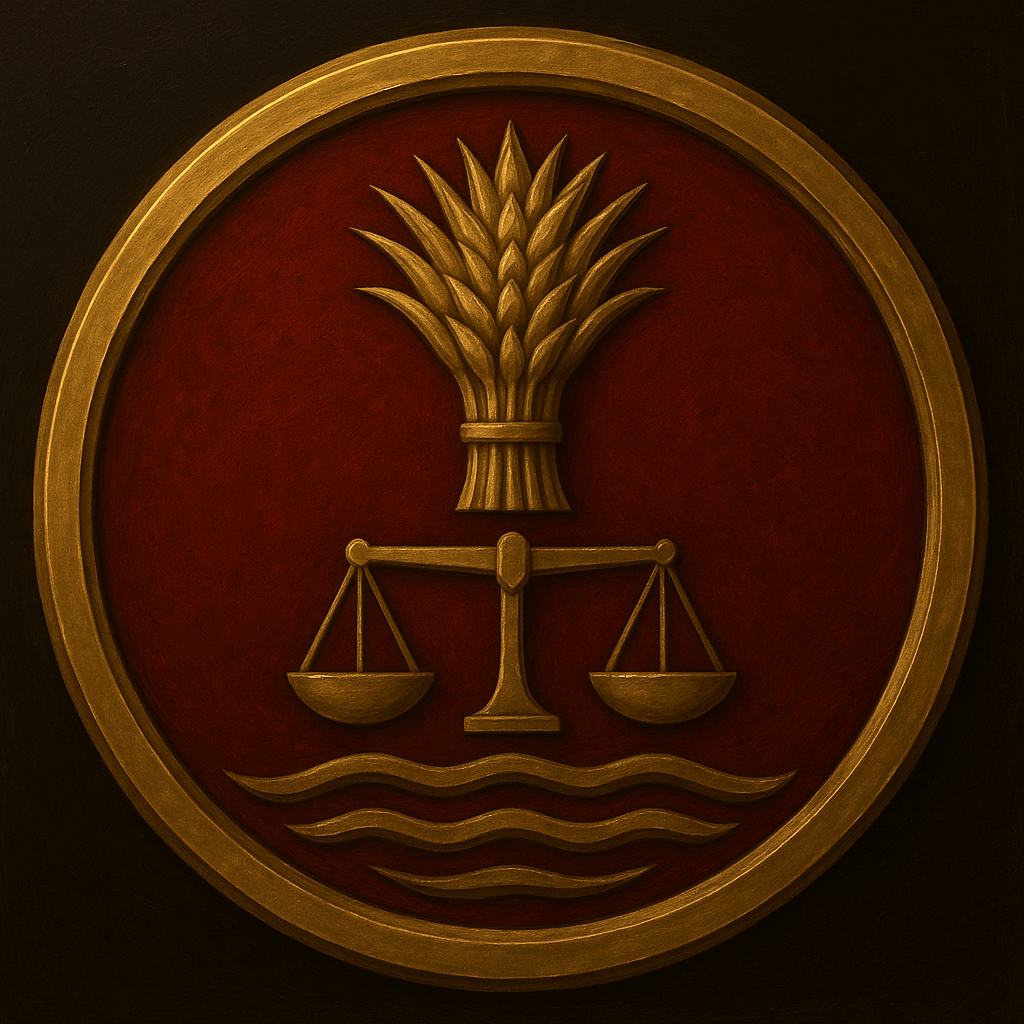
House Valerianus is one of the Imperium’s most economically entrenched noble lineages, rising to prominence through the twin pillars of agricultural dominance and financial stewardship. Rooted in the fertile eastern provinces, the family’s estates produce grain, olives, wine, and livestock at scales unmatched across Solaria. These lands form the breadbasket that feeds urban centres, sustains provincial garrisons, and supports the capital’s ever-growing population.
Leveraging this abundance, the Valeriani extended their reach into Imperial finance. Through calculated political alliances, strategic lending, and decades of reliable provisioning for the legions, they gained authority over revenue assessments, treasury oversight, and coinage standards. Today they stand as the quiet architects of the Empire’s economic health — conservative, powerful, and indispensable.
Neither flamboyant nor martial, the Valeriani embody patient accumulation and subtle leverage. Their voice in the Senate is calm but decisive; their influence is most strongly felt in policy, not parade. If Severiana governs intellect and Solaris governs order, Valerianus governs prosperity — controlling the flow of food and funds upon which the Imperium depends.
Culture
The Valerian culture is built upon stewardship, precision, and generational prudence. Children are raised between manor halls and estate fields, expected to understand harvest cycles as readily as balance sheets. Every Valerian heir is educated in economics, agriculture, logistics, and statecraft, with the expectation that they will one day act as custodians of the Empire’s stability.
Wealth is never to be flaunted — only demonstrated through reliability, generosity during crisis, and impeccably run estates. The Valeriani consider themselves guardians of material wellbeing, with a philosophy that treats prosperity as a moral duty rather than personal reward.
Their social conduct is formal and reserved. Conversations favour policy over poetry, numbers over nuance. Although they lack the glamour of magical bloodlines or battlefield glory, their sobriety commands deep respect from those who understand that true power often lies in who feeds the legions and who funds the state.
Assets
Agricultural Dominance
House Valerianus controls vast stretches of eastern farmland, producing grain, grapes, olives, and high-quality livestock. Their estates are run with quasi-military discipline, ensuring consistently high yields even during difficult seasons.
Granary Control
The Eastern Reserve Granaries, fortified complexes built during early Rift-era famines, allow the Valeriani to stabilise food markets and secure political leverage through controlled release of stored grain.
Treasury Integration
Valerian-trained administrators hold posts across the Imperial Revenue Office. The family oversees tax assessments, commodity analysis, and long-term resource planning.
Coinage Authority
While the Imperial Mint remains state-run, House Valerianus advises on metal sourcing, purity standards, and coinage quotas — a responsibility that grants quiet but immense influence.
Trade Route Holdings
The family owns warehouses and distribution hubs along:
- Via Solaria Occidentalis — the western overland trade artery linking the Brass Cities to the Empire.
- The Mare Australe Passage — the southern maritime corridor carrying goods along the Imperial coast.
Financial Networks
Their credit lines support merchants, minor nobles, and occasionally entire provinces, creating a web of obligation and loyalty.
History
House Valerianus traces its lineage to Lucius Valerianus, a landholding patrician Rifted into Exilum Novum with fertile estates and a talent for negotiation. While other nobles struggled to adapt, Lucius quickly recognised the importance of stable food supplies in the aftermath of the Rift. His well-managed granaries became the salvation of multiple early settlements.
In 106 NE, after preventing a province-wide famine, the Senate formally elevated the Valerianus line to noble status. From there, the family expanded its estates, secured transport rights along the eastern rivers, and aligned itself with key financial offices in Novaium.
By the third century NE, their influence over both agriculture and treasury functions had solidified into an unshakeable legacy. Centuries later, the Valeriani remain synonymous with economic continuity — the house that feeds the Empire and balances its books.
Infrastructure
Villa Valeriana
The ancestral seat — a sprawling manor overlooking the eastern plains, complete with administrative wings, wine terraces, olive groves, and expansive granaries.
Eastern Reserve Granaries
Massive storage complexes fortified against weather, theft, and wartime disruption. Their release schedules can shift entire provincial economies.
Valerian Ledger Hall (Novaium)
A polished marble bureau in the capital where accountants, auditors, and treasury envoys coordinate fiscal policy, trade forecasts, and taxation reports.
Estate Road Network
Privately maintained roads linking fields, river ports, and market towns — enabling enormous logistical efficiency.
River Ports & Carriage Fleet
A fleet of barges moves produce along eastern rivers toward Canncia, connecting agrarian production to maritime trade via the Mare Australe Passage.
Coin-Standard Repository
A secure vault holding historical coinage moulds, metal purity standards, and financial records dating back centuries.

Comments