
House Marcellon
“The tides favour the prepared.”
House Marcellon is a coastal mercantile lineage whose wealth and influence flow from the bustling fishing fleets and trade docks of Canncia, the jewel of Malaqu County’s eastern shore. Unlike the martial houses of the frontier or the refined patricians of Novaium, the Marcellons built their prestige on commerce: salted fish, coastal trade, maritime logistics, and shrewd dealings with Halfling merchants whose vessels frequently traverse the eastern seas.
The family’s success is rooted not in ancient bloodlines or imperial favour, but in generations of practical labour, risk-taking, and a near-instinctive understanding of the sea. Their rise from respected guildmasters to formally recognised nobility is one of the Empire’s most iconic tales of entrepreneurial ascent. Today, the Marcellons wield considerable soft power in coastal provinces, influencing shipping routes, market prices, and the flow of goods that sustain both local populations and the wider Imperial economy.
They are respected as pragmatic, forward-thinking traders with a cosmopolitan streak born from constant exposure to foreign crews, exotic goods, and the unpredictable moods of the sea. Though their interests lie far from the capital’s intrigue, few houses match their combination of wealth, adaptability, and community influence along the eastern shores.
Culture
Marcellon culture is shaped by salt wind, open water, and the rhythmic certainty of tides. Their values reflect the realities of maritime life: preparedness, adaptability, and a clear-eyed acceptance that profit and survival often hinge on timing. Marcellons are straightforward in manner, occasionally brusque, but rarely deceptive — in trade as at sea, they believe clarity prevents disaster.
Children are raised among docks, nets, and fish markets, learning to appraise quality by scent and weight before they can read. They are taught the fundamentals of seamanship, haggling, accounting, and weather lore. Storytelling is a staple of family life, with elders recounting storms survived, trade routes opened, and deals struck with foreign captains who became lifelong allies.
The house places great emphasis on community trust. A Marcellon is expected to honour agreements, avoid exploitative practices, and maintain a reputation for fairness — not out of altruism, but because commerce thrives on reliability. Their feasts are lively, grounded in coastal traditions: grilled fish, spiced stews, sea-greens, and songs accompanied by the creaking of ships in harbour.
They are more relaxed than most noble houses, disinterested in rigid ceremony or excessive ornamentation. Yet beneath their informal exterior lies a fierce pride in the work that built their house: honest trade, hard labour, and generations of weathered hands gripping oars and ledgers alike.
Assets
House Marcellon’s strength lies in its robust coastal empire of commerce. Their primary assets include:
- A vast fishing fleet: dozens of trawlers, longboats, and deep-sea vessels operating out of Canncia, supplying markets across Solaria and beyond.
- Canncian Fishery Yards: enormous processing and salting facilities employing hundreds, capable of preserving enough fish to feed entire legions during campaign seasons.
- Trade Warehouses & Dock Rights: exclusive rights to several prime piers in Canncia’s harbour, enabling control of loading schedules, storage fees, and maritime logistics.
- Halfling Trade Partnerships: longstanding agreements with Halfling merchant vessels, giving the Marcellons access to foreign spices, textiles, preserved fruits, and exotic commodities otherwise rare in Imperial markets.
- Coastal Estates: modest in grandeur but strategically located along key sea routes, these estates allow the family to monitor maritime traffic and support their shipping operations.
Their wealth is fluid — tied to market cycles, weather conditions, and trade winds — but consistently immense. While other noble families rely on land or military contracts, the Marcellons thrive wherever ships travel and goods change hands.
History
House Marcellon originated not in palaces or senatorial halls but in the humble markets of early Canncia. Its founder, Lucia Marcellona, was a fisherwoman of remarkable tenacity who built the first large-scale cooperative fishing enterprise shortly after Canncia’s expansion in the mid-Imperial era. By negotiating fair prices for her crews and investing relentlessly in better boats and salting techniques, Lucia transformed a struggling port into the eastern province’s beating economic heart.
Her descendants expanded the business with ruthless efficiency and shrewd maritime diplomacy. They established trade routes along the eastern coast, formed alliances with Halfling captains, and developed preservation methods that allowed Canncian fish to be shipped deep inland without spoilage — a breakthrough eagerly adopted by the legions and the Senate.
Their elevation into the nobility came in 412 NE, after the Marcellons supplied food during a major winter famine that struck the eastern provinces. Their intervention saved thousands, and the Senate recognised their indispensable contribution to Imperial stability by formalising House Marcellon.
Since then, the house has navigated political waters with the same expertise they apply to maritime routes — carefully, profitably, and always with an eye on the horizon.
Agriculture & Industry
While not agricultural in the traditional inland sense, House Marcellon oversees a robust maritime-industrial complex built around three essential pillars:
Fishing Industry
Crews working under Marcellon contracts form a significant portion of Canncia’s labour force. Fishing schedules are tightly coordinated, with fleets specialising in seasonal species to avoid stock depletion. The family invests in sustainability, recognising that overfishing threatens both livelihood and legacy.
Salt Production
The Marcellon-controlled Salt Fields of South Canncia are among the most productive in the eastern Imperium. Shallow evaporation pools, wind-driven drying, and meticulous refinement techniques produce salt of consistent quality, essential for both food preservation and trade.
Maritime Manufacturing
Their shipwright workshops produce vessels ranging from small inshore fishing boats to mid-sized merchant trawlers. They also manufacture nets, lines, floats, hooks, and coastal infrastructure such as pier-timbers and buoy markers — forming a vertically integrated maritime economy unrivalled in the region.
Together, these industries form the backbone of Malaqu County’s coastal prosperity and secure House Marcellon’s position as the unchallenged rulers of eastern trade.
Trade & Transport
House Marcellon presides over one of the most sophisticated coastal trade networks in the eastern Imperium. Their operations radiate outward from Canncia, whose natural harbour and deep-water approaches make it the primary maritime gateway of Malaqu County. Through this port flows an immense exchange of goods: fish, salt, grain, spices, Halfling imports, coastal timber, and seasonal luxury items drawn from the far reaches of the eastern sea.
Marcellon trade routes are meticulously planned, following predictable wind cycles and ocean currents known only to seasoned navigators. Their fleets operate in rotating circuits — inshore boats bringing daily catches to Canncia’s ever-hungry markets, mid-range vessels transporting preserved fish to neighbouring provinces, and deep-sea trawlers forging longer expeditions in pursuit of high-value hauls. The house maintains extensive relationships with Halfling merchant captains, whose fast ocean-going craft ferry Marcellon goods to distant ports in exchange for foreign wares coveted by Imperial buyers.
Transport is not limited to sea routes. Marcellon caravans travel inland along Malaqu’s riverways and roads, distributing salted fish, smoked goods, and preserved seafood to settlements far removed from the coast. These caravans are known for punctuality and security, their logistics refined to a near-science. The house invests heavily in infrastructure — warehouses, oared barges, distribution hubs, and road maintenance partnerships — ensuring their products reach markets without spoilage.
In negotiations with the Senate, House Marcellon often advocates for improved maritime laws, harbour standards, and coastal lighthouse construction, arguing (correctly) that the stability of the eastern economy depends upon predictable, secure transport routes. Their influence is such that seasonal naval patrols are frequently scheduled around Marcellon trade patterns, ensuring that piracy never threatens the lifeblood of Canncia’s market.
Through an interlocking system of ships, caravans, warehouses, and long-standing partnerships, House Marcellon has transformed trade into both an art and a lifeline —
Infrastructure
House Marcellon’s infrastructure is among the most impressive of any mercantile house, though not in the manner of patrician villas or frontier fortresses. Their power rests in:
Canncian Great Fishery
A sprawling harbour complex including salting sheds, smokehouses, drying racks, and vast cold-storage halls. It hums from dawn to dusk with labourers, sailors, traders, and inspectors.
Marcellon Harbour Offices
An elegant administrative building overlooking the main docks, designed to process contracts, tariffs, and fleet logistics with bureaucratic precision.
The Tide-House
Their family seat, modest by noble standards but perched on a cliff overlooking the harbour. Built from whitewashed stone and sturdy timbers, it features large balconies where family councils watch the sea to divine changes in trade winds.
Fleet Workshops
Boatyards where skilled carpenters repair hulls, maintain sails, and craft new vessels for the ever-growing fleet.
Salt Holdings
Salt flats and evaporation fields located south of Canncia, indispensable for preserving their catch.
Everything is functional, durable, and economically focused. Even their noble estate resembles a guildhouse more than a palace — a testament to the values that built the Marcellon name.
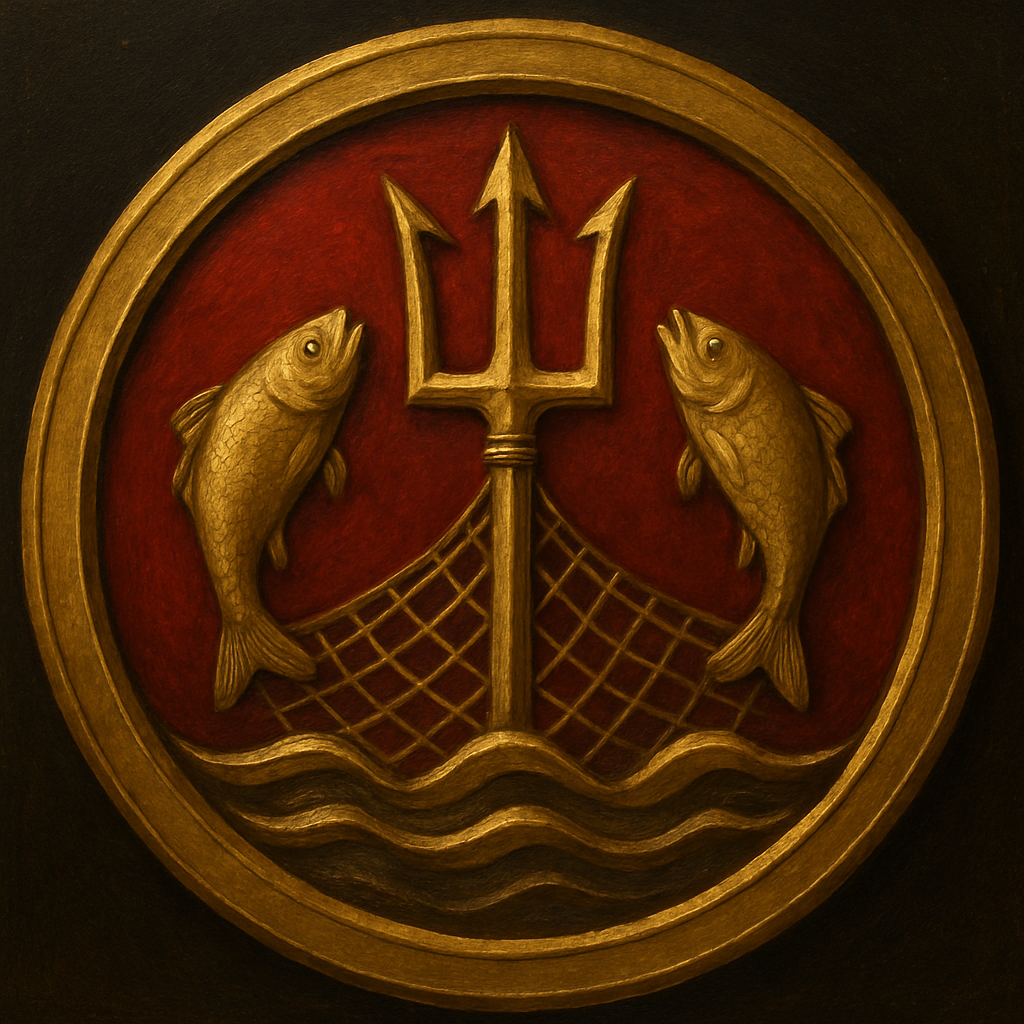
“Prosper by the Tide.”
Marcellon exports are among the most widely distributed goods across Solaria and neighbouring provinces:
- Salted and Smoked Fish
- Preserved Seafood
- Maritime Tools and Ship Components
- Salt
- Coastal Timber and Boat Frames
House Marcellon’s import network is vast, shaped by centuries of cooperation with Halfling sailors and eastern maritime traders. Their primary imports include:
- Spices and Preserved Fruits
- Exotic Textiles
- Foreign Hardwoods & Ship Resin
- Medicinal Salts & Sea-herbs

Comments