
House Ferrata
“Strength is forged, not found.”
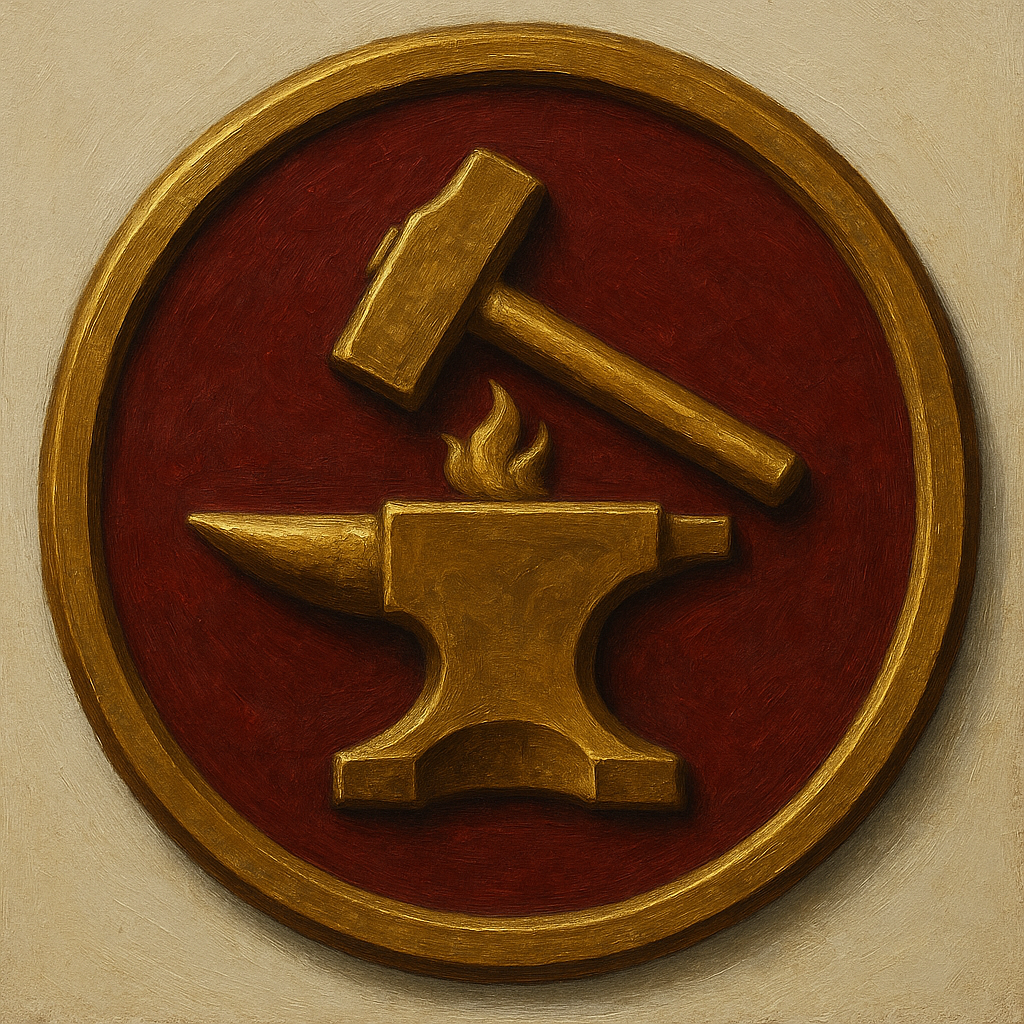
House Ferrata is the Imperium’s pre-eminent lineage of armourers, metallurgists, and military craftsmen — a noble house whose prestige is built not on ancestral glory or senatorial eloquence but on the steady, ringing certainty of hammer against anvil. While most patrician houses derive their identity from politics, piety, or frontier vigilance, the Ferrata forged theirs in fire. Their forges arm the Imperial legions, their artisans maintain the capital’s great standards, and their metallurgists produce alloys found nowhere outside their workshops.
The family’s influence is pervasive yet understated: without Ferratan iron, no legion marches; without Ferratan standards, no banner rallies the ranks; without Ferratan engineers, no siege engine is trusted in battle. Their reputation for exacting craftsmanship has grown across centuries, and legionary officers often speak the house name with the same respect reserved for their commanders. For the Empire, the Ferrata are not merely smiths — they are the stewards of its military spine.
House Ferrata long ago secured the Senate’s recognition not through diplomacy or inheritance, but through unwavering service. Their forges have burned without interruption since the first century NE, evolving from a practical necessity into an institution of military reliability. To bear the Ferrata name is to inherit discipline, precision, and the quiet conviction that steel, shaped properly, can outlast kingdoms.
Culture
Ferratan culture is defined by discipline, craft mastery, and a near-religious reverence for the forging process. Children of the house are raised in the heat of the forge halls, taught to distinguish metals by sound, weight, and scent before they can properly read. Patience is drilled into them as rigorously as martial skill is taught to the legions. A Ferratan does not rush a task, for imperfect workmanship is considered a moral failing.
The family embraces a culture of merit — skill commands respect regardless of birth order. Even the house head is expected to wield a hammer and inspect raw stock personally. Rituals revolve around the lighting of forge-fires, the consecration of tools, and the remembrance of master-smiths who advanced Imperial metallurgy. Meals are simple, discussions practical, and praise offered sparingly; Ferratans believe excellence should speak for itself.
In society they are viewed as industrious, blunt, and unromantic. Their manners are crisp, their judgements sharp, and their attitude toward idleness famously intolerant. They do not posture in the Senate nor cultivate excessive luxury. Instead, they uphold what they consider their sacred duty: equipping the Imperium so that others may fight in its defence. To them, a poorly maintained weapon is a breach of honour equal to cowardice.
Assets
House Ferrata commands extensive industrial holdings centred in the Iron Districts of Novaium, where their forge-complexes form a dense cluster of workshops, foundries, testing yards, and metallurgical laboratories. These facilities operate continuously, maintained by teams of master-smiths, engineers, and apprentices who labour under the house’s uncompromising standards.
Their most valuable asset is the Ferratan Pattern Forge, an ancient complex whose original hearths were lit in the early days after the Rift and have never been extinguished. Within these halls, the family produces imperial-standard spears, armour plates, shield bosses, and ceremonial standards. Many of the Empire’s most iconic relics — including several legionary aquilae and the sceptres of early emperors — were shaped in Ferratan fire.
The family also controls several iron and mineral rights in Solaria and northern provinces, ensuring a steady supply of ore. Their wealth is considerable, derived from defence contracts, specialised commissions, and the selling of finely wrought civilian tools. Yet House Ferrata rarely flaunts its income; funds are reinvested into improving ore refining, alloy experimentation, and forge infrastructure.
They maintain small contingents of private security — mostly retired legionaries — to protect their forges, but no organised military force. The Ferrata protect the Empire through steel, not armies.
History
House Ferrata emerged in the first century after the Rift, during the period when the young Imperium struggled to stabilise its supply chains and arm its expanding legions. Its founder, Titus Ferratus, was a master-smith who served the original Rifted legion. When the Empire settled in Exilum Novum, Titus took upon himself the monumental task of adapting Roman metallurgy to the properties of newly discovered ores and minerals. His innovations in smelting and alloy formation led to stronger spearheads and more resilient armour — advancements that caught the Senate’s attention.
By 78 NE, after decades of providing indispensable service to the military, the Senate formally elevated House Ferrata to noble status. Their forges became official suppliers to the legions, and Titus’s descendants inherited the responsibility of maintaining consistency in weapon production. Over the centuries, the Ferrata advanced Imperial metallurgy through countless refinements: cold-weather alloys for northern campaigns, reinforced shield-rims for urban combat, and ceremonial metals for imperial rites.
During conflicts with the Warborn, Drusennus commanders relied heavily on Ferratan expertise to maintain frontier armouries. The house also collaborated with the Collegium Arcanum when arcane forges were first developed, helping integrate rift-infused materials into Imperial weapon design.
Despite occasional tension with patrician elites who viewed smithing as too “common” a profession for nobility, House Ferrata’s reputation for reliability has never faltered. Their history is one of unbroken service — a lineage that has hammered its legacy into the bones of the Empire.
Infrastructure
Ferratan infrastructure is sprawling, functional, and unmistakably industrial. Their primary estate, Ferratan Hearthhold, is both a noble residence and a massive forge-complex, its central atrium dominated by the original hearths lit by Titus Ferratus himself. The air is perpetually warm, filled with the scent of coal, oil, and steel; every chamber is oriented around efficiency and workflow.
Across Novaium’s Iron Districts, the family maintains smelting towers, quenching halls, alloy laboratories, and precision workshops where master artisans refine designs for legion equipment. Most structures are reinforced stone with thick chimneys and vaulted ceilings capable of handling intense heat. Storage vaults lie underground, humidity-controlled and guarded at all hours.
Ferrata-controlled roads link their foundries to legion depots and transport hubs, enabling rapid distribution of arms and armour. Their estates also include training halls where apprentices practice forging techniques, and drafting rooms where engineers collaborate with legion quartermasters on new equipment patterns.
Practicality defines every structure: wide corridors for moving raw ore, pulley systems for lifting ingots, and relief frescoes depicting famous Ferratan weapons. Even their private chambers retain a sense of austere purpose — this is a house shaped by craft, not ceremony.

Comments