
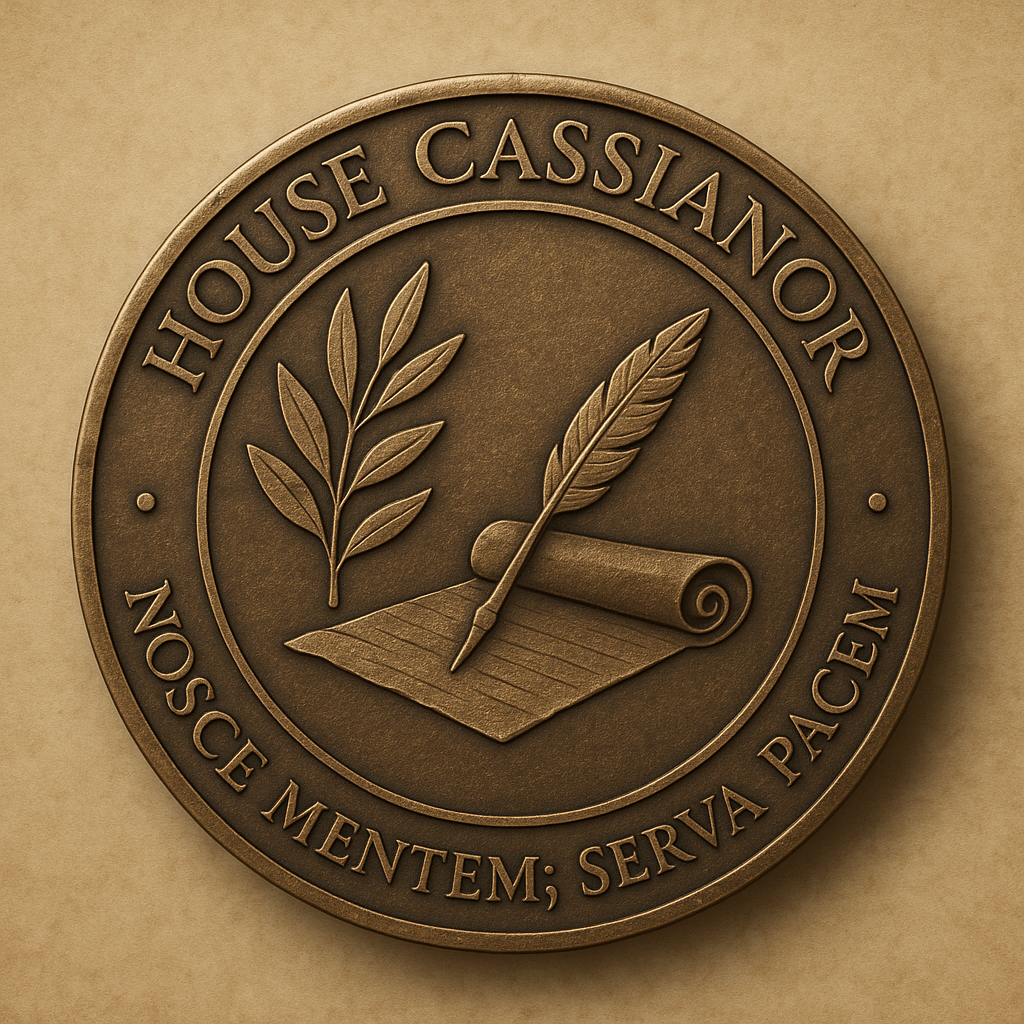
House Cassianor
“Know the mind, steady the hand, keep the peace.”
House Cassianor stands as the Imperium’s foremost lineage of diplomats, cultural mediators, and architects of peace. While other patrician houses carved their legacies through conquest, governance, or piety, the Cassianor forged theirs at negotiating tables, border encampments, and the hard terrain of inter-civilisational tension. From the earliest centuries of the Imperium, their envoys walked paths few dared tread — south to the Halfling harbours, east toward the expanding influence of the Brass Cities, and west across the uncertain frontiers where Centaur riders kept their own counsel.
The Cassianor reputation rests on three virtues: insight, restraint, and unshakeable composure. Their diplomats are trained from childhood to read intention as easily as language, to temper emotion with calculation, and to understand that peace is not maintained by sentiment but by clarity, preparation, and a keen awareness of what each party stands to lose. Their work has prevented wars, restored trade, and shaped treaties that still hold the Empire together.
Though often overshadowed by more martial or aristocratic houses, their influence is profound. Imperial commanders value the Cassianor for their ability to de-escalate border conflicts before swords are drawn; senators rely on them for clarity on foreign laws and customs; and the Emperor turns to them when diplomacy must be extended without appearing weak. If the Aureliata are the spine of Imperial duty and the Draconis its earned honour, then the Cassianor are the hands that steady the realm’s borders.
In temperament, the house is cosmopolitan and worldly. Its members are fluent in foreign tongues, comfortable in unfamiliar courts, and at ease navigating a dozen cultures. They are not idealists but pragmatists, believing peace to be the most stable foundation upon which the Empire may prosper.
Culture
The culture of House Cassianor is rooted in observation, discipline, and a deep respect for the complexities of civilisation. From an early age, children of the house are instructed in rhetoric, foreign languages, comparative customs, and the subtle art of reading motive through expression and gesture. Emotional control is prized; a Cassianoran does not raise their voice unless doing so is calculated, and they do not allow their pride to sabotage the long game of diplomacy.
Hospitality is a central virtue of the house. Their halls in Novaium are famous for hosting foreign envoys, scholars, merchants, and explorers — guests who are received not with opulence but with impeccable etiquette, attentive listening, and a careful display of Imperial dignity. Cassianor feasts are quiet affairs, where conversation is valued above theatrics, and where foreign dignitaries often find a sympathetic ear even when the Senate turns cold.
The house also embraces a culture of meticulous record-keeping. Each diplomatic mission, treaty, cultural exchange, and negotiation is preserved in the Cassianoran Archives of Accord, a private yet respected repository of agreements and grievances dating back centuries. These records inform new negotiations and ensure that no Cassianoran diplomat steps into a foreign court without the weight of precedent at their back.
Their values lean toward pragmatism. They believe that a treaty that prevents bloodshed is preferable to a victory that demands it, and that the Empire’s dignity is best preserved not by bluster, but by the quiet mastery of protocol. To be Cassianoran is to understand that stability is earned at the cost of patience, insight, and impeccable timing.
Assets
House Cassianor maintains a refined but restrained portfolio of assets, each selected for its utility in diplomacy rather than display. Their primary estate in Novaium serves as both residence and embassy, designed with interconnected courtyards and reception chambers that allow private negotiations to unfold away from the Senate’s more theatrical spaces. The architecture is elegant but never ostentatious — the house prides itself on demonstrating dignity rather than wealth.
Their most valuable asset is the Cassianoran Archives of Accord, a vast collection of treaties, cultural analyses, linguistic guides, and diplomatic correspondences extending back to the first century NE. Scholars and magistrates often request access when preparing for negotiations with foreign civilisations, though permission is granted sparingly and always under supervision. The archive is considered one of the Empire’s most reliable external-memory systems for inter-civilisational relations.
Beyond Novaium, House Cassianor owns a small number of estates positioned near key trade routes and diplomatic crossings. These holdings are designed to host envoys, serve as neutral meeting grounds, or act as temporary resupply stations for diplomatic missions. They generate income through hospitality, trade facilitation, and a modest but steady investment in maritime commerce tied to Halfling shipping networks.
The house neither fields soldiers nor maintains mercantile dominance; their strength lies in soft power, accumulated knowledge, and a network of relationships cultivated across generations. Their wealth is measured not in legions or land, but in access, influence, and trust.
History
The roots of House Cassianor reach into the second generation after the Roman Rift, when the Imperium first began encountering neighbouring civilisations whose customs and languages differed from their own. Early tensions with the Centaurs, Halflings, and later the Brass Cities often threatened to erupt into open conflict, until a young magistrate named Publius Cassianor successfully negotiated a ceasefire between two rival Centaur clans. His work, unconventional at the time, demonstrated that diplomacy could secure what military force alone could not.
Recognised for this achievement, Publius founded House Cassianor in 41 NE, establishing a tradition of diplomatic service that would shape the Empire’s relationships for centuries. Their greatest triumph came with the early treaties forged with the Centaurs, whose unpredictable raiding patterns had long strained Imperial resources, and later with the Halfling Enclave, whose maritime trade routes became essential to the Empire’s economy.
During periods of expansion and arcane disruption, House Cassianor served as the Empire’s stabilising instrument. They mediated territorial misunderstandings during the rise of the Brass Cities, assisted in cultural integration following peaceful Rift events, and drafted legislation guiding how Imperial citizens interact with foreign travellers and envoys.
While never as politically dominant as Aureliata or as publicly lionised as Draconis, the Cassianor influence permeates the Empire’s foundations. Their signatures appear on treaties that kept borders calm, their counsel guided emperors during moments of uncertainty, and their methods trained generations of diplomats who ensured the Empire never mistook arrogance for strength.
Today, House Cassianor remains indispensable. In an age where new Rifts still open and unknown banners appear on distant horizons, it is the Cassianor who remind the Empire that clarity, patience, and understanding are the first tools of survival in a world shaped by discontinuity.
Infrastructure
The infrastructure of House Cassianor reflects their diplomatic vocation: elegant, functional, and meticulously arranged to facilitate quiet conversation and careful negotiation. Their principal residence in Novaium, known as the House of Accord, is designed around enclosed gardens, colonnades, and shaded porticos that allow dignitaries to meet informally without the spectacle of the Senate or the rigidity of military halls.
Within the House of Accord lies the Hall of Concordance, a circular chamber where negotiations are conducted beneath frescoes depicting historic treaties and peaceful reconciliations. The chamber’s acoustics are intentionally soft, encouraging measured speech and discouraging raised voices. Private antechambers lead off from the hall, each soundproofed and designed for confidential discussion.
Attached to the complex is the Cassianoran Archives of Accord, a multi-level library secured by both mundane and Arcanii-approved methods to ensure the integrity of sensitive documents. The archive contains reading chambers, translation rooms, and diplomatic rehearsal spaces where envoys prepare for foreign audiences by studying cultural behaviours under Cassianoran tutors.
Outside Novaium, the family maintains several neutral lodges along major roads and frontier crossings. These lodges function as rest houses, training sites for junior diplomats, and safe meeting places for cross-cultural negotiations. They are modestly defended — enough to deter brigands, but never so fortified as to suggest military intent.
Every structure owned by the Cassianor reflects intentionality: calm lighting, controlled acoustics, and designs that emphasise harmony over dominance. Their infrastructure stands as a reminder that diplomacy is an architecture of stability — built stone by stone through patience and understanding.

Comments