
House Caeliadus
“Light the flame; honour the fallen.”
House Caeliadus is one of the Empire’s oldest and most venerable patrician families, revered not for martial conquest or political ambition but for its unwavering guardianship of Imperial funerary tradition. Since the earliest decades after the Roman Rift, the Caeliadus line has stood at the intersection of civic piety, ritual remembrance, and the sacred duty of honouring the dead. Their influence flows not from armies or wealth but from the profound moral authority they wield over the Empire’s rites of closure, mourning, and ancestral veneration.
Members of the house have long served within the Civic Priesthood of the Phoenix, acting as priests, ritualists, archivists of the dead, and custodians of the torchlit processions that define the Empire’s relationship with memory. To the Caeliadus, remembrance is not a sentimental act but a civic obligation — the tie that binds the living to the past and preserves the moral spine of the Imperium. Their household is steeped in ritual discipline: children are raised in the philosophy of impermanence, the importance of bearing witness, and the belief that to forget the fallen is to erode the foundation of the state.
House Caeliadus holds a quiet but enduring presence in the Senate, where their interventions, though rare, carry unusual weight. They speak only when a matter touches the spiritual integrity of the Empire — funerary law, civic rites, or the ethical treatment of those whose names risk fading into oblivion. In such moments, even the most hardened generals and ambitious nobles pause, knowing that Caeliadan words echo with centuries of sacred trust.
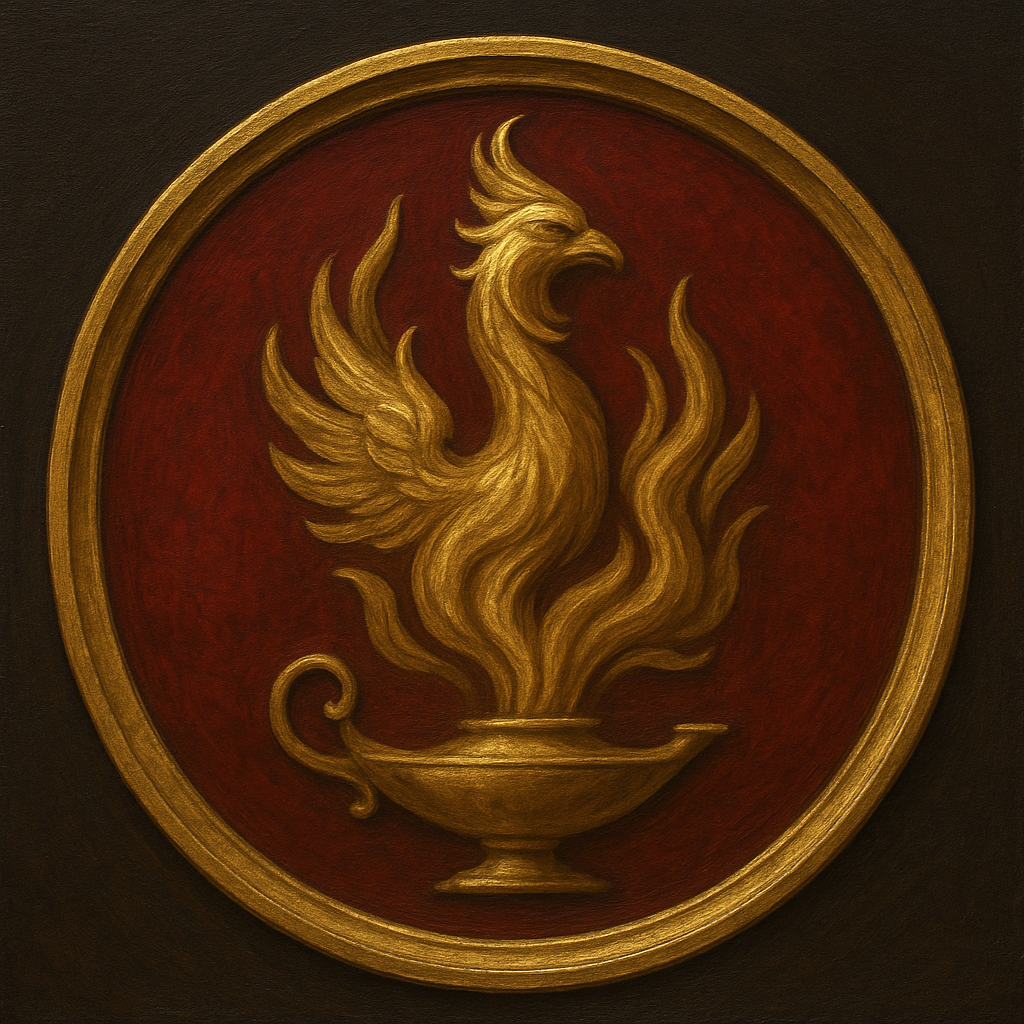
In temperament, the house is solemn, introspective, and austere. They do not court popularity, yet they are universally respected. Their compounds, both in Nova Roma and in the provinces, are more akin to sanctuaries than noble villas, adorned with ever-burning lamps, memorial tablets, and the soft glow of phoenix symbolism. Through quiet vigilance, House Caeliadus ensures that the Empire remembers its dead — and in doing so, preserves its soul.
Culture
The culture of House Caeliadus is shaped by a profound and enduring relationship with death, remembrance, and civic sanctity. Unlike many patrician houses that cultivate prestige through military triumphs or political theatre, the Caeliadus cultivate reverence. Their lives unfold according to ritual rhythms: dawn lamps lit for ancestors, evening offerings at household shrines, and the meticulous upkeep of memorial tablets recording the names of the fallen. Their philosophy teaches that the Empire’s greatness rests not merely on conquest or governance, but on its fidelity to those who came before.
Within the household, children are raised in a disciplined environment where solemnity is not equated with sorrow but with clarity of purpose. They learn early to move with quiet respect, to speak thoughtfully, and to treat funerary rites as an honour rather than a burden. Emotional restraint is valued, not to suppress feeling but to show respect for the weight of their responsibilities. A Caeliadan laughter is rare but sincere; their grief, when shown, is deliberate and dignified.
Ritual permeates every aspect of their lives. Births are marked with vows to honour the lineage, and deaths are occasions of both mourning and celebration — the passing of a flame from one generation to the next. The household observes strict purification rites, especially before and after major civic ceremonies, believing that spiritual integrity is essential to preserving the Empire’s moral stability. Even their architecture reflects their values: open courtyards filled with lanterns, corridors lined with inscriptions, and quiet chambers dedicated to meditation on impermanence.
Although they hold seats in the Senate, the Caeliadus do not engage in political manoeuvring unless required by matters of ritual law or civic ethics. They view their influence as a stewardship rather than an entitlement. Their counsel is sought when the Empire wavers in its remembrance — when cities must honour the fallen after war, when festivals drift from their solemn origins, or when the Senate debates legislation touching upon burial, commemoration, or spiritual duty.
Among common citizens, House Caeliadus is regarded with a mixture of reverence and gentle awe. They are not seen as aloof nobles but as custodians of something sacred — the memory of the Empire itself. To meet a Caeliadan is to be reminded that life is brief, duty is enduring, and the flame of the past must be carried with humility into the future.
Assets
House Caeliadus commands few material riches compared to other patrician families, yet possesses resources of profound cultural and spiritual weight. Their primary holdings are a series of ancestral sanctuaries within Novaium, most notably in the districts surrounding the Imperial processional routes where funerary and civic rites are most often performed. These sanctuaries, each built around an ever-burning phoenix lamp, serve as ceremonial halls for remembrance, state mourning, and the ritual obligations tied to the Civic Priesthood of the Phoenix.
Their estates are quiet, contemplative complexes rather than opulent villas, designed to facilitate ritual purity rather than social display. Here lie the Caeliadan Memorial Vaults, chambers filled with meticulously preserved tablets, scrolls, and funerary registries. These records chronicle generations of Imperial citizens — soldiers, magistrates, commoners, and nobles alike — and are often consulted by magistrates and scholars when resolving matters of lineage, burial rights, or historical precedent. Among all Caeliadan holdings, these archives are considered their most sacred asset.
The house maintains an extensive collection of ritual instruments: consecrated lamps, phoenix-carved censers, ceremonial braziers, purified oils, and scrolls of liturgical verse used in rites of passage and remembrance. Many of these objects are centuries old, revered not for their craftsmanship but for the generations of devotion they have absorbed through use. Each item is catalogued and preserved with the same care given to their ancestral records.
Financially, House Caeliadus subsists on modest senatorial stipends, offerings given during rites, and patronage from those who seek guidance or honour their dead. They command no private soldiers, no trade fleets, and no mercantile ventures; their influence is moral rather than material. Still, their sanctuaries are never unguarded — ceremonial attendants and hereditary retainers watch over them, bound by multigenerational loyalty rather than wages.
In essence, the assets of House Caeliadus are measured not in gold but in continuity: the trust of citizens, the sanctity of ancient rites, and the solemn responsibility of safeguarding the Empire’s memory.
History
The origins of House Caeliadus trace back to the earliest decades following the Roman Rift, when the newly displaced settlers struggled to understand their place within an unfamiliar world. Amid the uncertainty and loss of those first years, a small group of Romans took it upon themselves to preserve the rites of mourning, burial, and remembrance that had defined their ancestral culture. From this devotion, the Caeliadus lineage emerged.
The first recorded ancestor, Marcia Caeliada, served as a ritual attendant during the establishment of Novaium. She tended the lamps that burned for those who perished in the initial years of hardship, and her calm stewardship of mourning rites drew others to her. Over time, the family became synonymous with the care of the dead, and their guidance helped transform fragmented Roman customs into the formalised funerary tradition adopted throughout the developing Imperium.
By the mid-first century NE, House Caeliadus had become the natural custodian of remembrance within Novaium. Their early sanctuaries—simple structures built near the city’s first stone roads—were recognised by both magistrates and legion commanders as essential to maintaining civic order. The house formalised its responsibilities under the nascent Civic Priesthood of the Phoenix, whose rising flame came to symbolise the endurance of memory in a world shaped by rifts, upheaval, and renewal.
Their influence deepened in 9 NE, when Caeliadan ritualists played a central role in the state mourning that followed the Pact of Iron and Stone, guiding the Empire through months of tension and loss. The dignity of their ceremonies secured them both public trust and patrician status. From that moment onward, the Caeliadus were no longer merely keepers of tradition—they were stewards of the Empire’s soul.
Throughout the centuries, they have intervened sparingly in political affairs, choosing instead to shape policy in moments of ethical uncertainty. In times of war, they oversaw the naming and burial of the fallen. In times of plague or disaster, their sanctuaries served as centres of solace, documentation, and ritual purification. Their archives became one of the Empire’s most reliable sources of generational memory, consulted by scholars, magistrates, and even emperors seeking clarity on lineage or ceremonial precedent.
House Caeliadus has endured without scandal or upheaval, its influence running deep but silent. Unlike other noble families, their legacy does not rest in conquests or treaties, but in a collective act of preservation: the unwavering belief that an Empire forgets its dead at the cost of its identity. Through centuries of devotion, their name has become synonymous with reverence, continuity, and the sacred duty of remembrance.
Infrastructure
The infrastructure of House Caeliadus is unlike that of any other patrician family, shaped not by political grandeur or military might but by the quiet architecture of remembrance. Their holdings within Novaium form a constellation of sanctuaries, memorial chambers, and ritual spaces that together create the spiritual backbone of the Empire’s funerary tradition.
At the centre of their domain stands the Caeliadan Ancestral Hearth, a solemn complex situated near Novaium’s processional avenues. It is composed of open courtyards lit by continual lamps, shadowed cloisters inscribed with the names of the fallen, and a central hall where the Phoenix Flame burns day and night. The entire structure is built in the restrained stonework of early Imperial design—arches, vaulted ceilings, and muted frescoes depicting the cycle of death and renewal. Its atmosphere is one of stillness, broken only by the measured footsteps of attendants and the soft crackle of ritual flame.
Beneath this complex stretches the Memorial Vault, an underground archive of funerary records and ancestral tablets maintained with exacting discipline. The vault’s corridors form a labyrinth of memory, each chamber dedicated to different centuries, legions, civic offices, or notable events. Its indexing system has been refined over generations, allowing magistrates and scholars to trace lineages or verify ancient honours with precision unmatched elsewhere in the Empire.
Outside the capital, the Caeliadus maintain several rural sanctuaries used for purification rites and seasonal observances. These structures are modest—stone chapels, lone watchtowers, shrine gardens—yet each contains an ever-burning lamp tended by local attendants sworn to the family. These sites serve as places of retreat for Caeliadan priests preparing for major ceremonies or recovering from the spiritual toll of extended ritual service.
The family commands no fortifications beyond what is required to protect their sanctuaries, nor do they maintain private barracks or administrative courts. Instead, their infrastructure expresses continuity and reverence: stone polished smooth by generations of mourners, lamps fed with consecrated oil, and quiet chambers designed for meditation, prayer, and ritual instruction.
Even their storage spaces are shaped by purpose rather than wealth—carefully controlled rooms for preserving purified oils, ceremonial robes, and phoenix-carved censers; sealed cabinets that house ancient tokens entrusted to the family by grateful citizens; and repositories for the ashes of ritual flame, believed to carry residual sanctity.
In sum, the infrastructure of House Caeliadus is an architecture of duty: built to sustain memory, uphold the Empire’s sacred traditions, and ensure that no life—however humble—is consigned to oblivion.

Comments