
Raluine Fungus may seem terrifying at first. A fungus that hunts for meat sounds like a horror show premise. And make no mistake, it's certainly not a good way to go.
It grows over you, encasing you in a cocoon of mycelium. Then it grows into you til you are nothing but bones and fibers.
But Raluine Fungus is a very efficient decomposer, not a hunter.
It takes about four hours to encompass a full-grown sophont, and the mycelium is easy to remove if you stay on the move.
The danger of Raluine Fungus comes from being uneducated and unprepared.
Raliune Fungus is a family of decomposers that grow in the temperate environments surrounding the Valuser'rh Region. They tend to grow on well-traveled pathways or trails, where they wait for food to come to them.
They have multiple stages of life, starting from a tiny spore that can spread to a kilometer-wide singular entity. The larger a Raluine Fungus can grow, the more nutrients are in the soil to support it. While this makes them a greater threat to Sophont, it also serves as a natural fertilization method.
They are cultivated in agriculture to provide fertilization, and they are also capable of converting the aggressive plant-life into mulch, making them a great way to protect areas from overgrowth.
Facts
Biology
The Raluine Fungus can grow in a shade from pale yellow to a dusty white and grey. Other varieties have shown deep red or oily black if exposed to certain metaphysical conditions such as Glisterwax.
The sensing tendrils slither up from the ground in razor-thin appendages. In many species, they have a near-translucent appearance as a way to hide from foraging predators.
See that?
No, no. Get on your knees and look!
See that glistening in there? That's the sun reflecting of Raluine. We can't stop here unless you want to be digging fungus out of your boots.
The fruiting bodies of the Raluine Fungus are bulbous, multi-chambered bodies with a distinct sulfuric stench. Their spores are contained in the pressurized chambers which will explode when touched.
There is core growth below the central fruit that serves as the brain of the Raluine Fungus. Destroying that fruit and the flesh beneath it will kill the entire colony over the period of four days. Any remaining spores will be ejected in an attempt to replant itself.
Unique Traits
The Raluine Fungus will seek out carbon dioxide and warmth. Tendrils will rise from the ground like tiny worms and begin to clutch onto their target. If the target is still, the fungus will continue to grow and interlink to form a sheet around the potential food.
Once the sheet is formed, the fungus will begin growing inwards to devour the captured food. Depending on the size of the prey, this will take several days. Fruits will bud from the growth, and once complete with digestion, they will spore. Finally, the cocoon will become brittle and break apart, revealing whatever was not digestible.
Within the perimeter of the Fungus, small grass-like tendrils will sprout from the ground. These tendrils are cheap to produce for the planet, but are exceptionally sensitive.
These growths are well hidden and hard to spot, growing in other native grasses and plant life. Once something brushes against the tendrils, it sends back an electrical impulse that triggers a spurt of growth of the sensory tendrils. The more tendrils are touched, the stronger the impulse.
Raluine Fungus expands through a crawling mass of mycelium that worms its way through the ground to expand its area of control. It grows in a spiral pattern out from the center. If it encounters a block it can't push through, it will follow the surface until it surrounds it.
Mycelium will grow into thicker bands if a source of food is discovered, and the entire plant will grow at a much faster pace if properly sated.
See it growing up your pant legs already? Those little—
No no! Don't panic, no need for it. Just move your leg away, see? It comes right off.
Just keep your head, and keep moving. If you see a lot of it, it probably means creatures have been dying nearby.
Life Stages
The Life of a Raluine Fungus
During the spore stage, the Raluine Fungus is flung from its parent's fruiting body. It is light enough to be carried by the wind or on the bodies of passing animals. Once the small teardrop-shaped spores fall to the ground, they will begin to root and spread downwards. In a day, it will have burrowed several centimeters down allowing it to start forming a central root.
It can grow on almost any surface, from dirt to rock to flesh.
This Stage takes up to a week to complete. At this point, the spores are little threat except to air filters, which can clog with spores.

Pictured Above: A placeholder for spores burrowing into a surface.
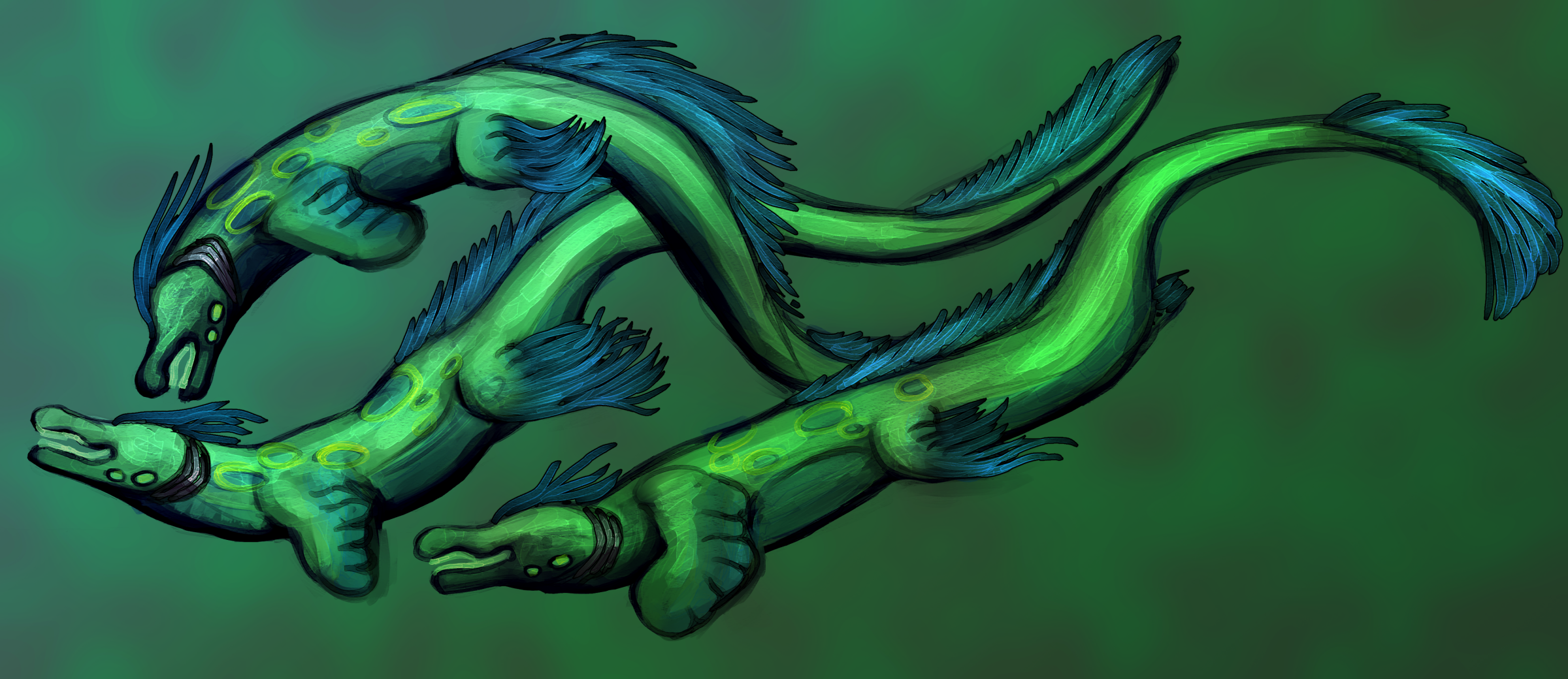
Pictured Above: During the Swimmer Stage of the lifecycle, larval Snare-Snappers will form 'schools' as they travel upwards towards the surface. They will remain in schools until they enter their adult phases.
The explosive phase of the Fungus occurs once a suitable central base of solid mycelium has formed. Once critical mass is reached, the central growth will begin expanding outwards in a spiral pattern, sensing tendrils will sprout from the ground
This is the most aggressive phase of the Fungus, growing a meter every other day. Competitors such as Valuser'rh Ivy are grown over, strangled, and broken down. Animals are forced to flee the ground or become overgrown themselves. Even packs of Tonogra can be uprooted from their dens by the explosive growth.
This phase can prove dangerous if an unwary person steps on explosive Raluine.
After reaching two to three meters in diameter, the Fungus will slow down its growth to centimeters instead of meters. This is the point where the Fungus has stored up enough energy to begin forming its central fruit above the center.
If large prey is found, the Fungus will continue to grow outwards in that direction, forming spiderwebs of subterranean mycelium networks and feelers that can extend for several dozen meters beyond the main 'body.'
During this stage of life satellite fruiting clusters will form as a way to attract foot traffic while also distracting predators from the central core of the Fungal colony.
Pictured Above: A placeholder for a colony of Fungal fruit rising from a vaguely critter-shaped mound.
Pictured Above: A placeholder of a Sazashi footprint in the soil, it has sunken several centimeters in, signifying that the mycelium underneath has passed away and left a loamy top soil.
A Raluine Fungus can be killed in several ways.
If the central mycelium fruit is destroyed and no other fruit remains, the fungus will break down.
If the central core is poisoned or removed, the fungus will die off.
If the temperature is freezing or too hot for an extended period, the fungus will shrivel and die.
After Raluine Fungus dies, the mycelium shrinks before breaking down into its remaining nutrients. This process makes the soil very soft, to the point where the top layer can collapse like a pit fall.
The leftover soil from the death is very rich in nutrients, making it perfect for new life to grow.
Sophontic Interaction
Agricultural Use
Raluine Fungus can be sown into hard or dead soil to gather nutrients and aerate the ground. This practice is mainly done through traditional Shejlt-rajh farming methods, as Raluine Fungus can outgrow a lackluster farmer and overtake a field.
The Shejlt-rajh strode through the seemingly barren field of dirt. She peered at the ground, scrying for something that I couldn't see.
She took another step and froze. Her ears perked up, and she stomped twice on the same spot in the ground.
With a smooth motion, she removed a harpoon from the quiver on her back and plunged it into the soil. It sank to the hilt, and a bright yellow flag denoted its location. I assumed for later collection.
The ground beneath us quivered for a split second. We kept walking.
"One hundred and ninety-nine to go." My guide spoke in hoarse, broken Ubiq.
Ivy Control
Raluine Fungus' first purpose came through its natural evolution alongside other aggressive plants in the Valuser'ran region. The Raluine Fungus evolved to defend its area against competing overgrowth. The external perimeter is dense in sensory tendrils. When hostile plants approach, the fungus enters attack mode, growing over the encroaching plant to either stunt its growth or kill it.
These battles between plant and fungus provide a wealth of essential nutrients from the decomposition and can fuel the growth of the fungus.
Sophonts, especially the Shejlt-Ra, have utilized the fungus to control ivy growth as the fungus is easier to remove than the Ivy is.
Predation and Myths
Raluine Fungus is capable of breaking a sophontic corpse down in a week or so. There are thousands of documented cases of corpses recovered from fungal cocoons, including some examples of casualties who were killed by the Fungus itself.
This reputation has been stoked from the early days of the Valuser'ran Supremacy where the fungus was used as a torture and execution method. In the modern era, the Raluine Fungus has been depicted as a way for shady people to dump a body or as a secret killer in the night.
In reality, the Fungus is more of a nuisance. The feelers and growth can bog you down if you are not careful, but being injured by one can only happen when you can't move for nearly half a day.



A fascinating organism, with a unique form of predation. I think my biggest question is: why has it evolved a centralized "brain"? Fungal nervous-analogue processes are distributed throughout the mycelial net which is distinctly advantageous for their niche as decomposers. Did the Raluine Fungus evolve the centralized nervous-analogue node as an adaptation to more active predation?
That's what I was thinking, Spyglass, a centralized nervous-analogue node allows the fungus to form a 'perimeter' around itself so it can defend itself against predators and competing plant life. I also loved the idea of this Fungus being easier to control via this central nervous system-like feature. It is something I'm doing to maybe tweak a bit, but I'd have to think of ways to take down the fungus to prevent it from being able to take over all the land haha. Great question Spyglass, hit me up on Discord sometime if you have more ideas!
Wanna see some good articles? Of course you do.
Showcase