You can find Snare-Snapper wherever there's water. From the surface creeks all the way down to the oceans in the Abyss. Up here on the surface, they'll just take give you a good bite, but down in the Abyss?
They'll swallow you and all the gear you carryin' whole.
The Snare Snapper is a family of scaled quadrupedal species native to Jhoutai. They live hundreds of years, and have a life cycle that takes them from the bottom of the ocean, up to the surface, and back down again.
Snare Snappers are omnivorous opportunists, catching prey with its very own lure and snare, a specialized powerful tongue with a ring at the end. Whatever unlucky thing it catches will be paralyzed, reeled in and chomped on by their long razor-lined maw.
A unique trait of Snare Snappers is they will mate for life, traveling in a pair and only changing mates if their chosen partner is slain.
Facts
Biology
The most specialized element of a Snare-Snapper is it's long and powerful tongue, which it uses as a lure and a line in its aquatic and in some rare cases, terrestrial hunting.
The tongue is about three as long as the length of their body from snout to tail, and is tipped with a ring that grows wider with age. When the Snare-snapper senses a vibration, they will constrict the ring in their tongue to lasso their potential find. The tongue is then rapidly yanked backwards by a specialized bone and muscle structure in the lower jaw.
The ring of the tongue changes between subspecies, some are basic, but some subspecies have evolved dazzling or oddly shaped tongue rings to attract certain prey.
Venomous Fishing
In some subspecies, the loop of the tongue is covered with jelly-fish like nematocysts that envenom prey. This venom is intended to weaken prey being reeled in or as a defense against predators. If left untreated, the venom causes paralysis and extreme burning pain in the limb.
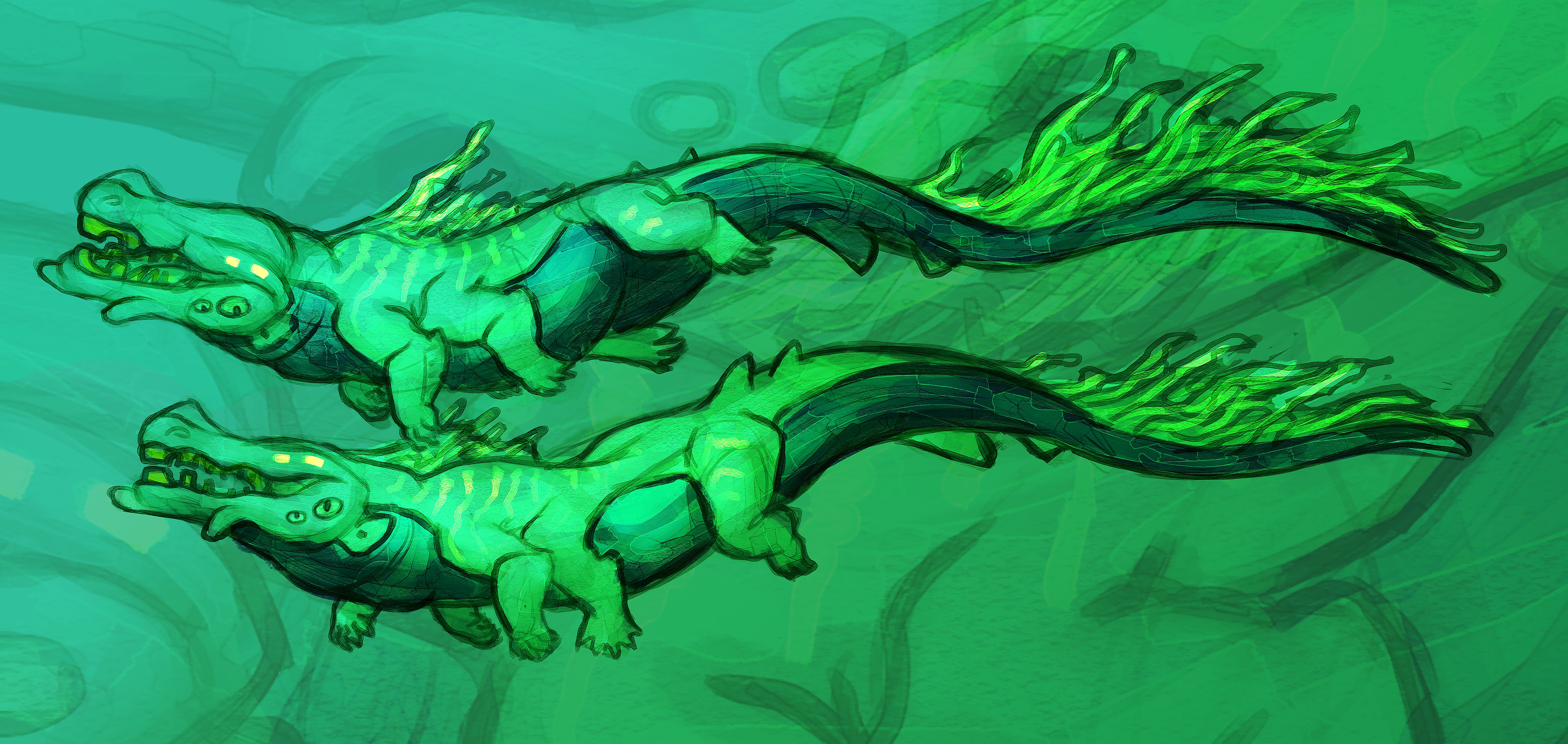
In the adult phase of it's life, a Snare-snapper closely resembles an Earthen Crocodile; with it's long body, thick propelling tail, and its low to the ground stature.
Unlike Crocodiles, Snare-snappers have an extra set of legs in the front that serve multiple purposes. They can be used to sprint, or they can be used to plant into the ground to reel in a catch with their tongue.
A Snare-snapper does not like to chase prey, as it expends a lot of energy, but they will use their limbs to reach burst speed of up to 40 KMH. They typically will do this to escape or finish off wounded prey.
In Water
Snare-snappers can move swiftly in the water by twisting and propelling their bodies through the water, when they use their thick tail they can even propel themselves several meters into the air. When not fishing, they will hunt by ambushing prey from the water.
Exceptionally large Snare-snappers will rarely go on land due to their size, but they make up for this by being tremendously fast in the water, up to 60 KMH.
The Snare-snapper's mouth an elongated snout that is first intended to swallow prey whole. As it grows into it's adult stage, the bone of the jaws begins to extrude into sharp plates that function as teeth.
Adult Snare-snappers have anywhere between 6 and 10 teeth. The number of teeth changes between subspecies. The teeth function like the blades of a pair of scissors. They either close off escape for swallowed prey or they take a chunk out of whatever they can bite into.
Bite Danger
Snare-snappers in their adult phase will also have a infectious microbiome, which can lead to necrosis and paralysis if not properly treated. If the species is venomous, their mouths carry the same venom as their tongues.
Snare-snappers have olfactory receptors strong enough to sense blood or other scents from a kilometer away. Their tongue is exceptionally sensitive to vibrations and movements, and is complex enough to not be tricked by most inorganic material.
They have an array of four ears located on the back portion of their head, it's theorized they evolved this way to listen to the land behind them since they are primarily facing the water when hunting.
Poor Eyesight
Their eyesight is their weakness, they detect primarily movement and only in a cone directly in front of them, but they are exceptionally sensitive to vibrations around them and their environment. They can be quick to startle if they feel something approach them from behind.
Life Stages

Pictured Above: A Valuser'rh lake known as a bed for larval metamorphosis and the first stages of a Snare-Snapper's growth.
A Snare-snapper starts life as a larva barely the size of a finger tip and through out it's life, it will travel from the deepest depths of the ocean, to the rivers of the mainland, and back down again.
I struggled to understand what the guide was explainin' at first, but I think I got it.
The entire surface is basically a corralum waterslide down to a great big ocean below us. The Snare-snapper comes all the way up from the ocean so it can spend a lifetime riding the slide all the way back down again.
The Life of a Snare-Snapper
A Snare Snapper starts life at the bottom of the sea, where they are spawned by their parents. Thousands of little larva burst from eggsacs that were carefully placed by their mother. These larva will follow the currents of the Corralum tubes until they reach the ocean.
During this stage the Snare Snappers are the most vulnerable, and only a small percentage make it out to the ocean to being their next stage of life. They have not evolved any of their teeth yet, their scales are soft, and their tongue is but a sticky spike they cast out while they float.
A larval Snare-snapper's primary diet are krill and plankton-like creatures that inhabit the abyss and lower oceans of Jhoutai.

Pictured Above: A Luea ocean-village will harvest tons of Snare-snappers at this stage for their protein content and savory flavor.
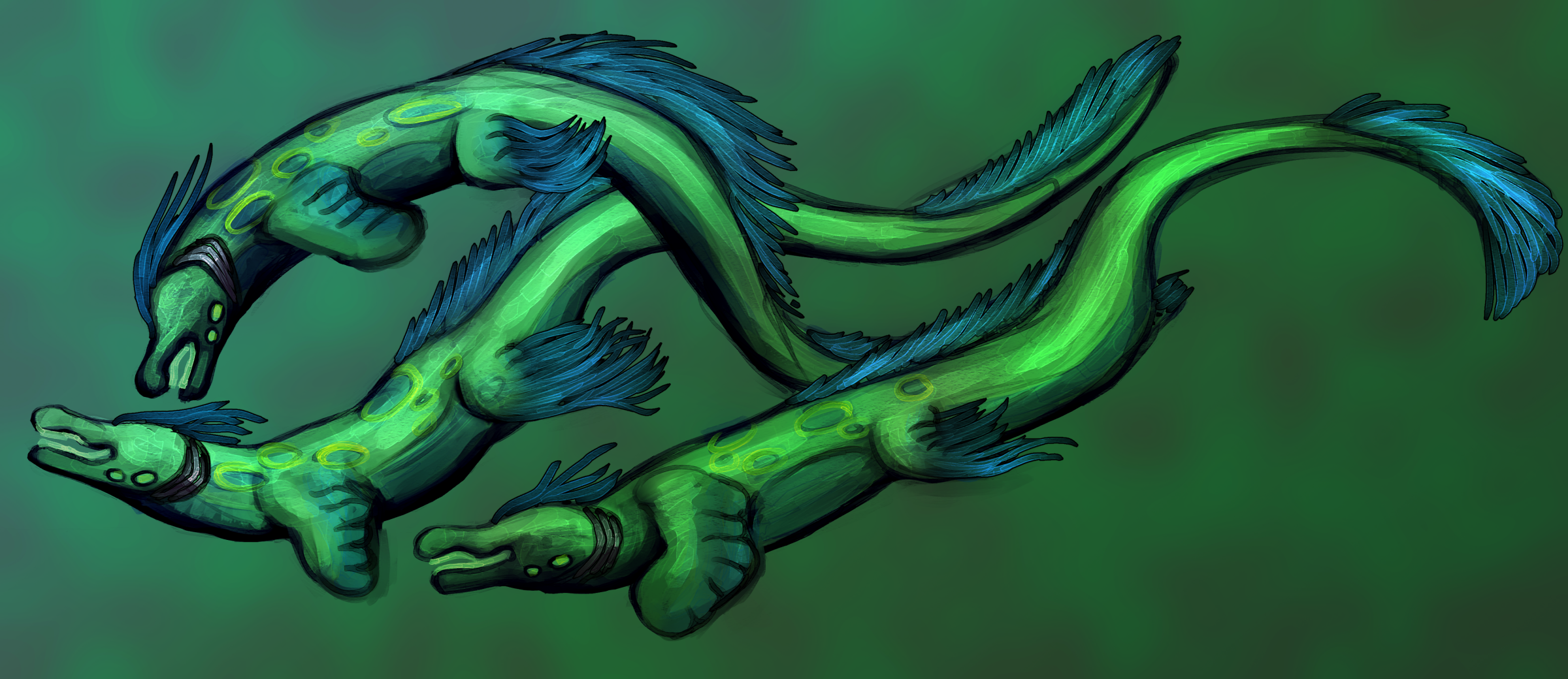
Pictured Above: During the Swimmer Stage of the lifecycle, larval Snare-Snappers will form 'schools' as they travel upwards towards the surface. They will remain in schools until they enter their adult phases.
This stage of the life cycle involves a long journey upwards. This stage will take the tiny larval Snare-snappers up to the shallower waters and shorelines.
During this stage the Snare-snapper will develop stronger fin appendages and they take on an eel-like length and movement. They slither through the water, letting their tongue out grasp anything that might swim into them.
As they grow closer to the surface, their smaller and translucent scales will begin to harden and turn opaque as a way to defend itself from the new UV light it is being exposed to.
This stage ends when the young Snare-Snappers move inland to begin finding mates.
At this stage, the Snare-Snappers have begun to undergo another wave of metamorphosis: their fins begin to grow into full fledged legs, and their size triples in the span of just a few weeks.
At this stage, they are drawn inland, moving from the coasts and oceans and into the surface and subsurface corralum layers. They do this through a dangerous journey that takes them through the riparian zones of the Corralum, filled with predators, and while they are formidible fighters even at this stage, a lone swarming snare-snapper doesn't stand a chance against a Tonagra or Laughing Night
Traveling so far in the corralums requires strength and energy, and so a Snare-snapper's first layer of teeth will grow in at this stage.
They are absolutely ravenous at this stage of their life, and will bite at anything fleshy it comes across to try and take a chunk.

Pictured Above: A Tonagra, a primary competing predator on the surface and subsurface levels of Jhoutai. Fights are quick, typically with a few young snare-snappers dead and an occassional Tonogra nursing a missing chunk.
Pictured Above: A mated pair of Peak phase Snare-Snappers swim together in a lake, at this stage, most Snare-Snappers will come in pairs. Aggression towards one will cause the other to retaliate as well.
Life Partners
During this stage, Snare-snappers begin to search for their life-long mate. Once bonded they will try to travel together for the rest of their lives.
Now that they are at the top level of the corralum, they continue to slowly migrate their way down, following the water back towards the ocean. This is the majority of their life span, and at this stage they have acheived full motion of their legs and become semi-terrestrial, especially to hunt and find their mate.
As they grow older, they wind up deeper in the maze of corralum tunnels, gaining size and widening their diet. They start with either stealing bites off of bigger prey, or swallowing smaller prey whole.
If you feel a strong tug at your leg, don't just reach down to pull it, either cut it or rip and toss it if you are desperate. You let the Snare-snapper reel in to you and you're gonna be missing a limb or just straight up gone.
Once they find their way back down to the Abyss, they mate and expire where their bodies will provide nutrients to the deep ocean.
At these stage, the Snare-snappers can be massive, as large as a city bus. They will eat anything that encroaches on its territory, which can be an entire kilometer cubed.
I've spent years working the abyssal erosion control shift, setting up those nettings that keep the cities from collapsing. It's not the cushiest job, but this was the first time I saw just how dangerous it is.
I watched our rookie plummet all the way down into the ocean. Must have been a half-kilo down into nothing but blackness.
He didn't die at first, called out to us for help, not like we could do anything.
I saw the beam of his headlamp looking up at us, then they began to swim towards the netting.
I had just started to cheer him on when I heard his scream and the light was pulled under and gone.
Nesting and Reproduction
A majority of Snare-snappers do not reach the age and depth needed to begin reproduction. Snare-snapper bodies are sensitive to the specific environment provided by the Abyss. Once they hit the correct depth, they will make a nest with their mate if they have one, or seek a new mate if they lost their first.
Nests are typically built in the porous corralum walls, they will find a section near the abyssal shore to make their nest. Once they are comfortable, they will begin to lay eggs in pre-scouted locations.
Beware the Deep
The Abyssal Ocean is not to be traversed by small boat or by swimming, as Deep Snare-snappers are capable of destroying small vessels and devouring cargo and passengers whole.
All vessels are expected to be carrying proficient weaponry to deal with Deep Snare-snappers.
Sophontic Interaction
As Food
Snare-snappers in their swimmer phase have been fished commercially since the The Vadakendanic Procession. Their meat at this stage is oily and flakey, and is a popular protein and is a stable in Luean and Helyk cuisine.
Peak Snare-snapper meat is firm and mild tasting, it has a low fat content overall but certain cuts around the belly are fattier. It is not until recently that a Snare-snappers life cycle was fully understood thanks to the introduction of remote trackers and so farming Snare-Snapper was not a possibility.
In the Banner-Era, a synthetic subspecies of Snare-snappers are farmed using vertical hydroponics that help simulate a microscopic version of the Snare-snappers life cycle.
Other Harvested Parts
Their unique tongue is harvested as well, where it can be used for traditional binding applications. There are records of the first Verin, using Snare-snapper tongues as slings for hunting.
Snare-snapper hides are tough, and it hardens as they grow older. Ancient armors made from Snare-snapper used to be the most expensive on the market, due to their light weight, flexibility, and capability to stop a thrust spear.
As Pets
Do you think it's a good idea to keep something that can swallow you whole as a pet?
A concerning few do.
Keeping Snare-snappers as pets is illegal in most Banners that have animal laws. They also have no imprint capabilities or ability to domesticate to sophontic care. This doesn't dissaude some who keep them and say they are 'pets', despite the growing list of caretakers swallowed whole or dismembered by their supposed best friends.
This danger is exponentially greater because in captivity, Snare-snappers can grow to enormous size if given the space. Limiting their size is reliant on limiting their diet and space.
Give a Snare-snapper a cookie, and soon it'll be eating grandma.
Snare-Snapper Riding
Snare-Snappers are practically impossible to turn into mounts, just as they are impossible to domesticate. However some skilled tamers (particularly the Sauthei) are capable of raising Snare-Snappers into a lifelong companion and mount. Doing so has a lot of risks, as an errant brush with the Snare-Snappers tongue or not having total control can lead to a disastrous fate.

Pictured Above: A Sauthei rides their Snare-Snapper through the subsurface waterways of Jhoutai, providing a uniquely fast mode of transportation through the maze-like corralum.
Gallery


I love how just about every new creature feels like y'all asking "ok how can we make Jhoutai even scarier?" Lotta great info here! Their lasso-tongue is real creative, and the depth you go into on their life cycle is fascinating!
Why thank you Grace, these guys were a lot of fun to work on. Despite being so scary, Hiive went and made them kinda adorable! I'm glad you thought the concept was creative, very difficult to make critters who feel unique!
Wanna see some good articles? Of course you do.
Showcase