
Windpots are a domesticated genus of Kite that has coevolved along side the Sazashi since they were discovered on the mainland.
They are a staple livestock of the Aempians & Negenani people. They are raised for their milk-like byproduct, meat, and bioplastic. Ranching Windpots can be done at small and large scale, with the largest Kite fields taking up over a thousand acres and consisting of tens of thousands of kites.
As their diet consists of airborne fungus spores and smaller creatures, they also provide a natural pest control for cities with the space to raise them.
Log of Adventine Sal Ritter
Waking up in the Drat'n Metkrah apartment was quite an experience. I couldn't appreciate the scenery at night, but with the morning sun, I could see across the Korum plains. In the distance, I saw thousands of specks floating on the horizon.
"What are those?" I asked my native Aen guide. They joined me at the window, taking in the view.
"You mean the Windpots? Those little specks? They're livestock." The Aen looked at me, as if half-expecting me not to know what livestock meant.
I leaned in and squinted. On some of the closest specks, I could see a long string dangling towards the ground.
"Ranchers use the rope to guide them in for milking and care; the rest of the time, they soak up the sun and eat all the spores they can," he explained, "We will go see them today, get dressed."

One of the first Sazashi livestock
When the Sazashi were sent by the Vadakendanic Procession to colonize the mainland, food was not provided for them as it could not be reliably shipped from Verra. Part of the colonization mission was to find stable sources of food, a difficult task considering the lack of suitable farmland.
Initial colonists struggled to survive off of foraging and hunting until the discovery of the first Windpot Herds. The Sazashi that settled near what would become Drat'n Metkrah first wrangled the Wildpots and discovered their ability to produce Milk. They tied small leads to the Windpots, and created synthetic nests for them. These nests provided the Windpots safe haven and a place to store excess milk 'jugs' and gave Sazashi a new source of milk, cheese, and meat.
The domestication of Windpots helped stabilize the nutrient intake of the Sazashi mainlanders, allowing them to thrive even without the backing of Verra.
Without these Windpots and their gifts of milk and meat, all of us might still be under the heel of the Procession.
The Biology of the Windpot
The Windpot is a six-legged Rutas with a body broken into three distinct segments and one head. Their back and sides are strapped with four air-tight bladders for storing methane. Large bioplastic wings stretch out of the two middle segments. The wings are fragile but can be used to dash and propel through the air.
The Windpot has four eyes, one pair located on the top of the head, and the other pair is located at the bottom, behind the bottom jaw. Their mouths are lined with thick baleen used to filter out particulates in the air. Above and below their mouth, sensitive hollow hairs sense changes in the atmosphere, allowing them to prepare for incoming changes.
The legs and body of the creature are covered in a layer of short green and black fur which is patterned with black dots. These dots resemble eyes, a natural defense.
As Windpots eat, unused energy is stored as a protein-rich milk. This milk is stored in woven bioplastic jugs that stick to the middle two pairs of legs.
Pictured to the Right — A Cloudskipper Kite, which I wish was a Windpot Kite, but also art is hard.

The two back legs of the Windpot are long and dangle like tentacles. They can wrap around objects and are very dexterous. They are used to roost at night by latching onto surfaces.
The front and middle legs are shorter but more robust. All three pairs of legs are tipped with bioplastic glands that are used for weaving wings or new buckets.
The Windpot has two pairs of eyes. The larger set is on the top side of the head, and a smaller pair is located on the lower side.
These compound eyes are capable of seeing into the UV spectrum and spotting minute clouds of fungal spores.
One on each side and two on the back, the leathery float sacks are how the Windpot floats through the air effortlessly.
These sacks are filled with methane, which is gathered from their nests during the nights.
Windpot Wings consist of a chitinous skeleton that stretches above the middle body segment in a V-shape. The V-shape is filled in with a thin layer of firm bioplastic excretion.
The color of the wings changes to match their diet. Wing patterns can be used to get an overall picture of the Windpot's Health from a distance.
The Story of the First Windpot
Stories tell of us the first Windpot who fell from the heavens and landed on the head of a young Sazashi just like you...
The little Windpot grew on the head of the young Sazashi. The young Sazashi cared for it and walked it around the entire town.
At first, the town ridiculed them. Saying it would carry him away to his death or bring the rest of the creatures down for revenge.
But then, the creature on the Sazashi's head would begin to eat the fungus that plagued the town. The Windpot was so good at eating fungus that the people of the town paid them to walk around the city.
The young Sazashi and the Windpot on their head were treasured by the town.
The Windpot grew in size, and for the first time, it attempted to float off from the Sazashi's head. The young one caught it between their hands and held on tight.
Over the next few days, the young Sazashi panicked and trapped their friend inside their room. Without the Windpot, they felt hopeless, purposeless. They felt they would lose their best friend.
But, as they saw the Windpot bump into the window over and over again, day after day, they knew they couldn't keep it inside forever.
So, they talked to the town, and they helped craft a string of Vampire Vine that stretched back and forth through the whole town twice!
The young Sazashi gently tied the rope to his best friend, but just loose enough that if it wanted to leave forever, it could.
They staked the other end of the rope to their front door, so that the Windpot could always find its way back home if it wanted to.
For months, they woke up each morning, expecting to find the rope to have fallen back to the ground, but every morning the rope waved back at them, stretching high into the clouds above.
The problem came when the young Sazashi no longer had a purpose; no one paid them to walk around anymore. And without the help of their Windpot, the young Sazashi struggled to find food.
But at least they still knew their friend was out there in the sky.
One day, the young Sazashi found the Windpot had sunken down to the ground. At first, they assumed it was hurt or sick. As they looked closer, they found their friend had brought milk in its own woven plastic jugs.
The young Sazashi drank of the milk and felt a surge of strength. Excited, they took the other jug to the villagers, who declared it a gift from the Wheel.
The Windpot saved its caretaker and, over the next few years, convinced other Windpots flying high in the sky to lay eggs on other Sazashi.
Soon, the Sazashi made homes for the Windpots, who thanked them with milk enough for the entire village and by keeping their skies clean of harmful fungal spores.
And that's the story of how our Windpots came to be.
The Windpot Cycle
The Windpot Kite reproduces by sinking into the lower atmosphere and ejecting clouds of pollen and eggs into the air. These eggs are wrapped in a thin layer of ultralight bioplastic, which makes them sticky to the touch.
At this same time, Mature Windpots will craft a bowl-shaped nest that trails behind them. When an egg is fertilized, it will begin to sink as cellular reproduction takes place. Windpot kites will swoop to only a couple meters from the ground to catch fertilized eggs in their nest.
Eggs that don't get caught fall to the ground where they are an easy snack for creatures like the Tonagra or other Scavengers.
As the young Windpots grow on the nests, the caretaker Windpot will fly through clouds of fungal spores to feed them.
Raising Windpots
Jhoutaioan's have created large nets for catching eggs that fly too low to be picked up naturally. These eggs are then stored in high-up simulated nests for safekeeping and feeding. When they grow to adults, they are attached to a lightweight string so they can fly outside and 'graze' on fungal clouds.

Pictured Above: A Tonogra, one of the predators of the low flying Kites and Kite spawn.

Pictured Above: A place holder image of a guy walking along corralum, this will hopefully depict a rancher walking along with a young Windpot drifting besides them on a string.
When Windpots are large enough to float on their own, they will depart the nest and float alongside the rest of the Windpot swarm. As they start feeding, they will begin forming sacks alongside them, which are filled with the byproduct of their digestion. The byproduct is stored as a water-based liquid in woven bioplastic jugs on the Windpots side. When full, the jugs will break off naturally or be broken off by a collision with a high tree or another Windpot.
During this phase, they have a few natural predators. Predatory flying creatures such as Raptorhounds can be a threat to Windpot swarms, and when they swoop low, opportunistic predators such as the Tonogra can pounce on them.
Domestication
When domesticated, adult Windpot Kites will return to the nest to leave their milk and get cared for by the ranchers. At this phase, the strings holding the Windpots to the nest can be broken. A length of string is left to dangle, both to assist in handling and to identify the Windpot at a distance.
Log of Adventine Sal Ritter
We rode out of the city, which was a process in itself. A small caravan was put together, including a Ral-Mi Extermintor who carried a nasty-looking spear.
"No worry, safe trip." His translation came back choppy, thanks to his thick rolling accent.
"We're at the Windpot nests." The Aen added, pointing outside. A large sculpted tower rose from the ground. A hut had been constructed on the top, with what looked to be a pair of covered balconies. As we grew closer, I saw dozens of the strings coming out of the balconies, holding dozens of Windpots to the building.
"The ones attached to the tower are Juveniles. In the wild, they would follow their caretaker, but this teaches them that the nest is its caretaker." The two car caravan pulled off to the side of the raised road and we stepped out to observe the nest.
"The string also allows the caretakers to reel them in if they are in danger."
As I watched, a pair of these Windpot creatures floated downwards from the sky, sinking slowly like a half-deflated balloon. Below it, a long red string dangled. A hook reached out from the balcony, latching onto the string and guiding the adult Windpot in.
"That one comes for milking." The Exterminator smiled, reaching over my shoulder to point at the two cocoon-looking pouches hanging from its tendrils. "They will cut and let go. Then freshest milk."
"Perhaps if we ask nicely, they will give us some to try. Come."
Ranching Nests
Windpot Nests have evolved from tree houses to reinforced concrete structures that rise from the Corralum in a perimeter around cities.
A platform is built on the top of the tower, which has a house for the Ranchers and balconies that are equipped to care for the Windpots that float in. The facilities allow for the feeding, cleaning, trimming, and processing of the byproducts, such as bioplastic sheets and sanitized milk.
Windpot Cuisine
Ingredients Derived from the Windpot
Cheeses
Comparing Windpot cheese to your Earthen samples is not a contest!
The Windpot Cheese tastes better on the tongue and feels better between the teeth.
Windpot Milk curdles when introduced to acids. Then the cheese happens. Alot of cheeses.
Cheese made from Windpot Milk is sour, unless it is aged for a long time and under controlled conditions.
Cultures
Windpot Yogurt with Cracklefruit Preserve
Windpot Leg in Cream Gravy
Windpot Cultures started with the first Windpot Yogurts and Creams and have evolved into dense caloric rations and supplements.
High in protein and minerals, just like the milk it comes from.
Butters
Maybe I'm misremembering the butter I used to get back home, little as it was.
This Windpot stuff tasted like candy compared to the stuff back home. It's such an Exotic Butter!
Windpot Milk can be agitated into butter, which is a staple in cooking and baking in Jhoutai cuisine.
Windpot Butter has a high smoke point, allowing it to be used for frying as well as sauteeing.
Meat Cuts
At the Windpot Ranch, we had a lunch of spiced meats over a bed of greens. The meat was all from the Windpot, it had such a unique tenderness with a flavor profile like prawns.
Windpot meat is rich in protein and minerals such as magnesium, iron, and vitamin B. The cuts come primarily from the body sections, but the head meat is used as well.
Steaks from Windpot meat are served either by themselves or as an addition in many different dishes. The meat itself is pretty rubbery until cooked for a prolonged period.
Broth
We were taken down into a cellar where the Ranch had set up two massive car-sized pots. I could feel the heat coming off of them.
I had a feeling what it was already, considering the savory smell coming from the vapors. It smelled like a delicious crab bake in there!
When a Windpot is butchered, the unusable pieces are cleaned and set into a boiling pot of water to pull out any collagen and flavor left in the carcass.
Vegetables and spices are added to the pot until a broth is formed. This broth is similar in flavor to fish stock.
Offal
I've learned from my guides that Jhoutai punishes wastefulness.
At the Windpot Ranch, I watched the butchers set the organs into pots and salt them. I was told they'd be used in all sorts of recipes.
Windpot Offal includes organs such as intestines, hearts, lungs, livers, and more. While these cuts are not the most appealing, the Sazashi have invented ways to prepare them to make them more palatable.
They are also mineral-dense cuts, so Windpot Offal is used in preservation and survival food.
Gilded Windpot Rice Pudding
A Valuser'ran Favorite, Sweet and Comforting.
- 950 ml Windpot’s milk
- 100 g short-grain rice (Ser'ran Rice)
- 50–70 g sugar (to taste)
- 1–2 strips Crackle Fruit
- 5 ml sweet extract
- Pinch of salt
- Optional: cinnamon, nuts, dried fruit, honey
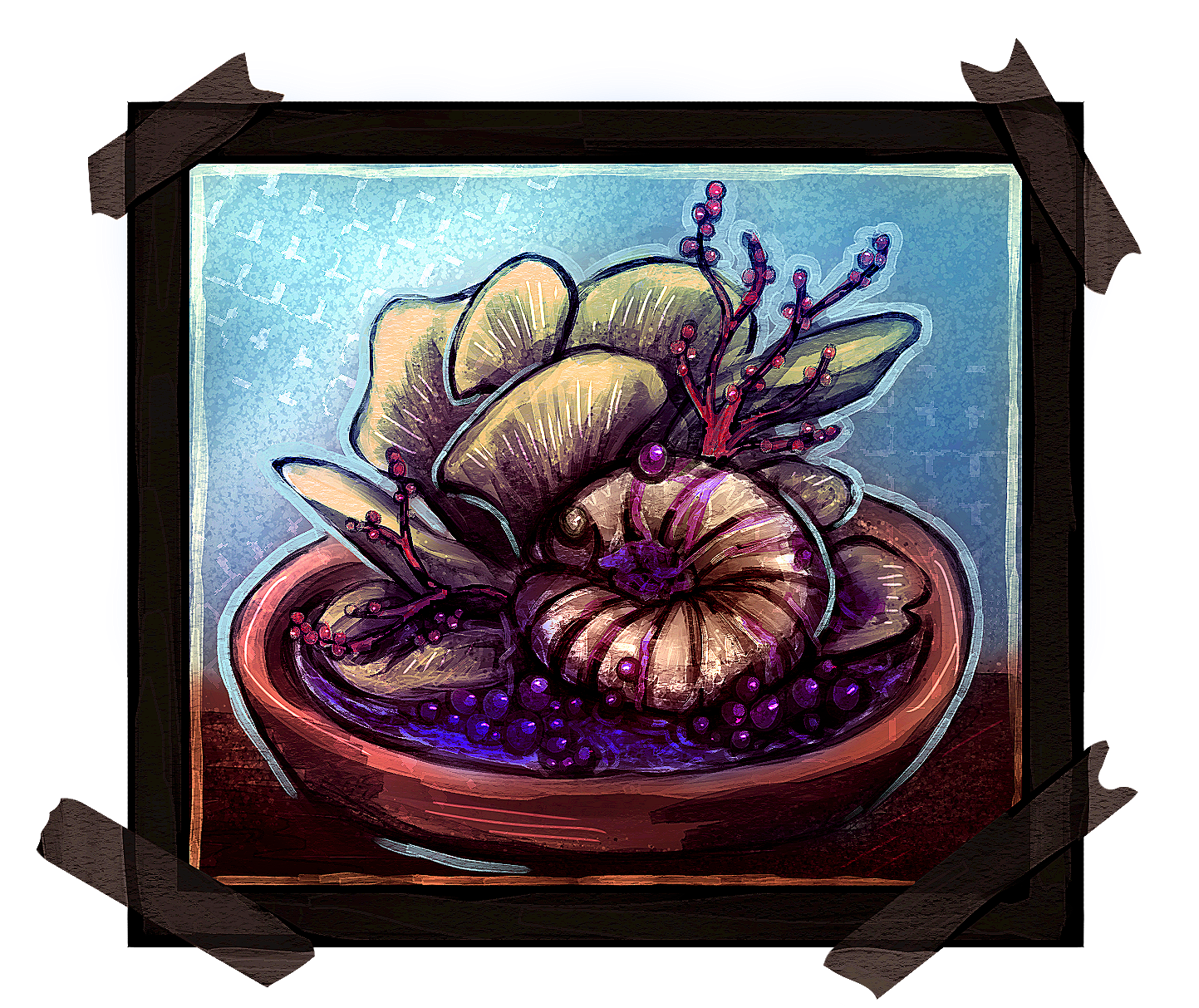
Rinse the rice until the water runs mostly clear.
Heat the Windpot milk in a pot until it begins to steam.
Add rice, Cracklefruit strips, and salt.
Simmer gently for 25–35 minutes, stirring often.
Remove Cracklefruit Flesh.
Stir in sugar and extract; cook another 3 minutes.
Serve warm or chilled; top with additional optional toppings.
Rope Tugger's Stew
A creamy stew made popular by the ranchers who handle Windpots.
- 710 ml Windpot’s milk
- 240 ml vegetable broth
- 30 g Windpot butter
- 1 small onion, finely chopped
- 2 cloves garlic, minced
- 16 g Jhoutaioan Wheat flour (about 2 tbsp)
- 2 tsp dried savorweed (about 1 g)
- Salt & pepper to taste
- Optional: cooked diced roots or crushed and fried SulaRutas
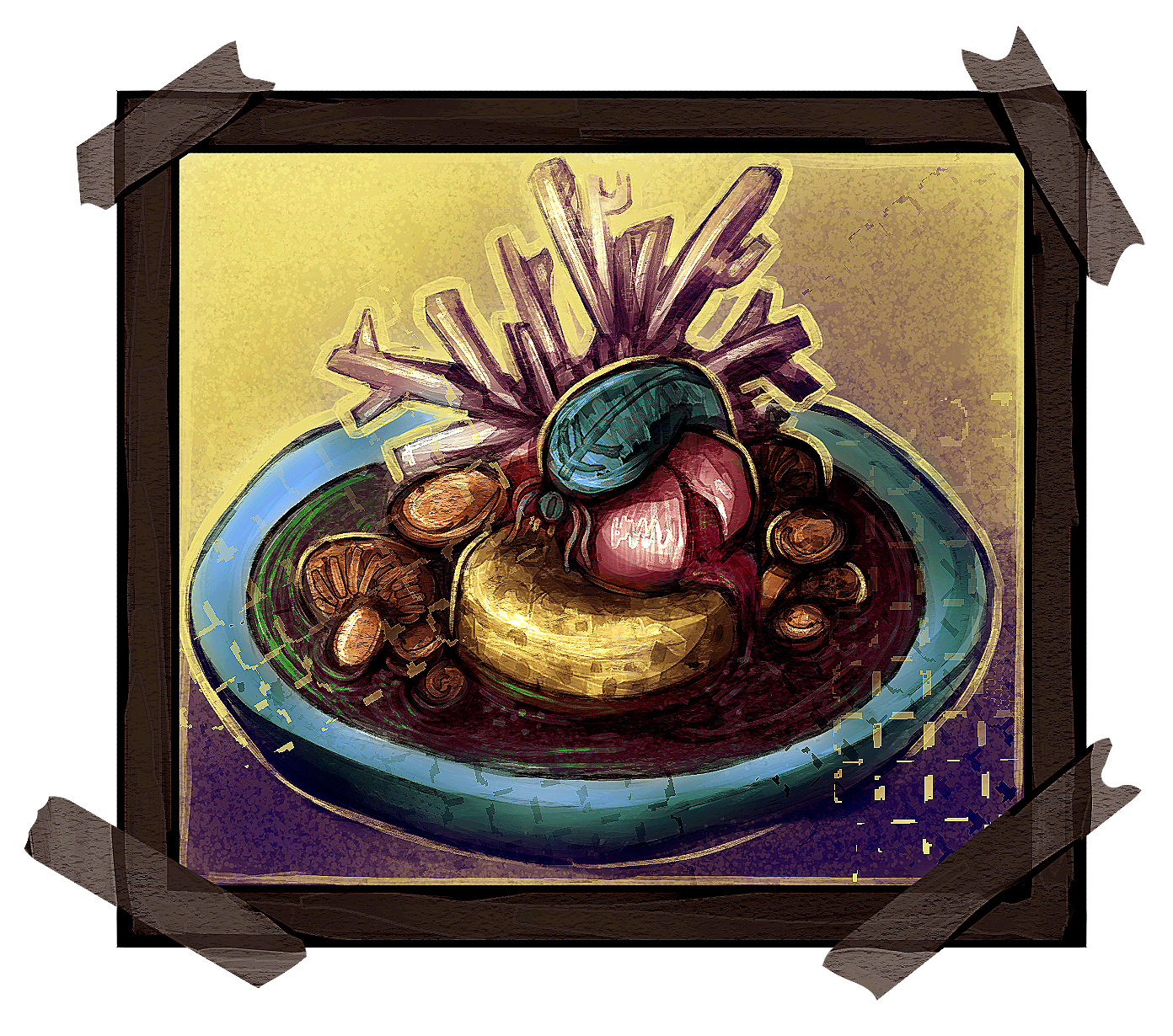
Melt the butter in a pot and sauté the onion until softened.
Add garlic and cook for 1 minute.
Add flour and stir to form a roux.
Slowly whisk in the Windpot’s milk until smooth.
Add broth and herbs; simmer for 10–12 minutes.
Season to taste; add optional ingredients if desired.
Serve warm.
Grilled Windpot Cheese
Sweet, Tangy, and Sour. A popular appetizer in the cities of Valuser'ran Republic
- 250 g firm Windpot’s cheese, sliced 1–1.5 cm thick
- 1–2 tbsp pressed oil
- 1–2 tbsp honey
- 1 tbsp crushed nuts
- Pinch of pepper flakes or fresh chili
- Optional: Cracklefruit wedges
Heat a cast iron pan or grill to medium-high and lightly brush with oil.
Sear the cheese slices for 2–3 minutes per side until golden and caramelized.
Transfer immediately to a plate.
Drizzle with honey while still hot.
Sprinkle with crushed nuts and a pinch of chili or pepper flakes.
Add a slice of cracklefruit if desired.

I love love love the food pictures. They look so appetising. The windpot is a great creature, what a lovely and amazing article. <3
Explore Etrea | WorldEmber 2025
I love how this one came out so much, so I'm glad you enjoyed it too! I'm hopin that our lovely Drone will be able to make more pictures for this before the end of world ember!
Wanna see some good articles? Of course you do.
Showcase