

Bog Titan
When you hear the name Bog Titan, you probably picture a massive, muddy humanoid with a dripping face, thick sludge for arms, and a fistful of rocks ready to hurl at anyone who comes near.
Well… sorry to disappoint you, but that impressive creature is not the Bog Titan itself only the natural magic it commands.
The real Bog Titans are the small insectoid creatures hidden inside the mud golem, directing its movements and shaping its form. These bugs are remarkable, with a shared hive mind, intricate tunneling systems, and a deep connection to the bogs they call home. They maintain the balance of nutrients, manage water flow, and help regulate the minerals within their wetlands, quietly caring for their environment while most outsiders focus only on the fearsome golems they create.
Basic Information
Anatomy
The Bog Titan is a small, insectoid swamp creature with a body perfectly adapted for moving through mud, sludge, and shallow swampwater. Its form is long and low to the ground, designed for efficient burrowing and for fully submerging itself beneath wet soil.
Its elongated, segmented body tapers toward the rear like that of an aquatic or burrowing insect. Each abdominal segment is shielded by smooth, hardened chitin plates that overlap like natural armor. The Bog Titan’s coloration is a muted greenish-brown, allowing it to blend seamlessly with mud, algae-coated water, and swamp vegetation.
The creature stands on six long, slender legs, each jointed and slightly angular, giving it a spider-like stance. The legs end in two different structures:
The upper and lower sides of each foot bear three-pronged claw-like tips for gripping and climbing.
The central pad is a flexible, four-pronged membrane, tough yet pliable, used for channeling mana and sensing minute vibrations around them.
Together, these features make the legs ideal for gripping wet earth, navigating tangled root networks, and anchoring the creature during its mud-manipulation magic.
The head is rounded and armored, set with two large, bright amber-yellow compound eyes that are highly reflective and positioned to maximize peripheral vision.
From the rear of the body extend several thin tail filaments, similar to whiskers or feelers. These act as an extended sensory array, capable of detecting vibrations and subtle movements through mud and water. Fine sensory hairs cover the legs and body joints, further enhancing the Bog Titan’s exceptional vibrational sensitivity.
Across every chitin plate are paired spike-like structures. Though softer than the surrounding armor, these protrusions are durable and serve as mana-conduction points, allowing the Bog Titan to channel and shape magical energy when altering or animating mud.
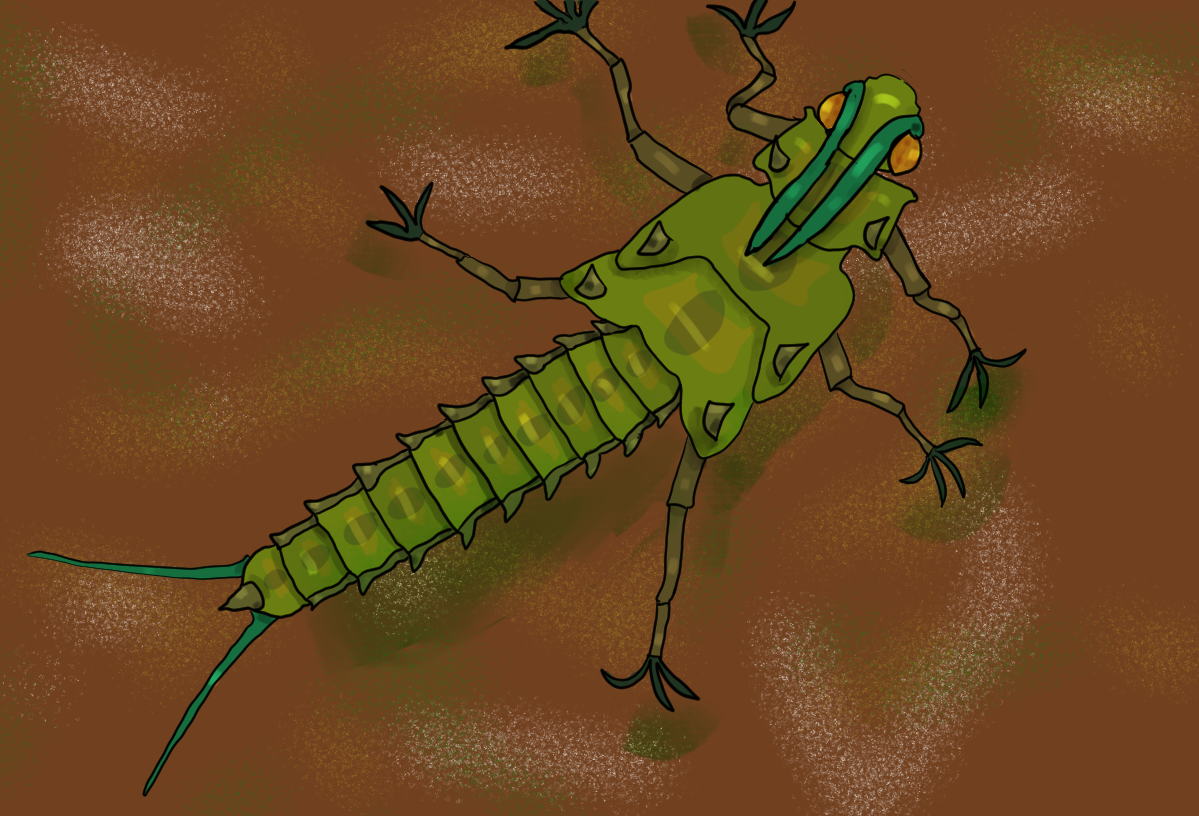
by Valcin (Marc Zipper)
Biological Traits
Breathing
Bog Titans are capable of breathing both oxygen and water, allowing them to function equally well on land, underwater, and submerged beneath dense mud layers. This dual-breathing trait is essential to their lifestyle, as much of their work takes place deep within bog tunnels and waterlogged chambers.Magical Resistances
Bog Titans possess a natural immunity to Earth magic and a strong resistance to Water magic. These traits come from their unique magical biology and the constant mana field generated by their hive mind. When they create or inhabit a mud golem, their magical immunity and resistance are infused directly into the construct. The golem inherits the same protective aura as the Titans controlling it, making it extremely difficult to disrupt with earth-based spells and notably resistant to water-based attacks.Weakness
Bog Titans have a pronounced weakness to Fire magic, and this vulnerability extends to their mud golems as well. Fire rapidly dries and hardens the mud they manipulate, transforming it into brittle mudstone. When this happens, the magical energy flowing through the mud becomes sealed inside the hardened shell, preventing the Bog Titans from reshaping or controlling it. A mud golem struck by strong fire magic will stiffen, crack, or collapse entirely as its structure dries out. Likewise, Bog Titans caught in dried mud may become temporarily trapped or forced to burrow out slowly, making fire their most dangerous and feared elemental threat. Another major weakness of the Bog Titan is their reliance on the hive mind. Any spell or ability that disrupts telepathy or interferes with mental links can completely cripple a colony. When the hive mind is severed, the Bog Titans become confused and disoriented. Their instincts no longer synchronize, leaving them unsure of what to do and unable to coordinate even basic tasks. Without the hive’s shared guidance, they cannot control a mud golem, combine their magic, or maintain defensive formations. A disconnected Bog Titan is effectively helpless and defenseless, making hive mind disruption one of the most dangerous counters to their species.Hive Mind
Bog Titans share a powerful but instinct-driven hive mind. The two small antenna-like structures on their heads constantly emit a faint magical signal that links every member of the colony together. This connection does not let them see through each other’s eyes or share full thoughts. Instead, it synchronizes:- instincts
- emotional cues
- needs of the hive
- task prioritization
- magical rhythm and output
Mud-Shaping Magic
A Bog Titan’s primary magical ability is the power to reshape and manipulate mud specifically any dirt or soil that contains moisture. By sending waves of mana through their legs, tail filaments, and the softer mana-spikes on their chitin, they can:- tunnel
- carve chambers
- create caverns
- redirect water
- compress or loosen mud
- alter the structure of any wet soil
Mud Golem Creation
The mud golem is the Bog Titan’s signature defensive creation and one of their most impressive magical feats. To form a golem: Several Bog Titans gather and merge their mana flows. They shape a mass of wet mud into a humanoid or beast-like frame. Individual Bog Titans crawl inside the structure, stationing themselves approximately every half-foot throughout the body. Each Titan acts as a joint, nerve cluster, or mana node, controlling movement and maintaining structure. Limb ends especially the arms often contain two Titans to channel energy for striking or ranged mud-projectile attacks. As long as the hive maintains synchronicity and the Titans inside the golem have mana, the construct remains solid and animate.Mud Ball Assault (Rare)
In extreme situations, a colony may create a mud-ball projectile loaded with living Bog Titans. When launched, the Titan-filled sphere: smashes into the enemy bursts open releases sharp, needle-like mud tendrils spills multiple Bog Titans who immediately attack or regroup Although dangerous for the Titans involved, those who survive sometimes become founders of new colonies if thrown far enough to lose hive contact. Bog Titans possess a natural immunity to Earth magic and a strong resistance to Water magic. These traits come from their unique magical biology and the constant mana field generated by their hive mind.Growth Rate & Stages
Egg Stage
Bog Titan eggs remain in this stage for two to three weeks, unless laid during winter, in which case development slows and takes four to six weeks to hatch.
Nymph Stage
Bog Titan nymphs hatch directly into fresh water pockets within the swamp. At this stage, their bodies resemble the upper half of an adult, with a developed head, partial dorsal plating, and only four legs. They are much smaller and rely heavily on interaction with the hive.
Nymphs can manipulate very small amounts of mud, allowing them to help shape early hive structures, tunnels, and small biomes within the mud. However, their magical ability is weaker, and their communication with the hive mind is slower and more fragmented.
They remain nymphs for 12 to 18 months. When ready to mature, they burrow deep into soft mud until nearly fully submerged. There, they use their limited magic to harden the surrounding mud into a mud-stone cocoon and begin their metamorphosis into adulthood.
Adult Stage
Upon emerging, adults are fully capable of living both in water and on land. Their sensory systems become highly refined, allowing them to perceive the world with exceptional clarity both above and below the swamp’s surface.
Adults gain their full ability to shape, animate, and mold mud, and they can now seamlessly synchronize with others. Their communication becomes almost instantaneous—fine sensory hairs, tail filaments, and additional legs allow them to extend their mana more efficiently and strengthen the hive mind connection.
Bog Titans live for approximately four years in their adult form.
Ecology and Habitats
Bog Titans are found, as their name suggests, primarily in bogs. These wetlands provide everything they need: mineral-rich water, acidic soil, and thick, heavy mud that suits their biology perfectly. Bogs often form under a dense layer of moss, peat, and plant matter, giving Bog Titans natural cover while letting them blend into the muted greens and browns of their surroundings.
The slow, dense bog-mud is ideal for both burrowing and construction. It provides the raw material they use to build their hives and the perfect substance for shaping their defensive mud golems. Unlike the thinner waters of marshes or the flowing currents of swamps, bogs offer a stable, quiet, and nutrient-rich environment where Bog Titans can truly thrive.
Dietary Needs and Habits
Bog Titans are omnivores, though their diet shifts significantly as they mature. In their nymph stage, they survive primarily on algae, microorganisms, and mineral-rich sediments found in swamp and bog waters. Their small size and weaker mandibles make soft plant matter and dissolved nutrients ideal for early development.
As adults, Bog Titans can digest a much broader range of food. They feed on plants, fungi, decaying and vegetation. Adult colonies have been observed using their mud golems to pull down leaves or drag vegetation into the bog, providing enough food for the entire hive.
Some locals joke that when the golems start gathering large amounts of plant matter, the Bog Titans must be preparing for “a feast of Titanic importance.”
Behaviour
Bog Titans are a deeply communal species, unified by their shared hive mind. Unlike ants or bees, they do not have rigid, predetermined roles. Instead, once they reach adulthood, they naturally gravitate toward whatever task the hive currently needs. Any adult can scout, expand tunnels, repair chambers, tend the nursery, or forage for food. Their hive mind directs them fluidly, allowing them to shift roles instantly and without conflict.
This adaptability is most clearly seen when a threat is detected. The Bog Titans stationed as defenders will immediately shape and inhabit a mud golem. If the threat becomes too great, the rest of the hive responds without hesitation, reinforcing the defenders and channeling mana together to empower or repair the golem. The same pattern occurs for all tasks if the hive needs more builders, more scouts, or more foragers, adults simply shift into those roles.
The hive itself operates on a staggered sleep cycle. Some members are nocturnal, others diurnal, ensuring there is always activity within the colony. The hive is never completely dormant.
Foraging Behavior
Bog Titans forage by sending out small groups of scouts who search for nutrients the hive lacks. When vegetation is needed, they often use mud golems to pull down leaves, drag plants into the water, or break apart roots. They tend to gather not only what they need for themselves, but also materials that enrich the bog water, maintaining the mineral balance required for their species to thrive.Hive Expansion and Nesting
Bog Titans almost always live and die within their hive. It is rare for an individual to leave permanently. However, if one becomes separated far enough that the hive-mind connection breaks, it may form a new hive or attempt to join another. Another rare method of colony expansion occurs during combat. If a mud-ball projectile launched at an enemy carries living Bog Titans inside, and they land far from their original hive, they may begin a new colony if they cannot reestablish the link. Bog Titan hives are constantly under construction. They slowly dig and expand tunnels, chambers, and water channels, carefully deepening their territory. Because the nursery sits in the lowest levels, they gradually soften tougher ground by letting water soak into it, working patiently until it becomes malleable. Many of the unusually deep pits or sink-like depressions found in bogs and swamps are actually the long-term work of a thriving Bog Titan colony.Territorial Warnings and Defense Golems
Entering a Bog Titan hive’s territory is often noticeable by the appearance of a small, slimy mud golem. These early constructs typically have crude facial features and simple limbs usually arms ending in claws, rounded shapes, needles, or rocky protrusions depending on the hive’s traditions. If you keep your distance, the golem will simply watch. Approach too close, and the golem fully emerges as a clear warning. If the intrusion continues, it attacks. Mud golems vary in form and size between colonies, but all share two features:- eye sockets and mouth for two scare intruders
- functional arms shaped according to hive preference
Additional Information
Uses, Products & Exploitation
Mudstone
Mudstone created from dried Bog Titan magic is highly valued. It is excellent for fertilizing soil, serves as a potent alchemy ingredient, and is a key material in golem construction, especially for earth-based constructs.
Bog Titan Bodies
The remains of Bog Titans contain a variety of useful minerals and components prized in medicine. Their chitin plates, mana-spikes, and inner tissues can be refined into salves, stabilizers, and magical reagents.
Bog Tentacle Filaments
The thin sensory filaments—often called Bog Tentacles—are exceptional for crafting magical communication devices. When properly treated, they retain a faint telepathic resonance, allowing them to strengthen signal clarity or act as conduits in enchanted messaging tools.
Perception and Sensory Capabilities
The Bog Titan’s sensory system is both vast and uniquely adapted to swamp life. Their sense of sound is the weakest of all their senses barely used, and only capable of detecting the loudest nearby noises. In contrast, their vision is exceptional, granting them nearly 360-degree awareness. They see in UV spectra, allowing them to perceive shapes and movement even through murky water, thick mud, and swamp grime. A specialized, protective lens shields their eyes whenever they burrow beneath the surface.
While their eyes are impressive, their strongest sense by far is their vibrational awareness. Their entire body is covered in fine sensory hairs, and each foot ends in a soft, flexible membrane that spreads out slightly when they stand or cling to surfaces. These structures allow Bog Titans to feel even the faintest disturbances water ripples, shifting mud currents, and subtle ground tremors. Because of this, they can detect the approach of anything entering their territory, even the light footsteps of a small predator.
Their sense of smell is moderate but useful, helping them locate rotting plant matter, nutrient-rich mud pockets, and sources of stagnant or muddy water while traveling through the swamp.
Lifespan
4 to 5 years
Average Length
2 inches
Body Tint, Colouring and Marking
Mud green, dirt brown, and light orange yellow

Comments