
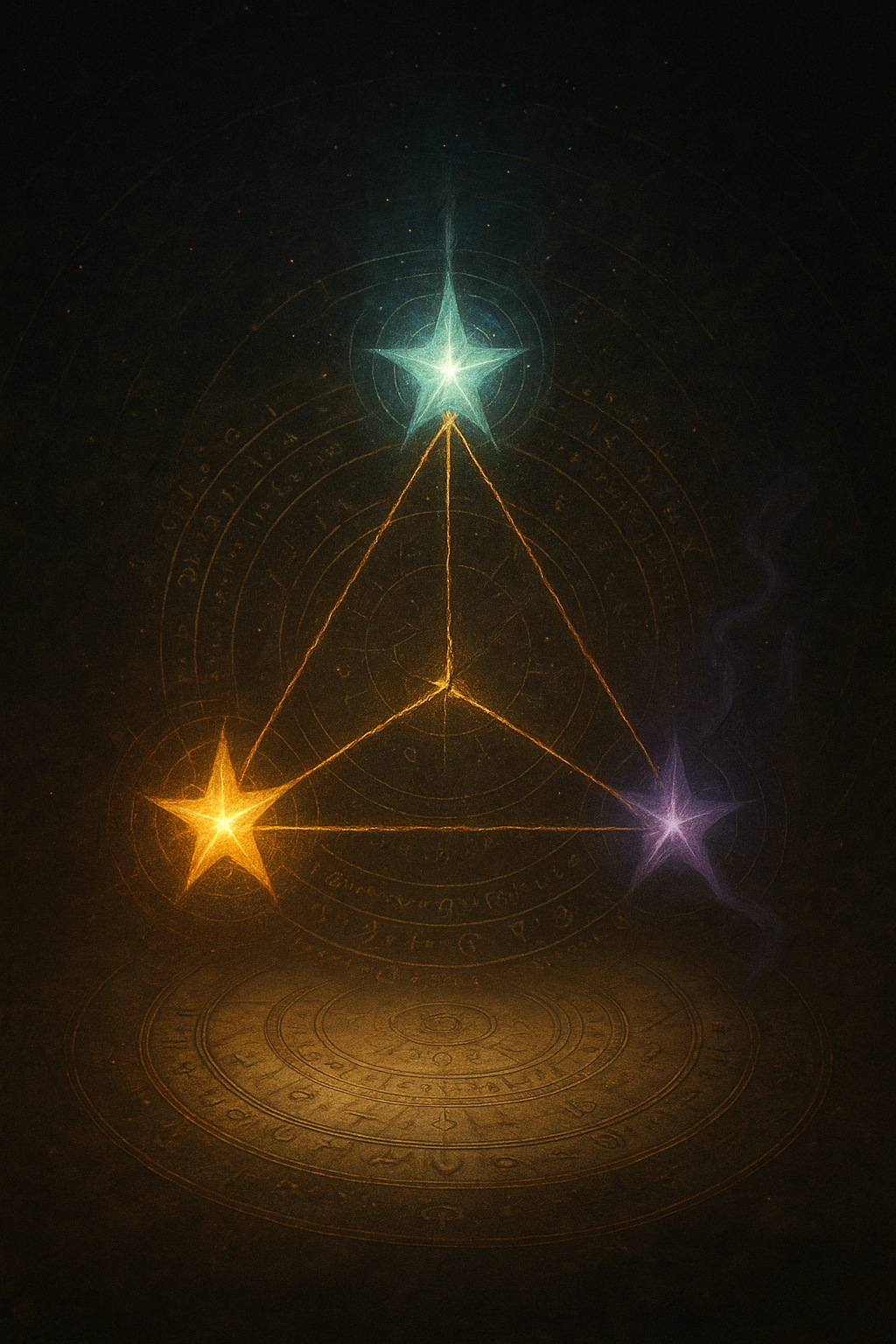
The Troublesome Trio Part III
Part III: Three Prodigies
Declaration
The Tower’s grand circular hall had always reminded Lavan of an amphitheater for ancient gods, its every surface charged with the memory of a thousand ceremonies, all hungry for the promise of future glories and failures. The air, as ever, vibrated with the latent tension of an unsolved equation: twelve students assembled in a ring, eyes shifting from their shoes to the dais, hands fidgeting with sleeves or lockets or the invisible boundaries that marked them as survivors, and therefore already a little monstrous. Above them, a floating array of orbs—each a different hue, none of them quite matching—cast moving shadows on the obsidian floor. These orbs, rumored to be the petrified eyes of ancient seers, tracked every movement, every tic, and blinked, occasionally, when a moment grew charged enough to merit memory.
Tonight was the Specialty Selection Ceremony. Only twelve of their cohort remained, the others having fallen to the attrition of failed exams, administrative exile, or—less frequently discussed—the other things that haunted the Tower and its experiments. Each student would rise, step onto the dais, and declare which of the great magical schools would bind their next four years: Conjuration, Evocation, Illusion, Transmutation, Abjuration, or the rare, whispered specialties that the Tower sometimes allowed if a student was exceptional or, more often, troublesome enough to merit containment through novelty.
The Masters sat arrayed at the outer circle. Pembroke was at the center, as always, his dark blue robe trimmed with patterns of shifting gold. To his left, Tullups wore a green so violently bright that even the stone seemed to squint at it. Kerrowyn Lightfoot wore her signature indigo, its deep purple border flickering with the illusion of perpetual motion, a self-referential joke that played well with anyone who’d ever read her treatises on conjuration. The remaining faculty completed the circle, their faces a gallery of anticipation and calculation. For centuries, Tower professors had wagered on students' choices, a ritual as embedded in the institution as the cornerstone itself.
Pembroke stood, tapped his staff once on the floor, and waited for the silence to saturate. "We gather for the oldest tradition in the Tower," he intoned, voice smooth as honeyed steel. "Tonight, you declare not just a specialty, but a path: a prism through which your future will be refracted, split, and, if you are diligent, made brilliant." He paused, letting the gravity of the word "brilliant" dangle above them, its promise and its threat equally clear. "You are the survivors, the brightest, the boldest. Remember that with every choice you make, you are also making a mark on the Tower itself, and it will remember you."
The first three students were a blur, their names as unmemorable as the specialties they selected: Evocation for boy who favored ice magic, Abjuration for the girl who’d already mastered every shield spell in the student lexicon, Conjuration for the girl that never went anywhere without her familiar, a small mouse, on her shoulder. Each performed the ritual with the nervous efficiency of a bureaucrat signing a loan document, bowing to Pembroke, receiving a faint smile, and slinking back to their seats.
When Ophelia's name was called, she walked with the absolute lack of deference of someone who'd learned, early, that the world only respected what it could not destroy. She wore her hair up, a single black ribbon binding the mass of it like a challenge. Her hands were steady, her stride measured, and she didn’t bother to look at the Masters as she passed. She reached the dais, placed both hands on the pedestal, and said—loudly, so there could be no mistake—"Illusion."
There was a microsecond of silence, as if the room needed to process not the choice but the certainty behind it. Then Pembroke nodded, his face registering a flicker of approval. "Ophelia Saloth: Illusion," he intoned, and as he spoke, the orbs above shimmered, the one directly above Ophelia’s head pulsing a deep, resonant violet.
Ophelia returned to her seat without looking left or right, but those who watched closely saw the slight relaxation in her shoulders, a tension released not from relief but from the pleasure of having anticipated, and then perfectly met, the expectation of spectacle.
Two more students went, neither noteworthy. One, a boy with a stutter and the look of someone waiting for the axe, declared Transmutation. The girl after him, hands pale as paper, chose Evocation, her voice barely audible, as if the word itself were too hot to touch.
When Lavan’s turn came, the murmuring began—small, but persistent. He had, in the past year, shown an incredible aptitude with nearly every school of magic. The professors waited with bated breath to see if they had guessed correctly. The masters, for their part, watched him approach with unreadable expressions. He walked to the dais slowly, feeling every pair of eyes on him, every flickering orb tracking his gait.
He reached the pedestal, placed one hand upon it, and hesitated. The pause stretched, then became awkward, then teetered on the edge of disastrous. He looked up, met Pembroke’s gaze, and found in it not impatience, but something else, curiosity, or perhaps the steady, resigned interest of a scientist watching a specimen refuse to behave.
"I—" Lavan began, then stopped. He closed his eyes, took a breath, and started again. "Conjuration," he said, his voice quiet but carrying. He paused, as if surprised at himself, then shook his head. "No. Transmutation." He looked up again, meeting Kerrowyn's eyes this time, and she did not flinch. "I choose Transmutation."
Pembroke raised one eyebrow. "Lavan Edor: Transmutation. Are you certain?"
Lavan nodded, the motion small but decisive. "Yes, sir. I am."
"Would you like to explain your choice?" Pembroke offered, a rare deviation from script.
Lavan looked out over the circle of students, then to the Masters. "I thought I wanted to make things appear. Bring back what was lost. But maybe it’s better to learn how to change what’s already there." The words felt raw in his throat, but he let them stand.
The orb above him pulsed a soft, sky-blue, and he felt its light settle on his face like a benediction.
He returned to his seat, aware that Ophelia and Isemay were both looking at him, one with a faint smirk, the other with a kind of restrained delight.
The rest of the students went, some quickly, some with all the ceremony of a confession. At last, only Isemay remained.
She stood, more slowly than the rest, and crossed to the dais. Her hair was braided in two thin plaits, each tied at the end with the green and silver of her house, and she wore the long, formal robes that her mother insisted on for any public ceremony. She placed both hands on the pedestal, closed her eyes for a moment, and spoke.
"Divination," she said.
The room reacted as if she’d shouted a curse. The word was not forbidden, but neither was it commonly uttered. Divination was a dead art at the Tower—no Master had specialized in it for fifty years, and the last student to do so had gone quietly mad. There was a shuffle in the ranks of the professors, as if they’d not planned for this contingency.
Pembroke smiled knowingly. "Isemay Misendris: Divination," he said, the syllables crisp. He inclined his head in a gesture that could be read as respect or warning. "We will make the necessary accommodations."
The orbs above the dais flickered, the one over Isemay’s head wavering between blue and gold before settling on a cool, uncertain white.
Isemay bowed, then returned to her seat. She met Lavan’s gaze and smiled, her face bright with relief and a defiant pride.
When the last student had finished, Pembroke addressed them all again. "You have chosen. The path ahead is not easier, only more narrow. The burden of mastery is not just skill, but wisdom. You are expected to use both." He paused, eyes traveling the circle. "The Tower will remember you, as it remembers all who have shaped it. And, should you falter, it will not hesitate to correct you. Tradition is not a chain; it is a challenge. Meet it."
He tapped his staff again, and the orbs spiraled up, merging into a single point of light that exploded, quietly, into a web of filaments that hung in the air like a declaration of intent.
The ceremony ended as suddenly as it had begun. The Masters dispersed, each with their own gravity, their own satellites of students or lesser faculty trailing in their wake. The twelve newly specialized students were left alone in the hall, each pondering the weight of the choice they had just made, and the infinite consequences that would now follow.
In the hush that followed, Lavan found himself sitting next to Ophelia and Isemay, the three of them a crooked line on the bench, their futures suddenly more real than ever before.
"That went well," Ophelia said, her tone so dry it might have started a fire.
"I thought you’d choose something more… explosive," Isemay said to Lavan, her smile teasing.
He shrugged, a little embarrassed. "I don’t like surprises anymore."
They sat in silence, listening to the echoes of the orbs as they faded into the stone, each lost in the new geometry of their lives.
Above, the ceiling of the hall flickered with the residual afterglow of the ceremony, the filaments slowly receding into the bedrock of the Tower’s memory. Even now, the building watched, waited, and remembered.
The Tower was always hungry for what happened next.
Labyrinths and Reflections
Ophelia had never cared much for reflection—mirrors, in her experience, rarely showed you anything worth seeing. Yet here she was, in Master Tullups’s private training chamber, a room made entirely of curved glass panels set into a ring of pearl-white stone. The mirrors caught her image from a hundred angles, each one exaggerating or distorting some element of her: the length of her tail, the sharpness of her horns, the way her teeth sometimes showed even when her mouth was closed. She supposed the point was to teach you something about yourself, but mostly it just made her want to smash every last one of them.
Tullups was already there, seated cross-legged at the room’s exact center, his hands folded and his robes bunched about him like a mossy pillow. His eyes, bright with that feverish curiosity she’d come to respect, found her in the mirrors before she even opened the door.
“Punctuality is the soul of self-respect, Miss Saloth,” he said, the phrase tumbling off his tongue as if he’d just invented it. “And a healthy suspicion of mirrors is a sign of good breeding.”
She bowed—ironic, but respectful—and sat opposite him. The glass floor sent a chill through her trousers.
“You are here,” Tullups said, “because you have chosen Illusion. Or because Illusion has chosen you. The difference, as in most things, is a matter of framing.”
Ophelia rolled her shoulders. “Let’s get to the part where you throw the first punch, sir.”
Tullups smiled. “Today’s lesson is about what makes an illusion stick. Not the details, not the brushwork, but the expectation. Most will tell you it’s all about what people see, but they’re wrong. It’s about what they hope to see, or fear to see. The trick is to make the world behave as it should, right up until the moment you need it to behave otherwise.”
With a flick of his hand, the chamber transformed. The mirrors melted away, replaced by a labyrinth of corridors lit with wavering torchlight. Somewhere, a wolf howled. The echo bounced from wall to wall.
“First challenge,” Tullups said, his voice now coming from everywhere at once. “Find the exit. Find me, if you can.”
Ophelia stood, surveying her options. The labyrinth was textbook: every turn promised a dead end, every door a trick of the light. She tested the nearest corridor, brushing her fingers along the cold stone, and immediately sensed the leyline signature—Tullups’s, of course, but threaded with a dozen faint markers, each designed to bait and trap.
She smiled, letting the room know she’d seen the play.
She ran, flat out, the length of three corridors before doubling back. Her footsteps didn’t echo; a subtle touch, meant to confuse, but she’d grown up in alleys where silence was a tactical necessity. She stopped at the first T-junction, closed her eyes, and listened. There, at the very edge of perception—a whisper of movement, not in the room, but in the expectation of the room.
She grinned wider.
She raised her left hand, fingers splayed, and snapped. The world rippled. An illusory wall evaporated ten paces ahead, revealing a hidden staircase. She darted up, two steps at a time, not bothering to hide her approach. She wanted Tullups to know she’d solved it.
At the top, she found a door, ancient oak. She reached for the handle, then paused. Too obvious. She dropped into a crouch and pressed her palm to the floor, channeling a small surge of illusion. The door’s shape warbled, then dissolved: behind it, the real staircase twisted down in a spiral, this time lit by lanterns that flickered with a genuine heat.
“Well done,” Tullups’s voice sang, now directly overhead. “But you’re not done yet.”
Ophelia didn’t hesitate. She ran down, the stairs narrowing as she went, until at last she emerged into a circular chamber identical to the first—but with one change: in the center stood a copy of herself, arms folded, tail flicking in irritation.
The copy looked up and sneered. “Nice trick,” it said, voice a perfect match.
Ophelia considered, then lunged. The copy sidestepped, matching her exactly. They circled, neither breaking eye contact. Ophelia reached out with her will, not for the copy, but for the leyline thread running through the room. She teased it, just a little, and felt the copy do the same.
A standoff.
Then she thought, What if the copy isn’t meant to be outsmarted? What if it’s meant to be let go?
She stopped circling. She stepped forward, arms wide, and embraced her double. For a brief, dizzying second, she felt herself in two places at once—every sense doubled, every impulse mirrored. Then the room snapped back to reality, the glass walls reappearing, the mirrors now showing her standing alone, arms folded, a small, satisfied smile on her face.
Tullups clapped, slow and deliberate. “Bravo, Miss Saloth. Most never try reconciliation. It’s always knives, never embraces. You’re ahead of where I was at your age. And I was ahead of most.”
Ophelia bowed again, this time with a flick of her tail.
Tullups grinned, then tossed her a small, opalescent stone. “Homework: maintain three illusions at once. At least one must fool me. You have until next lesson.”
She caught the stone, palmed it, and let the challenge settle into her bones.
“Thank you, sir,” she said, the words unfamiliar but not unwelcome.
Tullups nodded, his eyes warm with approval. “You’re going to make the Tower very nervous, Miss Saloth.”
Ophelia liked the sound of that.
She left the chamber, mirrors multiplying her exit in a thousand fractured shards, each one a little different from the last, each one a possible future she couldn’t wait to try on.
Firestorm
The practice arena, like so many things in the Tower, existed less as a space and more as a process. It was the size of a modest amphitheater, bounded by walls of ancient basalt, the stones knotted with old wards and lit from above by daylight filtered through a lattice of leaded glass. When Lavan entered, the air crackled with anticipation: students packed the periphery, some standing on tiptoe, others perched in the shallow tiers of seats or balanced on the rungs of ladders lashed to the pillars.
At the center of the arena, the day's challenge stood waiting: three elemental constructs, each carved from a different material—granite, ice, and living wood—animated by the Masters for the purpose of violence. Each construct was twice Lavan’s height and three times his width, but all shared the same abstracted, animalistic form: squat torsos, too many arms, mouths bristling with serrated teeth.
Lavan stopped just inside the marked circle and waited for the hush to fall.
From the observation gallery above, Pembroke’s voice cut through the silence: “Begin, Mister Edor.”
Lavan nodded, took a breath, and opened himself to the leyline.
The world narrowed to a tunnel, every color sharpening, every sound distilled to a bell-like clarity. His hands trembled, not from fear but from the sudden rush of magic through his nerves.
The constructs advanced, granite first, pounding the earth with every step. The other two fanned out, flanking, their movements clever and predatory.
Lavan’s lips moved, silent at first, then louder. He sketched a circle in the air, then a triangle, then a pattern too quick for most to follow. The leyline responded—first reluctantly, then with something that felt like hunger. He raised both arms and pointed skyward.
Above the arena, the air condensed, thickening into a pinprick of darkness that shimmered, then ignited.
A single, burning sphere.
It was not as large as he’d hoped, but it would do. Lavan willed it down, streaking toward the granite construct’s head. The audience tittered, unimpressed by the size.
The sphere struck. Where it hit, stone boiled away, scattering shards and a plume of acrid dust. The construct didn’t even slow down.
The real trick of Transmutation, Pembroke had said once, was not to change a thing into something else, but to change a process into a result.
He focused on the ground beneath the granite constructs feet, tracing elaborate glyphs with his wand and sending a stream of red, shimmering energy to the stone floor, causing it to ripple and shift. The golem sank into the floor before it re-hardened, trapping it in place.
Next, he turned his attention to the ice and wood constructs. He traced two large circles in the air, and then breathed the incantation into them, each floating to encircle the constructs, causing them to slow to a snail’s pace.
Lavan focused harder, his hands now glowing with residual energy. He poured heat into the air above the constructs, then split it: one became two, two became six. Each orb crackled, pulsing with a contained fury.
The arena became silent, the audience still.
Lavan directed the new spheres to their targets—ice, wood, and stone—each one aimed not for brute destruction but for maximum effect. The meteors hit: the ice construct shattered, the wood ignited in a flash of blue flame, the stone staggered, a chunk of its shoulder now a glossy, molten slag.
But that wasn’t enough.
Lavan felt the leyline flex, an old, familiar pressure against his ribcage. At the edge of his vision, a black dog waited, tongue lolling, eyes pitiless. For an instant, the world wavered; the crowd vanished, the arena was a single, infinite plane, and only the challenge mattered. The Hound didn’t snarl, didn’t move—just watched, as always.
Lavan turned the presence into willpower. He stretched both arms wide, fingers clawing at the open air. Above him, dozens of tiny sparks whirled into existence, each one bright as the heart of a kiln. With a snap, he called them down: a meteor shower of controlled, burning destruction.
They hit in a hail of impacts, tearing through the constructs with precision, melting ice, splintering wood, vaporizing stone. The crowd flinched at the heat, and those in front were forced to step back, hands raised to shield their faces.
When the smoke cleared, the three constructs lay in smoldering heaps. The circle at the center of the arena was scorched.
A stunned silence, then a slow, growing ripple of applause.
Lavan bowed, sweat streaking down his face, his hands shaking so violently he had to clasp them behind his back.
From the gallery, a single student’s voice cut through: “Firestorm!”
Others picked it up, a chant rising in volume: “Firestorm, Firestorm, Firestorm—”
Lavan blushed, but inside, he felt something cold and pleased. He liked the sound of it.
At the edge of the arena, Pembroke stood next to Kerrowyn Lightfoot, the two Masters murmuring to each other. Pembroke’s face was thoughtful, his lips pressed in a line; Kerrowyn’s eyes glittered with a complicated pride.
“He’s only a third-year,” Pembroke said quietly.
“And already two years past where I was,” Kerrowyn replied. “If he keeps this up, he’ll break the Tower before he graduates.”
“That’s what worries me,” Pembroke said, and the two fell silent.
Lavan left the arena to the sound of his new name echoing in the air. He could feel the stares—admiring, envious, afraid. He didn’t mind. He’d grown up in a place where to be seen was to be hunted. Better, he thought, to be feared than to be nothing at all.
Outside, in the shadowed corridors, the black Hound followed at a distance, silent and watchful, as it had always been.
He hoped, just once, that it would say something.
But it never did.
Innovation
The Divination Room had no business being a room at all. It was a shape carved from uncertainty, a pocket where the Tower’s geometry folded in on itself, the ceilings and walls flowing in parabolic sweeps that defied standard architecture. At its heart was the pool: a shallow dish of perfectly still, lapis-lit water, rimmed in silver, its surface so polished it reflected not just the ceiling above but the intent of whoever gazed into it. The rest of the space was hung with mirrors—hundreds, maybe more, in sizes from thumbnail to full-length, each one a portal to some other room, other time, or, if Isemay was being honest, some other version of herself.
She sat cross-legged at the pool’s edge, her green robe trailing behind her like the shadow of a peacock. Her hands moved with slow precision, fingertips tracing sigils into the water. Each touch sent a ripple outward, and in the glassy surface, images shimmered: first a study hall, empty but for a forgotten quill; then the Council Chamber, awash in daylight; then, after a particularly deft flick, the kitchens, where Ophelia and Lavan were locked in mortal combat over Tullup’s last honey roll.
Isemay smiled, but the amusement vanished quickly. She had been coming here for weeks, sometimes during the day, but most often late at night, when the only witnesses were her own reflections and the weight of her ambition. She had read every treatise on Divination in the Tower’s archives, cross-referenced every footnote, and, when those ran dry, scavenged journals and marginalia from the restricted sections. More than once, a new book would simply appear on her worktable, or a previously blank page would sprout a diagram, as if the Tower itself wanted her to learn.
Today, she was doing something different. Divination, she knew, was a two-way street: to look was also to be seen. The Masters liked to pretend otherwise, but she’d found too many warnings scrawled in too many margins for it to be coincidence. If you peered hard enough into the world’s secrets, sometimes the secrets peered back.
She wanted to reverse the polarity.
She closed her eyes, summoned the leyline, and pictured the library—specifically, the reading carrel where a certain junior arcanist (always loud, always nose in a forbidden romance) spent her afternoons. Isemay shaped the energy, not into the usual web of sight, but into a shell: a translucent cube of blue energy, gently humming with contained force.
On the first attempt, her mind’s eye saw only the library, as if nothing had changed.
On the second, she felt a tingling resistance, like a pane of glass that wanted to become opaque but wasn’t sure how.
On the third, she got it right. The image snapped shut, and where the arcanist had been, there was only a gentle blue haze, impenetrable and serene.
Isemay let out a laugh, sharp and triumphant.
"Interesting technique," said Pembroke, his voice floating in from the doorway. He wore his customary midnight blue, his beard a little longer than usual, and his eyes, as always, alive with the quiet pride of a man who’d watched generations of disasters and geniuses pass through these walls.
Isemay straightened, feeling a flush of embarrassment and delight. "I was trying something new. You said once that every magic is vulnerable to itself, if you know how to look."
Pembroke inclined his head. "You remembered. That’s rare."
She pointed at the pool, the blue cube still hovering in her vision. "It’s a simple recursive ward. Instead of amplifying perception, it limits it—blocks all scrying, all remote view. I think it could be layered."
Pembroke approached, hands clasped behind his back, and peered into the pool. He smiled. "That’s a valuable spell. Many in the Council would pay dearly for such privacy."
Isemay hesitated. "I call it the Misendris Privacy Partition," she said, half-joking, half-not.
Pembroke’s eyes twinkled. "A little vanity is permissible when it’s earned." He gazed at the mirrors, as if seeing something Isemay could not. "How many times have you been in here?"
She shrugged. "Too many, probably."
"No such thing," he replied. "The Tower is as much about obsession as it is about discipline. You’re not the first to lose yourself to the pool."
Isemay wondered what he meant, but decided not to press. "Would you like to see how it works?"
Pembroke nodded, settling cross-legged beside her with the flexibility of someone half his age. "Show me."
Isemay closed her eyes, reached for the leyline again, and this time focused on the Council Chamber. She shaped the energy, layer by layer, then wove the Partition over the entire room. It was easier, now that she’d done it once. The Chamber’s image faded to blue, then to nothing.
She opened her eyes to find Pembroke watching her with open admiration. "Very good," he said. "If you’re willing, we should teach this to others. It will change how people think about Divination."
Isemay felt the pride bloom in her chest. She looked down, suddenly shy. "Do you think it’s enough?"
Pembroke’s face softened. "Isemay, it’s more than enough. It’s a foundation for everything that comes next."
They sat together, in the strange, mirrored quiet, neither feeling the need to fill the silence.
After a minute, Pembroke cleared his throat. "Do you ever feel the Tower… helps you?"
She considered. "Sometimes. Books appear. Pages write themselves. Once, I think the water whispered my name."
Pembroke nodded, as if confirming a private suspicion. He glanced at a patch of empty air over Isemay’s shoulder and smiled, though she saw no one there. "You have a knack for attracting attention, even from things that shouldn’t have it."
Isemay smiled back. "I’m used to it. I like to think it’s because I’m special."
"You are," said Pembroke, his tone gentle and absolute.
They stood, and Pembroke gestured for her to lead the way. As Isemay left the room, she felt the eyes of a hundred mirrors following her, not with judgment, but with the quiet expectation of someone who knows the future will be interesting.
Pembroke lingered a moment, listening to the leyline hum, before following her out.
In the silence, a faint lavender shimmer hung above the water, and, if one looked closely, a smile formed in the surface of the pool, a smile that belonged to no one at all.
Their Favorite Kind of Trouble
The faculty common room was a den of accumulated comfort and strategic neglect. Years of overflow from other wings had left it cluttered with half-broken armchairs, a sofa that sagged in three places, and tables of mismatched height and dignity. Along one wall, an ever-replenishing tea samovar steamed quietly, the Tower’s way of reminding its Masters and professors that even geniuses needed hydration.
Kerrowyn Lightfoot was first to the table, having claimed the only chair with a fully functional backrest. She poured herself a mug of black tea and surveyed the day’s campus digest, arching one eyebrow at the latest circular on "Leyline Security Best Practices." Tullups wandered in a minute later, hands buried deep in the pockets of a patched smoking jacket, humming a tune that sounded suspiciously like a barroom ballad.
Pembroke arrived last, and eased himself into the seat opposite Kerrowyn, favoring his left knee.
"Rough session?" Tullups asked, slouching into the third chair.
Pembroke’s lips twitched. "The constructs are getting too clever. They nearly outwitted the boy. Nearly."
Tullups grinned. "Rumor says he’s the best student the Tower has had since Kerrowyn here."
Kerrowyn flicked her eyes up, expression unreadable. "The boy is quick, but he still thinks in straight lines."
Tullups sipped his tea, then waggled his eyebrows. "Speaking of un-straight lines, did you hear about the debacle in Seminar Seven?"
Pembroke shook his head. "What now?"
Tullups leaned forward, voice dropping to a conspiratorial whisper. "Ophelia Saloth staged a phantom faculty meeting in the east corridor. Three junior instructors spent half an hour arguing policy with a table full of paper golems."
Kerrowyn laughed, sharp and genuine. "Let me guess—the golems won."
"Of course," Tullups said. "They always do."
Pembroke allowed himself a smile, but only just. "I heard she’s managing four simultaneous illusions, with no visible leyline bleed."
"And Lavan Edor nearly burned down the west laboratory," Kerrowyn added. "He claims it was a controlled experiment, but the fire still reached the ceiling."
Tullups chortled. "Ah, the Troublesome Trio. Always on the edge."
Through the thin plaster walls, the corridor echoed with voices. Two professors ambled past, their conversation as subtle as a drumline.
"Did you hear about Isemay Misendris?" the first voice asked, "She predicted every question on next week’s test. Even the bonus ones."
"Did she cheat?" the second asked, skeptical.
"No. They say she just... knew. Like she was reading the future out of her teacup."
Tullups nodded toward the wall. "They’re legend already."
"If only they knew," Pembroke said, his voice lower than the others.
The three fell into a thoughtful silence, each considering the implications.
Kerrowyn broke it first. "They’re brilliant. But brilliance without wisdom is dangerous."
Tullups nodded, solemn for once. "They need to be challenged. Not punished. Channeled."
Pembroke agreed. "It falls to us."
Kerrowyn’s eyes sharpened. "We’ll need to give them work. Real work. Something that will demand all their focus."
"Something that will keep them from turning the Tower inside out," Tullups mused.
The conversation turned to practicalities—rotating seminars, advanced projects, possible apprenticeships with the Masters themselves.
Tullups set his mug down, the clink echoing slightly in the lopsided common room. "If we’re making assignments, I want Saloth. Illusion is my home domain, and she’s the first student who’s managed to fool me since I stole the department chair from Jorval." He grinned, the lines around his eyes deepening. "Frankly, I thought you would have poached her for yourself, Kerrowyn."
Kerrowyn shook her head, feigning exasperation but betraying a glint of pleasure. "Ophelia is yours, with my blessing. I’ve already got a project in mind for Lavan. He’s a brute-force caster, and I’m told he’s stubborn enough to eat his own foot if it meant proving a point. I can help him learn subtlety.”
Pembroke, watching the playful back-and-forth, felt a pang of nostalgia along his jawline—tense, electric, like the prelude to a storm. "Alric would be insufferably proud," he said. "It wasn’t so long ago that Kerrowyn here refused mentorship altogether. She said it would only tempt the arrogant and poison the curious. I had to drag her to faculty meetings, practically by force." He lifted his mug, and the old, conspiratorial smile pinched the corners of his mouth. "Now she’ll be hand-feeding two of the Tower’s hungriest students. It’s almost poetic."
Kerrowyn rolled her eyes, but the effect was mild, affectionate. "Alric was a thief in every sense," she said. "He liked to steal people’s ideas, their time, their best students. He’s the reason I started teaching at all. I’m going to have to figure out how to balance two protégés, though. Alavara takes up much of my time as it is. You’ll have to give me some advice, Pembroke.”
Pembroke nodded. “Of course.”
"Isemay’s on Divination," Pembroke continued, "but I want her work to be supervised. There’s no living Master of her discipline, and the last Divination prodigy the Tower saw ended up in the river."
Tullups nodded, somber now. "I heard they found her face up. Eyes open. Smiling. No one ever figured out what she’d seen." He shrugged away the chill. "You going to sponsor Misendris’s work for the spellbooks?"
Pembroke didn't answer at once. His gaze drifted toward the steam rising from his cup, as if the answer might lie in the patterns there. When he spoke, it was with the gravity reserved for Tower-wide precedents. "If the spell holds up in peer review, I'll sponsor it myself. And if she can refine it further—layer it, as she's already theorizing—I’ll have it trialed in the Council's secure wards. She could be the first in a generation to have her name listed next to the likes of Mordenkainen or Bigby." He allowed himself a faint, secret smile. "Frankly, I think she may surpass them."
Kerrowyn whistled, low and impressed. "Well. Now I feel inferior, and that's a rare treat."
Tullups grinned, the effect only slightly offset by the jam on his chin. “Then let’s all try not to die in the next three years, so we can at least say we knew her before she was famous.”
As they spoke, the air in the room shifted. A faint tingle in the soles of their feet, a resonance that climbed up their legs. The leylines beneath the floor pulsed, once, then again—a heartbeat of approval, or perhaps anticipation.
Tullups shivered. "Did you feel that?"
Pembroke nodded. "Halli’s awake. They like the plan."
Kerrowyn grinned, showing more teeth than usual. "Then let’s not disappoint them."
They raised their mugs in silent toast, the future of the Tower—and maybe the city—held together by the thinnest thread of hope, and by the faith that even the most unruly students could, with enough patience, be made into something more than trouble.
Outside, the echo of laughter faded down the corridor, and the Tower hummed, quietly, to itself.
Debut
The Fifth Year was the year the Tower stopped feeling like a home and started feeling like a pit. It was also the year of the Conference, a gathering that happened once every half-decade and always, according to the older students, left the place crawling with spies, headhunters, and people who would sell their own mothers for a footnote in the next edition of Arcanist’s Quarterly. For a full week, every available classroom, antechamber, and overlook was converted to suit the appetites of visiting dignitaries: tables groaning under the weight of pastries iced in the sigils of old houses, stairwells choked with petitioners and their baggage, and a courtyard alive with the chatter of dozens of accents and the smell of burning ozone from ill-supervised experiments.
It was into this madhouse that Isemay Misendris was scheduled to debut her first original spell—a feat that, up until now, had been reserved for graduates or the most precocious of prodigies. Her friends, of course, thought it was a setup: Kerrowyn was famous for throwing her favorites to the wolves just to see if they’d come back with fangs. But Isemay had worked two years for this, and she would not be cowed by the hissing, gossamer court of academia that had descended on the Tower.
She spent the hour before her demonstration in a borrowed robe, Lavan’s, because hers was wrinkled and Ophelia had declared it unfit for public viewing, pacing the length of the dormitory with a book in one hand and the other tracing spell diagrams in the air. Lavan sat on the bed, one eye on the clock and one on her, and did his best to project a calming aura.
“You’ll be brilliant,” he said, for the fourth time in as many minutes.
“I will be adequate,” Isemay replied, her voice so tight it could have severed rope. “If I can avoid blacking out.”
Ophelia, who had been napping with her feet propped on the window ledge, snorted. “You’ll be fine, May. Just remember what Tullups always says: ‘The only bad illusion is the one that doesn’t fool the person holding the knife.’”
“That is not remotely what he says,” Isemay muttered, but she smiled.
The bell rang, loud and insistent, signaling the start of the demonstration block. Isemay tucked her book into the crook of her arm, smoothed the borrowed robe, and took a breath that tried very hard to become two.
They walked together, as they always did; Ophelia leading, Lavan flanking, Isemay tucked in the middle like a child on her first day of school. The corridors were a river of traffic, every few yards marked by the loitering of delegates in livery or the drift of a minor dignitary’s retinue. The old faculty portraits glared down from the walls, as if daring anyone to stain the stone with embarrassment.
The auditorium was already half-full when they arrived, a low hum of voices thrumming beneath the dome. At the dais, Pembroke conferred with two visiting Masters, their robes bristling with honorary tassels. Tullups was nowhere to be seen, but Kerrowyn perched on a side bench, her indigo cloak the only unmoving object in the whole room.
The first demonstration was a disaster, an apprentice from Orafast who tried to show off a new water-shaping cantrip and instead managed to spray three rows of distinguished guests with ice-cold mist. The laughter was polite, but not forgiving.
Ophelia nudged Isemay. “Whatever happens, just don’t soak anyone.”
“Thank you for the encouragement,” Isemay said, though her hands were steadier now.
She was called up second, the MC’s pronunciation of her name close enough to count. She ascended the steps, aware of the packed room, and let her gaze sweep over the faces—not the ones she knew, but the ones she didn’t: the dwarves from Kir Darul in their gleaming Sunstone pins, the Greinard delegates with their gold-edged spectacles, even a few from Aresford, the old banner of the Arethian Empire still stitched on their cuffs. She saw the skepticism, the predatory attention, the calculation.
She began with the ritual preamble, her voice thin but audible. “Isemay Misendris, Tower of the Capitol, presenting a new abjuration in the field of cognitive occlusion.” She paused, then added, “With thanks to Master Pembroke for his guidance, and to Master Lightfoot for the use of the practice space.”
She felt, more than saw, the nods from the faculty.
“The spell,” she continued, “is called Misendris’ Privacy Partition. It is designed to create a bounded space in which all forms of remote scrying, magical observation, and divination are blocked or severely degraded.”
She heard the rustle, a collective, skeptical interest.
“The theoretical basis is that of recursive overlay,” she said, “using blue leyline energy to establish a resonance field which counteracts intrusive spells by referencing their own structure. Instead of merely blocking a divination, it offers a false endpoint, tricking the scryer into believing they’ve reached an impassable barrier, or, if one prefers, the edge of the world.”
She saw a few faces light up. Tullups, who had snuck in during her introduction, gave a sly wink from the back.
“I will demonstrate now,” she said, and flicked her left wrist. A blue filament unspooled from her hand, sketching a slow, deliberate square on the flagstone. It was a near perfect cube, and it shimmered with an inner light that wobbled at the edge of visibility.
She turned to the audience. “If anyone would care to attempt to scry the interior, I invite you to do so.”
It was a bold move, and it paid off. A dozen hands flicked; two or three mages mumbled the trigger words for their favorite surveillance spells. One elderly dwarven woman near the dais activated a crystalline monocle and peered straight into the cube.
The results were immediate. The cube shimmered, condensed, and for a moment, every divination in the room collapsed back onto itself. To the naked eye, the interior of the cube was only a slightly blue-tinted air; but to magical perception, it was an abyss. The monocle-wearer sat back, blinking in surprise.
“I detect nothing,” she said, loud enough for half the room to hear.
“Impossible,” muttered a younger man, twiddling a gold ring and frowning at the cube. “There should be leakage, at least.”
Isemay smiled, adrenaline making her voice almost tremble. “That is the innovation. The overlay is recursive, masking even the spell’s own presence. It is, for all practical purposes, an unobservable blind spot.”
Pembroke coughed into his hand, a sign he was pleased but did not wish to show it. Kerrowyn’s lips tightened at the corners, a micro-expression of pride.
“Thank you for your attention,” Isemay said, and stepped back from the dais.
She felt the applause as a physical sensation, a wave of heat, a softening of the air. She descended the steps, her head spinning.
Ophelia was waiting in the aisle, grinning like a cat who had just discovered a nest of baby birds. “You were perfect,” she whispered, then smacked Isemay on the back so hard it stung. “You made that old bat from Kir Darul choke on her monocle. Did you see?”
Isemay could only nod. Her hands shook, not with fear, but with the sudden slackening of months of tension.
Lavan was more subdued, but his eyes were bright. “You made history,” he said.
She flushed. “I only made a trick.”
“That’s all history ever is,” he replied.
The rest of the session was a blur. Other students came and went, their spells flickering and popping in the air, but none seemed to capture the room’s attention as Isemay’s had. At the end of the block, Pembroke cornered her near the refreshments table, hands clasped behind his back.
“You did well, Isemay,” he said, voice even. “Better than well. The partition is… elegant. I suspect you’ll have imitators before the week is out.”
She dipped her head, unsure whether to feel pride or dread.
“Would you care to join me and the other Masters for the reception tonight?” he asked. “It would be good for you to be seen.”
Isemay hesitated. She had not brought a second robe, and the borrowed one was already sweat-dampened at the collar. She glanced at Lavan and Ophelia, who were deep in a whispered argument about whether it was possible to prank the visiting delegations without being caught.
“Thank you, sir,” she said. “But I think I’d rather be with my friends tonight.”
Pembroke nodded, a ghost of a smile crossing his lips. “Very wise. Enjoy it.”
—------------------
They ended up on the roof, as they often did, passing a bottle of blackberry wine and watching the city below them unfurl into lights and evening shadows. Ophelia kicked her shoes off, balancing on the balustrade with the insouciance of a circus performer.
“You know what this means, right?” she said, voice thick with delight.
Isemay squinted at the stars. “That I’ll be buried in paperwork for the rest of the year?”
“That you’ll be famous,” Ophelia retorted. “You’ll be the first one in the Tower’s history to have a named spell before graduation. They’ll put your face in the books. You’ll be a cautionary tale, or maybe a legend. Either way, you win.”
Isemay snorted, but she felt the pride anyway.
Lavan sipped the wine, eyes distant. “What do you want to do next?”
The question took her by surprise. She had not thought past this day, this hour.
“I don’t know,” she admitted. “Maybe figure out why it works as well as it does. Maybe… make something even better.”
Ophelia whooped, tossing the bottle from hand to hand. “That’s the spirit.”
For a while, they just sat in the blue-lit hush, listening to the distant sound of bells and the closer, more urgent buzz of ambition. Below, the Tower hummed with the energy of a world that seemed a little less dangerous and a little more full of possibility.
Later, long after the wine was gone and Ophelia had started snoring on the cold stone, Isemay found herself alone with Lavan.
“You did good,” he said.
“You always say that.”
“I always mean it.”
She looked at him, at the thin line of scar above his eyebrow, at the way he never quite met her eyes unless something was at stake. “Thank you,” she said, and meant it.
Lavan rose, dusting off his robe. “You’ll never be invisible again, you know. Not after this.”
Isemay smiled, a quiet, private smile. “I was never very good at hiding anyway.”
They left Ophelia asleep on the roof, wrapped in Lavan’s spare cloak, and tiptoed down the stairs. The hallways were empty, the only light coming from the ever-burning lamps that lined the walls.
At her door, Isemay paused. “You’re sure you’re not angry?”
“Why would I be?”
“Because,” she said, “I’m supposed to be the sensible one. The one who stays behind and takes notes. Not the one who—” she gestured, helpless—“does this.”
Lavan shook his head. “You’re still you, May. Just… more of you.”
She nodded, understanding and not understanding. “Goodnight, Lavan.”
He smiled. “Goodnight.”
Inside her room, she lay awake for a long time, listening to the pulse of the Tower and the echo of her name as it passed from voice to voice in the lower halls.
It felt like the beginning of something.
Where Spell Meets Song
Ophelia had never much cared for boundaries, especially the ones that separated disciplines. The old Masters liked to say that bardic magic was for hedge wizards and minstrels—“parlor tricks,” as Tullups called them, “with the occasional assassination on the side.” Wizardry, on the other hand, was serious business. It required discipline, a certain contempt for the ephemeral, and an abiding faith that the universe was best addressed with hard edges and memorized formulae.
So it was, perhaps, inevitable that Ophelia spent her afternoons in the liminal zone where song met spell and no one could say exactly who was in charge.
The practice chamber assigned by Tullups was a marvel of architectural irresponsibility: a sphere, suspended in the Tower’s north wing, accessible only by a ladder and a series of small, circular portals that made even the most dignified visitor feel slightly ridiculous. The walls were lined with panels of polished amber, and every footstep set the whole room humming with the echo of a honeybee’s dream.
Tullups lounged on a floating cushion, hands folded behind his head, as Ophelia circled the room, muttering to herself and occasionally emitting bursts of music that shimmered in the air for a second before fading.
“Start with something easy,” Tullups suggested, though his tone implied the opposite. “A classic. A rabbit from a hat, perhaps.”
Ophelia ignored him, fixing her attention on the center of the room, where a metal stand waited—a single, battered top hat resting on its flat, indifferent surface. She closed her eyes, hummed a note, then spoke the trigger word. The leyline trembled. The hat began to smoke.
Tullups sat up. “That’s not part of the trick.”
“It is now,” Ophelia replied, and with a flourish of her left hand, she coaxed a pulse of violet light from the hat. The smoke thickened, then resolved itself into a cloud shaped like a rabbit, but as the audience (in this case, Tullups) watched, the rabbit split into two, then four, then a dozen, each chasing the others in a rapid, choreographed ballet with musical accompaniment. The whole thing was over in a blink, and when it finished, the hat stood empty, save for a tiny, perfect replica of Ophelia herself, arms folded and tail twitching with what could only be described as smugness.
Tullups applauded. “Showy, but what’s the innovation?”
Ophelia grinned, gesturing for the tiny self to climb onto her palm. “The music. I embedded the sequence in a fugue—each voice carries part of the spell. If you don’t listen for the harmony, you miss half the effect.”
Tullups considered this, then tilted his head. “And if one wanted to, say, interrupt the performance?”
Ophelia shrugged. “Then you’d get chaos. Each thread tries to finish itself, but they’re not coded for cooperation. That’s what makes it fun.”
The word “fun” landed differently in this context. Tullups prided himself on his sense of mischief, but even he sometimes found Ophelia’s appetite for risk a little alarming.
“Try something less... self-referential,” he said. “A scene, maybe. Something narrative.”
Ophelia nodded, then raised both hands. Her voice dropped an octave, gaining resonance, and this time the room filled with the sound of distant thunder—a minor chord, sustained and urgent. She sang, softly at first, the words wrapping themselves around a cantrip designed for conjuring atmospheric effects.
A storm gathered in the chamber. Not a real one—no risk of water damage, thank the gods—but an illusion so vivid it tasted of ozone and rain. Bolts of lightning crawled along the amber walls, and a wind circled, tossing Tullups’s hair until it stood at right angles to his skull.
In the heart of the storm, a pair of silhouettes appeared, locked in what looked like a dance, or perhaps a duel. Their bodies flickered, each movement punctuated by a sharp, melodic counterpoint in Ophelia’s song.
Tullups watched, and, for the first time in years, felt the hairs on his arms stand up.
When the illusion faded, he cleared his throat. “Impressive. Did you base that on something?”
“Not really,” Ophelia lied, because she didn’t want to talk about the nightmares, or the way the Tower sometimes seemed to vibrate with the energy of a coming storm, or how she woke up certain she’d been dueling with a shadow that wore her own face.
Instead, she smiled. “Just improvising.”
Tullups said nothing for a moment, then: “You realize this is not traditional illusion work. It’s something else.”
“I know.”
“People are going to talk.”
“I hope so,” Ophelia said, voice bright and sharp.
Tullups nodded, almost solemn. “They will. They already are.”
The rest of the session was a blur. Ophelia ran through a dozen variations, each more outrageous than the last: a parade of tiny elephants, their trunks entwined like vines; a song that made the entire room seem to tilt and sway like the deck of a ship; a final performance in which she became, for an instant, a perfect copy of Tullups, right down to the gap in his left incisor and the way he cocked his eyebrow when amused.
When she finished, Tullups dismissed her with a wave and a box of his homemade cookies. “Tell your friends I said hello,” he called, as she disappeared through the portal.
The rumors spread, of course. They always did. By dinner, half the Tower had heard about Ophelia’s “living illusions” and the way she’d turned a storm into a story. Lavan found her in the hall outside the kitchens, still humming under her breath, a tiny storm floating between her hands.
“That’s incredible,” he said.
“It’s just the beginning,” she replied. “You think May will like it?”
“She’ll love it,” Lavan said, and he was right.
—-----------
They found Isemay in the library, surrounded by three different textbooks and a cup of tea gone cold.
“You have to see this,” Ophelia said, without preamble.
Isemay looked up, startled, but smiled when she saw her friends. “Is it another storm?”
Ophelia shook her head. “Better.”
She didn’t sing, this time. She just spoke, slow and soft, and as she did, the air above the table shimmered. A trio of rabbits appeared, chased by the tiniest, most belligerent Ophelia imaginable. They performed a miniature reenactment of the afternoon’s spectacle, down to the bow at the end.
Isemay laughed, a bright, spontaneous sound. “You’re going to break the Tower, you know that?”
Ophelia shrugged. “Maybe. Or maybe it’ll learn to be more interesting.”
Lavan grinned, settling into the chair beside them. “The Tower is going to remember us,” he said, “one way or another.”
And in the silence that followed, it was hard not to believe it.
Transformation
It was not Lavan’s idea to make the demonstration public, but once word got around that he’d finally cracked the theoretical barrier on controlled polymorph, that allowed the spell’s target to retain their faculties, there was no stopping the Tower’s rumor engine. By dawn, the entire third-year cohort had placed wagers on whether he would succeed or end up naked and disoriented in the main quad (the odds were ten to one against him keeping his dignity). By noon, two arcanists had reserved front-row seats in the arena. By dusk, you could hear the buzz from the kitchens to the Observatory, and the janitorial staff had tripled their betting pool in anticipation of “collateral damage.”
They called it the Event. No one used his name; it was as if the magic had already devoured it, and all that remained was the act and its consequences.
The arena was packed, every seat filled, with latecomers standing three deep along the walls. Pembroke stood at the lectern, his face as impassive as ever, though the small tic in his left eyebrow betrayed his curiosity. Kerrowyn Lightfoot hovered near the dais, arms folded and mouth set in a line so severe it threatened to cut glass. Tullups had brought popcorn, and was sharing it with the Head Librarian, who watched the proceedings with the serene amusement of a man whose shelves had already been fireproofed.
Lavan waited in the wings, flanked by Ophelia and Isemay. He had spent the morning rehearsing, though the rehearsal mostly involved pacing, muttering, and reading over his own notes until the words dissolved into a slurry of panic and possibility.
“You look pale,” Ophelia observed, adjusting his collar with a critical flick.
“I feel pale,” he replied, but his hands were steady.
Isemay smiled, and it was the sort of smile that reminded him why he’d ever tried any of this in the first place. “Just remember to aim away from the audience.”
Lavan almost laughed, then nodded. “Thank you. Both of you.”
“Don’t thank us until it’s over,” Ophelia said, and gave him a wink.
Pembroke raised his staff and the room quieted, the hush falling like a velvet curtain.
“We are gathered,” Pembroke began, his voice carrying effortlessly, “to witness an experiment in advanced transmutation. Mister Edor, when you are ready.”
Lavan stepped onto the stage. For a moment, the crowd disappeared, and all he saw was the circle etched in blue chalk, and beyond it, his two best friends.
“I will begin,” he said, “with a familiar subject. Volunteers?”
Ophelia stepped forward, her confidence radiant and infuriating. “Let’s do something impressive,” she stage-whispered, and the audience laughed.
Lavan nodded, then turned to Isemay, who also stepped up. “Are you sure you’re up for this?”
She rolled her eyes. “If I wasn’t, I’d have left already.”
He took a deep breath, reached for the leyline, and began.
The air thickened, the ambient noise draining away. He focused on Isemay, on the shape of her, the memory of every line and angle of her face, and then pushed—not with force, but with gentle, relentless intention. The energy coiled, then uncoiled, and Isemay shimmered, her outline blurring at the edges. There was a brief, impossible moment when her face was both hers and not hers, and then, in a ripple of blue-white light, she transformed.
Where Isemay had stood, there now stood a doe—tall, pale as driven snow, antlers branching in impossible fractals. Her eyes were the same, though, and as she glanced down at her hooves, she gave a sound that was unmistakably a snort of amusement.
The crowd went silent, then erupted in applause.
Lavan let the transformation hold for a count of five, then released it. Isemay shimmered again, and was herself, looking only slightly winded.
“Excellent,” she said, flexing her fingers. “I think I could get used to that.”
Ophelia’s turn was next. She requested “something dramatic,” so Lavan obliged. The spell was harder, the leyline resistant to the amount of energy required, but he’d practiced this—he’d practiced for hours, every night, with Ophelia sitting patiently while he worked out the kinks. He focused, summoned the words, and pushed.
Ophelia’s shape collapsed and then exploded outward, fur bristling, bones stretching, and in a heartbeat, a dire wolf the size of a small horse stood in the center of the ring. Its fur was midnight black, its eyes gold, and it turned to the audience and grinned, all teeth and mischief. The audience gasped as one.
Tullups stood and applauded, popping corn into his mouth by the handful. The Head Librarian whistled.
Kerrowyn Lightfoot allowed herself a single, approving nod.
Lavan held the spell as long as he could, then eased it away. Ophelia reconstituted, shaking her head as if clearing water from her ears.
“That was,” she said, voice slightly hoarse, “the best thing I’ve ever done in public.”
The applause was deafening.
Pembroke stepped to the center, motioning for silence. “That concludes the demonstration,” he said, but the crowd was already abuzz, students mobbing the stage, begging Lavan to try it on them next.
The rest of the night was a blur. Everywhere they went, people stared. Some with envy, some with admiration, some with the complicated, terrified awe reserved for those who walk too close to the edges of possibility. Lavan found it exhilarating, but also exhausting.
It was after midnight when the three of them finally made it to their reading alcove in the library. The Tower was quieter now, the excitement cooled, but the energy lingered.
Ophelia flopped into her favorite chair, kicking her feet up and folding her hands behind her head. “I give it two days before the faculty institutes a ban on public shapeshifting.”
Lavan settled next to her, rubbing the bridge of his nose. “You think I overdid it?”
“No,” said Isemay, sliding into the seat opposite. “You were perfect. I could feel every part of it. Like flying, but also like being made of light.” She flexed her shoulder, wincing as her fingers found the edge of the old curse. The pain was always worse after magic, but she tried not to let it show.
Lavan noticed anyway. “Does it hurt?”
She shook her head. “Just a little. Nothing Glyrenis’s tea can’t fix.”
Ophelia watched the two of them, then said, “You know everyone is calling us the Troublesome Trio now? It seems the name we picked stuck.”
Isemay smiled. “Good. It’ll keep them from underestimating us.”
They sat together in silence, watching the candlelight flicker on the marble walls.
Later, as they gathered their books, Lavan turned to Isemay. “You know, you can tell us when you are hurting. You don’t have to be the bravest one all the time.”
She looked at him, surprised. “But if I’m not, who will be?”
He laughed, a soft, genuine sound. “Maybe all three of us, together.”
She considered this, then nodded. “Deal.”
They left the library arm in arm, the night alive with the sense of impending history.
And above them, Hallione watched, storing every moment away for the day when they would be ready. For when the Troublesome Trio would be fully, officially theirs.
Birthday
They met in the last blue hour before midnight, three fugitives from the rigors of study, trailing contraband and anticipation into the eastmost courtyard of the Tower. The place had a reputation: it was rumored to be the site of a duel-to-the-death, or a tryst, or (if one believed the lurid third-year gossip) both at once, depending on which stones you stepped on. Tonight it belonged to the Troublesome Trio, who had, by unspoken consensus, claimed it as their own since the first time Ophelia scaled the wall rather than risk being seen by a patrolling professor.
Lavan was the first to arrive, clutching a satchel so overstuffed it threatened mutiny at the seams. He hovered in the archway, nervously plucking at the collar of his new, too-tight shirt, and counted the cobbles out of habit. He’d never admit it, but part of him always expected to be the last picked for any celebration, even his own.
He needn’t have worried. Isemay followed close behind, her footsteps quick and silent. She carried a wrapped parcel, the kind of precise package only a Misendris could produce: crisp corners, green ribbon, and a wax seal stamped with their house sigil. Her hair was braided, more neatly than usual, and she wore a cloak a shade more formal than the Tower’s dress code strictly required. She caught sight of Lavan and gave a little wave, almost shy, as if this were not the thousandth hour they’d spent together in clandestine meetings.
Ophelia arrived last, vaulting the balustrade with a grace she always pretended was accidental. She wore no cloak, and her shirt was untucked, her tie knotted loosely around her neck like a leash abandoned by a distracted master. She grinned, one canine visible, and presented her own “gift” with a magician’s flourish: a bottle of red, pilfered from the kitchens and wrapped in what appeared to be an inside-out sock.
“Happy birthday, little flame,” she declared, brandishing the bottle at Lavan like a torch.
He blushed so hard his ears burned, then remembered to look offended. “I’m only a year younger than you,” he muttered, but the effect was spoiled by the smile he couldn’t contain.
“I believe the technical term is ‘baby of the group,’” Ophelia said, relishing it. She plopped down on the low wall and uncorked the wine with her teeth, ignoring the faint spray of red droplets that splattered her cuff. “Now, which of you is carrying the cake?”
Isemay lifted her package, then set it aside with ceremonial care. “The kitchen would only let me have honey biscuits. I didn’t want to risk Master Lightfoot noticing a missing dessert tray.”
Ophelia shrugged, “close enough. Now, for the entertainment.” She gestured, and a trio of glassy motes emerged from her sleeve, drifting upwards in a lazy spiral.
With a practiced flick, she set the motes circling the courtyard. Each glowed a different color; deep blue, warm amber, and a shimmering green, and as they orbited, they left contrails of light that lingered in the air, fading only slowly. Ophelia tuned them to the tempo of her voice, and as she spoke, the colors shifted, blending at the edges in a haze of possibility.
Isemay whistled. “You’ve outdone yourself, Fia.”
Lavan, never one for words at such moments, simply watched the lights, his mouth partway open. The magic was simple, but the effect was not. “You made them… pulse,” he said, after a pause. “Like heartbeat. Or music.”
“Exactly,” Ophelia replied, pleased.
Isemay produced three battered teacups, relics of the common room’s lost and found, and poured wine into each. “To Lavan, on the occasion of his fifteenth birthday,” she intoned, raising her cup. “May he never set the Tower on fire again.”
“That was only the once,” Lavan protested, but he clinked his cup to theirs anyway.
They drank, the wine cheap but sharp, and for a while they simply sat, watching the motes circle. Above them, the city’s lights were visible as a faint, scattered glow, but here, in the shelter of the Tower’s shadow, it felt like a secret kept from the rest of the world.
Isemay handed Lavan her package. “You have to open it now,” she said, her voice gentler than usual. “No waiting for the party to be over.”
He took it, aware of both girls watching, and tried not to fumble the ribbon. The seal popped with a satisfying crack, and the paper unfolded to reveal a thin, leather-bound book. The title, embossed in silver, read: “Advanced Principles of Leyline Resonance and Material Permanency: Revised Edition.”
Lavan blinked, then looked up at Isemay. “This is the… the Vraemont treatise. You can’t get this outside the Tower’s high stacks. How did you—?”
Isemay shrugged, trying to appear modest but clearly delighted at his reaction. “Pembroke owed me a favor,” she said. “I traded three weeks of Library Desk duty for it.”
Lavan turned the book over, reverent, as if afraid to scuff the corners. “Thank you,” he said. Then, after a moment, “I’ll read every page. Twice.”
“Just don’t try any of the experiments in the dorm,” Ophelia interjected. “The last thing we need is another incident report with your name on it.” She reached into her own satchel and produced a long, narrow case, wrapped in a faded scarf. “My turn.”
Lavan accepted it, expecting some prank, but when he opened the case he found a writing quill—genuine eagle feather, the tip silvered and the shaft banded in alternating colors. “It’s—” he began, then stopped. The feather shimmered, reflecting the wine-dark motes overhead.
“It’s enchanted,” Ophelia explained. “The ink changes color to match your mood. Found it at a market stall last time I was in West Town. Figured you’d appreciate the drama.”
Lavan grinned, running his fingers along the shaft. “It’s beautiful,” he said, and meant it.
They settled in, the gifts laid out between them like a hoard. Ophelia poured another round, and the talk turned, as it always did, to stories: the time Ophelia tricked a visiting dignitary into believing the Tower was haunted (it was, but not in the way she claimed the day Isemay predicted every question on a quiz and got a week’s detention for “precognitive cheating”; the infamous night Lavan broke curfew to chase a meteor shower and ended up lost in the old cemetery, only to be rescued by Kerrowyn herself, who pretended not to notice his trembling hands.
“Face it,” Ophelia said, swirling her wine, “we’re legends already. The first trio in Tower history to have an official warning posted in the dining hall.”
Isemay grinned. “It was a public service. Now everyone knows to check their tea for illusion spells.”
“Speaking of which,” Ophelia said, rising to her feet, “I promised you an encore.”
She cleared a patch of grass with a dramatic sweep, then began to hum—low and steady, a vibration rather than a melody. The air around her thickened, and from the haze, a quartet of tiny, translucent musicians appeared: a violinist, a cellist, a flutist, and a conductor with wild hair and exaggerated gestures. They arranged themselves on a conjured dais and began to play, the music faint but unmistakable. With every note, the motes above responded, shifting hue and intensity in perfect harmony.
Lavan sat back, transfixed. He knew the theory, how illusion and sound could be braided, how light could be made to dance to the beat of a heart, but to see it done was another thing entirely.
Isemay watched him watch, her own smile small and secret. “Do you remember when you tried to create a dancing lights sequence, but only managed to make them all explode at once?”
He flushed. “I was thirteen.”
“You nearly blinded Professor Vinder,” Isemay said, laughing.
“He shouldn’t have been standing so close,” Lavan replied, but he laughed, too.
Ophelia let the illusion fade and reclaimed her seat, sprawling on the grass with arms behind her head. “Best birthday party ever,” she announced. “Even if the cake is just biscuits.”
They ate the honey biscuits, each sweeter than the last, and washed them down with the rest of the wine. Lavan felt the warmth in his chest, not just from the alcohol, but from the comfort of being exactly where he wanted to be, with exactly the right people.
As the hour grew later, the talk grew slower, more earnest. They speculated about their futures: Isemay wanted to invent a new branch of magic (“Divination is too restrictive; we need something that lets us see the future and change it at the same time”), Ophelia wanted to perfect the art of illusion until no one could tell the difference between real and not (“Maybe start a theater, or a criminal syndicate, whichever pays better”), and Lavan, asked directly, hesitated for the first time all night.
“I just want to stay here,” he said, voice small. “With you two. Nothing else ever felt this right.”
There was a pause, gentle and unjudging.
Isemay reached over and squeezed his hand, her own smaller but stronger. “We’re not going anywhere. Not unless it’s together.”
Ophelia nodded, solemn for once. “Agreed. We’re the Troublesome Trio. They’ll have to kick us out together.”
Lavan smiled, the words settling into his bones.
Eventually, the wine was gone, the biscuits mere crumbs, and the motes had faded to a lazy, drowsy gold. The trio lay on the grass, heads close, gazing up at the slice of sky visible through the high walls of the Tower.
“You know,” Ophelia said, “we’re going to break every record next year.”
“Or at least get banned from three more libraries,” Isemay replied, dreamy.
Lavan listened to their voices, the way they overlapped and curled around each other, and felt the Friendship Symbol on his inner forearm glow with a comforting warmth.
Above them, the stars spun, indifferent and infinite. But here, in the secret courtyard, three friends made their own constellations, and promised to remember every night like this, for as long as the Tower would have them.
And maybe, if they were clever—and lucky, and stubborn enough—they’d outlast even the stars.
Pride and Worry
The Masters’ lounge was a study in conflicting intentions. Its mismatched armchairs were scavenged from at least three centuries of fashion, every surface bore the patina of spilled tea and arcane residue, and the walls, once a dignified grey, had long since absorbed so much rumor and worry that even the new paint could not help but look conspiratorial. The only constant was the long table in the center, strewn with the day’s correspondence, and the trio of Masters who held it as their unofficial fortress against the Tower’s slow, irresistible entropy.
On this evening, as the spring rains battered the narrow windows and turned the perimeter lanterns to foggy halos, Kerrowyn Lightfoot was already two mugs deep into the special-occasion brandy. Tullups had commandeered the armchair nearest the hearth, slippers kicked off and feet propped on an ottoman that had once been, if the embroidery was to be trusted, a diplomatic gift from the dwarves of Kir Darul. Pembroke, the last to arrive, paused in the doorway to survey his colleagues, then joined them with the resigned grace of a man who had long ago accepted that he was the only force in the room keeping the furniture from outright warfare.
“News?” he asked, pouring himself a modest half-glass and taking his seat at the table’s head.
Kerrowyn nudged a folio toward him, the top page annotated in three hands. “The next year’s admissions. Twenty-seven, assuming the attrition rate holds. If we’re lucky, we’ll only lose two or three to self-destruction.”
Tullups snorted, “Or to the new cafeteria food. I heard the chef is trying something called ‘steam-baked radish.’”
“Progress,” Pembroke said, deadpan. Then, as he flipped through the dossier, “How are our projects?”
Tullups perked up, his eyes glinting with the conspiratorial thrill of gossip. “Ophelia’s latest is remarkable. She’s integrated auditory resonance into her illusions—full sound, mapped to every detail. Yesterday, she had three dozen first-years convinced that a ghostly orchestra was playing from inside the statue of Elantris in the main hall.”
“She can’t resist a spectacle,” Kerrowyn added, but her tone held admiration. “And she never once loses the thread. I ran a dispel mid-show and she rebuilt the sequence in two seconds, without missing a beat.”
Pembroke closed the folio and leaned back, giving the conversation his full attention. “And Lavan?”
“He’s improved,” said Kerrowyn. “He’s refined his transformations, finally learned to layer control with empathy. I saw him turn a frog into a kestrel and back again, with no visible distress to the animal. More impressively, he convinced a fourth-year volunteer to take the spell—held the form for a full minute. No side effects except a mild craving for seeds.”
Tullups grinned. “You should have seen the aftermath. The volunteer spent the next hour boasting about the experience to everyone in the quad. They’ll have to start a new club just for people who want to be animals for a day.”
Kerrowyn smiled, then grew thoughtful. “And Isemay?”
Pembroke’s expression softened. “Four new spells since winter break. All original, all already registered with the scroll registry. Her Privacy Partition is now the gold standard for defensive divination—I saw a delegation from Seaport trying to reverse-engineer it from the Council’s own wards.”
Tullups shook his head in admiration. “She’s even taught a variant to the other students. There’s a junior Arcanist now who can shield entire classrooms from surveillance.”
“A public service,” said Kerrowyn, raising her glass.
Tullups hesitated before speaking again. “How is she doing? With the injury?”
A pause, thoughtfutl.
Kerrowyn looked to Pembroke, who shrugged, then said, “I see her at breakfast sometimes. She walks stiff on the left, like her shoulder aches in the cold. But I never hear her complain. Not even once. She’s relentless.”
Tullups nodded. “Glyrenis’s tea still helping?”
“She says so,” Kerrowyn replied. “But the curse flares up when she’s tired or stressed. I suspect she’s not always diligent with the dosage.”
Tullups laughed. “Would you be? It tastes like pickled mud and makes you forget your own name for half an hour.”
Pembroke allowed himself a brief, private smile. “Still. She’s holding up better than most would, under the circumstances.”
For a moment, they sat in quiet accord, the weight of collective memory hanging in the air. Pembroke reached for the brandy, topped off his glass, and swirled the amber liquid.
“You realize,” he said, “that they have already reached the skill required to graduate as full Arcanists, surpassed it even.”
Tullups whistled, “The youngest in a century, at least.”
Kerrowyn leaned forward, voice low. “I’ve heard the other Arcanists whisper it. They still call them the ‘Troublesome Trio,’ but the tone has changed. Used to be warning. Now it’s envy.”
“They’re legends,” Tullups said, pleased. “Even the old ghosts in the basement talk about them.”
Pembroke spoke. “Do you worry?”
Kerrowyn laughed, a short, sharp bark. “Of course I worry. But not about them. I worry about what happens when and if they leave the Tower. The city isn’t ready for students who can outthink the Council.”
“Or out-cheat the Watch,” Tullups added, eyes twinkling.
They toasted, the glasses clinking with a resonance only the Masters could truly appreciate.
Pembroke settled back in his chair, gaze fixed on the rain-streaked window. “If Lavan truly wanted to leave, I no longer believe we could stop him. I do hope, however,” he said, almost to himself, “that we can keep them here, just a little longer.”
The others nodded, the silent understanding passing between them.
For a moment, the lounge was a place of refuge, and outside, the Tower trembled with the unspent energy of a future not yet written.
Making History
The Tower library had many rooms, but none as well-loved by its denizens as the alcove at the south curve, where the walls bowed just enough to admit a circle of warm, perpetual sunlight, even on a grey day, even after nightfall. The shelves here were curved to fit the angle, the chairs worn to velvet by generations of students who, like the trio now gathered, needed a place to be brilliant and afraid in equal measure.
Ophelia had claimed the window seat, sprawling sideways with her boots pressed to the glass. She held the syllabus for the coming year between two fingers, as though reading it required as much disdain as possible for the art of administration.
“It’s official,” she announced, “we’re the youngest candidates ever considered for full Arcanist. They’ll have to give us medals, or at least decent office space.”
Isemay, perched on the edge of the opposite chair, rolled her eyes but didn’t argue. She was too busy cross-referencing the assignment lists with her own color-coded notes, every margin filled with the neat, obsessive script that had become her signature. “I heard they’re putting us on public rotation. We’ll be teaching first-years as soon as spring term starts.”
“They’ll rue the day,” Ophelia intoned, then flicked a page at Lavan, who sat between them at the little table, surrounded by a chaos of paper, ink, and his own nervous energy.
Lavan snatched the syllabus out of the air and studied it with the intensity of a dragon counting its hoard. “I wish they’d told us which Master we’ll be officially apprenticed to. It’s supposed to be a secret, but everyone already knows Tullups wants you, Ophelia.”
Ophelia winked, “He likes my sense of style.”
“Or your ability to conjure a storm in a teacup,” Lavan said. He glanced up, the corners of his mouth betraying the beginnings of a smile. “I’d bet on Pembroke for you, May. He’s been singing your praises all over the Tower.”
Isemay flushed, which only made her more determined to hide behind the next page of notes. “Lightfoot is clearly intrigued by your capacity to harness leyline energy, I wound’t be surprised if she wanted you, Lavan.”
“She’s just happy I haven’t broken anymore windows,” Lavan replied.
“That’s not a high bar,” Ophelia observed, then pretended to shield herself from Isemay’s glare.
The afternoon drifted by, the candlelight overhead growing softer as the sun set beyond the glass. High in the stacks, magical lanterns kindled themselves, sending constellations of motes drifting through the upper air. The room hummed with the quiet of concentrated ambition.
It was Isemay who broke the silence, her voice eager and a little breathless. “Wait—listen. I’ve been working on a spell. It’s not quite finished, but I think it could work.”
She beckoned Lavan closer, and he slid his chair to her side, their heads bent together over the notebook. Ophelia watched, amused, but said nothing.
“It’s a variation on the Partition,” Isemay explained, “but instead of just blocking scrying, it reflects it. Whoever tries to look in gets their own vision sent back at them. Like a mirror, but with a twist.”
Lavan traced the runes she’d drawn, brow furrowed. “That’s… actually brilliant. If you could anchor the reflection, you could send a whole council of scryers chasing their own tails.”
Isemay laughed, delighted. “Exactly! Only problem is, it needs a double leyline anchor, and I can’t figure out how to stabilize the feedback.”
Lavan, engrossed, began to sketch alternative sigils in the margin, his shoulder pressed lightly to hers. “Have you tried binding the outer ring to a secondary focus? Like a mirrored talisman?”
“That’s—” she stopped, considering, “That could work.”
Ophelia, watching the two of them, raised her eyebrows and shot them a sidelong glance, as if to say: get a room, you adorable nerds.
The discussion grew animated, the ideas bouncing back and forth with increasing velocity. Lavan, usually reticent in crowds, opened up in this tight circle, matching Isemay’s excitement with his own.
They worked until the dinner bell sounded, the walls briefly resonating with the Tower’s own version of a chime: not a simple bell, but a harmonic sequence, each note tuned to a different leyline. The sound meant nothing and everything, time to stop, time to remember you existed outside your project, time to go be a person for a while.
Packing up was a ritual. Ophelia flicked her fingers and the loose papers stacked themselves; Isemay sealed her notebook with a band and gathered the rest into her battered satchel, which had seen as many adventures as its owner. Lavan closed his treatise, but hesitated when he saw Isemay struggling with the weight of her bag.
“Let me,” he said, reaching for the strap.
Their hands brushed, and both froze for a half-second. Isemay let him take the satchel, which looked oddly at home slung over his shoulder, the green-and-silver of her house contrasting with the red of his robe.
“Chivalry is dead,” Ophelia said, “but at least we have Lavan to revive it.”
He ignored her, but the tips of his ears turned pink.
They filed out of the alcove and into the main library hall, which was quiet at this hour, the only other patrons lost in their own worlds. The air was thick with the scent of old paper and candlewax, and overhead, the magical lights bobbed in lazy orbits.
At the threshold, Isemay paused, turning to look back at the window seat. “Next year,” she said, “we’ll be teaching here. Maybe we’ll get to pick our own students.”
“We’ll definitely pick the ones who never turn in their homework,” Ophelia said, already scheming. “We’ll have to keep the tradition alive.”
Lavan looked at his friends, their faces alive with promise, and felt the impossible hope that maybe, just maybe, they would be the ones to change things for the better.
As they left the library, the Tower’s bells sounded again, softer now, echoing through the stone like the heartbeat of some ancient, dreaming beast.
They walked into the evening together, their laughter trailing behind them, and in the hush of the Tower’s corridors, it was easy to believe they were already making history; one page, one spell, one wild idea at a time.
Attraction
The library of the Wizard’s Tower held midnight differently from the rest of the city. There was an alchemical quality to its darkness: not merely the absence of sun but a substance in itself, distilled and bottled behind the diamond-glass windows and then decanted through the soft globes of mage-light that hovered like pale moons above each study carrel. There were rules about the library at night. The rules, as in all things in the Tower, were both strictly enforced and universally ignored.
Ophelia sat with her boots on the table, perched on the edge of a rickety chair. Her right hand clamped a scribbler’s quill, the feather chewed down to a ragged beard. She tried, with limited success, to read the treatise in front of her.
Directly across the aisle, Lavan Edor and Isemay Misendris were failing, with notable intensity, not to look at each other.
They sat flanking a narrow table, a monument to disarray; ancient tomes stacked spine-out and crosswise, half-filled coffee mugs, scraps of spells sigils on loose parchment. Isemay had one leg tucked under her, the other stretched to the floor, and in the amber glow of her mage-lamp, she could almost pass for human except for the subtle point to her ear and the way her hair, when caught by stray light, showed the fine silver of her elven heritage. Lavan was less of a study in grace, but more so in intensity: his brow furrowed, eyes always a degree too keen, as if perpetually on the verge of discovering a flaw in reality itself.
Ophelia could have withstood the tension if it were only the glances. But the silences between them were excruciating; raw, unvarnished, full of meaning left to rot. Five minutes they sat, saying nothing. Five minutes of Lavan’s fingers tracing nervous orbits around the runes on his battered spellbook. Five minutes of Isemay tucking the same loose strand of hair behind her ear, then letting it fall, then tucking it again, as if the movement were necessary to maintain the library’s fragile equilibrium.
Ophelia’s quill snapped in two. She didn’t even notice, her jaw having migrated to a point of unrepentant grinding. After an epoch, marked, in her mind, by the uneven flicker of the lights and the shrill mating calls of the moths who haunted the library’s upper reaches, she found she could take it no longer.
She slammed her book closed. The echo rippled across the carrels like the knell of a clock tower. “Just fuck already,” she said, enunciating each word with the precision of a hex.
Silence, for the span of three heartbeats. Then: “Ophelia!” Isemay’s voice leapt half an octave, cheeks instantly painted with blood-red shame. “You—”
“What?” Ophelia said, gesturing with both halves of her quill. “I’m sorry, is this not the liberal arts wing? Did I forget which section I was in?”
Lavan found his own voice, but only after a complicated dance of failed utterances. “We weren’t—” he started, then, “There’s nothing—” He fumbled, as if the words themselves were a spell gone awry. “That’s… inappropriate.”
Ophelia grinned, wide and unsparing, though she could taste the old bitterness at the edges of her mouth. “Inappropriate is sitting here for hours pretending you care about macro-planar geometry while you’re both one missed glance from combusting.”
There was a shuffle of footsteps near the librarian’s desk. One of the Library’s living constructs poked its head from behind a stack of catalogs. “Please maintain a studious environment,” it intoned. “If you must pursue carnal enlightenment, please do so in one of the assigned alcoves.”
Ophelia snorted, and even Isemay managed a nervous smile at that. Lavan’s face, which had already been red, found new territory to claim. Ophelia relented, kicking her chair back and gathering her essays. “Good night, scholars,” she said, with a lopsided half-bow. “Try not to set the library aflame with your yearning.”
As she left, she caught a last glimpse of Lavan and Isemay, him staring at the table, her at her hands, and between them, a silence even denser than before. Ophelia’s own heart felt hollow and enormous, as if she’d evacuated something essential by voicing what they themselves dared not say. She took the stairs two at a time, pausing at the landing to steady herself against the cold banister. “Stupid,” she muttered, more to the Tower than to herself. Hallione’s face winked from a sconce nearby, smile sly and inscrutable.
* * *
A week later, the library was empty except for a skeleton crew of upper-year students, all of them too intent on their projects to notice or care about rumors. Ophelia sat alone this time, arms folded atop a tower of field notes, her gaze fixed not on the page but on a high alcove window, where the dusk painted the sky the same bruised violet as the under-sides of her eyelids after too many sleepless nights.
The footsteps behind her were light, but not unfamiliar. Isemay, voice barely above a whisper, said, “He asked me out.”
Ophelia turned, catching the way Isemay’s lips quivered in an effort to contain her smile, the way she held both hands to her chest as though she were physically restraining her heart. “Lavan?” Ophelia said, already knowing.
Isemay nodded, the motion frantic and feather-light. “Yes! Tonight. Dinner. He said—he wants to see the Observatory. He never asks people to go up there with him. Ever.”
Ophelia forced a laugh, and then a louder one, until it became real. “Finally!” she said, drawing out the word, making it sound like a triumph.
“I know, I know,” Isemay said, and for a moment she looked uncertain. “You’re not…mad?”
Ophelia pulled her into a hug, tight and brief. “Mad? Please. I’m just glad I don’t have to chaperone your awkward non-conversations anymore.” She gave Isemay a gentle push toward the door. “Go. Don’t make him wait.”
Isemay hesitated only a moment before darting out, nearly colliding with a professor carrying an overly large stack of scrolls. Ophelia waited until she could no longer hear Isemay’s footsteps, then settled back into her chair. She stared at the alcove window, watched the stars begin their slow work in the sky, and let herself feel, for the first time, the full measure of what she had lost, or perhaps had never been entitled to want in the first place.
The night pressed in, silent and unjudging, and Ophelia listened to her own breath, counted the seconds until the lamps dimmed, and then remained where she was until dawn.
Impressive, For Her Kind
Sunlight in the Capitol had a strange, refraction-prone quality. It ricocheted off the glass roofs and marble columns, caught in the ever-present motes of spell-dust that settled on every surface, and hung in the air like a spell on the verge of failing. Most people wore heavy hoods or lacquered hats to keep the glare from their eyes, but Ophelia let the light in, even as it made her pupils pinch to needlepoints and burned the tips of her horns.
She trailed behind Lavan and Isemay, keeping a precise three paces’ distance. Close enough to hear their conversations, far enough to make her presence optional. They walked as if the city belonged to them, weaving side by side through the main market avenue, pausing at every vendor’s cart as if there were time in the world for nothing else. It was an open-air day: awnings of every shade stretched from stall to stall, and the air was stitched with calls and barters, the ring of hammered metal, the distant chime of enchanted bells. It smelled of brined olives, cinnamon breads, and the crisp shock of ozone from the leyline-fed kiosks.
Isemay stopped at a shop that sold crystal birds, each one pulsing with a different vein of magical energy. She lifted a blue glass swallow, holding it to the light, and for a moment even Lavan was content to simply watch her. Ophelia, meanwhile, watched herself in the shop window’s reflection, watched her expression cycle from curiosity to envy to bland disinterest.
When they moved on, she followed, letting the crowd jostle her more than it did them. Her tail caught on the edge of a wooden cart and nearly upset a pyramid of oranges; she righted it with a flick and a muttered apology. The vendor scowled, but the apology sufficed. It always did. Tieflings were expected to apologize.
“Try one,” Lavan said, pressing an orange into Isemay’s palm. She peeled it with expert precision, segmenting the fruit and holding out the first slice to Lavan as if offering a communion wafer. He accepted, their fingers touching for the briefest possible moment before each retreated, red-cheeked and grinning. Ophelia, watching this ritual, wanted nothing more than a glass of something bitter and the solitude of her room.
Instead, she stood on the curb, hands in her pockets, and scanned the plaza. Across the street, on the steps of the old city court, a knot of young men in the red-and-gold livery of the Watch lounged in a loose circle, laughing and arguing in the easy way of people who have never worried for their lives. One of them, taller than the rest, with a mane of brown hair combed back from his forehead and a face as clean as freshly sanded wood, caught her gaze, not with malice but with curiosity.
One of Watchmen caught the look, and said something that made them all laugh. But the taller man’s expression shifted to one of determination.
He smoothed the front of his uniform jacket and broke away from the group, cutting a direct line toward the market stalls. His steps were practiced, not just confident but engineered for effect. As he approached, the crowd seemed to thin in anticipation, giving him space as if he were the one person in the market armed with purpose.
Ophelia could have ignored him, but she stayed put. There was power in not moving.
He stopped two feet from her, smiled, and said, “Never seen a tiefling carry herself quite like you do.” His voice was low, not a challenge but a compliment, and for a moment Ophelia’s script failed her.
“Most tieflings I know are dead or in jail,” he continued, shifting his weight in a way that was meant to look casual but instead called attention to the lines of his body. “But you look like you’re actually enjoying yourself.”
Ophelia resisted the urge to bare her teeth. “You’d be surprised what passes for enjoyment,” she replied, letting her voice drop to a sly undertone. “Some of us even know how to read.”
He laughed. “A sense of humor. That’s rare.” His eyes lingered—not on her horns or her tail, but on her face, and then lower, taking in the array of medals on her Tower jacket. “You’re one of the apprentices, right? The magic-division?”
“The Wizard’s Tower, yes,” Ophelia said, correcting him with the smallest possible inflection. “I’m in my final year.”
“Impressive.” He meant it, or at least he pretended to. “The name’s Albreicht Lowshade. But you probably already knew that.”
“I didn’t.” She stared straight into his eyes, refusing to blink first.
He smiled, a little softer this time. “I’ll be at The Shield after shift tonight. If you want to talk about magic. Or about Watch politics.” He offered a two-fingered salute and walked away, leaving the faintest trace of cologne and confidence in his wake.
Ophelia waited a full minute before turning back to the others. Lavan and Isemay were still at the next stall, but their smiles had slipped into something tighter, more guarded. She caught up with them as Isemay was trying to smooth things over. “He’s not so bad,” Isemay was saying, eyes darting from Ophelia to Lavan and back. “I’ve heard he’s actually very professional.”
“He’s a cop,” Lavan said, keeping his voice low. “They’re all the same. Just want to know what you know and who you know.”
Ophelia shrugged. “Everyone wants something.” She picked up a trinket from the stall, a glass paperweight shaped like a dragon’s skull, and turned it in her palm. “At least he asked nicely.”
Isemay smiled, relieved. “Are you going?”
Ophelia grinned, sharp and ironic. “Why not? I hear the drinks are cheap if you don’t get arrested on the way out.”
Lavan’s laugh was genuine, and for a moment the tension faded. But as they moved on, Isemay looped her arm through Lavan’s and leaned her head on his shoulder, leaving Ophelia alone once again on the outside of the geometry. She watched their reflection in the next window—two points and a tangent, never quite meeting, never quite parallel. Her own face, caught in the warped glass, seemed at once older and more tired than she remembered.
“Maybe I’ll buy something nice for the occasion,” she muttered, pocketing the dragon’s skull, paying the vendor, and trailed after them in the gold-washed morning.
—---------------
The evening bled into Fountain Square in slow, concentric ripples, as if the city itself was reluctant to surrender the day. Market carts had been wheeled to the edges, replaced by buskers and tricksters and the itinerant saints who sold blessings to the unwary. In the center, the great fountain churned and gleamed, its carp the color of molten metal, swimming in endless orbits as children shrieked and chased each other along the wet rim.
Ophelia arrived first, uncharacteristically early. She’d exchanged her usual Tower livery for a charcoal jacket and a loose white blouse, her hair brushed smooth for the first time in weeks. The dragon’s skull paperweight was tucked in her pocket, a silent totem against the possible tedium of the night. She paced a circuit around the fountain, arms folded tight, ignoring the dampness that soaked through the hem of her trousers. This was their second date. The drinks at The Battered Shield hadn’t been as terrible as she thought, and maybe, just maybe, this could be something real.
Lowshade appeared with the punctuality of a summoned demon, dressed in civilian clothes, simple, clean, nothing to betray his rank. He spotted Ophelia at once and made his way to her, every step measured but not without grace. For a moment they simply stood, neither knowing the correct social script for an appointment between a Watchman and a Tower apprentice.
He was the first to speak. “You’re early,” he said, and the words could have been a challenge but landed instead as a compliment.
“Habit,” Ophelia replied. “The Tower drills punctuality into us, so if we ever do assassinate someone, they’re dead exactly on time.”
He laughed, the sound surprisingly genuine. “I should remember that, in case I’m ever the target.”
She shrugged. “You’re safe tonight, at least until the third course.”
They circled the fountain together, falling into an easy stride. Lowshade pointed out the buskers who’d had the same pitch for years; an old woman with a harp missing three strings, a pair of twins who juggled fire in perfect mirror-image. He offered to buy them candied almonds from a cart, and Ophelia accepted, more for the novelty of being offered something than for the treat itself.
They stopped at the fountain to watch the carp. “Did you know,” Lowshade said, “that these fish were here before the city? They say the builders just built the fountain around their pond.”
“That’s a lie,” Ophelia said, though she smiled. “Nothing in this city is older than the city.”
He shrugged. “Some lies are worth believing.” He tossed a handful of almonds into the water, and the fish swarmed, mouths breaking the surface with a desperate joy.
They talked, then, about nothing of consequence. The best pastry in the city (Ophelia claimed it was Becker’s, Lowshade preferred the pie at West Gate), the worst teacher at the Tower, the time Lavan had tried to transmute his own hair and ended up bald for a month. Lowshade told stories of his Watch days; street fights, midnight patrols, the time he’d talked down a berserk orc with only a box of doughnuts and a signed letter of pardon. He was a natural storyteller, and Ophelia found herself laughing more than she expected.
When dusk had fully settled, they crossed the square to a narrow tavern with lanterns strung from its awning. Inside, the air was thick with stew and old wood, and they found a corner table away from the other patrons. Lowshade ordered spiced lamb stew and rolls slathered with salted butter. He raised his mug of ale and waited for her to do the same.
“To getting to know one another,” he said, and they drank.
The food was better than Ophelia anticipated; rich, deeply savory, with a heat that bloomed but didn’t overwhelm. She ate with gusto, the nervous edge of her appetite dulled by the wine and Lowshade’s steady, undemanding presence.
After the meal, they walked to a nearby café, its walls lined with stained-glass panels that threw patterns of violet and blue across the tabletops. Here, the energy was quieter, more private. Ophelia ordered black coffee, Lowshade took a hot chocolate.
They sat in silence for a moment, the first of the night, and watched the candlelight flicker in their cups. Ophelia spoke first.
“Why did you ask me here?” she said, keeping her tone neutral.
Lowshade considered. “You’re interesting,” he said at last. “You’re not like anyone I know. You’ve seen more than you let on.”
Ophelia snorted. “You’re a Watchman. You’ve seen everything.”
He shook his head. “Not like you. Most people in this city are scared or angry, or they want something from me. You just… exist.”
She sipped her coffee, finding comfort in its bitterness. “Is that a compliment or an insult?”
“It’s meant as a compliment,” Lowshade said, and leaned forward, elbows on the table. “You know, I’ve never met a tiefling who could hold a conversation for more than five minutes without telling me to go fuck myself.”
She grinned, baring her canines. “I can do both.”
He returned the smile. “I hope so.”
They drifted into talk of magic; the way the city was laced with leylines, the endless rivalry between the Watch and the APS, the upcoming competition at the Tower. Ophelia admitted, with a rare shyness, that she wanted to make it all the way, to have her own name inscribed on the Tower’s wall.
“You’ll make it,” Lowshade said, and the certainty in his voice startled her.
“Maybe,” she replied. “If they let me.”
“They will,” he said. “You’re so impressive for your kind.” The words were spoken gently, almost as if he hadn’t noticed the barbed edge.
Ophelia’s mouth dried, but she forced her lips into a smile, the expression brittle and perfectly formed. She felt the weight of the phrase, the little fissure in the compliment, the old wound made new again.
“Thanks,” she said, and sipped her coffee, the bitterness now a shield.
Lowshade, oblivious, reached across the table and brushed her hand, just once, with his fingertips. “I mean it,” he said.
She let the contact linger a second before pulling her hand away, careful not to let her disappointment show. “I know you do,” she replied.
They finished their drinks in companionable silence, and when they left the café, Lowshade offered to walk her home. She accepted, because it was easier than arguing, and because the night was warm and full of the easy promise of city lights.
They parted on the steps of the Tower, Lowshade pressing a quick, chaste kiss to her cheek. “Same time next week?” he said, and the hope in his voice was almost sweet.
Ophelia nodded. “Next week.”
She watched him go, hands in his pockets, whistling a tune she didn’t recognize. She waited until he was gone from sight, then climbed the stairs to her room, setting the dragon’s skull paperweight on her desk. Suddenly, it seemed unbearably heavy.
She undressed slowly, and washed the day from her face. In the mirror, she studied herself, tracing the line of her jaw, the way her eyes slanted up at the corners, the subtle mark of otherness that could never be hidden or lost.
“You’re so impressive for your kind,” she repeated, softly, just to hear it in the dark.
—-------------
Lowshade’s apartment was a study in absence. The walls were the color of skimmed milk, bare save for a single oil portrait—an old Watch captain, perhaps his father, regarding the room with an expression that suggested disappointment was an inherited trait. There was a table, a bed, a wardrobe with one door slightly ajar and nothing in it but a single pressed jacket and two pairs of boots. Even the air inside seemed secondhand, borrowed from a cleaner, less lived-in place.
The only light came from a candle on the table, its flame so low and hesitant that it threw more shadow than illumination. Ophelia stood just inside the door, jacket folded over one arm, hands tucked behind her back like a child awaiting judgment.
Lowshade moved with the assurance of a man who’d made this approach before. He closed the door with a quiet click, crossing the tiny room in three strides, and reached out to cup her chin in his palm. The touch was gentle but not quite knowing, as if he were miming tenderness rather than performing it. For a moment, Ophelia let herself believe this was how it was supposed to happen, ritualized, inevitable, the logical conclusion of two people having dinner and drinks for several months and not hating each other’s company.
He kissed her, and she responded, careful to match his rhythm and pressure, careful not to bare her teeth. She’d read books, overheard stories from the other girls at the Tower, and pieced together a script that would get her through the awkward beginning. She let him untuck her blouse, let his hands settle on her hips, let him steer her gently but inexorably to the edge of the narrow bed.
He unfastened his own buttons with practiced ease, but fumbled at the clasp of her trousers, his fingers clumsy with excitement or drink. She helped, working the button loose, and the fabric dropped to the floor. He ran a hand along the base of her tail, tentative, then firmer when she didn’t protest. She forced herself not to flinch when he grazed the spot where scales faded into skin. He didn’t seem to notice.
They lay down together, Lowshade above her, propped on one elbow. He kissed her neck, then her shoulder, and Ophelia closed her eyes, waiting for something to ignite. Instead, there was only a gathering pressure—his, not hers. He was inside her before she was ready, and the pain was sharp, then dull, then gone. He moved fast, a rhythm more suited to a sprint than a dance, and in less than a minute he shuddered, groaned softly into her shoulder, and collapsed beside her.
She lay there, staring at the ceiling, counting the cracks in the plaster while her heart thumped quietly in her ribs. He rolled over, breathing already slow and even, one hand resting heavy on her hip. She could feel the sweat cooling on his skin, the unfamiliar weight of his body pulling the sheets tight across her legs.
The candle guttered, the flame shrinking to a blue dot before surging back. She listened to his breathing, even and oblivious, and let herself wonder whether this was how it always went, this sense of anticlimax, this hollow ache that filled the space where satisfaction ought to be.
She turned onto her side, careful not to disturb him. She watched the candle burn lower, the wax pooling around the base, and told herself it was normal, the disappointment. That first times were always awkward, that real intimacy took work. But as she drifted toward sleep, she felt the old doubt coil in her chest, the suspicion that she was simply another thing for him to acquire, another story to tell at The Battered Shield or over late-night coffee.
She closed her eyes, let the darkness settle over her like a second blanket, and resolved that next time would be better.
First Kiss
At the apex of the Tower’s east garden, a little courtyard had been built into the angle of two walls—more an architectural afterthought than a planned feature, but all the better for it. It was the sort of space people forgot existed, half-wild with climbing jasmine and night-blooming violets. The courtyard’s only illumination came from the canopies of mage-light, tiny motes suspended in netted wires, programmed to mimic the slow dance of stars across the sky.
Lavan had chosen this spot with care. He arrived early, shoes nearly silent on the flagstones, and took a seat on the curved bench under the main arch. He waited, hands folded in his lap, rehearsing in his head what he might say and discarding each attempt as insufficient.
Isemay arrived right on time, her braids unravelling around her face, a thin green scarf looped carelessly around her neck. She smiled, hesitant, and Lavan scooted to make room beside him. They sat in silence at first, listening to the wind thread its way through the lattice, watching the motes above shift from pink to lavender and back.
“This is beautiful,” Isemay said, after a long minute. “I never even knew it was here.”
Lavan nodded. “Most people don’t. It’s always empty.” He hesitated, then added, “I like it better that way.”
She looked at him, eyes catching the faint blue of the nearest light. “Me too.”
They lapsed into another silence, but it wasn’t awkward. Lavan risked a glance at her, took in the slope of her nose, the way she tucked her hands under her thighs for warmth. His own hands twitched with the desire to reach for hers, but he kept them still.
Isemay broke the quiet. “Did you ever think we’d end up here?” she asked, voice soft. “Not just… in the Tower, but like this.”
Lavan’s answer was honest. “No. Not really.” He watched the lights above them spin in slow gyres. “I always thought you and Ophelia would be… you know. Together forever.”
Isemay’s lips pressed into a line. “She’s still my best friend. That won’t change.”
Lavan nodded again, understanding more than he could say. “I’m glad.”
They watched the lights a while longer, and then Isemay scooted a fraction closer, her thigh just brushing his. Lavan swallowed, feeling his pulse pick up.
He lifted a hand, tentatively, and brushed a loose strand from her cheek. She turned toward him, eyes wide and uncertain, and for a moment neither moved. Then, with a shyness that surprised them both, they leaned in at the same time, meeting in a gentle, uncertain kiss.
It was quick, a brush more than a press, but it left them both dizzy. Isemay laughed first, covering her mouth, and Lavan felt his own face flush with heat.
They tried again, this time slower, letting the moment linger. His hand found hers, their fingers locking together, and when they finally parted, they both stared up at the sky as if hoping the lights had witnessed and approved.
Above them, the motes whirled, shifting into a tight constellation—a triangle, three points, connected by a dotted line.
Isemay squeezed his hand, smiling. “I think it likes us.”
Lavan smiled, too, and they sat together in the garden, hands entwined, the silence now full and golden.
Part IV: Division
The Trigger
In the earliest hour of morning, when only the library ghosts and junior scriveners haunted the halls of the Wizard’s Tower, Ophelia Saloth found herself alone in her spartan dormitory room. The far wall, lined with shelves of course texts and borrowed treatises, watched her with mute judgment. She sat cross-legged on her cot, a half-written essay at her feet, her focus intent on the flickering candle flame. The flame fascinated her, not for the warmth or the light, but for its ceaseless movement: always searching, never content, and always a breath away from vanishing.
The knock at her door startled her, so abrupt that for a moment she thought it was thunder. “Post for Saloth,” called a nasal voice, and a folded parchment slipped under the door’s edge with military efficiency. She crossed the chilly tile, snatched up the letter, and recognized the blocky, smudged script of Uncle Staunch even before the red-wax seal confirmed it.
Her hands fumbled with the wax, and she split the letter with the haste of an addict. The scent of Nightvalley drifted from the page: sour lamp-oil, mildew, a faint residue of sharp perfume that might have been Staunch’s latest mistress or just the air of his flat. She braced herself for complaints about the rent, or a desperate request for coin, or even, she hoped, an overdue apology for one of his outbursts. Instead, her eyes landed on a word she’d never expected: tragedy.
She read the letter once, twice, unable to fit the words into her mental scaffolding.
Lia, it started. He always called her Lia, even after she’d informed him at age twelve that the name was technically Ophelia and she would appreciate the respect. Lia, I’m writing with news that will—Staunch’s script stuttered, a line drawn through the original verb and replaced with ‘ruin you’ in a heavier, almost illegible hand—ruin you. I wish I could soften it, but there’s no way. Trigger’s dead. He’s gone.
She stopped, hand trembling as if she’d just triggered her own spell trap, and pressed her fist to her mouth.
It happened last night. There was a raid on the tenement across from mine—those Watch bastards came in heavy, all spears and torches and righteous anger. I heard the ruckus, looked out my window, and saw Trigger coming back from Kossy’s, that’s the new grocer who replaced old Dillah. He had a loaf and a jar of those pickled plums you used to like. Idiot was walking right through the worst of it, because he never could pay attention to anything. I yelled at him from the stairwell but he didn’t hear.
There was shouting and a lot of smoke. I saw him go down, but I couldn’t see what got him. Maybe it was a Watchman, maybe a ganger, everyone’s got a different story. What matters is he hit his head on the curb, split it right open. Some say it was a club, others say it was the stone. I don’t know. I just know he didn’t get up.
They wouldn’t let me near. They told me he was already gone, that it was ‘clean up’ time. But I saw his hand move, Lia. I saw it. When I tried to help him, they shoved me back. Called him a gutter fiend, said it wasn’t worth wasting a healer on a tiefling junkie. You know Trigger’s never even smoked a pipe in his life.
I got him back in the end. Had to bribe the undertaker. They had him tagged as a ‘John Doe’, because of course they did.
There’s more to say but I can’t write it all. The funeral’s tomorrow. I wish you could come, but I know you’re busy being a genius and all.
I’m sorry. It should have been me.
Uncle S.
The letter dropped from her hands and slithered down to the floor. Ophelia sat on the bed for a long moment, the world narrowing to a single line of salt along her upper lip, the dull roar of blood in her ears. Her body felt sluggish, as if she were encased in resin. She wanted to scream, but found she could not remember how to breathe.
She collapsed backwards, striking her head against the bare wall in a way that might have been satisfying if she had any feeling left. The ceiling above her swirled in sickly off-white, each crack forming a new pattern of heartbreak, a web of failure that she could not map or mend. She squeezed her eyes shut. All she could see was Trigger at age six, sticky with the juice from an orange stolen from the market, face split in a gap-toothed grin as he displayed his loot to impress her. All she could hear was his voice, pitched high in panic as he’d called for her the night the bakery fire swept their alley. All she could remember, suddenly and with violence, was her own promise to protect him, a promise she had broken with every year she spent here in the Tower instead of home.
The tears came at last, a hot and shameful flood, and she let them burn their way down her cheeks, soaking her hair and the threadbare pillow beneath. The letter was still clutched in her left hand. She did not let go, even as her nails pierced through the parchment, tearing the final lines into confetti.
There would be no more letters from home. There would be no one left who needed her.
The candle finally guttered out, plunging the room into darkness. She lay there, staring into the void, until the thin winter light crept through her window, making her misery plain.
—-----------------
The funeral was held at dawn, when the Nightvalley streets were still slick with the prior evening’s rain and the sun rose bloodless behind the Iron Peaks. The parlor, if one could call it that, was a rented basement room beneath the butcher’s on Helker Avenue, where the walls oozed condensation and the air stank of old brine and sorrow. Uncle Staunch was waiting outside when Ophelia arrived, hands shoved so deep in his patched coat that his shoulders hunched up past his ears. He looked smaller than she remembered, his horns yellowed at the tips and his eyes a dull shade of rust. Neither of them spoke at first. Instead, Staunch pressed a hand to her shoulder, then to the back of her neck, pulling her in for a hug that felt both desperate and obligatory.
“You made it,” he whispered, as if she had conjured herself by spell. “Thank the hells.”
Inside, the coffin was a simple wooden box, unvarnished and undecorated, resting on a pair of milk crates. Trigger’s body, thin as wire and already shrinking in death, was wrapped in an old blanket from Staunch’s sofa. Someone had placed a tattered scarf around his neck—a ridiculous gesture, Ophelia thought, as if he were simply asleep and chilly. There were no flowers; the neighbors could not afford them, and she doubted Trigger would have wanted them anyway.
A handful of tieflings from the block huddled near the wall, hats in hand, glancing between Ophelia and the body with that mixture of embarrassment and pity particular to those who have survived too many funerals. At the front, a gaunt human priest recited a halfhearted benediction, eyes already drifting to the next errand of the day. Ophelia knelt beside the coffin, ignoring the words, and pressed her forehead to the blanket. The smell was familiar: sweat, smoke, and the iron tang of blood. She thought, for a moment, that she could hear his laugh, and nearly sobbed.
Uncle Staunch took his place at her side, one shaking hand resting on top of the blanket. “He always wanted to be cremated,” he said, voice hoarse. “Said it was faster, less fuss. That’s why I picked this place. No delays. Quick and clean, then back to the dirt.”
She nodded, unable to muster a single syllable.
She heard the door open and close, and turned to see Lavan and Isemay enter, both still in their Tower robes. Lavan’s face was drawn and pale, his hair slicked back to hide the curl that she had always mocked. Isemay hovered behind, awkward and out of place, but Ophelia felt oddly grateful for their presence. She remembered, with a pang, the day they had both shown up for Lavan’s own double funeral, terrified of looking stupid. Lavan had been so overwhelmed he’d clung to her arm the whole time, a lifeline in a sea of strangers.
Now, Lavan approached, hesitated, and set a hand on her back. “I’m so sorry,” he said, the words brittle. “If you want, I can—I mean, do you want me to say something?”
Ophelia shook her head. “No sermons. No speeches.”
“Right. Sorry.” He shuffled his feet, staring at the coffin as if it were a puzzle he might one day solve.
Isemay fidgeted with the hem of her sleeve, then leaned in. “If you need help with anything, cleaning up or, just, anything, you let me know.”
She tried to smile, but her mouth would not obey. “Thanks. Really.”
They stood in silence, the priest’s voice a drone that faded into the steady drip of water from the ceiling. She felt, through the Friendship Symbol, their concern and their care, and she held onto it tightly, as if it was the only thing keeping her tethered to the world. When the ritual ended, Staunch paid the undertaker with a handful of greasy coins, and together they watched as the coffin slid into the oven, the flames visible through a sooty glass window. Ophelia fixed her eyes on the blaze until she could no longer distinguish the box from her brother.
Afterwards, Lavan and Isemay walked her back through the maze of alleys and haphazard stairwells. The Tower’s dormitory seemed impossibly far away, a different city, a different reality. She stopped at the entrance to her building, and Lavan cleared his throat.
“He was lucky to have you,” he said.
Ophelia let out a small, bitter laugh. “I didn’t even see him the last time I was home. I had exams. I left before he woke up.”
Isemay’s eyes filled with tears. “He knew you loved him. Everybody did.”
She nodded, grateful but unable to express it verbally.
They said their goodbyes, hugged her tightly, and she slipped inside, ascending the narrow stairwell to the top floor. The flat was as she remembered: stained wallpaper, dishes stacked in the sink, the faint, ever-present aroma of burnt onions and spilled gin. Uncle Staunch had already retreated to his room, door shut tight, so she made her way down the short hallway to Trigger’s. It was a mess, as always; clothes in heaps, bootprints on the window ledge, an empty bottle of cheap soda balanced atop a stack of comic digests. She sat on the edge of his bed, the mattress sighing under her weight, and tried to assemble a coherent picture of who he had been.
In the days that followed, she cleaned out his room, item by item. Each article of clothing had to be inspected, folded, and packed away in a trunk. His schoolbooks, some with the pages still blank, went into a crate for the Salvation Mission. The rest, a few childish sketches, a bag of marbles, a broken pocket watch, she left untouched, unable to part with the smallest fragment. She worked with mechanical precision, her mind a blank slate except for the moment each night when, alone in the dark, the tears returned with double force.
Morning always came too soon, and with it the tasks of the living. She had to fetch groceries from the market, and the journey through Nightvalley’s streets was a daily gauntlet. She noticed, with growing clarity, the rhythms she had once ignored: the way the Watch patrols converged at certain corners, their helmets glinting in the thin light; how the children scattered at the sight of a red cloak; how the storekeepers leaned into every shadow, eyes never quite meeting hers.
On her third day home, Ophelia saw it happen. She was turning onto Dillah’s old avenue, clutching a sack of vegetables to her chest, when she heard the sharp crack of boots on stone. A Watchman, young and already grim, had a tiefling boy pinned to the wall, hands pressed to the small of his back. The boy was no older than twelve, with blue-gray skin and a shock of white hair. He looked so much like Trigger at that age that Ophelia’s vision went white around the edges.
The Watchman spoke in a voice just loud enough to carry. “I said empty your pockets, scum.”
The boy whimpered, produced a stub of bread and two copper coins. “It’s all I have. Please.”
“Funny, isn’t it? You lot always say that.” The Watchman’s gauntlet closed around the boy’s upper arm, fingers digging in so deep the skin changed color. “What about this?” He yanked a red kerchief from the boy’s sleeve, holding it aloft like a bloody trophy. “Gang colors. That’s five lashes, right there.”
The boy shook his head, eyes huge. “It’s my sister’s. She gave it to me.”
Ophelia stood rooted to the spot, nails digging into her palm, every muscle screaming for action. She could feel the rage boiling in her chest, ready to incinerate the world, but she forced herself to turn away. She had seen what happened to people who interfered, and Staunch had already lost enough. Instead, she walked away, faster and faster, the world narrowing to the sound of her own breath and the crunch of gravel beneath her feet.
When she reached home, she set the vegetables on the counter and broke down, knees buckling beneath her. She pressed her forehead to the cold tile, letting the fury drain out in silent, shaking sobs.
The neighborhood did not change. The Watch still prowled, the gangs still extorted, and the city remained a machine built to grind the weakest into dust. But something in Ophelia changed: the dull ache of grief twisted, day by day, into a sharper and more dangerous thing.
—----------------
Ophelia arranged to meet Albreicht Lowshade at the public gardens on the upper terrace. The gardens were a symbol of order—perfect hedges, measured rows of imported roses, paths laid out in mathematical spirals. If the Capitol wanted to show its citizens what a world without chaos looked like, this was it.
Lowshade arrived precisely on time, as always. He wore his Watch uniform even though he was off-duty, its stiff red wool complimenting his rigid posture. He had the kind of presence that made others stand straighter, a jawline that promised authority, and an unyielding sense of certainty that struck Ophelia as both admirable and suffocating.
He greeted her with a thin smile, already impatient. “You said it was urgent.”
She had rehearsed the conversation in her mind a dozen times. The words did not come out as she had intended.
“It’s about my brother,” she said, struggling to keep her voice steady. “And about Nightvalley. The things I saw there—I think you should know.”
Lowshade’s mouth pulled tight. “You know I can’t get involved in investigations outside my jurisdiction. If it’s about the Watch, there are proper channels—”
She cut him off. “That’s not what I mean. It’s not about policies, or channels, or the usual red tape. It’s about how people live there. How we die there.”
He sighed, an exasperated huff. “Ophelia. Your brother’s death is a tragedy, but Nightvalley’s been a rat’s nest since before the Empire fell. You can’t lay all that at the Watch’s feet.”
She clenched her fists, nails biting into her palms. “He was killed in a crossfire. Nobody even checked if he was breathing. They tagged him a John Doe and dumped his body like garbage. I watched a Watchman rough up a child because of a scarf. You don’t see it from the inside—”
Lowshade’s eyes hardened, the faintest curl of a sneer in his voice. “And what do you want? For us to go easy on the gangs? They’d have your whole block in a bonfire if we let up for a week.”
“I want you to stop treating us like the enemy. I want the Watch to care if we live or die.”
He snorted, looking past her to a distant fountain where pigeons fought over crumbs. “If the Watch seems harsh, it’s because Nightvalley breeds criminals. That’s just reality. You saw what happens when you let tiefling gangs run wild, your own brother got caught up in it.”
She recoiled. “He never…he was never part of a gang.”
“Sure, but that’s not how it looks from the street, Ophelia. When a tiefling kid’s out after dark, running errands for his uncle, it’s a safe bet he’s up to something.” His tone was patronizing, the way a teacher might talk to a child determined to fail at arithmetic.
“You think we’re all just waiting to stab someone?”
He shrugged. “I think some people are different, that’s all. You’re different from the rest of your people. You got out of Nightvalley because you’re smart. You shouldn’t go back.”
The words landed with the precision of a knife’s point. For a moment, she saw herself as he did; a rare exception, an outlier, someone to be measured against the sum of her people’s failures. It made her want to vomit.
She stepped back, voice shaking with fury. “You don’t understand anything. You never have.”
Lowshade’s lips curled into a smirk, but he seemed unsettled by her reaction. “I’m just being honest. Why would you even want to be associated with that place?”
“Because it’s where I’m from. Because it’s my family.”
He made a dismissive gesture. “You’ve got the Tower now. A real future. Why throw that away?”
She felt something break inside her, a cold fissure that ran from the center of her heart outward. “I can’t do this anymore,” she said. “I won’t.”
Lowshade’s face transformed, the arrogance collapsing into open hostility. “Fine. Go back to your gutter. See if I care.”
She turned to leave, and he called after her: “You know, the only reason I ever looked twice at you was because the guys said I couldn’t. It was a bet, Saloth. That’s all you ever were to me. A curiosity. A game.”
She kept walking, even as her hands shook so violently she could hardly keep them at her sides. The path before her blurred with tears, but she did not stop, did not turn around, did not give him the satisfaction of seeing her broken. She fled through the clipped rows of roses and perfect white stone, each step a rejection of the world Lowshade tried to build around her.
At the edge of the gardens, she stopped and pressed her back against the marble balustrade, sucking in deep breaths of cold air. Her mind replayed every word, every micro-inflection, every sneer. The humiliation seared itself into her memory, and with it, a new understanding: She could never depend on anyone who saw her as an exception to the rule. She would have to become her own rule.
—-------------
Ophelia did not return to the Tower for two weeks. When she finally arrived, it was after midnight, and the corridors were silent but for the distant ticking of the maintenance automaton patrolling the main hall. She made her way to her room without encountering a soul and collapsed fully clothed onto the narrow bed. She wanted nothing more than to disappear, to be as insubstantial as the shadow under her desk.
The next evening, there was a tentative knock at her door. “Fia?” Isemay’s voice, barely more than a whisper.
Ophelia did not respond, but the door opened anyway. Isemay stepped inside, followed by Lavan, who hovered uncertainly in the threshold as if waiting for permission to exist in her orbit. Ophelia kept her back to the room, facing the wall, her tail curled tightly around her body.
Isemay sat at the head of the bed, took Ophelia’s head in her lap and rested a gentle hand on her hair. She stroked it softly, untangling the knots with her fingers. “We were worried,” she said. “You missed exams. Master Lightfoot said not to bother you, but we couldn’t just leave you alone.”
Lavan shuffled forward, standing awkwardly at the foot of the bed. “Do you want us to go?” he asked, his voice cracking.
Ophelia shook her head. The movement was barely perceptible, but Isemay smiled with relief.
They sat with her for a long time, Isemay humming a lullaby that Ophelia vaguely remembered from their first year, something about magpies and lost coins. Lavan didn’t speak, but his presence was an anchor, solid and unjudging. Eventually, the silence became less oppressive, and Ophelia found herself willing, if not eager, to fill it.
She told them about her time at home, about Staunch’s hollow eyes and the neighbors who whispered their condolences but would not meet her gaze. She described the Watchman and the boy in the scarf, the way the world had closed in around her, every corner sharper than before. She told them about the gangs, how they ran the streets and owned everyone and everything. She spoke of Lowshade, of his dismissal and the words that had sliced her deeper than any blade. She did not cry, not then, but her voice wavered as she said, “He told me I was only ever a curiosity. A bet.”
Isemay’s hands tightened in her hair, fingers trembling with barely contained rage. “That’s not true. None of that is true. You’re—” She choked on her words, then tried again, more quietly. “You’re the best of us.”
Lavan, for once, did not try to offer a solution or a clever turn of phrase. Instead, he sat beside her, close enough that their knees touched, and placed his hand over hers. “People like him don’t get to decide who you are,” he said. “If they did, I’d have never made it out of the Lower Docks.”
Isemay nodded, eyes shining. “We’re your family now.”
Ophelia squeezed their hands, the smallest of smiles flickering across her lips. She believed them, or wanted to.
Eventually, Isemay and Lavan left, promising to return in the morning. Ophelia lay awake in the dark, staring at the faint blue glow that seeped under the door from the corridor beyond. She remembered their earliest days at the Tower, how, in the first year, the three of them had faced down an entire warehouse of human traffickers. How in their second year, she had held off a horde of undead long enough for the Masters to come help. How, no matter what, they’d always had each other’s backs.
She remembered the first time she’d ever cast a real spell in anger, the heady rush of power and purpose, the certainty that she could bend the world to her will if she only wanted it enough.
The memory lingered, fierce and bright, banishing the shadows. She clung to it as the hours crept past, and by the time dawn painted the Tower windows with bands of rose and gold, Ophelia had made a decision.
She would never again let anyone define her limits.
She would never be the exception, they would learn to fear her as the rule.
Twin Blades
She waited until the first bell, when the Tower’s supervisors changed shifts and the city’s main thoroughfares belonged to the early merchants and street sweepers. The sun was thin and indifferent, barely making a dent in the gray mist that blanketed the Capitol. Ophelia moved quickly, her cloak drawn tight and her hood up, keeping her face hidden from the few students who might recognize her.
The weapons merchant was exactly where she remembered, tucked beneath the sagging awning of an abandoned fishmonger’s stall, flanked by bins of rusted farm tools and stacks of mildewed crates. The owner was a human man with a nose like a butcher’s hook and a collection of scars that mapped out decades of bad decisions. He glanced up as Ophelia approached, his lips twisting into a sneer as he took in the Tower robes.
“Looking to trade in your wand, miss?” he said, voice syrupy with sarcasm. “Or just browsing for your master?”
Ophelia said nothing, reaching into her satchel and setting a heavy leather pouch on the counter. The coins inside made a satisfying clink, and the merchant’s demeanor shifted instantly. He swept the pouch into his apron and produced a battered trunk from beneath the counter, unlatching it with a flourish.
“Got a fine selection today. Mostly legal, all sharp. What’s your poison?”
She scanned the inventory with a practiced eye. Knives, daggers, sabers, and a battered shortsword—all serviceable, all unremarkable. At the bottom, wrapped in oilcloth, was a matched pair of rapiers, their blades polished to a mirror finish and their hilts wrapped in plain black leather. No ornament, no engraving, just pure utility.
Ophelia lifted one, testing its balance. It was lighter than she expected, the weight distributed perfectly from tip to pommel. She sliced the air twice, listening to the faint whistle the blade produced.
The merchant watched her, uneasy. “Not many go for the double. Takes discipline. Takes training.”
Ophelia smiled, but the expression did not reach her eyes. “I’ll manage.”
She tested the second blade, then nodded. “These will do.”
He wrapped them for her, careful to keep the blades separated, and handed over the bundle with both hands. “You ever need repairs, or a tune-up, don’t come here. I don’t like seeing the same customer twice.”
Ophelia shrugged. “I don’t plan on coming back.”
She tucked the bundle under her arm and strode out into the morning, the city already coming alive around her. She could feel the weight of the rapiers through the cloth, two perfect lines of possibility. Her grief had not vanished, nor had her anger, but both had been forged into something new: a certainty, cold and indestructible, that she would never again be left powerless.
She walked on, the mist swallowing her up, already dreaming of the world she would cut her way through.
—----------
At midnight, the Tower was at its quietest. The halls belonged to the hush of ancient stone and the faintest tick of the leyline’s pulse. Even the spell-wards were drowsy, their minds lulled into a meditative torpor by the regularity of the hour. Ophelia stood before her narrow pane of glass, arms folded, black hair unbound. Her own reflection watched her with unsettling clarity, the faint starlight silvering the sharp lines of her cheekbones and the half-moons of sleeplessness beneath her eyes.
Tonight, as every night, she would slip the bounds of the Tower and step into the body of someone, something, else. But ritual was important: the mask, the blades, the transformation.
She reached for the mask first. The metal was cold, bronze hammered until it was as smooth as eggshell, and completely featureless save for two almond-shaped slits. She pressed it to her face and drew the leather ties taut behind her head. Her breath grew close and echoing within the mask’s confines, and for a moment, she let herself stand unmoving, acclimating to the world through pinpricks and shallow inhalations. Each time, it was a little easier.
The rapiers were next. Twin blades, their handles wrapped in mismatched black and scarlet cord. They were not works of art, but they were hers, and she had bled on them, bled for them, for months now. She buckled the crossed baldrics tight over her coat, checked the sheaths’ release with a practiced flick, and knelt to check the fit of her boots.
The rest was all patience and timing. She glided through her chamber’s door, careful not to let the latch catch. The hallways of the Tower were a serpentine tangle, but she had long since memorized every sound the stones made underfoot, the rhythms of the magical patrols, the gaps in the spellward’s attention. At the first landing, she paused, let her eyes adjust to the velvet dark, and whispered a single syllable, her own name, stripped to its core.
A bloom of shadow curled around her like an embrace, and she felt herself...not disappear, exactly, but lose priority to the world’s attention. It was a small spell, an old one, the sort her instructors considered “parlor tricks” or “the last recourse of the untalented.” That suited her fine. She had learned quickly that the Tower’s greatest weakness was its own arrogance.
The side entrance was a weathered postern, facing onto a dead courtyard that even the groundskeeper ignored. Ophelia pressed her back against the stone, counted to one hundred while the guard made his circuit, and then stepped into the night.
The outer city was nothing like the Tower. Its air was wet, rank with the runoff of rain and refuse, and the light came from a patchwork of smoky lanterns and glowing fungus. Here, even the cats stalked with suspicion. She moved quickly, shoulders hunched, the mask reflecting only blackness as she wound through the choke-point alleys towards Nightvalley.
Nightvalley was a district of angles and hunger. The streets had been designed, if that was the word, to trap and funnel the city’s undesirables; the only light came from guttering torches and the red-glass lanterns above doorways best left unentered. Tieflings walked here with their heads down, tails curled in on themselves, always braced for the next humiliation. For years, Ophelia had done the same, even after the Tower took her in. She was done with that now.
She reached the warehouse a little after one, the hour when most honest folk had surrendered to dreams and only the restless remained awake. The building was an old grain store, long since hollowed by fire, its upper stories collapsed and the windows lined with soot. Inside, the vast darkness was broken only by the moon through the sagging roof, and the soft, shifting shuffle of rat paws.
She started with drills. Single blade, slow at first, letting her muscles find the old shapes of dance: lunge, retreat, disengage, parry, riposte. Breathing through the mask became part of the rhythm. Each pass left a smear of her shadow on the warehouse floor, but she did not pause to look at them; to see herself as she was now would only have invited doubt.
After twenty minutes, she drew both rapiers and began anew. The extra weight threw her off at first, and the twin points were prone to tangling if she grew careless. But she had studied, long hours in the library, longer in the Archives, every treatise and memoir of the old dueling orders. She practiced in silence, only the occasional grunt of effort and the scuff of boot on dust to mark her presence.
At the half-hour, she layered in the next discipline: illusion. This was her true advantage. The schools of magic were rigid, but in Nightvalley, illusions were currency and language both. She willed a second shadow into being, a half-step behind her, copying her moves with uncanny mimicry, then a third. The illusions lacked substance, but in the moonlight, they were impossible to distinguish from flesh.
Sweat prickled along her spine. The warehouse, though vast, felt suddenly close, as if the shadows she’d conjured wanted to close in, suffocate her, drag her back into the anonymity of the district. She pressed on, perfecting the timing of each feint and misdirection. She whispered, “You cannot catch what is not there,” and four shadows echoed her, their voices overlapping into a sibilant hiss.
It was never enough to simply fight. The gangs of Nightvalley had centuries of practice in violence; they had their own martial traditions, their own rules. If she was to challenge them, she would have to become legend. And legends were built on fear, not force.
The first night she confronted the Vipers, it was almost an accident. She had meant only to watch, to gather information about their routes and habits. But they cornered a half-grown tiefling boy, called him “rat” and “devil-whelp,” and drew knives, and before she could think better of it, Ophelia was in the alley with them, mask flashing, blades drawn. Her hands shook, but her voice was steady.
“Three against one,” she said. “Hardly fair. Let me fix that.”
She wove her illusions, and suddenly there were six of her, moving as one, the edges of their bodies drifting into vapor when the torchlight caught them. The Vipers froze. The first, thinking it some trick of the night, charged anyway. Ophelia’s blade met his, turned it aside, and with a movement almost accidental, the tip slashed across his hand. He screamed, and his blood spattered black on the ground.
The other two dropped their knives and ran. She let them.
The boy, eyes wide and gold as new coins, gaped up at her. She wanted to say something, but what could she say? Instead, she nodded, and turned away, the mask cold against her skin.
By the third week, she was more careful. She studied the gangs, mapped their territories, learned their leaders’ names and the names of their lieutenants. She targeted only those who preyed on tieflings, or the shopkeepers who would not pay for “protection.” She didn’t kill. She didn’t even cripple. A cut, a bruise, a terror that would linger longer than any wound: that was the goal.
Word spread. Some called her the Devil’s Shadow, others the Mask. A few whispered her true name, or what they thought was her name, but Ophelia knew that the rumors were more useful than the truth. In the alleys and cramped backrooms, in the shivering hearts of those who made their living off the suffering of her kin, her mask was a prophecy. One could run from the Watch, but not from a ghost.
After every night’s work, she returned to the Tower and peeled the mask away with trembling fingers. Some nights, she vomited in the privy. Other nights, she sat on her bed and traced the pattern of the sigil on her arm, the one Isemay had marked her with so many years ago, and wondered what her friends would make of her now.
But each night, the donning of the mask grew less strange, the slip through the Tower more routine. Each time she fought, she thought less of the faces of her enemies, and more about the movements, the possibilities, the satisfaction of being uncatchable, indelible, free.
And when the time came for her to do more, to gather allies, to build something new out of Nightvalley’s bones, she would be ready.
But for now, there was only the mask, the cold echo of her breath, and the endless practice in the ruins of the world that made her.
First Kill
The moon hung high and sharp, slicing shadows along the eaves of Nightvalley’s worst streets. Ophelia crouched atop a sagging awning, gaze fixed on the warped glass window of The Scarab—an establishment that even regular thieves avoided after midnight. It was here that the three men had come, drawn by their own thirst and the certainty that no one would ever punish them for what they’d done.
Ophelia waited. She watched them drink, watched their laughter turn from brittle to sodden as the night deepened. She named each one from the moment they entered: Jerek, whose left ear had been torn away in a brawl and never healed right; Muldoon, thick-necked, habitually picking his teeth with a splintered matchstick; and Tas, a tiefling like herself, whose horns had been snapped off at the base, leaving scarred ridges above his brow. She hated him most of all. He had known Trigger, once.
They were part of the gang that initiated the fight that got Trigger killed. The rage simmered, curdling with every gulp of cheap gin and every slap on the back. She had rehearsed this night for months: stalk them, learn their patterns, choose the moment. Tonight, finally, they were alone. Even their usual hangers-on had wandered off, drawn by the promise of easy prey elsewhere.
She waited until they stumbled out the door, arguing over something inconsequential, their bodies weaving together like a three-headed serpent. She shadowed them as they veered down an alley, then another, a shortcut toward the bridge. There, the darkness was almost complete; the lanterns had been smashed weeks ago, and no one bothered to replace them. Perfect.
She dropped silently to the ground behind them. Her boots whispered against the gravel, the mask catching a ghost of the moon. For a moment, she let herself imagine that she was the ghost, the avenger, something beyond pain or hunger or the paralyzing weight of memory.
Then she struck.
She sent the first illusion forward: a flock of ravens, bursting from the shadows, wings beating a hurricane into the air. The men jerked back, stumbling into each other, and in that confusion she let the next vision bleed out, the shape of her mask, dozens of them, flickering at the edge of vision, impossible to count or focus on. The men roared and lashed out blindly.
“Gods, what the fuck—?”
She was already inside their reach. Jerek managed to swing a fist, but it met nothing but air; Muldoon flailed, and she sidestepped, letting his own momentum turn him to face her. She saw the whites of his eyes, the panic blooming there, and for a split second she almost stopped.
She charged. Her first blade caught Muldoon across the belly, opening his coat and the flesh beneath in a single slash. He screamed, loud enough to echo. Jerek turned, reached for her mask, but she drove her elbow into his throat and felt the cartilage collapse under the blow. The third man, the traitor, the tiefling, hesitated. He saw her, really saw her, and recognition widened his eyes.
“Ophel—?”
She plunged the rapier straight into his chest, the point sliding between ribs. His hands fluttered at her arms, fingers scrabbling at the mask, his breath a wet whistle. She twisted, and the warmth of blood spilled over her gloves and down to the crook of her elbow.
He fell away from her, making a sound like a broken pipe. His body hit the ground, the impact soft and final. For a moment, Ophelia stood above him, frozen, staring at the way the blood pooled and blackened under his cheek.
The other two ran. She let them. In the sudden hush, her own breathing was deafening. She gasped, once, twice, staggered back a step, the sword still in her grip. The iron tang of blood clogged the air. Her hands shook so hard she thought she might drop the blade.
She waited for guilt, for terror, for the chasm that killing was supposed to open in a person. Instead she felt only the echo of rage, diminished, hollowed, but not gone.
She thought of Trigger’s body, the way it had curled in on itself, as if trying to disappear from the world even after death. She wondered if, in these final moments, Tas had remembered what he’d done, or if there had been only the animal panic of dying. She hoped it was the former.
“For you, little brother,” she whispered, and pressed two fingers to the wound in Tas’s chest. It was not a blessing.
The Watch would find him. They would write up the incident, blame it on some rival gang, and nothing would change. Not tonight. But a seed had been planted, and the Mask would haunt the alleys of Nightvalley for a long time to come.
Ophelia wiped her blade, sheathed it, and slipped into the darkness. Behind her, the blood kept spreading, indifferent and inexorable as memory.
Lavender Cookies
The aroma of lavender and sugar hung in the Illusions classroom, an invisible but stubborn presence. Master Tullups had risen early, as he always did before a lesson with Ophelia, and devoted the hour before sunrise to his baking ritual. He believed that food softened the mind and sweetened the tongue, and with Ophelia, he needed every possible advantage.
The cookies rested in a spiral on the plate; one for her, one for him, and the rest for whichever students happened to wander past. He took a moment to arrange them just so, then brushed the last of the flour from his robes and settled behind his battered desk.
He was reading a treatise on inversions in minor glamour, but it was mostly for show; his eyes drifted to the door every few moments. When Ophelia arrived, precisely on time, she did not knock but opened the door with a practiced flick and swept into the room.
Tullups’s eyes registered the changes immediately. The girl, no, the woman, before him was sharper, harder-edged than even a week ago. Her skin was drawn tight at the cheekbones, the dark beneath her eyes unsoftened by any cosmetic. The once-jovial bounce in her step was now a soldier’s march. She met his gaze and nodded, silent, before dropping her books on the table and sitting.
“Morning, Fia,” he ventured, using the old nickname in hopes of drawing a smile. Nothing.
“Master Tullups.” Her voice was even, uninflected.
“I’ve baked these for you. You remember the lavender cookies, yes?” He pushed the plate forward, willing the scent to do its work. “You used to say they made your tongue tingle.”
She glanced at the plate, selected the smallest cookie, and bit into it without ceremony. “Thank you, Master,” she said, though her gaze drifted past him, to the window and the grey sky beyond.
Tullups set aside his book. “You seem tired. Heavy-hearted, maybe?”
Ophelia shrugged. “Long week. Exams soon. I’ve been practicing late.”
He considered her carefully. “Would you like to begin with a new technique? I’ve been experimenting with shadow refraction; turning light into a tool for misdirection, rather than simple obscurity.”
She nodded. “Show me.”
He stood, brushed his hands together, and conjured a small orb of yellow light. “Most illusions are about what the mind expects,” he began, spinning the orb on the tip of his finger. “But sometimes, if you give the mind too many options, it chooses none. You follow?”
She nodded again, eyes fixed on the light.
He split the orb into three, then six, then twelve—each whirling around him, casting a shifting array of shadows on the walls. “Your enemy can’t fight what they can’t predict.”
Ophelia’s lips thinned. “Is this from the dueling treatise? Varosian School?”
Tullups beamed. “You’ve been reading ahead.”
“I have.” She recited, “Varos the Elder taught that ‘a mind lost in possibilities is the slowest thing in the world.’ It’s in chapter three.”
He felt a strange pride, mingled with disquiet. “And what did you make of it?”
“Fear isn’t enough. It has to be real.” Her eyes drifted, just for a moment, to the window again.
Tullups extinguished the lights, letting the room return to the gentle glow of dawn. “We could play a game. Like when you were younger. Hide the butterfly?”
A ghost of her old self flickered in her smile, but it vanished as quickly as it had come. “I don’t think so, Master. There’s too much work.”
He hesitated. “You know, Fia, you don’t have to do it all alone. Grief is a clever illusionist. It multiplies itself, makes you believe you’re the only one who suffers.”
She stood, shouldering her books. “Thank you for the lesson.”
He moved to intercept her at the door, not blocking her way, but gently, almost awkwardly, pressing a lavender cookie into her hand. “If you need to talk, about anything, ever, my door is open. Day or night.”
She looked at him, and in that look he saw a thousand things unsaid: gratitude, exhaustion, longing, the iron discipline to keep it all buried. She nodded once and left, closing the door behind her with the softest click.
Tullups stood in the center of the room for a long while, surrounded by the scent of sugar and the fading memory of laughter, and wondered when it was that he lost her.
—-------------------
The evening air in the Masters’ lounge was heavy with the scent of pipe smoke and the faint ozone tang of arcane wards. Alistar Pembroke, sat in his wide leather chair, legs tucked beneath him, a mug of cooling tea balanced on one knee. The fire in the grate was for atmosphere, not heat; Pembroke preferred to feel the subtle cold and the way it sharpened the mind.
Tullups arrived late, his steps hesitant and his usual smile replaced with a line of worry that dug deep into his cheeks. He stood just inside the door, wringing his hands, eyes darting from Pembroke to the stacks of books and back again.
“Sit,” Pembroke offered, patting the low stool opposite his chair.
Tullups sat, leaning forward, elbows on his knees. He stared at his hands. “She’s changed,” he said. “I know it’s not my place to say. Students grow up, they lose their spark, become adults. But Ophelia, she… I barely recognize her.”
Pembroke let the words linger before replying. “The world has a way of demanding we grow thorns,” he said. “It’s not always gentle about it.”
Tullups’s lips twitched. “You haven’t seen her lately. It’s not just the attitude. She’s always tired. There’s no joy in her anymore. She used to make the lights in the classroom dance, just to see if she could make me laugh. Now she barely smiles at all.”
Pembroke drew on his pipe, exhaled a perfect smoke ring that drifted toward the ceiling and hung there, unmoving. “Grief is a hungry thing, Tullups. It gnaws from within and refuses to be evicted, no matter how many pleasant illusions we conjure.”
“I keep thinking I should do something,” Tullups said, voice tight. “Say something, drag her out of this hole she’s in. But nothing I try gets through.”
Pembroke set his tea aside and leaned forward. “Do you remember Sirel the Sable? From two years past?”
Tullups frowned. “The conjurer. The one who couldn’t sleep for weeks after losing her familiar?”
Pembroke nodded. “We tried every remedy, every spell. Nothing helped until she decided she was ready to let the grief pass. Sometimes, our role is simply to be here, to hold the lantern until the lost find their way home.”
Tullups let that settle in. His gaze drifted to the fire. “What if she’s not just grieving? What if she’s in danger? She’s always gone at night. I hear things from the other students; bruises, rumors of fights, gang violence in the districts. You know how she grew up. I worry that she’s slipping back into it.”
Pembroke considered that. “Watch over her, as you have. But understand that the greatest kindness is sometimes patience. A spell forced too soon cracks the vessel.”
Tullups nodded, but the line of worry did not ease. “Thank you, Alistar,” he said. “I’ll try.”
He rose and took his leave. Pembroke watched him go, the door closing with a soft clack, and sipped his tea again.
The fire flickered, and for a moment, Pembroke allowed himself to feel the chill, and wondered how many more lanterns he would have to keep lit before the dawn came.
Noticed
The night had been coughing drizzle for hours, and the city was slick as a fresh corpse. Ophelia crouched on the edge of a rooftop, boots anchored to wet slate, gaze fixed on the alley below where a trio of enforcers loitered near the side door of the Moonrise Bakery. The rain gathered in the hollows of her mask, running down in steady rivulets. She did not bother to wipe it away; the mask had long ago become a second skin, its discomfort as familiar as breath.
She watched as the enforcers banged on the bakery’s service entrance, their voices rough and lazy, drunk on power more than liquor. The baker, a tiefling woman with arms dusted in flour, opened the door with her back straight and her horns polished, but Ophelia could see the tremor in her tail as she handed over the day’s take. A bag of coin. The shortest enforcer counted the coins, made a show of dissatisfaction, and lashed the baker across the cheek with the back of his hand. The coins scattered on the wet stones.
It was always the same. Every night, different targets, same story.
She prepared to leap the gap between roofs when a flicker of movement on the next building caught her eye. A figure, slender, high-shouldered, tail twitching with predatory rhythm, stood as if part of the night itself. Tabaxi, unmistakably. Even at a distance, the spotted pattern on the fur was visible, pale against the black.
Ophelia paused, reevaluated. She shifted position, letting her shadow blend into the rain-streaked chimney. She watched the watcher.
The tabaxi stood motionless, ears forward, eyes reflecting the orange spill from the lanterns below. She was not watching the enforcers; she was watching Ophelia. The realization sent a pulse of electricity up Ophelia’s spine.
The moment stretched, then broke. The tabaxi smiled, teeth white and sharp in the night, and lifted one hand in a lazy wave.
The enforcers finished their shakedown, two of them scraping coins from the ground while the third mocked the baker’s tears. Ophelia weighed her options. She could walk away, no one would blame her, not even the baker.
She pulled the mask tighter and leapt.
She landed in the alley with the soft clap of boots on stone. The enforcers spun, hands going to knives. Ophelia drew both rapiers, one for each hand, and let her illusions swell into the drizzle.
At first there was just one of her—then three, then a dozen, each staggered in the rain, rippling forward and back in impossible patterns. The enforcers froze, unable to track the true threat. The shortest one blurted, “It’s the Mask,” as if naming it would dispel the horror.
Ophelia moved, quick and precise. The first rapier flicked a knife out of a hand; the second traced a shallow line down the leader’s forearm. She let the wounds bleed just enough to stain, to scare. The third man turned to run, but an illusionary Ophelia blocked his path, eyes bright with cold fire. He screamed, fell, and scrambled away on all fours.
The real Ophelia sheathed her blades, stepped over the coins, and offered the baker her hand. The woman hesitated, then took it, rising to her feet with silent dignity. Ophelia pressed a coin, her own, not from the stolen bag, into the baker’s palm, then nodded once and vanished into the alley’s shadows.
From above, she sensed approval. The tabaxi watched her until the last possible moment, then bounded down from the roof, landing with the effortless grace of her kind. Ophelia doubled back, circled, and climbed the fire escape to the next block. She waited in the darkness, breath steaming behind the mask, until the tabaxi appeared at the top of the ladder.
Rain dripped from the cat-woman’s whiskers, and her spotted tail curled with interest.
“Nice work,” the tabaxi purred, voice low and unhurried. “You make it look easy.”
Ophelia inclined her head, neither accepting nor rejecting the compliment. “You watched the whole time.”
The tabaxi shrugged. “I like to know what I’m up against.”
Ophelia considered the woman, noting the subtle flex of muscle beneath the patchwork jacket, the sharp intelligence in her eyes. “Who do you work for?”
A smirk. “That depends. Tonight, no one. I like to think of myself as a… free agent.”
Ophelia said nothing, waiting.
The tabaxi extended a clawed hand. “Tarma. And you are…?”
Ophelia hesitated, then gave the name the street had gifted her. “Mask.”
Tarma’s grin widened. “You’re the one scaring the gangs silly? They say you don’t bleed.”
Ophelia laughed, surprised by the sound. “I bleed. I just don’t let them see it.”
Tarma’s hand lingered, claws tapping a rhythm against the rail. “You’re making quite a mess down there. Someone’s bound to notice.”
“I want them to notice,” Ophelia said.
“That so?” Tarma’s voice dropped to a whisper. “Not every day someone tries to take Nightvalley back from the gutter.”
They stood in silence, city sounds pulsing beneath them; distant shouts, the moan of the river, the dull thump of drums from a tavern. Tarma’s tail lashed, not in anger but in anticipation.
“You have a plan?” Tarma said, eyes narrow.
“Not yet,” Ophelia admitted. “Right now, I’m just making it hurt.”
Tarma nodded, as if this was the answer she’d expected. “That’s a start. But the wolves will come for you, Mask. You’ll need more than tricks and blades.”
“Are you offering help?” Ophelia asked.
Tarma stepped closer, breath warm against the night. “Maybe. Maybe I just want to see what happens. But if you ever want to talk strategy—” she tapped her temple, “—I know every secret tunnel in Nightvalley. Every fence, every fence’s fence. It’s a gift.”
Ophelia held her gaze. In the tabaxi’s eyes, she saw herself reflected: sharp, hungry, restless.
“I’ll keep that in mind,” Ophelia said.
The two stood side by side, watching as the clouds thinned and the first hints of morning light bled into the city. Tarma flexed her claws, then slid back toward the edge of the roof.
“Be seeing you,” Tarma said, and dropped out of sight.
Ophelia stayed a while longer, listening to the world wake up below. The rain had eased, and she could see the bakery door opening, the baker peering out at the new day, her bruised cheek already turning purple.
Ophelia pressed a hand to the mask, felt the cold, and wondered if this was what it meant to start building a legend.
Somewhere, as night turned to day, a cat walked alone, and the city braced itself for change.
Intervention
Nightvalley never truly slept. Even as the witching hour faded, its alleys remained alive with muffled arguments, the clatter of scavenged metal, and the nervous laughter of those who had not yet decided whether to be predator or prey. Isemay and Lavan moved through this world with the caution of ghosts, clinging to shadows and keeping well out of the sparse pools of lantern light.
They followed her, Ophelia, or the thing she had become. In the beginning, it had been an act of loyalty: Isemay insisted that someone needed to watch her friend’s back, and Lavan, unable to refuse, had come along. But as the nights passed, the patrols grew less like support and more like surveillance, and both of them felt the ache of that shift.
They trailed her to the low border where the tenements bled into the market district. Tonight, a commotion had drawn Ophelia’s attention to a squat, soot-stained apartment block. Through a cracked window, Isemay glimpsed a small tiefling family, parents, two children, huddled in the corner while three masked men ransacked their kitchen. One of the men found a loaf of bread, took a greedy bite, then spat it at the eldest child.
Ophelia moved in quickly. She vaulted the stairwell and kicked the apartment door inward, a blur of black and silver in the half-light. The three men fell back, surprised, but quickly drew knives.
Ophelia’s mask reflected the room’s sickly lamp-glow, making her face a blank and inhuman thing. She lifted her rapiers and called forth her magic: shadows peeled from the corners, swirling around her in shapes that almost looked alive; arms, wings, jaws. The thieves hesitated, clearly unnerved.
That was when Lavan and Isemay stepped from their cover, moving in through the kitchen window.
The confrontation that followed was brief, but brutal. Ophelia’s blades kept the men off-balance; whenever one closed in, she was already gone, replaced by a flanking illusion that delivered a stinging blow or a sudden flash of white fire. Lavan, slower but precise, muttered a guttural spell and gestured at the floor. The wood beneath the thieves’ feet warped and splintered, suddenly soft as tar; two of the men went down in it up to their ankles, flailing helplessly. The third, seeing the odds, lunged for Isemay.
Isemay had always preferred to keep her distance, but tonight she stood her ground. She flicked her fingers and a brief line of force struck the man across the cheek, spinning him off-balance. She followed with a second gesture, a calculated diviner’s trick, and the man’s next move, a knife thrust, missed her by exactly the width of a finger. She stepped in and delivered a punch to the gut. He went down and did not rise again.
Ophelia turned on the last two, her shadows forming a cage. “Go,” she said, her voice distorted by the mask but unmistakably hers. “Tell everyone you meet: the Circle protects this place.”
The two men scrambled, dragging themselves from the enchanted muck and bolting into the street.
The fight’s aftermath was silence. Ophelia glanced at the family, then at her friends. The mask made her expression unreadable.
Isemay spoke first, gentle but steady. “You’re getting reckless, Fia. That last one would’ve gutted you if I hadn’t—”
“If you hadn’t what?” Ophelia’s words were clipped, each syllable honed to a point.
“If we hadn’t been here, you’d be dead,” Lavan said, his voice strained. “It’s not just you against the city.”
Ophelia sheathed her rapiers in a single, practiced motion. “Someone has to do it. No one else will.”
Lavan shook his head. “That’s not true. If you’d let us help, really help, we could build something better than this. You’re… you’re not alone, Ophelia.”
For a moment, no one spoke. Ophelia’s breathing was ragged, her chest rising and falling beneath the damp coat. Isemay stepped closer, lowering her voice. “You’re hurting, and you think this is the only way to make it stop. But it won’t. Please, come back. We can find another way.”
Ophelia stared at the family. The tiefling parents were whispering to their children, eyes darting between the three mages and the open door. The eldest child, a girl with stubby horns and defiant gold eyes, watched Ophelia as if searching for a clue in her silence.
“I can’t,” Ophelia said finally, the words flat and final. “You wouldn’t understand.”
Isemay reached out, almost touched Ophelia’s sleeve, but let her hand drop. “We do,” she said quietly. “More than you know.”
Lavan looked away, jaw clenched. “You’re not the only one who lost someone.”
The silence stretched. Ophelia turned, slipped past them, and out into the night.
They followed at a distance, neither saying a word until the maze of alleys yielded to the main avenue, where the city’s magical lights struggled against the night. Isemay’s right hand moved to her shoulder, rubbing as the curse surged, a delayed reaction to her use of offensive magic. Lavan, noticing, squeezed her hand; a motion both comforting and sadly apologetic. Ophelia did not glance back, not once. Isemay and Lavan kept pace, each step heavy with the burden of what they could not say.
They returned to the Tower as the sky paled with pre-dawn blue. The three entered together, but it was clear to all that only two walked as friends, and the third as something else entirely.
The sigil that bound them, the magical constellation that marked their eternal friendship, still glimmered faintly on Isemay’s forearm. She pressed her fingers to it, tracing the three-pointed star, and wondered how many nights it would take for their constellation to realign.
In her own room, Ophelia set her mask on the desk, staring at its blank face. She thought of the girl with the gold eyes, and the way Isemay and Lavan had stood between her and oblivion, and the ache in her chest was as fresh as ever.
She whispered, “For you, little brother,” and closed her eyes against the coming light.
—---------------
In the hours when the Tower should have belonged to the patient sweep of silence, Lavan found Ophelia in a corridor ribbed with stone and shadow. She leaned against a window that was little more than black glass, shoulders squared, arms crossed, her hair a sooty flame in the dim hush. Beyond the glass, the lamps of the Capitol watched over the city with milky indifference, painting Ophelia's silhouette in restless, half-defined gold.
He stopped short of her, clutching the hem of his robe to still the nervous fidget of his hands. The corridor’s torches guttered in their iron sconces, casting their world in an unsteady collage of shadows. He wished, absurdly, childishly, that there were more light.
Ophelia spoke first, not looking at him. "Are you going to stand there breathing like a fish out of water, or do you have something to say?"
He shut his eyes. In the pressure of his skull, something heavy and shamed sloshed. "I'm sorry. I know it's late. I just, I couldn't—"
"You couldn't what?" She tilted her chin, the angular lines of her face sharpening in the torchlight.
He lowered his voice, conscious of the hour, of the echoing emptiness. "It’s happening again. Every night. The Hound. He waits until I’m asleep and then he’s there, pacing. Watching."
Ophelia made a sound, not quite a laugh. "Still seeing dead dogs? I thought you were past that."
"But I’m not," Lavan said, forcing the words out, "He’s in my dreams, Ophelia. I can feel his nails on the floorboards. Smell the grave rot. Sometimes, sometimes I think he’s not the only one watching me. Sometimes I think—"
He caught himself, pressing a fist to his lips. The memory of the necromancer’s spellbook, of the candlelit chamber and the bone-tingle thrill when the first corpse had stirred for him, he had sworn never to speak of it, not in full.
Ophelia exhaled through her nose, eyes closing. She looked weary, and for a moment, Lavan almost believed he could reach her.
"It’s not just the Hound," he said. "It's the urge. To open the door a little wider every time he calls. To answer. Because I know, I know if I let him in, just once, the fear and the guilt will stop. I’ll finally have the power to fix things. To protect you. To protect Isemay, to make it so she doesn’t hurt anymore. I keep telling myself, just one more time—"
She turned then, the edge of her face bright as steel. "You always want to fix things, Lavan. But you’re not strong enough to control what’s on the other side of that door, and you know it."
He felt the old ache in his chest, the one that had begun the night his parents died. He tried to meet her gaze. "You think I don't know that? I think about it every day. But I'm not the only one tempted by darkness, Ophelia. You…what you’re doing—"
She cut him off with a gesture, palm slicing the air. "Don’t compare your necromancy bullshit to what I’m doing."
Lavan faltered. "You’re hurting people," he said, voice shrinking as soon as it left him. "The spells you’ve been weaving. You’ve started carrying blades—"
Her eyes snapped open, bright with offense. "I’m making a difference, Lavan. For the first time in my life, I’m actually keeping people safe. The Watch doesn’t care about Nightvalley. The Council doesn’t care. You think the gods give a damn about some tiefling kids knifed in an alley? This is on me."
He took a step forward, his footfall muffled by the threadbare carpet. "You don’t have to do it alone."
She laughed, but there was no warmth in it. "You think you understand what it’s like out there? Your biggest trauma is that you lost your parents and got a full scholarship. You walk the main street and no one spits at your feet. You never had to eat in the stables with the servants, or pretend you didn’t hear the names they called you. Don’t talk to me about loneliness."
Lavan flinched as if she’d struck him. The truth of it was ugly and naked in the candlelight. "I know I'm privileged. I know I can never understand fully. But I care, Ophelia. I always have."
Ophelia shook her head, exasperated. "Then stay out of my way."
She uncrossed her arms, setting her jaw. "I'm not dabbling in forbidden magic, Lavan. I'm doing what the powers in this city refuse to do. When the Watch cracks a skull, they get a medal. When I do it, it's a crime against the social order."
He wanted to tell her that she was wrong, that justice did not require blood. But he could not forget the faces of the bullies who had tormented him, or the children who disappeared from the Nightvalley district every year, only to be forgotten by everyone except for the ones who missed them.
"Sometimes justice requires blood," Ophelia said, almost kindly. "Sometimes it’s the only way the world notices you exist."
He reached for her arm, desperation breaking through his reserve. "Please, Ophelia. Just let me help. Let me in."
She pulled away, the movement swift and final. "You don't understand Nightvalley. You never will."
Her footsteps echoed down the corridor, firm and measured. He watched her until the darkness took her, until even the echo of her presence faded and the torchlight guttered lower.
For a long time, Lavan stood in the corridor, listening to the steady, imagined click of the Hound’s claws on the cold stone behind him.
—---------------
The sun rose over the Tower, unrolling gold across the flagstones of the practice yard. A few students had gathered at the edges, half-heartedly reciting cantrips or sparring with training staves. Isemay Misendris stood alone in the center of the court, arms wrapped tight around a clutch of parchment, the sharp corners digging into her palms.
She found Ophelia at the far end, spinning a wand in an idle circle above her head, each motion tracing a thread of blue in the air before it snapped and dissolved. Isemay hesitated, counting three breaths before she advanced.
"You're up early," she said, voice pitched just above the hush of morning.
Ophelia finished her flourish. "Couldn't sleep," she replied, not looking up. "You?"
"I had a lot to think about." Isemay shuffled the stack of parchment, hands trembling. "I wrote out a proposal. Actually, a few proposals." She offered the bundle, fanning the pages so Ophelia could see the careful handwriting.
Ophelia eyed the stack, her mouth twitching in a sardonic smile. "What is it this time? New dress code for Tower dinners?"
Isemay ignored the jibe, drawing a steadying breath. "Petitions. For the Council. If we can get enough signatures, they'll have to discuss reforms for Nightvalley. Better representation. More funding for the schools and clinics, and a community watch, run by locals, not the Watch. Maybe even a public apology for—" She stopped herself, but the words hung there, unfinished.
"For what?" Ophelia said, finally looking up. "For killing my brother? For letting the Nightvalley rot for fifty years?"
Isemay's knuckles whitened on the parchment. "Trigger's death was a tragedy," she said quietly. "But we can't change the past. We can only try to make it right, now."
Ophelia twirled the wand with a flourish that was just shy of theatrical, her eyes glittering cold. "You really think the Council cares about us? Or the Watch? They only care when there's a riot, or a headline, or when someone rich gets their purse snatched."
Isemay pressed on, voice trembling with urgency. "It doesn't have to be that way, Ophelia. We could send the names of the real criminals, the gangs, directly to the Watch—"
Ophelia snorted, actually snorted, the contempt so thick it made the air vibrate. "The Watch doesn't distinguish. If they see horns and a tail, that's enough. They'd round up every tiefling from here to the docks, call it 'sweeping the district.'"
“Then we go directly to Lawmaster Runecoat, she helped us before, didn’t she?” Isemay gripped the parchment in her hands.
Ophelia glared at Isemay. “The only reason Runecoat was able to do shit was your parents’ title, don’t pretend any different. Even then, Raulon only got a couple years in a fancy private cell. For Nightvalley, for tieflings, I doubt she’d even try.”
"But what about the Arcane Protection Service? Commander Sylren, she's a war hero. If anyone could—"
Ophelia's laugh was a sheet of broken glass. "If Iliyria Sylren, great war hero that she was, hasn't done something by now, she never will." She stepped closer, nostrils flaring. "Face it, Isemay. The only reason you're here, making these petitions, is because you can't stomach the idea of getting your hands dirty."
Isemay flinched, stung. "That's not fair. You know I—"
Ophelia cut her off. "You grew up in a castle, Isemay. Fine, so you were an orphan, but after you got adopted, it was silks and sweets and etiquette tutors. You were never hungry. Never scared. Never powerless. As much as you pretend to be an outcast, you'll never know what it's like to walk down a street and have every door slam shut behind you. To see your neighbors vanish in the night and know, deep down, no one will ever look for them."
Isemay’s lips moved, searching for an answer. She found none. The sun crept higher, catching in her eyes and turning the blue to glass.
"I don't want to lose you," she said finally. "But this path you're on—"
"Is the only one left to me," Ophelia finished, voice flat as iron. "So unless you plan to actually help, instead of just writing letters, I'd appreciate it if you let me get back to training."
She turned, back rigid, and walked away. Isemay stared after her, the petitions wilting in her grasp, until the early light painted her shadow long across the stones.
—-----------------
The Merlon Club was the kind of place where all the city’s sins could be measured in gold-leaf trim and the thickness of the carpet underfoot. Ophelia entered by the staff entrance, carrying a silver tray, the borrowed uniform cinched around her hips and a glamour masking her horns and tail. In the mirror of the cloakroom she looked like a plain, washed-out human with hair scraped into a bun—utterly forgettable, the way the city’s upper crust preferred its servants.
Inside, the chandeliers sweated diamonds, each crystal radiating a thick, syrupy light that bled down the damask walls and pooled in the velvet chairs. The air stank of sugar and tobacco, voices rising and falling in languid, dangerous laughter. Beneath the laughter, Ophelia could sense the tension: predators eyeing each other, knives hidden by politeness.
She circled the room twice, counting faces and noting doors, before approaching the main event: two syndicate bosses from Nightvalley, holding court beside a marble column. The first was a lean man with mustache and pale eyes, his voice thick as tar. The second was a woman, heavy-jowled and draped in a sequined caftan, fingers ringed with fat emeralds. They drank from cut glass, the brandy catching fire as it slid around the bowl.
"What about this masked vigilante I keep hearing about?" the man asked, swirling his drink, a mocking arch to his eyebrow. "Knifed three of Cardullo's boys last week. Killed a fixer down in the tannery district."
The woman snorted, waving her rings. "One girl? I’m more afraid of my own daughter with a paring knife. Next month she’ll be gone, just like the last one."
"One girl can be plenty threatening," Ophelia said, leaning in to offer a platter of crystal goblets. She kept her voice steady, flat, just a hint of mockery. "Depends how sharp the knife."
The man laughed, not bothering to glance at her. "See? She gets it."
But the woman frowned, scrutinizing Ophelia's face. "You look familiar, waitress. Did you work at Galetti’s before this?"
"No, ma’am," Ophelia replied, stepping back and bowing her head. "Just have one of those faces."
The conversation drifted away as she refilled glasses and eavesdropped. There was a rumor about a local councilman, a fight between two minor gangs on the docks, the bribe required to keep the Watch's hands off their books. Every story was a lattice of cruelty and calculation, and Ophelia listened to each one, weighing the justice of what she would do tonight.
She waited for her moment: at the next hour, the club’s servants would gather in the kitchen for a mandatory count. She left her tray by the punch bowl and ghosted through the crowd, brushing elbows with councilors and priests, each of them so sure of their invincibility.
At the kitchen, she slipped the magical mask from her face. Horns curved sharp from her brow; her skin darkened to its true obsidian; her tail unwound from her thigh, the tip trembling with anticipation. She unbuttoned the jacket, fixed her bronze mask onto her face, and unsheathed the twin rapiers from the oilskin bundle hidden in the icebox.
She drifted back into the hall, no longer invisible. The guards at the door tensed at her approach, but she wove an illusion so deft that to them she was just another servant, clearing glasses.
She found the syndicate bosses at the top of a grand staircase, framed against the roaring fire of the upper lounge. The man caught sight of her and sneered. "Lost, darling?"
Ophelia ignored him, focusing on the woman, who blanched as realization dawned. "You—you're the one."
Ophelia bared her teeth. "Yes," she said, voice diamond-hard. "I'm the one you can't buy off."
The man moved for a weapon. Ophelia’s fingers wove in the air, her tongue quick and sharp, and phantasmal force spilled over the two. Their faces contorted in horror. The man dropped his brandy, eyes rolling white; the woman clawed at her own sleeves, shrieking as she saw her skin crawling with imagined insects.
The room erupted. Someone called for the Watch; another, braver, tried to grab her from behind. Ophelia danced away, the rapiers in her hands drawing their own patterns of blue in the air. The first boss went down with a neat line cut across his throat. The woman tried to run, but Ophelia caught her at the balustrade, skewering her clean through the gut.
As the woman's body tumbled to the floor below, Ophelia allowed herself one breath of satisfaction, then misty stepped through the nearest window in a flash of cold blue light.
She landed on a balcony, blood on her hands and the smell of velvet and fear in her nose. The club’s guards sounded the alarm, boots stomping up the stairwells. Ophelia invoked an invisibility spell, vanishing into the outline of the night, and dropped lightly to the alley below.
The backstreets teemed with syndicate enforcers, faces pale in the moonlight, voices raised in confusion and dread. Ophelia moved between them, each time shifting her shape—a washerwoman, a lost courier, a drunkard on her way home. Each time, they let her pass, seeing only what they wanted to see.
By the time she reached the boundary of Nightvalley, her heart had slowed, her hands steady again.
She stopped at a dark window and glanced up at the stars, the city’s pulse beating strong beneath her feet. For a moment she thought of Lavan and Isemay, of what it would have been like if she’d let them in, if she’d let herself be soft.
But the city was hard, and the justice it demanded was harder.
She slipped away into the night, leaving behind two fresh corpses and the rumor of a devil-girl who had the syndicate bosses trembling in their silk sheets.
Without a Trace
Lavan's room was a library in miniature, the walls overrun by books and the floor colonized by scrolls, potion vials, and the odd half-eaten sandwich. Isemay perched on the edge of the desk, a fortress of open tomes surrounding her. A candle guttered low between them, throwing a thick shadow across Lavan’s face as he slouched in the battered armchair, hands folded like a supplicant’s.
For a long time, neither spoke. Outside, the night pressed in, wind rattling the leaded glass.
"I keep thinking she’ll show up at breakfast," Isemay said at last, voice a thread. "Sit down at our table, make fun of your hair, say it was all some elaborate joke."
Lavan looked away, jaw working. "Ophelia doesn't do elaborate jokes anymore. She does revenge. She does unfinished business."
Isemay nodded, twisting a lock of her hair around her finger until it threatened to snap. "I'm afraid we're going to lose her."
He didn’t answer. Instead, his hand drifted to the inside of his forearm, fingers tracing the outline of the three-pointed constellation, the dots raised faintly under the skin, a little rough where the spell hadn’t set quite right.
Isemay caught the motion. "I wonder if she ever thinks about it," she said. "The mark. The promise we made."
Lavan tried to smile, but it came out brittle. "I think it’s the only reason she hasn’t cut us off entirely. Yet."
Isemay hugged her knees to her chest. "I heard the teachers talking. Some think she’s working for a gang. Some say she’s possessed."
"She’s not possessed," Lavan said, too sharp, then more quietly, "But she’s changing. You saw what she did to Soren last week."
Isemay winced. The memory of Ophelia, calm and smiling, as she humiliated a boy twice her size in the dueling ring, first with words, then with spellwork, was still fresh and raw.
"Maybe she’s right," Isemay said, barely audible. "Maybe all these reforms, all this talk…it’s pointless. Maybe blood is the only thing anyone listens to."
They fell into silence again, words pooling like water at their feet.
Suddenly, both stiffened. It started as a subtle pulse under the skin, a tingling at the site of the constellation tattoo. Then, all at once, a surge of heat, followed by a surge of feeling so intense it nearly dropped them to their knees. Regret. Love. Loneliness. Apology. Then the pain: a line of pure, white-hot agony along the pattern of the mark, as if a tiny branding iron was searing it from the inside out.
Isemay screamed, clutching her arm; Lavan grunted, gritting his teeth.
The sensation lasted only a moment, but when it passed, their marks were different, on of the stars was dim, gray, almost erased.
"She’s in trouble," Lavan gasped, face slick with sweat. "She’s hurt! I…I can’t feel her anymore."
Isemay was already on her feet, stumbling toward the door. "We have to find her—now!"
They ran through the Tower’s silent corridors, slippers slapping against cold stone, the candle left forgotten on the desk. At Ophelia’s room, they found the door ajar, the bed unslept in, the wardrobe still full of her old uniforms and scarves. A single note lay on the pillow: I’m sorry.
They searched the campus, then the alleys, the rooftops, ran through the streets of Nightvalley looking for any sign of her. For a while, the faintest hint of the mark guided them, a tug in the chest, a whiff of her aura. But as dawn bled into the sky, the sensation grew weaker, then vanished altogether.
Meanwhile, in a locked room above a Nightvalley tannery, Ophelia lay sprawled on the floor, forearm pressed against a chunk of heated iron. The stink of scorched flesh filled the air. A bandage and a bottle of cheap whiskey sat on the crate beside her.
Tarma, the tabaxi with cheetah-spotted fur and eyes like polished amber, stood by the window. She watched with clinical detachment as Ophelia held her own arm to the iron, breath coming in ragged hitches.
"You think you'll regret it?" Tarma asked.
Ophelia grit her teeth, eyes watering but never quite spilling over. "No."
"Does it hurt?" The question sounded more like idle curiosity than concern.
Ophelia looked up, the skin around her eyes tight and pale. "Yes. But not as much as it will hurt them, if they get involved."
Tarma nodded, tail flicking. "You don’t want company?"
Ophelia shook her head. "This is for the best. I can’t let them get tangled up in this. Not with what’s coming."
She finished bandaging her arm, the mark beneath now a ruin; burned, distorted, unrecognizable.
Tarma left without another word, the door closing with a click.
Ophelia lay back on the rough floorboards, breathing shallow and uneven. She stared at the cracked ceiling, tracing each fissure with her eyes. Her hands went to the pendant at her neck, an amulet of non-detection, paid for with the gold of dead criminals. Isemay could try, but she would never find her.
For a while, she allowed herself to grieve: for her friends, for her future, for the girl she might have been if the world had allowed it.
Then, when the grief had faded into numbness, she rose, shrugged on her coat, and stepped out into the first, ash-pale light of morning.
—-------
By the time Lavan and Isemay staggered back to the Tower, the sun was well above the rooftops, turning the east windows of the upper floors into a blaze. Their search had produced nothing except foot blisters and a growing sense of futility. They walked in silence, shoes muddy and hair limp, each step a little heavier than the last.
They went straight to Master Pembroke’s study, not even bothering to clean up. The old arcanist sat by the window, spectacles perched low on his nose, grading a stack of beginner spell essays. He looked up as they entered, taking in their disheveled state with a frown that deepened to something close to alarm.
“What on earth—?” he began.
“She’s gone,” Lavan interrupted, voice hoarse. “Ophelia.”
Pembroke’s face emptied of all its usual warmth. “Sit down, both of you,” he said. “Tell me everything.”
They did, recounting the marks on their arms, the wild chase through alleys, the message left on Ophelia’s pillow. Isemay broke down twice during the retelling; Pembroke handed her a handkerchief and waited each time, patient as stone.
When they finished, Pembroke was silent for several minutes, fingers tented in front of his face. At last he said, “You did the right thing by coming to me. I’ll file a missing person report with the APS immediately. But—” His eyes flicked from one to the other. “If she really doesn’t want to be found, she may have erased every magical trace of herself. It’s difficult, but not impossible.”
Lavan spoke up, voice thick. “She was hurting. You saw it too. The things she was doing—”
Pembroke nodded, the lines in his face deepening. “I did. But I thought—” He closed his eyes, pressing his thumb and forefinger to his brow. “I hoped she would come to me, or to Master Tullups, if it got to be too much.”
He dismissed them with instructions to get some sleep and report to him if they heard anything, no matter how small.
Over the next week, Pembroke threw all his considerable weight behind the search. He enlisted every scryer in the Tower, sent word to the Watch, even bribed contacts in the Nightvalley underworld. It was as if Ophelia had dissolved into air. Isemay haunted the library, re-reading every divination text she could find. Lavan roamed the city at night, checking the old meeting spots, leaving notes wedged in the cracks of certain bricks, just in case.
One afternoon, Pembroke was summoned to the Arcane Protection Service headquarters, an occassion so rare it made the students gossip for days. He found Iliyria Sylren’s office as imposing as its reputation: dark wood, a desk the size of a small boat, and walls lined with bookshelves of records and annotated maps of the city.
Iliyria stood as he entered, her gaze equal parts steel and empathy. “Master Pembroke,” she said, gesturing him to a chair. “Thank you for coming on such short notice.”
He sat, feeling very small in the presence of a living legend.
“Tell me everything,” she said. “Don’t leave anything out.”
So he did, repeating the story in full, including details he’d omitted from his original report: Ophelia’s sleeplessness, the rumors about a tiefling vigilante, the strange magic that had severed the friendship mark.
“She’s been dealing with some personal demons,” Pembroke said, voice lowering. “She’s going after the worst of the criminals in Nightvalley. Alone, I think. And given who runs that district—”
“She’s likely made some powerful enemies,” Iliyria finished.
Pembroke nodded. “I’m worried she’s been caught. Or worse.”
Iliyria leaned back, fingers steepled. “I remember the Raulon affair. She’s a fighter. I’ll put my best people on it. And off the record, so you’re not hounded by scandal.” She gave him a measured look. “If–when– I find her, I’ll see if I can convince her a career at the APS is a better alternative to vigilantism.”
Pembroke tried for a smile, but failed miserably. “I should have done more.”
“You did everything you could,” she said, and there was a gravity to it that made him believe, just for a second.
The weeks turned into months. Every so often, a new rumor would reach Pembroke’s ear; a masked figure disrupting a smuggling ring, a mysterious tiefling slipping through the Watch’s fingers. But each time, the trail went cold before he could even lace his boots.
Lavan and Isemay retreated into their studies, growing quieter and more withdrawn with each passing day. Pembroke watched them both, keenly aware that they were holding each other together by the thinnest of threads.
Once, while returning from a late meeting, he found them asleep in the common room, heads resting on the same book, fingers laced together. He covered them with his robe and dimmed the lights, walking away on silent feet.
He never told them, but he checked Ophelia’s old room every night before bed, just in case she decided to come home after all.
—-------
Nightvalley was a different city after midnight. The neon sigils over the pawn shops went dark, the music from the cellar taverns died to a subterranean murmur, and the only people left on the streets were those who either had nowhere else to go, or chose not to be seen by daylight. It was in these black hours that Kerrowyn Lightfoot felt most herself, able to slip from one shadow to the next with barely a whisper, her small form vanishing behind rain barrels or beneath the eaves of sagging tenements.
Tonight, she watched from the threshold of a shuttered bakery as Lavan Edor and Isemay Misendris moved together down a narrow lane. They made little effort at stealth. Their footsteps echoed, heel and then toe, on the uneven cobblestone. Their heads were down, eyes flicking from door to window, from alley mouth to the next patch of darkness. Every gesture bespoke exhaustion, but the drive that animated their search was a creature older than hope: stubbornness, stripped of all its idealism.
Kerrowyn trailed them, always ten paces back, melting into alcoves when Lavan paused to check a doorway. She had done this every night for weeks, sometimes joined by Pembroke, sometimes alone. It was not surveillance precisely, it was stewardship, or perhaps the mercy of knowing when to step in and prevent disaster.
Isemay and Lavan stopped beneath a leaning street lamp. The gaslight painted their faces in jaundiced hues. Isemay spoke first, gesturing at a half-collapsed boarding house with a broken sign: THE LUCKY STAR. “She mentioned staying here once,” Isemay whispered.
“I know,” Lavan replied, voice flat. “You told me.”
Kerrowyn leaned closer, picking up their words as she hugged the wall. The pair approached the door, found it bolted, and exchanged a glance. Lavan drew a finger through the air, tracing a spiral that shimmered faintly before the lock clicked open. They slipped inside, and for a moment, Kerrowyn considered following, but decided against it. Even she had her limits.
She waited in the alley’s darkness until footsteps sounded behind her. Pembroke arrived, breathless from the Tower’s hill, cloak damp at the hem. He nodded to her, then peered down the alley.
“Any luck?” he whispered.
“None,” she replied. “They’ve checked the same five places three times each. I think they’re hoping repetition will turn the odds.”
Pembroke sighed. “Do you ever regret teaching them persistence?”
Kerrowyn smirked, but it was a brittle gesture. “Sometimes. But I’d regret not teaching it more.”
They stood in silence, watching the yellow rectangles of light flicker as Lavan and Isemay prowled the building’s interior. The Masters were too far away to see faces, but they recognized the pattern. Each door opened and closed, each window checked, each whispered conversation that ended in nothing.
“They should let it go,” Pembroke said, though not as if he meant it.
“Could you?” Kerrowyn asked.
Pembroke shook his head.
The pair re-emerged, closing the door behind them. They returned to the street and walked for a time, speaking little, their steps no less dogged for the hour.
“They look so old,” Pembroke said softly.
“They’re nineteen,” Kerrowyn replied. “And I think they were born old.”
Lavan’s hand drifted to his forearm, rubbing at a point just above the wrist. Even from a distance, Kerrowyn recognized the movement: the Friendship Symbol, that triangle of stars and dots, a mark that still carried the faintest magical resonance. Isemay, too, had her tells. She would pause, fingers brushing her collarbone, where the necrotic curse still webbed pale lines beneath her uniform. The wounds of the past were never far from the surface.
“They won’t stop,” Pembroke said. “Not unless we order them.”
“I won’t,” said Kerrowyn. “We’re all they have left.”
Another silence. The only sounds were the distant clatter of a wagon and the rustle of wind through guttered banners.
“They need closure,” Pembroke said.
Kerrowyn looked up at him, her eyes gleaming in the dark. “So do we.”
The pair watched as Lavan and Isemay vanished into the next alley, swallowed by the city’s unlit veins.
Kerrowyn waited a moment, then stepped back into the shadows, ready to follow again. “Tomorrow night?” she asked.
Pembroke hesitated, then nodded. “Tomorrow night.”
Neither believed anything would change.
But still they watched, and still they waited.
—--------------
Spring faded into summer, and the air in the Tower grew thick with the humidity of approaching storms and the quiet misery of unanswered questions. At first, everyone pretended not to notice Ophelia's absence. Professors marked her name as "excused" on the roll sheets; the lunch steward set out three trays at their usual table, then quietly boxed up the third when no one claimed it. But as the days slipped by, the loss began to bleed through the walls, staining every conversation, every shared glance in the corridors.
Lavan and Isemay clung to routine: classes in the morning, tutoring younger students in the afternoon, shared reading sessions in the library as dusk settled. But at night, they walked the city, retracing the paths they used to travel as a trio, hoping for a glimpse of a dark tail or a flash of blue-black hair in the shadows. They visited every bridge, every rooftop, every dive bar where Ophelia had ever laughed or sulked or started a fight. Sometimes Lavan would pause mid-step, a look of wild hope in his eyes, but then it would fade, and he would walk on.
At first, they brought candles and burned them in odd places, a silent beacon in case Ophelia passed that way. Over time, the candles grew smaller, the flames weaker.
Graduation loomed on the horizon. The other students gossiped about assignments, about postings, about the new faces who would arrive in the fall. Lavan and Isemay drifted through the preparations like ghosts, the world already grown distant and gray. When the final day came, they stood together at the back of the hall, listening to the speeches and the applause, clapping when it was expected and never meeting each other's eyes.
Afterward, they returned to the Tower and sat on the roof, legs dangling over the edge, the city sprawled beneath them in a haze of summer heat.
"She would have hated this," Isemay said, breaking the long silence.
"She would have climbed the clocktower and dumped a bucket of paint on the Master Pembroke," Lavan replied, a real laugh surprising them both.
They talked that way for hours, spinning stories of what Ophelia might have done if she were there, each tale a little more outrageous, a little more impossible. When the moon rose high, they fell silent again.
Lavan looked down at his arm, her star now a pale scar. "You think she's gone?"
Isemay nodded, tears tracking silently down her face. "I hope not," she said. "But I don't know anymore."
They watched the moon move across the sky, letting the silence stretch between them like a bridge.
Somewhere in the city, a rumor was beginning to spread of a masked woman who prowled the streets of Nightvalley, righting wrongs with a cold, precise violence. Some said she was a devil, others an angel, but most agreed she was nothing like the stories from the papers.
Lavan and Isemay never spoke about it. Instead, they kept their memories close, a hidden pocket of warmth in the chill that lingered after Ophelia's absence. And every year, on the longest night, they left a single candle burning on the Tower roof, just in case.
—-------------
Master Tullups' culinary illusions workshop had once been a chamber of riotous delight, wall-to-wall shelves jumbled with glass jars of poppy-colored dust and candied root, tables buried under illusory charcuterie boards, each edible simulacrum more improbable than the last. It was where the youngest apprentices learned that magic, like a soufflé, demanded both precision and bravado. Now, the room felt hollowed. The stoves stood cold and flecked with the greasy soot of past lessons; the once-overflowing larder hung open and barren, its shelves empty save for a crust of moldy bread, hard as onyx. Dust motes pirouetted through the watery morning light, tracing silent spirals in air that stank of scorched sugar and abandonment.
Tullups stood hunched over the largest of his battered wood counters, sleeves rolled past his pale elbows, hands quivering over a slab of dough. The dough was not real, not precisely—it was a coalescence of flour, yeast, and his own thinning aura, held together by the ritual gestures of his wrinkled fingers. He had once delighted in conjuring up breakfast for a hundred, making pancakes dance mid-air and sausages spiral around students’ heads. This morning, he could not muster a single bun to rise. The magic kept fizzling, collapsing into sticky, inert matter that stuck to the board and gummed up his nails. Even the spells had begun to fail him, as if the room itself knew what was coming.
He tried again. He pressed two trembling fingers to the raw lump and whispered, “Levatio panis.” A feeble blue glow tickled the surface, inflating it just enough to shudder, then cave in with a faint sigh. He glared at the dough, half-expecting it to apologize.
“You’re useless without her, aren’t you?” he muttered, voice hoarse with last night’s brandy. “Just like me.”
A boot squeaked on the tile floor behind him. Tullups spun, startled. He had not heard the click of the door. Kerrowyn Lightfoot leaned against a pillar, arms crossed, purple eyes keen as a cat’s. Even standing motionless, she looked as though she might dart off at any moment, a living contradiction of patience and mischief.
“Kerrowyn,” he said, and tried to smile. “I didn’t hear you come in.”
“Habit,” she replied, her tone half-kindness, half-accusation. “If I were a proper thief, you’d be dead by now.”
“Or just relieved,” Tullups said, picking at his dough. “Not much left to steal.”
Kerrowyn’s gaze swept the room. Her nose wrinkled at the fermenting air, but she said nothing. Instead, she looked over her shoulder and beckoned. Alistar Pembroke entered, dignity preserved despite the dust. The beard made him seem even older than he was, and today it seemed to droop. Tullups noticed that Pembroke, too, looked like a man who had not slept.
“Is it true?” Pembroke asked, without preamble. “You’re leaving.”
Tullups shrugged. He tossed the dough into the trash bin with a plop. “Not immediately. Month’s end, maybe. Gives me time to clear out the kitchen, make room for whatever ambitious young conjurer you put in my place.”
“Don’t do this, Tullups,” Pembroke said, voice careful, measured. “The students need you. With the new admissions from Orafast, we’re already stretched—”
“You’ll manage.” Tullups’ tone was brisk, but he would not meet Pembroke’s gaze. “You have Kerrowyn here. The Tower will outlive us all.”
“And what will you do?” Kerrowyn asked, softly.
Tullups snorted. “Was thinking I’d start a bakery for real. Maybe in Riverside, where they still eat bread.” He rummaged under the counter, retrieving a battered rolling pin. “Or perhaps I’ll turn hermit. Plenty of wizards do, when their usefulness expires.”
“Don’t talk like that,” Kerrowyn said.
He rounded on her. “Why not? You of all people should understand. We’re not like them—” He flung a hand at the frosted window, which overlooked the parade grounds where apprentices milled about in ill-fitting robes, some chasing after illusory birds, others huddling in nervous packs. “We don’t get to grow old and forget. Not after—” He stopped, face knotting up. The words hung in the air, unspoken but deafening.
Pembroke cleared his throat. “If you want time, take it. No one’s forcing you to teach. But don’t pretend you’re done, Tullups. You’re not a coward.”
“Cowards,” Tullups said, “live the longest.”
He turned his back on them and began stacking his precious glass jars into a wooden crate, hands slow but methodical. “You want honesty?” he said, not looking up. “I’m tired. I’ve taught three decades’ worth of children, and every one of them made me proud. Except I failed the one who mattered.” He paused, letting the silence stretch. “The Tower devoured her. And I fed her to it.”
Pembroke moved to the counter, placing a heavy hand on Tullups’ shoulder. “That’s not true. You did everything you could.”
“Did I?” Tullups jerked away, eyes bright. “She’s gone, Alistar. Vanished into the gutters. And all my beautiful illusions can’t bring her back.”
Kerrowyn’s voice was gentle. “Have you heard anything new?”
He shook his head. “Rumors. None worth the air.” He set down a jar with trembling hands. “I checked every lead. Paid bribes. Even tried the Watch, gods help me.” He wiped his face, leaving a streak of flour across his cheek. “They all think she’s dead.”
Kerrowyn looked to Pembroke, a silent question passing between them. Pembroke’s face was unreadable, but his hand remained steady on the counter.
“You’re not alone, Tullups,” Pembroke said. “We all lost her. But don’t punish the living for the sins of fate. If you leave, make it because you want to, not because you think you failed.”
Tullups laughed, a broken, empty sound. “Not sure I know the difference.” He stuffed a final jar into the crate, then closed it with a snap.
“I’ll see myself out,” Pembroke said, voice stiff. He hesitated, as if to add something, then turned and left.
Kerrowyn lingered, watching Tullups with something like pity. “If you change your mind—” she said.
He cut her off with a wave. “Go on. Plenty of children waiting to disappoint you.” His lips twitched, almost a smile.
She left without another word, the door clicking shut behind her.
Tullups stood alone, surrounded by the husks of a hundred failed spells. He ran a finger over the flour-dusted counter, feeling the familiar grit. In his mind, he heard laughter—the raucous, infectious laughter of a girl who had once called him “the only wizard worth listening to.” He closed his eyes, and for a moment, he could almost believe she might walk through the door again, shoes muddy and hair askew, demanding a lesson in taste illusions.
But the room was silent, save for the faint sound of his own breath, and the air stank of old dreams and burnt sugar.
He would be gone by the month’s end.
Already, the scent of extinguished illusions was fading from the stone.
Moving Forward, But Not Moving On
The Grand Hall of the Tower had been transformed for the occasion. Banners of indigo and silver draped the stone walls in vertical rivers, their crests—constellations, open eyes, interlocking sigils—embroidered in threads that caught the light and threw it back as points of cold fire. High above, crystalline chandeliers dripped with arcane power, refracting every whisper and footstep into rainbows. The room felt more cathedral than classroom, the marble tiles burnished to a mirror shine and the dais at the far end laid with a carpet as thick as velvet.
Arcanists, Masters, and dignitaries filled the benches in their formal robes, a hierarchy of colors denoting status: deepest blue for the Masters, lighter shades for the Journeymen, white for the apprentices who still watched with wide, desperate eyes. Parents and sponsors crowded the balconies, craning their necks for a glimpse of their favored. Someone had even hired a string quartet from the Theatre District; their music sawed away at the air, both stately and funereal. Every detail bespoke celebration, but the room’s hush felt somber, as if it mourned more than it praised.
There had once been sixty in their cohort. Now, only two stood on the threshold of full Arcanist status: Isemay Misendris and Lavan Edor. Side by side on the first step of the dais, they wore their ceremonial cloaks—green and silver for her, russet and bone for him. The silk collars itched, and the weight of expectation pressed on their shoulders heavier than chainmail.
Pembroke presided, his blue robes immaculate, beard braided and oiled for the ceremony. He raised a crystal rod and banged it once on the lectern. The sound rang out, silencing even the whispers in the upper gallery.
“Let the record show,” he intoned, “that on this, the final day of the thirty-second cycle, we welcome two new Arcanists to our ranks.”
His gaze flicked over the assembly, a quick inventory. When his eyes returned to the dais, they lingered a moment too long on Lavan, as if Pembroke could see the shape of the Hound that still haunted him.
“We recognize their perseverance, their diligence, their sacrifices,” Pembroke went on. “We recognize the trials, both magical and mundane, that have shaped them. We do not forget those who could not join us today. Their spirits linger in the foundations of this Tower, and we—”
He broke off, the words snagging in his throat. There was a brief, awkward silence. Lavan dared a glance at Isemay; she stood motionless, chin lifted, eyes fixed on a point over the heads of the audience.
Pembroke regained his composure and continued, reading the ritual words from a scroll. The process was old, its cadences unchanged in a thousand years. He beckoned the two graduates to kneel before the dais.
His voice echoed: “By the authority vested in me by the Council of Masters, I grant you the title of Arcanist. Rise, and claim your badge.”
Isemay stood first. Her father, resplendent in a new suit, dabbed at his eyes with a handkerchief from the front row. A ripple of applause followed as she took the silver pin from Pembroke and affixed it to her cloak.
Lavan followed. The badge was heavier than it looked, the metal cold and oddly slick in his palm. He bowed to Pembroke, who gave him a rare, paternal smile, then turned to pin it to his own collar. As he did, something flickered at the edge of his vision. A brief shimmer of black fur, a wet nose, a single red eye. The Hound, ever waiting. Lavan fastened the pin, and the warmth of shame rose in his cheeks, quickly masked by the forced serenity of a newly minted wizard.
The string quartet resumed, and the applause swelled. Lavan and Isemay stood side by side, facing the crowd. Neither smiled. If anything, the moment underscored their separateness from the rest. They had survived, yes, but at a cost that no one dared mention.
After the formalities, Isemay and Lavan were swept into the post-ceremony current; handshakes from the other arcanists, stiff hugs from instructors, blessings from various Tower staff who had once scolded them for tracking mud down the corridors.
Pembroke drew them aside, beneath the shadow of the great stairwell. “I know today doesn’t feel quite right,” he said, voice low. “But you’ve earned this. Both of you.”
“Thank you, sir,” Isemay said, the words practiced. Her eyes were rimmed in red, but dry.
Lavan nodded, fingers absently tracing the badge. “Thank you, Master Pembroke.”
Kerrowyn Lightfoot materialized at their elbows. “Not even a smile? Come now, you’re official. Next stop, Council seats and infamy.”
Isemay managed a fleeting smile. “Council seats are overrated, Kerrowyn. You told me that yourself.”
“Only to weed out the power-mad. See? It worked.” She winked, but her gaze, too, lingered on the gap where a third figure might have stood.
The four of them held their awkward circle for a moment, each aware of what was unsaid. Then Pembroke excused himself to greet another dignitary, and Kerrowyn departed, murmuring about “a surprise for later.”
The applause died down. The crowd ebbed away, leaving the two Arcanists alone by the window, backs to the stained glass that cast rippling, polychrome shadows over their robes.
Isemay broke the silence. “It’s not fair, is it?”
Lavan shook his head. “No.”
He stared out at the Tower grounds, watching the banners flutter in the windless air. “I keep thinking she’ll just show up. Late, like always.”
“She won’t,” Isemay said flatly. “But I wish she would.”
They stood there, motionless, until the bells rang and the last of the confetti drifted to the marble floor.
The celebration would be recorded, speeches archived, badges polished for future generations. But neither Arcanist felt like a success. They were survivors, nothing more, nothing less.
—--------
The Tower’s inner courtyard was a world apart from the city outside—an enclave of stone and slow-growing yew trees, their trunks twisted into deliberate knots by some long-dead horticulturist. At its center stood a fountain shaped like an hourglass, its waters cycling with perfect, impossible precision: a loop of time, contained. The rest of the world had turned cold, but here the flagstones were still warm from the day, and the air hummed with the residual charge of a thousand spells.
Lavan sat on the lip of the fountain, staff resting across his knees. He watched the steady, infinite drip of water through the glass, counting the seconds until Isemay arrived. When she did, she came with the scent of fresh ink and paper dust, her hair braided back with green silk. She walked without her usual urgency, each step careful and measured, as if she moved through a library rather than an open space.
She stopped beneath the arcane lantern that floated overhead, its blue-white flame crackling against the encroaching dusk.
“You wanted to talk?” she said.
Lavan nodded. He straightened his robes, then immediately felt foolish for doing so. “I thought we should, now that it’s over, figure out what comes next.”
Isemay let out a soft laugh, more breath than sound. “You always plan ahead.”
“Not always well,” he said.
She joined him on the fountain, sitting close but not quite touching. For a moment they were silent, the only noise the whisper of water and the faint buzz of the lantern’s magic.
“I’m not leaving,” Lavan said. “Ever. You know that, right?”
She nodded. “I know. Pembroke and Lightfoot made it clear.”
He tried to smile, but it came out crooked. “Not much call for necromancers outside the Tower, anyway.”
Isemay stiffened. “You’re not a necromancer. You just made a mistake.”
“A big one.”
She reached out, fingers brushing his wrist where the Friendship Symbol lay, a faint triangle beneath the sleeve. “You’re not the only one.”
Lavan looked at her, searching for anger, but found only a weary kindness. He drew a deep breath. “What about you? You’re free now. You could do anything.”
She shrugged, but there was a light in her eyes that he hadn’t seen since their first year. “I want to stay. I want to become a Master Arcanist someday.” Her voice was steady, the words weighed and found sufficient. “I think that’s what she would have done, if things were different.”
The silence returned, heavier this time.
“She should be here,” Lavan said. “Tonight, I mean. Celebrating with us.”
“I know,” Isemay replied. “But she’s not.”
The two of them sat there, not moving, watching as the last daylight bled from the sky.
Lavan spoke first, voice barely above a whisper. “Do you ever think about leaving it all behind? Just… running?”
“Sometimes,” Isemay admitted. “But I’d rather fix what’s broken. Even if it takes my whole life.”
He looked at her, then down at his own hands, scarred, ink-stained, older than their years. “We’ll do it together, then,” he said, and reached for her hand.
She took it, her grip firm.
“For her,” Lavan said.
“For all of us,” Isemay agreed.
They sat beneath the lantern as the stars ignited overhead, holding on to the only thing that still made sense.
Each other.
—------------
Dinner at Misendris Manor was a production. The dining hall, paneled in cherry wood and hung with the portraits of ancestors (all human, none half-elven), was set for three: Isemay, her father at the head of the table, and her mother at the foot. Candles flickered in silver candelabra, their reflections multiplying in the polished surface of the table until the whole room seemed to pulse with gold. The walls were lined with glass-fronted bookcases, filled with volumes on law, history, and etiquette, her mother’s hand, evident in every detail.
Isemay sat halfway down the table, back straight, hair parted and smoothed. Her gown was bottle-green, the color chosen by her mother to set off the pale cast of her skin and the silvery blue of her eyes. The garment fit perfectly, but it felt like borrowed armor. She had grown so used to the Tower’s shapeless uniforms that even her own reflection seemed foreign.
Her father, Lord Misendris, was a man who believed in ceremony. He sipped at a goblet of red wine, then set it down with deliberate precision before speaking. “We’re proud of you, Isemay. You’ve accomplished more in seven years than most in their whole lives.”
“Thank you, Father,” she replied, careful to match his formality.
Her mother cut her venison into precise slices. “We are thrilled to have you home. Once the celebrations are over, you’ll begin shadowing me in the management of the estate.”
Isemay hesitated. “Actually, I was hoping to continue my studies at the Tower. I—”
Her father raised a hand, not unkindly, but with a finality that brooked little argument. “You are our only heir. Your place is here. The Five Families have never had a non-human head, and when you are introduced in council, it will set a precedent. That is as important as any spell you might learn.”
Isemay looked down at her plate, organizing her thoughts with the care of a scholar preparing an argument. “With respect, I think I could do more good in the Tower than at banquets or charity galas.”
Her mother bristled, lips tight. “Running an estate is not simply entertaining. It is stewardship. Tradition.”
“Tradition,” Isemay echoed, her voice even. “What’s the point of traditions if they don’t help anyone?”
Her father’s gaze sharpened. “You sound like Master Lightfoot. Which is not a compliment.”
Isemay smiled, small but real. Her father and Master Lightfoot had their fair share of disagreements in the years that they’ve been councilors; him as the representative of the Countis Nobelesse, her as the voice of the Tower. “It is to me.”
An uncomfortable silence followed. The only sounds were the ticking of the grandfather clock and the clink of silver on china.
Her mother softened first. “I know the Tower was important to you. But we’ve been so worried. You stopped writing after—”
“After Ophelia vanished,” Isemay finished. “Yes. I know.”
“We just want you safe,” her father said. “And happy.”
Isemay looked up, eyes clear. “I am not happy. I won’t be, not if I abandon everything I’ve worked for. If you want me to learn the estate, I will. But I’m not giving up magic. Not for a title, not for the Council, not even for you.”
Her father’s mouth set in a hard line, but he did not speak.
After a moment, Isemay offered, “Let me train a cousin or minor house member to assist me. I’ll attend all the functions and do my duty as heir. But I will also pursue Mastery. That’s my condition.”
Her parents exchanged a long, silent look. Her mother nodded, ever the pragmatist.
Her father, at last, relented. “Very well. But if you change your mind, you will not be shamed for it. This house is yours, for as long as you want it.”
Isemay nodded, her relief carefully hidden. “Thank you.”
They finished dinner in near silence, but not the brittle kind, more the wary, watchful truce of a family learning to let its children grow up and away. Isemay lingered in the hall after, running a finger along the spines of the books she had once been forced to read. She wondered if the ancestors in their portraits approved, or if they would have preferred a proper, rule-abiding Lady of the House.
She smiled at the thought, then turned and walked into the future she had chosen for herself.
Whether the world was ready or not.
—------
The ruins of the old Midnight King’s headquarters still reeked of blood and tallow, despite the rain that had pounded the city for three nights straight. Ophelia Saloth, though that name belonged to a vanished child, knelt on the warped floorboards, hands slick with the residue of her work. The wall behind her was spattered with arterial graffiti. What remained of the Midnight King was a ragged sack of flesh slumped across the high-backed chair at the end of the hall, its fingers still clutching a now-useless dagger.
She inhaled, slow and deliberate, through the slit of her mask. Her breath steamed in the cold. This mask was new, its porcelain painted with swirling grey and black. The lower half, shaped into a perpetual sneer, kept her features hidden from the few survivors.
Ophelia straightened, wiping her hands on a ruined velvet drape. She surveyed the room. Of the King’s loyalists, only three had been foolish enough to try to stand their ground. Two were dead. The third, a boy barely past his sixteenth winter, cowered in the corner, still too shocked to run.
“Tarma!” Ophelia called, voice low but clear.
The tabaxi woman appeared from the shadows, her cheetah-patterned fur flecked with rain and soot. She moved with the liquid silence of a predator, each footfall measured, tail coiled tight behind her.
“Is it done?” Tarma asked, not looking at the bodies.
Ophelia nodded. “He won’t trouble anyone again.”
Tarma offered a brief, feline grin. “Word will travel. But you know how it is. Every king killed makes room for five pretenders.”
Ophelia’s mask did not move, but she arched an eyebrow. “That’s why you’re here. You have the list?”
Tarma handed her a scrap of paper, creased and damp. Ophelia unfolded it, eyes darting down the names. Each was marked with a symbol, some already crossed out, others circled for recruitment.
“They’ll come?” Ophelia asked.
Tarma shrugged, shoulders rolling under the patched leather vest. “If not, you’ll make them. You always do.”
Ophelia let the paper drift into the gutter. “Good.”
She moved to the boy in the corner. His eyes were enormous, pupils dilated to black moons. She knelt, lowering herself until their gazes were level.
“Do you know who I am?” she asked.
He nodded, silent.
“I have no quarrel with you,” she said, her voice almost gentle. “But if you ever take up a knife again, make sure it’s for your own cause. Not some man who promises you magic and feeds you lies.”
The boy nodded again, and Ophelia rose, satisfied.
Tarma waited at the door, arms crossed, expression unreadable. “We should go. The others will be waiting.”
*
The cellar beneath the Salty Spittoon was candlelit and cramped. Eight figures sat on broken crates, their faces obscured by hoods or masks. Most were men, but there were two women and a half-orc with a nose bent from old breaks. All had the look of people who expected to be betrayed.
Ophelia stood at the center, arms folded behind her back. The mask made her voice echo, the acoustics of the space lending it the authority she had always lacked as a girl.
“You know why you’re here,” she began. “The city’s rotten, and there are more brutes and monsters crawling these streets than even the Watch can count. Every time someone cleans house, three more vermin fill the void.”
She let that sink in.
“I’m not here to promise you riches or power. Most of you know that’s a lie. But I will promise this: If you join me, you live. If you refuse, you won’t.”
The silence was heavy. Someone at the back spat on the floor.
“Why you?” a voice called, a dwarven accent, flat and unimpressed.
Ophelia reached into her sleeve and drew a silver stiletto, spinning it between her fingers. “Because I killed the Midnight King, his lieutenants, and every would-be usurper since last spring. I don’t care about gold. I want order. If you follow me, you follow my rules. No more preying on the weak. No more killing children. No more burning down homes just to make a point.” She paused, letting her eyes linger on each face. “We’re better than that, or we’re nothing.”
Another silence. Then, one by one, hands went up. Not all, but most. Tarma nodded her approval from the sideline.
“Good,” Ophelia said. “But a promise means nothing without a mark.”
She reached out, gathering the sigils of power in her palm, weaving them with a precision the Tower had never managed to beat out of her. The air shimmered, and she drew the shape in the air: a set of concentric circles, arcane symbols and thieves cant threaded into the gaps. A Friendship Symbol. But this one twisted, sharp at the edges.
One by one, the new recruits stepped forward. She pressed the mark onto their palms, burning it in with magic and a touch of pain. Each flinched, but none cried out. When it was done, the sigil glowed faintly in the candlelight, a constellation of loyalty, binding them to her cause.
Ophelia watched them go, then pulled off her mask. The air was dank and sour, but for the first time in months, she felt something like peace.
She looked down at her own forearm. Where the original tattoo had been, only a scar remained, the skin pale and rough. She ran a finger over it, then turned away, back to the world that had made her.
The Circle would be her legacy.
She intended to leave the city changed, whether it wished to be or not.
Mastery
The Heart of the Tower was a chamber unlike any other in the Capitol, sealed to all but the highest of initiates and spoken of in the kind of careful whispers reserved for sacred or dangerous things. Isemay Misendris entered first, steps echoing across an obsidian floor veined with lines of glacial blue. She wore her formal robes, the silver-edged sleeves trembling ever so slightly with each heartbeat. At her side, Lavan Edor paused on the threshold, as if the weight of the room pressed differently on him. For a moment he looked back. There was nothing behind them but the spiral of stair and shadow, but she felt his uncertainty like a vibration in the air.
The chamber’s domed ceiling soared above them, impossibly high, its vault hung with thousands of flickering candles. Each one hovered at a precise, mathematical interval from its neighbors, forming patterns that changed with every blink: constellations, equations, fractal geometries that spelled the unspoken grammar of magic. The perimeter of the floor blazed with a circle of runes, each sigil a foot across and burning with its own hue. The air itself hummed, charged with the raw stuff of leyline energy.
In the center, a single crystalline structure, the Heart, rose from the floor like an enormous, inverted stalactite. It radiated cold and a pulsing white light, throbbing in sync with the city’s own magical lifeblood. As the two drew near, the Heart responded, its surface shifting from opaque to clear, then to mirrored, then to a deep, impossible black.
“Do you think it’s always this dramatic?” Lavan whispered, voice thick with awe, or perhaps nerves.
Isemay tilted her head, studying the runes. “I think it knows we’re here,” she murmured, not sure if she was talking to him or the Tower itself.
A ripple passed through the air, like the shuddering of a tuning fork. From the depths of the Heart, a shape began to coalesce: first an outline, then a figure, gliding forward with supernatural grace. Hallione, the Tower’s sentience, sometimes manifesting as a woman, sometimes as something else, appeared in a manner that was both instantaneous and impossible, like a trick of perspective or a memory half-recalled. They stood before them, lavender-skinned and ageless, with shoulder-length hair that glimmered with galaxies and eyes like wells of indigo.
“Welcome,” Hallione said, their voice a chorus of many: some high and ringing, others so low they seemed to vibrate the stone. “You stand at the Heart. Are you ready to be weighed?”
Neither Isemay nor Lavan answered at first. The question felt less like a challenge than a riddle, its meaning layered in the way all Tower questions were. Isemay drew herself upright, hands folded at her waist. “We are,” she said, her tone formal but not entirely steady.
Hallione smiled. “Good. I detest delays. So many centuries, and yet still my patience is the rarest of my virtues.” They drifted forward, robes trailing behind them like mist, and with a flick of their wrist the runes at the perimeter doubled in brightness. A circle of power rose up, fencing them in.
“You are not the first to stand here,” Hallione continued, eyes shining with something like mischief. “But you are the first pair I have been asked to weigh at once. It will be a curiosity for the records. Unless one of you wishes to renounce?”
Lavan cleared his throat. “No, thank you.”
The Tower’s lips curled, pleased. “Then let it be noted that you, Lavan “Firestorm” Edor, have spoken before the weighing. A sign of bravado, or perhaps of a well-developed survival instinct.” They regarded Isemay next, gaze lingering. “And you, Isemay Misendris. Noble blood without noble blood, and a history of… let’s say, compensations. A pattern I have observed many times.”
Isemay felt her cheeks heat, but did not drop her eyes. “I am not my family,” she said, the words clipped.
“No, you are not,” Hallione said. “You are their improvement.” She turned her gaze upward, then snapped her fingers. All at once, the floating candles dove toward the floor, gathering around the Heart and forming a tight ring of fire. The Heart itself responded with a crystalline song, notes of pain and triumph, sorrow and hope, layered atop each other in a music that felt too large for mortal throats.
“Step forward,” Hallione intoned, their voice now the only sound in the world.
They did. The heat of the flames did not touch them, but the air on the inside of the circle was charged, each breath sparking against the insides of their lungs.
“Lavan, Isemay,” Hallione called, holding out her hands. “You are summoned by the leyline. You are called by the Tower. What is your answer?”
Lavan looked at Isemay; she nodded, feeling the moment like a weight on her tongue. “We accept,” they said together, the words vibrating in perfect resonance.
Hallione grinned, then bowed, arms spread wide. “Let it be recorded. By ancient compact, by the memory of the Heart, and by my own will, I grant you the right to call yourselves Master Arcanists of the Tower. But with this power comes the binding, and with the binding, the cost.” She stepped back and gestured to the Heart.
It sang again, a long, ululating note, and two small objects detached from its core: a pendant of deep emerald, and a brooch set with a ruby that seemed to burn from within. The two gems hovered in the air, spinning slowly.
“These are yours,” Hallione said, voice suddenly gentle. “A piece of the Heart, so you may always find your way back. They will mark you to others as mine, and grant you certain privileges. They will also tie you, inextricably, to this place.”
The gems drifted into Isemay’s and Lavan’s hands. Isemay’s fingers closed on the pendant, and at once she felt a surge of vertigo: a sense of falling through the city, through history, all the way back to the moment the Tower was laid down and the leyline first woke. She glimpsed, for a heartbeat, every Master Arcanist who had ever held the title, each a candle burning for an instant before guttering out. It was dizzying, terrifying, and, most of all, exhilarating.
Lavan held the brooch aloft. It glimmered with every shade of red he had ever seen, and many more he had not. “It’s warm,” he said softly, as if the gem had a pulse.
Hallione drew themself up, radiating satisfaction. “There. The line is unbroken. The Circle is closed. Let us hope the world does not require too much from you too soon.”
The candlelight flared, then guttered out, and the runes at their feet faded to a low blue. The sense of occasion dissolved, replaced by an intimate silence.
“Thank you,” Isemay said, not sure if she spoke to Hallione, to the Tower, or to something deeper still.
Hallione’s face softened. “The pleasure is mine. It will be good to have more Masters to talk to. Kerrowyn and Alistar have begun to repeat themselves, Evanton only comes when he has to, and Iliyria, well, she never visits anymore.” There was a note of loneliness in their words, quickly masked by a flicker of mischief. “Should you wish to visit me, you have but to call. My doors are always open to those who bear a piece of my Heart.”
With a gesture, they dissolved into mist, leaving them alone beneath the vaulted dome.
For a long moment, Isemay and Lavan simply stood, hands entwined around the new artifacts, neither quite able to speak. Finally, Isemay laughed, her voice ringing in the empty chamber. “We’re not going to regret this, are we?”
Lavan smiled, a rare and honest thing. “If we do, it’s too late now.”
Hand in hand, they left the Heart behind, the pulse of the leyline beating just beneath their skin.
—-------
The investiture banquet was a tradition as old as the Tower itself, a relic of a time when every magical milestone demanded three days of feasting and a parade through the Capitol. Now, with the world on the precipice of whatever new disaster the leyline conjured, the tradition survived in this pared-down form: an evening of ceremony, speeches, and a meal worthy of legend, all held in the Tower’s great banquet hall.
Tonight, the hall had been transformed. Illusionary night-blooming wisteria hung from the rafters, their indigo and white petals glowing gently against the rich blue velvet drapes. Tables, each set with polished silver and crystal, radiated in concentric rings out from a single elevated dais. On that dais, the new Masters would soon take their place. Every seat in the hall was filled: visiting Arcanists from across the continent, city dignitaries, and a generous smattering of Isemay and Lavan’s former classmates, their faces alight with anticipation (and, in a few cases, envy).
Isemay stood just outside the main doors, shoulders squared beneath the weight of expectation. Lavan fussed at his collar, which the seamstress had enchanted to maintain a state of perpetual crispness, a fact he found equal parts impressive and uncomfortable. Isemay reached over, straightening it for him.
“You look like you’re about to be marched to your execution,” she murmured, lips barely moving.
“Am I not?” he replied, managing a wan smile.
She suppressed her own nerves with a sharp breath, then nodded at the doors. “We should go. They’re waiting.”
Inside, the crowd fell silent as the two entered, arm in arm. For an instant, Isemay felt as if she was walking through the memory of every similar moment in Tower history: all the robes, all the hopeful faces, all the eyes that had watched before. It nearly unbalanced her, but she walked forward, chin up, the Tower’s Heart still pulsing at her throat.
The march to the dais was ceremonial and excruciatingly slow, punctuated by the titter of glassware and the soft exclamations of guests as they glimpsed the new artifacts. Hallione’s presence was everywhere: in the air, the walls, the candles, the faint shimmer around every surface. They did not appear, but their attention was palpable, like a smile in the back of the mind.
At the head table, Alistar Pembroke stood, resplendent in blue and gold. Next to him sat Kerrowyn Lightfoot, who wore a robe that shimmered between indigo and violet depending on the angle of the light, and who regarded the proceedings with an expression of restrained mischief. Beside them, Iliyria Sylren had chosen a dark, jewel-toned ensemble, and at the end was Zephyrus Evanton, hair and beard immaculately swept, looking every inch the Master, except for the way he drummed his fingers on the table, clearly desperate for the whole affair to be over.
As Isemay and Lavan took their places, the crowd burst into applause, warm, genuine, and, for the two new Masters, overwhelming. They managed tight smiles and shallow bows, then waited for the formalities to proceed.
Alistar spoke first, voice carrying effortlessly to every corner of the hall. “Tonight, we celebrate the investiture of two among us: Lavan Edor and Isemay Misendris, who have shown the dedication, courage, and brilliance required of the Master’s Circle.” He paused, eyes twinkling. “And, in their own way, have given us all something to talk about for years to come.”
Laughter rippled through the hall. Kerrowyn added, “They have also broken a record previously held for nearly a millennium: never before has the Tower seen two Masters so young, or so bound together in destiny.”
Isemay felt Lavan stiffen beside her, but she squeezed his hand beneath the table. This was the cost of recognition. Every secret, every longing, would be illuminated and dissected here.
Next came the ceremonial presentation of the Master’s robes: for Isemay, a cloak of emerald and silver, embroidered at the hem with the stylized stars of the Tower’s sigil; for Lavan, a mantle of deep crimson lined in gold, its pattern echoing the structure of the leyline network beneath the city. Hallione’s gifts, the emerald pendant and the ruby brooch, were already fastened at their throats, their energies setting off a subtle interplay of light across the room.
After the formalities, the meal commenced: a procession of courses, each more elaborate than the last. There was candied fruit and roast duck, miniature spell-confections that transformed on the tongue, and a dessert so exquisite that Isemay, despite her nerves, could not help but savor every bite.
For Lavan, the celebration blurred at the edges, like a watercolor viewed through rain. Each toast and well-wisher, each handshake from a former instructor or peer, felt subtly unreal. He heard the congratulatory words, so proud, so certain in their expectation, but all the while his mind orbited a single, silent point: the knowledge of what it meant to be “weighed” by the Tower.
He saw the Hound just before the second course, visible only to those with the right kind of guilt in their bones. It lurked in the periphery, a shape of shadow and old fur, eyes like embers banked low. It did not approach, but waited, still as a tombstone, content to let the evening spool out. The air around Lavan went cold, a flicker of frost on his goblet. For a heartbeat, he worried the others could see it, too, that the Hound would make him a spectacle among all these glittering, luminaries. But no one else seemed to notice. The laughter and chatter carried on, uninterrupted.
Except, perhaps, Iliyria Sylren. Sometime between the main course and dessert, Lavan glanced up and found Iliyria watching him with her head slightly cocked, as though she were testing the weight of a hypothesis. Her silver hair was pulled back carelessly, but her gaze, though outwardly mild, had the sharpness of a dissecting blade. Lavan forced a smile, but Iliyria did not return it. Her attention lingered with clinical detachment, and whether the message was “I see you” or “I’m waiting for you to break,” he could not tell. Then she looked away, but not before a silent understanding had passed between them, one which left Lavan feeling both seen and dissected.
Across the table, Kerrowyn caught the exchange and said, sotto voce, “Iliyria’s always been a little intense. She’s watching you like you’re an unstable magical artifact.” She clinked her spoon against her glass, eyes twinkling, and redirected the conversation to the lighter topic of one of Lavan’s spectacularly disastrous first-year exams.
Lavan replied with a noncommittal sound, and busied himself with the next course, but his appetite soured. The Hound no longer lingered just at the edge of vision; it now watched through Iliyria’s eyes, or so it felt, and he wondered how much of his history the Commander already guessed.
Iliyria, for her part, monitored the two new Masters with the detachment of a chess player in the late stages of a match. She tracked the currents of conversation, the subtle shifts of posture, the way Lavan flinched when the word “binding” was uttered, or how his gaze always flicked to the nearest window or exit. Most interesting, though, was the tremor of the leyline itself, the way it seemed to slosh and flex when Lavan reached for his glass or shifted in his seat. Perhaps he was just new to the artifacts, few wore the Heart so openly, and it sometimes took initiates weeks to adjust, but Iliyria suspected something deeper. A current, not of the leyline, but something colder, curled around Lavan’s aura like frost rime on a windowpane. She watched as his hand, steady as any Arcanist’s, fumbled ever so slightly at the rim of his glass, and for the briefest of moments, she caught a shadow overlaying the flesh: the suggestion of a second wrist, a set of ghostly claws, the imprint of a shape not entirely present.
She blinked, and the vision was gone, replaced by Lavan’s anxious smile and the chatter of the hall. Iliyria refocused, forced herself to join the polite applause for Kerrowyn’s speech, but the image gnawed her memory. A second ago, Lavan Edor had simply been the reserved prodigy of his class, and now she could not help but see the young man as the locus of some deeper, unspoken catastrophe. Iliyria let her gaze wander the hall, searching the faces of her peers, the old guard, the Council members, the watchers at the periphery. Surely someone else must sense it, must recall the incident all those years ago, the one that had left a stain on the Tower legacy that no amount of ceremony could bleach away.
Necromancy, yes, but not the clumsy, bone-rattling showmanship that marked the dabblings of students or desperate hedge-wizards. This was the precise and calculated reordering of the boundary between the living and the dead, a feat so subtle that only the best would ever know it happened at all. The Masters had buried the details, sealed the records, and taken the consensus that what had transpired was a one in-a-million anomaly, a fluke of leyline feedback, a rogue spirit, a transient thing.
But she knew that he had been what the Masters fought so hard to protect. A raw nerve, a wound that could never fully scar over. She watched him now, at the pinnacle of his achievement, and felt a complicated pride mingled with the old suspicion. If there was a monster in Lavan Edor, it had learned patience, learned to wear the skin of responsibility and restraint. Or perhaps, she thought, that was the best any of them could.
Regardless, she couldn’t arrest someone for “having a suspicious aura,” and there was no evidence to back up what her instincts told her was true. Besides, she had resolved years ago to never pursue it. He had, after all, been only twelve at the time. So instead, she resolved, she would watch, and wait, and hope that just maybe Master Arcanist Lavan “Firestorm” Edor would continue the path he had chosen, and not take back up the darker one he had left behind.
From their table, Isemay watched her parents. Lord Misendris was at the table of honor, front and center, clutching a handkerchief embroidered with the family crest. The poor man dabbed at his eyes with increasing frequency, ignoring the sidelong glances of the assembled nobility. Lady Misendris, ever the image of poise, kept one steadying hand on her husband’s arm and one eye on her daughter.
At last, when the plates were cleared and the wine poured, Lord Misendris stood and raised his glass. “To my daughter, Isemay! And to her dear companion, Lavan. May they bring the Tower, and the Capitol, into a new age of brilliance!”
A chorus of agreement. Lavan blushed, then hid behind his goblet.
Once the formalities ebbed and the guests wandered from the tables to mingle, Lord and Lady Misendris made their way to the dais. Isemay stood to meet them, not expecting the force with which her father swept her into a hug.
“My darling girl,” he whispered, voice thick. “You’ve made us so proud. Your mother and I, we—” He faltered, then squeezed her tighter. “You have always been a treasure, Ise. Always.”
Lady Misendris extricated her husband, smiling. “He’ll soak his doublet if you let him go on,” she said, dabbing at her own eyes with a perfectly folded cloth. She regarded Isemay, then Lavan, then reached to embrace them both in a more measured, but no less genuine, gesture.
When the moment stretched, Lord Misendris broke it with a boisterous clap to Lavan’s back. “Well, then! Now that you’re both Masters, it’s time you thought about the next step, eh? You know—” He lowered his voice conspiratorially. “Grandchildren. The future of the line.”
Lady Misendris’s elbow found its mark in her husband’s ribs. “Don’t pressure them, dear.”
Lord Misendris rubbed his side, chastened, but not truly contrite. “I’m just saying, the House has never been stronger. And I’d like to meet my grandchildren, while I still have my wits about me.”
Isemay’s cheeks went hot, and she ducked her head. Lavan, for once, did not look mortified. He met Isemay’s eyes, then nodded, a slight and meaningful gesture.
After her parents drifted off to accept congratulations from the other guests, Isemay and Lavan remained a moment longer. She leaned close. “We don’t have to decide anything tonight.”
“No,” he agreed. “But I’d like to, someday.”
She smiled. Somewhere beneath her collar, the Friendship Symbol burned with a gentle, golden warmth, matching the pulse she felt in her own heart.
—--------
It was well past midnight by the time Isemay and Lavan slipped out of the banquet hall, arm in arm, the echoes of laughter and conversation falling away behind them like so many petals. The Tower at night was a different beast than by day: the corridors were silent, the air laced with the hush of old stone and the promise of secrets best left unspoken. There were no wandering apprentices, no crackling spellwork, only the distant creak of beams and the occasional flicker of wardlight, as if the building itself was in a state of gentle, exhausted slumber.
They did not speak as they ascended the winding staircase to the upper cloisters. Isemay led the way, and Lavan followed, both wrapped in their new mantles, the Heart-gems shimmering faintly in the dark. At the top of the stairs, a door opened onto a small, private courtyard: a square of mossy stone ringed by flowering trees, all of them in bloom despite the lateness of the season. The moon overhead was nearly full, bathing the courtyard in silver and shadow.
Isemay sat first, choosing a stone bench beneath a canopy of white-petaled blossoms. Lavan hesitated a moment, then joined her, sitting so close their robes brushed. For a while, they simply listened; to the wind, to the distant pulse of the leyline, to each other’s breathing.
“I used to come to a place like this to hide,” Isemay said at last, voice barely above a whisper. “When I was a child. I’d sit right in the middle, pretending the trees were a forest, and that I could run away if I wanted.”
Lavan nodded, letting the silence stretch.
She looked down at her sleeve, tracing the outline of her family crest where it was embroidered at the cuff: the three-pointed star, the arc of a crescent moon. “My parents are good people,” she said, “but in the Capitol, especially among the nobility, marriage isn’t about love. It’s about alliance. The right blood, the right connections. Every time I think about it, I remember how alone I felt growing up, even after they took me in. I don’t want that for us.”
Lavan reached for her hand. His own was cool and dry, steady. “You don’t have to do anything you don’t want to.”
She laughed, then, a shaky sound. “You’re not supposed to say that. You’re supposed to fight for me.”
He smiled, just a little. “I want to be with you. In whatever way makes you happy.”
She let out a breath she hadn’t realized she was holding, and the world felt lighter, as if the Tower itself was exhaling around them. She turned to look at him, really look, and saw in his eyes the same fear, the same hope, that churned within her.
For a moment neither moved. Then Lavan brushed a stray blossom from her hair, and with a thumb traced the line of her jaw, and then the edge of the new emerald pendant. She closed her eyes and leaned in, and their lips met, tentative at first, then deeper.
When they finally parted, the Tower bells tolled the hour, their song echoing through the stone and into the night. Isemay rested her head on Lavan’s shoulder, and together they watched the moon rise higher, the world narrowing to just the two of them and the whisper of the leyline beneath their feet.
Beneath her sleeve, the Friendship Symbol pulsed, a starry triangle of warmth and memory, the anchor of all that had been and all that might still be.
—--------
Nightvalley never truly slept, but the deeper the hour, the more the district belonged to those who traded in shadow and secrets. In the backroom of a nameless tavern—one of a thousand such holes that lined the streets between the river and the old city wall—Ophelia Saloth stood at the head of a battered, candle-lit table, flanked by an audience of cutthroats, pickpockets, and foundlings with eyes too old for their faces. The walls sweated with the heat of bodies and old smoke. Every chair was filled, and those left standing pressed close, the press of flesh and hunger and hope as tangible as the stink of spilled beer.
Ophelia wore no mask tonight, nor did she bother to soften her voice or her gaze. Her tailored black coat, its high collar embroidered with silver threads, made her silhouette impossible to mistake. The twin rapiers at her hips gleamed faintly in the shifting candlelight. She scanned the crowd, marking every face, every twitch of unease.
“This is not a family,” she said, letting the words cut. “And it is not a gang. If you want brotherhood, you can bleed yourself dry for the Ironbacks. If you want a quick fortune, the Redcaps will take your hand the first time you steal from the wrong mark. What I offer is something different.”
She let the silence stretch, enjoying the discomfort.
“I call it the Gentleman’s Circle,” she continued. “Named for the man who once told me, to my face, ‘the game is for gentlemen only, not pretty little ladies like you.’” Her eyes glittered with remembered violence. “He runs the city’s black market no more. His corpse is still pinned to his desk, if you care to check.”
A ripple of laughter, equal parts respect and fear, passed through the crowd.
Tarma watched from just beyond the circle of light. She stood with arms folded, tail flicking in slow, deliberate arcs, her unreadable yellow eyes fixed on Ophelia. Of all the creatures in the room, Tarma was the one most likely to challenge her, one day, perhaps, but not tonight.
Ophelia raised her right hand, palm up. “Initiation is simple. If you wish to join, you take the mark.” From a pouch she drew a glass rod, its tip glowing with the faint blue fire of leyline. She beckoned, and a boy—scarcely fourteen, scars already forming a map across his jaw—approached the table, knuckles white. Without ceremony, Ophelia inscribed the sigil onto his palm: the concentric circles, the arcane runes, the thieves cant. The modified Friendship Symbol burned red, then settled into the flesh, a golden mark that would not fade, but would be invisible to anyone not initiated.
“You will be able to find each other,” she said, voice level. “And I will be able to find you. It is not a bond of trust. It is a means of control. If you do your part, you will prosper. If you fail, or if you betray the Circle, you will wish you had never heard my name.”
The boy did not flinch, nor did the next, or the next. She marked them all, one by one, until the air was thick with the mingled scents of charred flesh and hope. Each new initiate looked to her as they backed away—some with gratitude, some with terror, most with a brittle mixture of both.
When the last was marked, Ophelia closed her hand over the glass rod and nodded once, dismissing the crowd. Tarma lingered until the room was empty, then stepped forward, a low purr rumbling from her chest.
“You are making a name for yourself, ‘The Gentleman’” Tarma said. “Some say you’re mad. Others think you’re building an army.”
Ophelia smiled, though the expression barely touched her eyes. “Let them think what they like. I am neither.”
Tarma’s gaze swept over the marked recruits, lingering on the last one out the door. “They follow because you frighten them. They will stay so long as you keep winning.”
“That’s all anyone has ever asked of me,” Ophelia replied.
Tarma bared her teeth in a parody of a grin, then vanished into the shadow beyond the candlelight.
Left alone, Ophelia leaned back against the scarred wood of the table. She pressed her left forearm flat against the grain, where, beneath the sleeve, the ghost of her own Friendship Symbol lingered: a patch of smooth, burnished skin where the magic had once connected her to two other souls. She traced the outline with her thumb, remembering the warmth, the laughter, the shared sense of belonging she had forfeited in the name of her crusade.
For a moment, her expression softened. In that moment, she was not the Gentleman, not the leader of an empire of shadows, but simply a woman who had lost more than she’d won.
Then the moment passed. She let her sleeve drop, eyes once more cold and bright. Tomorrow, there would be work to do. Tonight, she would allow herself the smallest luxury: the belief that, in this new Circle, she had fashioned something that might, one day, fill the hollow space inside her.
