
The Troublesome Trio Part II
Part II: The Hound
Bitter News
Lavan hunched over his battered desk, the rock spinning in his palm like a prayer bead. It was an ordinary thing, dug up from the path outside the Tower, still flecked with dirt and the grit of city dust. The assignment was a right of passage for second-year students. It was deceptively simple: transmute the inert into the useful. “A show of intent,” Vinder had called it, “not of power.” Most of the class had already submitted theirs, marble eggs, copper weights, one insipid pebble made into a perfect sugar cube, but Lavan could not decide on a form. Every time he started the workings, some memory skewed the spell’s course, and the stone resisted him, reverting to its raw, lumpy self with an almost mocking refusal.
The room around him was a museum of unfinished transformations. A matchstick half-turned to glass. A quill whose nib had become bone. A scrap of paper that, when unwatched, still tried to crawl toward the window. He found himself lost in thought until a sharp knock at the door cut the silence.
It was not the hour for visitors. Most of the Tower’s residents had retreated to the warmth of the library or to secret alcoves where, theoretically, no one would disturb their studies. The knock came again, more urgent, and Lavan felt a muscle behind his left eye tighten, readying itself for the inevitable annoyance of a peer with a complaint or a dare.
He opened the door.
It was not a peer. It was a courier, cloaked in a dark green that denoted official business and carrying a scroll tube with the wax seal of the city Watch. She was older, hair the color of iron filings, and she did not smile.
“Lavan Edor?” she said, as if daring him to deny it.
He nodded, sensing the words in her mouth were arrows to be fired, not parcels to be delivered.
She handed over the tube. “You are to read this immediately and report to your supervisor. There will be further instructions. I am to wait until you comply.” She folded her hands and stepped back, perfectly still.
Lavan’s hands were so cold he nearly fumbled the seal. He broke it open with a thumbnail, trying not to notice the tremor in his fingers. Inside was a single sheet, the paper heavy and smooth, with letters written in a script so neat it could only be the product of bureaucratic magic.
He read the first line and, for a moment, the words were meaningless. He read them again. They swam, then snapped into focus.
…regret to inform you that your parents, Gaelon and Mirra Edor, were killed in an accident at the Docks at three bells this afternoon. The incident is under investigation. You may contact the Watch with questions. Arrangements for the remains are underway.
There was more, lines about compensation, about the Merchants Guild’s condolences, a signature that looked more like a scribble than a name, but the words flattened out into a single, suffocating note. Lavan stood motionless. The scroll tube slipped from his hand and hit the stone, the slap echoing around the narrow hall.
He made a sound. He did not recognize it.
The messenger, trained to handle all varieties of grief and disbelief, watched him for a full five seconds before she spoke. “If you need a moment, I can wait outside.”
He shook his head, lips numb, and closed the door in her face.
He sat back down at his desk, the stone forgotten, and stared at the wall. The frost on the window had thickened; behind it, the world was a blankness of snow and night. He tried to conjure an image of his parents, his mother’s hands, stained blue from dye work, his father’s voice echoing in the loft, but all he could find was the sensation of the letter in his hand, the way it seemed to burn through his skin and keep burning long after he’d dropped it.
He didn’t remember when he slid to the floor. One moment, he was at the desk, the next he was braced against the cold stone, knees drawn up, the muscles in his neck pulled so tight he felt them creak with each breath. The world shrank to a square foot of cold and a tide of silent, roaring regret.
At some point, the hall outside flickered with movement, and Lavan heard the distant call of the curfew bell. He might have sat there for hours, time dissolved into the ache behind his eyes.
He only registered the change in the air when the door creaked open and a small, pale shape slipped into the room.
Isemay Misendris had a gift for moving quietly even when she wanted to be noticed. She hovered at the threshold, scanning the room, the unmade beds, the stone on the desk, the scroll on the floor, then moved to Lavan with the precision of someone who had practiced this kind of thing. She crouched beside him and put a hand on his shoulder, but didn’t speak.
He could smell her; ink and paper, and the faint astringency of the herbal tea she always carried in a flask. He wanted to say something to her, to break the ice of the moment, but when he tried to summon words, his jaw refused to cooperate.
“Ophelia will be here soon,” she said. Her voice was soft, as if she’d lowered the volume for his benefit. “Master Pembroke explained what happened, he’ll come talk to you in the morning, but for now he thought you might want… company.”
Lavan made a non-committal noise, not quite a nod, not quite a shrug.
She settled in beside him, back pressed to the same wall, and drew her knees to her chest. For a while, neither spoke. The room grew colder, but Isemay’s presence seemed to buffer him against it. She didn’t ask for any details; she didn’t have to. The scroll was the only thing in the room that mattered, and it broadcast its poison to anyone with eyes.
A minute passed. Two. Then, as if by prior agreement, Ophelia Saloth arrived, swinging the door open with a force that suggested either alarm or annoyance. She took in the tableau, Lavan on the floor, Isemay beside him, the scroll within arm’s reach, and said nothing for a moment. Her eyes, usually bright with challenge or mischief, were flat as river stones.
She dropped down cross-legged in front of them, blocking out the weak light from the window. “You want to hit something?” she asked Lavan.
He almost laughed, but the sound caught in his throat and turned to a dry wheeze.
Isemay shot Ophelia a look, half-reproach, half-appreciation. “Maybe later,” she said, “he could use some water first.”
Ophelia fished a canteen from her satchel and unscrewed the lid. She offered it to Lavan. He didn’t want it, but took it anyway, if only to have something to do with his hands.
Isemay spoke again, her words measured and slow. “Do you want to talk?”
“No,” he said. His voice surprised him. It was a scrape, barely a whisper.
Ophelia nodded, as if this was the only possible answer. “Good. Because it’s not like we’re experts on this.”
Isemay frowned at her, then leaned over and rested her hand on Lavan’s arm. She didn’t squeeze, didn’t do anything except exist at his side. “We’re here,” she said. “That’s all.”
They stayed like that for a long time. The cold deepened; the Tower’s midnight bell rang, a hollow sound that made the glass in the window vibrate. Lavan felt himself float up out of his body, as if he were watching the scene from above, a collection of limbs and breath and shivering silence.
He wondered, distantly, if his parents had died quickly. The letter didn’t say. He wondered if anyone had been there to see it, to hear their last words, to gather up the pieces of what was left. He wondered if anyone at the Guild would remember them, or if they had already faded to a statistic in a report somewhere, a “tragic loss” and nothing more.
Sometime after the second bell, his mind circled back to the last time he’d spoken to them. It was three weeks ago, a letter written while half-distracted by Ophelia’s jokes and Isemay’s running commentary on the Tower’s food. He had said he would come home for Hearthswarming. He had not gone. There had always been another competition, another round of practice, another reason to stay.
The regret was a physical thing now, a weight pressing down on his chest and making it hard to breathe. He let his head fall against the wall, letting the pain anchor him in the present.
Isemay must have sensed the change in his breathing, because she shifted closer and put both arms around his shoulders. She did not offer platitudes.
Ophelia leaned forward and, after a moment’s hesitation, placed her hand over Lavan’s. Her grip was rough and callused, but steady. She looked him in the eye, and for once, her gaze was utterly free of mockery.
They did not try to force his grief into the shape of their own, although they both had their own stories of orphanhood. Isemay’s birth parents were lost to a fire when she was only two, and Ophelia’s were lost to the streets when she was seven.
“You can’t fix this with magic,” Ophelia said, not cruel, just true.
He nodded, not trusting himself to speak.
They sat like that, the three of them, until the sky outside shifted from black to a colorless predawn gray.
He did not remember falling asleep. When he woke, it was to the feel of Isemay’s hair against his cheek, and Ophelia’s tail curled around his ankle, an unconscious gesture of protection or solidarity.
For a few seconds, he let himself believe that the letter on the floor was just another assignment, that the day would go on as usual, that the Tower would not change.
But when he tried to stand, the ache in his chest returned, hollow and endless, and he knew that his world would never be the same.
When Magic Isn’t Enough
Dawn was little more than a pale film scraped over the rooftops of the city when the next knock sounded. It was softer than the messenger’s had been, but it roused all three from the blank exhaustion that had settled on them during the night.
Isemay blinked awake, her head still pillowed on Lavan’s shoulder. Ophelia stretched, shaking the pins and needles from her tail. Lavan felt as if he hadn’t slept at all; the ache in his chest had only grown more precise, the world sharpening into painful clarity.
The visitor was Master Arcanist Alistar Pembroke, whose long, blue robes trailed the scent of cold air and pipe tobacco. He stood just inside the door, hands folded at his waist, eyes radiating a solemnity reserved for illness or funerals.
“Lavan,” he said, with a nod so grave it might have passed for a blessing. “I am here on behalf of the Tower.”
Lavan pulled himself upright, a puppet on strings. Ophelia slid to the floor, giving Pembroke a wide berth. Isemay lingered a moment, then excused herself, promising to wait just outside.
Pembroke waited for the door to latch before speaking further. “First, allow me to offer my personal condolences for your parents. News of their loss must have come as a shock.” He gestured to the desk, where the scroll from the Watch still lay unrolled and accusing. “The Tower takes these events very seriously.”
Lavan studied the old man’s face. Pembroke’s beard was immaculate, but the lines around his mouth were deep and freshly etched. His eyes, usually placid, swam with the discomfort of someone who had buried too many students’ secrets.
“Thank you, sir,” Lavan managed. His voice felt foreign, as if he had borrowed it from another life.
Pembroke inclined his head, then continued, “It is Tower policy, in the event of a student’s orphaning, and if they have no other relatives, to assume legal guardianship until the student reaches majority. You will not be required to leave your studies or change your living arrangements.” He paused, as if weighing the next words on a scale. “If you wish, we can also arrange for the transfer of your family’s belongings. There is a fund set aside for such matters.”
Lavan nodded. “That’s fine.”
The old man waited for more, then seemed to accept the limits of the exchange. He cleared his throat. “The funeral will be held at the Docks, as per the customs of the River Districts. I will escort you. Your friends may accompany you if you wish.”
Lavan did not hesitate. “I want them there.”
Pembroke smiled, the expression small and self-effacing. “Of course. You should prepare to leave within the hour. There will be a brief service, then a return to the Tower.” He reached into a sleeve and produced a linen envelope, sealed with a twist of gold thread. “These are the formal robes. You can wear them, but only if you want.”
Lavan took the envelope, noting the weight of it, the crisp edge. It was heavier than it looked, as if the Tower’s expectations had been stitched into every fold.
“Thank you, Master Pembroke,” he said again.
Pembroke nodded once, then laid a hand on Lavan’s shoulder. It was meant as comfort, but the gesture felt like the closing of a ledger: sympathy tallied and paid.
After the Master left, Lavan stared at the envelope for several minutes before opening it. The robe inside was blue, finer than anything he’d ever worn, the fabric shot through with a thread that caught the light and turned it into a muted shimmer. He slipped it over his head. It fit perfectly, which was more disconcerting than reassuring.
He went to the window. The world outside had turned colorless in the morning mist, the towers and bridges rendered as if in a dream. He pressed his palm to the cold glass, then traced a lazy spiral in the condensation. The motion was automatic, muscle memory from a thousand idle moments in his childhood, but today it felt like a cruel echo.
He wondered again what had happened. The letter said “accident,” but offered nothing further. In his head, he conjured every possible scenario—fire, flood, collapse—and each one felt more plausible than the last. He imagined his mother’s hands, callused and quick, scrabbling to save her dye pots. He imagined his father, who’d once lifted an entire crate of salt by himself, pinned under a load of timber or stone, unable to even call for help.
He wondered if anyone in the Docks had ever tried to stop a death before it happened.
He wondered, suddenly, why magic wasn’t enough.
The robe’s collar itched at his throat. He found himself staring at the leyline rune stitched over the left breast, a symbol that was supposed to signify unity with the Tower, but today felt like a brand.
The regret from last night had fermented into something sharper: a need to understand, to fix, to undo. He’d spent the last year and a half learning to control fire, to shape stone, to summon light out of air. There were students in his class who could change the shape of their own hands, who could move objects across the room with a single, effortless word. The Tower had rules about what you could and couldn’t do, but Lavan had always assumed that those limits were temporary, that someday he would learn the trick behind the trick and find the power at the root of all things.
But the world was silent, the scroll unchanging, the ache in his chest undiminished.
At the hour appointed, Ophelia and Isemay met him at the base of the Tower’s grand stair. They had also dressed in their best: Ophelia wore a black shirt with a banded collar, her hair brushed and her horns gleaming with oil; Isemay was in a dark green dress, hair in twin braids down her back, face scrubbed and solemn.
Pembroke waited at the entrance, his beard damp from the morning fog. He offered a brief, approving nod, then beckoned them out into the courtyard.
The walk to the Docks was silent. Lavan took in the city as if seeing it for the first time: the twisting alleys, the pitted cobbles, the smell of woodsmoke and wet rope. He could not remember if he’d ever brought his friends to this part of the city before. The people in the streets wore expressions of work and worry, and none of them gave a second glance to the four figures from the Tower.
The Docks were already crowded when they arrived, the air thick with the mingled scents of salt, fish, and the sharp bite of winter on the river. The crowd was a patchwork of longshoremen and stevedores, families in borrowed coats, merchants from Riverside, and a handful of Watchmen.
The dockside funeral was as unadorned as the lives it commemorated. The cold mist off the water gave every figure a nimbus of gray; even the gaudy silks of the Watch failed to spark in the fog. Ships creaked in their moorings, sails shuddering with every errant gust. The crowd that gathered was neither family nor friends in the strict sense, Lavan could not have named three faces among them, but they belonged to the same breed: the city’s unremarked, the ones who loaded and unloaded the world while the rest of it slept.
At the center of it all, on a pair of wooden trestles, rested two coffins. Each box was plain, unpainted, the wood sanded to a matte finish and stained only by the cold river air. They were set on trestles at the edge of the dock, half-shrouded in the banners of the Merchant’s Guild.
Lavan did not know whether to feel anger or relief that they were closed.
Pembroke steered them toward a makeshift dais, where a man in the vestments of the Temple of Pelor stood with his hands raised for silence. The crowd parted to let them through, and Lavan felt a thousand eyes measure him, weigh his loss, and move on.
Lavan stood at the front, with Isemay and Ophelia flanking him as if to keep him upright by their presence alone. Pembroke stood behind, one large hand occasionally resting on Lavan’s shoulder, a silent metronome of authority.
The service began with the priest—an old, raw-boned man with a voice like boiled rope—intoning the proper words. Lavan did not register them. His senses were flooded with the raw stuff of the docks: the stink of wet wood and fish, the cackle of gulls, the rhythm of a winch winding up chain somewhere upriver. The priest’s speech washed over him, leaving not a single mark. It was not until Isemay nudged his arm that he realized it was his turn to approach the coffins.
He did so, the blue of his robe striking against the dull gray of the morning. The priest muttered a benediction. Pembroke placed a hand on Lavan’s shoulder, as if to anchor him to the earth.
He stared at the coffins, and at the faces beyond: a wall of unfamiliar men and women, some in work-stained coveralls, some in threadbare dresses. They shuffled, they coughed, they looked everywhere except at him. He wondered if any of them had spoken to his parents in the last year, or if their presence was simply part of the bargain, show up when death happens, keep the chain of obligation unbroken, then leave.
Lavan’s anger began to pulse again, sharper now for its uselessness.
What is the point of all this? he wondered. All the years his parents had labored, all the dreams they’d harbored for his “better life,” and it ended here—two boxes and a half-heard prayer, a crowd of people who would forget their names before the day was out.
He let the rage expand, let it fill the space hollowed out by grief.
Why do we learn to move water, to build fire, to cheat the world’s own rules if we can’t use it when it matters? What is the point of power if it cannot undo what the world has done?
He clenched his fists, knuckles popping. He knew there were magics for mending bone, for drawing toxins from blood, for healing wounds that should have killed. He had seen masters of the Tower call down rain from a clear sky, summon beasts from air and illusion, twist the very shape of time for a heartbeat. There were even, if rumor was true, magics that touched on life and death itself. But those were forbidden, sealed away in the Lower Archives, reserved for “emergencies” that never seemed to include people like him.
Isemay squeezed his arm, as if she sensed the violence in his thoughts. Her touch was gentle but insistent, a reminder that the world still contained a few things worth holding onto. On Lavan’s other side, Ophelia stood with arms crossed, face set in a mask of defiance, her tail snapping with each insult the priest’s words seemed to deliver to the living.
He reached out and laid a palm on each coffin. The wood was rough and unvarnished, the grain pronounced under his fingertips. He closed his eyes and tried to remember his parents alive, but all he saw was the way his own hands shook against the wood.
A single thought rose up, clear and cold: with all the magic in the world, why can’t I fix this?
He tried to speak, but the only words that came out were: “I’m sorry.”
No one answered. The world spun on, and the river continued its slow, implacable flow toward the sea.
The rest of the service was a blur. The priest said something about passage and release. Then he recited the final blessing and signaled to the dockworkers, who hoisted the coffins and bore them down a narrow plank to a waiting barge. The boxes looked insubstantial, as if they might dissolve on contact with the river, but the bearers moved with practiced ease, securing them with ropes and tar before stepping away. The crowd, as if on cue, dispersed, leaving the quay empty but for the four of them.
Pembroke cleared his throat. “If you wish, you may return to the Tower at your own pace. The day is yours.”
Lavan nodded. He was not sure what to do with the rest of the day, or the rest of his life.
The crowd melted. The priest vanished into the fog. The Watch offered a perfunctory salute, then wandered off to their next appointment. Within minutes, Lavan and his friends were alone on the quay, the only sound the burble of water and the far-off clank of ships.
He did not want to leave. He found himself rooted to the planks, eyes fixed on the barge as it drifted downriver, guided by a single, cloaked figure with a pole. He tried to imagine where the bodies would go—burial, burning, maybe just a quiet return to the mud at the river’s mouth—but the vision would not come. He could only see them here, now, hovering between the world of the living and the world he had never learned to believe in.
Isemay and Ophelia gave him space, but did not stray far. He was grateful for their silence, for their willingness to be present without demanding anything from him.
After a long while, Lavan noticed that his thoughts had grown quieter, less jagged. He still wanted to scream at the world, to tear the rules of the Tower apart and demand an explanation. But beneath the rage, something else was growing: a cold, stubborn curiosity.
If there were magics that could heal, and others that could kill, then there must be a way to reverse what had happened. He was certain of it. The Tower might forbid it, the Masters might warn against it, but Lavan had never been good at obeying limits. His parents had taught him to work until the work was done. He would honor them by finishing the job.
He would find the magic that could bring them back, or he would learn why it was impossible.
He did not notice the shape at the edge of his vision until it had been there for several minutes.
It was a darkness, darker than the fog, hovering just beyond the reach of the dock. At first he thought it was a bundle of rope or an abandoned coat, but then it moved, gliding along the perimeter of his sight. It was low to the ground, more shadow than substance, and it seemed to pulse in time with the beat of his own heart.
He turned to look at it directly. There was nothing there.
He glanced at Isemay and Ophelia, but neither seemed to notice anything amiss.
When he looked back, the darkness was closer, pressed against the far edge of the quay. This time, he recognized it for what it was: a dog, or the suggestion of a dog, all black and smoke and sinew, eyes like two raw coals.
It regarded him with a patience that bordered on intelligence. When he blinked, it blinked back.
He felt a jolt of recognition—a memory of a story, half-forgotten, about the spirits that haunted the docks, about the black dogs that carried away the souls of the drowned. The elders in his childhood had spoken of them with dread, but also with a kind of reverence. They were not devils, but guides. Sometimes, it was said, they chose their own.
He took a step forward, uncertain whether he meant to confront the thing or join it.
It faded, then, slipping through a gap in the mist, gone as if it had never existed. But the sense of being watched remained, and Lavan found himself shivering, not from cold, but from the certainty that his life had been touched by something old and dangerous and entirely outside the reach of the Tower’s rules.
Isemay’s hand was on his arm again. “Are you ready to go?” she asked, voice gentle.
He nodded. “Yeah.”
Ophelia said nothing, but when she met his eyes, he saw that she knew something had changed.
Together, they left the dock, the river and its secrets trailing behind them like a shadow.
Unseen by the living, the Hound waited in the mist, eyes fixed on Lavan’s retreating form. It knew, as all true familiars did, that a new story had begun, and that its role in it was far from over.
Compelled
Lavan dreamed of the Hound again. It stalked him through a swamp of leaning tombstones, their slabs warped by centuries and weighted with lichen. The fog was a living thing, hissing and roiling in tides that clung to his shins, and the air stank of wet earth and the slow rot of things never fully buried. The Hound followed. It was never far, a mass of shadow, its body stitched together from darkness, jaws wide and slavering with a tongue of black fire. Its eyes were coin-bright, red as a cauterized wound, and when it set its gaze on him the world seemed to contract, the headstones bending inwards like ribs snapping shut.
He ran, of course. The way one always does in dreams: with legs that refused the logic of movement, stuck as if he were shuffling through molasses or the heavy mud left behind by the river when it flooded the docks in spring. The Hound never hurried, but it gained on him nonetheless, padding in patient circles, letting him waste his panic in the open ground of the dead.
Tonight, the dream was worse than usual. When it finally caught him, there was no teeth or blood. The Hound simply sat, massive and motionless, its chest rising and falling with the slow, measured breath of something that was not really alive. And it spoke—not aloud, but straight into his mind, a voice that trembled between hunger and infinite, pitying patience.
You will come back to me. Sooner or later. It’s what you are.
He woke with a wet gasp, biting down hard on the edge of his palm to stifle the cry. He’d learned, over the weeks, to wake this way—quietly, with nothing to betray him but the smell of sweat and the raw ache at the back of his throat. His roommate, a boy named Keld, barely stirred in the opposite bunk. Lavan held himself still, counting the seconds until his pulse eased and the world regained its sensible, non-predatory shape.
For a long time, he just lay there, staring into the inky dark of the Tower’s dormitory. The leyline hum was barely audible at this hour, and the city outside was dead silent except for the distant ring of a watchman’s bell and the occasional, solitary shout—animal or human, it was impossible to tell. Lavan reached under his pillow, groped for the tiny bundle he kept hidden there, and fished out the portrait.
The picture was old, painted on a chip of river-worn slate. His mother and father sat shoulder-to-shoulder, awkward in their festival best, his mother’s hair braided tight and shining with grease, his father’s eyes bright and uncertain in a face not yet carved by the years of dockwork that would eventually kill him. Lavan held the portrait between thumb and forefinger, careful not to smudge the faces, and whispered to it.
“I’ll find a way,” he said, the words so quiet they barely rose above the sound of his own breath. “I promise.”
The portrait didn’t answer, but that was just as well. He didn’t need it to.
Sleep wouldn’t come again, so he rose. He lit a candle with a nervous cantrip, a trickle of magic that cost more energy than it was worth, and padded over to his desk. His journal was there, hidden beneath a pile of discarded homework and the week’s failed attempts at spell-forms. He opened it to the bookmarked page and began tracing the symbols he’d copied from the Restricted shelves in the Library: intricate, looping glyphs in a language no one admitted to knowing.
Necromancy, the forbidden magic.
His hands trembled as he wrote. He knew what would happen if he was caught: expulsion at best, a visit from the Watch at worst, and the likelihood of being handed over to the Raven Queen’s Reaper if the infraction was severe. But the risk did nothing to dull the compulsion. Each symbol he drew felt like a step closer to something—an answer, a power, a way to make the world less cruelly finite.
He worked for an hour, stopping only when the candle guttered low and his eyelids began to droop. He closed the journal, slipped it back into its hiding place, and tiptoed back to his bunk.
He did not dream for the rest of the night.
—-------
The next day was a shamble of exhaustion and hunger. Lavan ate breakfast in silence, ignoring the wary looks from Keld and the rest of his yearmates. Even Ophelia, usually first to pounce on any sign of weakness, left him alone, shooting only a raised eyebrow as she knifed into her waffle. Isemay, always more perceptive, caught him in the corridor after first bell.
“You look like the dead,” she said, voice pitched low enough that only he could hear. “Bad dreams again?”
He nodded, not trusting himself to speak. She made a sympathetic noise, then dug in her bag and handed him a strip of candied ginger. “For the shakes,” she said. “I used to get them, too. My father said it was nerves, but I think it’s the magic. Sometimes it leaks out.”
He took the ginger, chewed it slowly, and tried to muster a smile.
“You ever—” he started, then stopped. It was stupid to ask. No one here ever admitted to dabbling in anything off-limits.
But Isemay just waited, her face open.
“You ever feel like… the magic’s trying to talk back?” he finished, voice barely above a whisper.
She frowned, then shrugged. “Sometimes. But I ignore it. I’m not brave enough to listen.” She squeezed his shoulder, gentle but firm. “You don’t have to be brave all the time, Lavan. Just don’t be stupid.”
He nodded, though her words didn’t really help.
Classes were worse than usual—his mind wandered, hands shaking so badly that his spellwork was a disaster. Professor Vinder, the day’s first instructor, called him to the front for a demonstration of basic summoning. Lavan managed a pitiful puff of blue smoke, which promptly condensed into a greasy puddle on the bench. The class tittered, but the Professor only marked something on his slate and moved on.
He made it through the day, somehow. By the time supper rolled around, he was almost numb enough to pretend the nightmares were just that. Almost.
That evening, he waited until the dormitory lights were out, the snores and murmured sleep-curses of his classmates a lulling, familiar background noise. Then, moving with the precision of someone who’d rehearsed it a thousand times, he dressed in his darkest clothes, tucked his journal into an inside pocket, and slipped out the door.
The Tower’s Lower Archives were three levels down and guarded by more than just locks and passwords. But Lavan had learned, from weeks of careful observation, that the night custodian was a drunkard and the arcane wards refreshed only at the hour of deepest night. He’d also acquired, at considerable risk and a fair amount of bribery, a key from one of the senior apprentices—a key that looked unremarkable but hummed with a tiny, persistent note when it passed near certain doors.
The halls were silent, but not empty; the Tower was never empty, not really. He could feel the presence of the place, the slow, indrawn breath of its magic, as if the whole structure was waiting for him to make a mistake.
Lavan slipped inside the Archives, closed the door, and waited in the dark. He counted slowly to a hundred, listening for any sign of pursuit. There was nothing but the sound of his own breathing and the faint, sweet perfume of old parchment.
He lit his way with a spell, a cantrip that generated a sphere of blue flame, cold to the touch but bright enough to see by. The stairs wound down into a tunnel of stone, the air growing colder and more oppressive with each step. The records said the Archives were built atop a leyline fracture, a scar left over from the old days when the city was ruled by the Arethian wizards. Lavan didn’t doubt it; he could feel the pressure mounting, like a headache that started behind the eyes and worked its way down the spine.
At the bottom of the stairs, a heavy door barred the way. The key fit perfectly in the brass lock. The mechanism gave a soft, oily click, and the door swung inward on silent hinges.
Inside, the Lower Archives were nothing like the public Library above. The shelves here were taller, the books chained to the racks with links of blackened iron. Each volume exuded its own flavor of menace, some humming audibly, others shrouded in a fog of faintly glowing script. The blue flames in the wall sconces flickered and guttered as he passed, casting long shadows that crawled across the floor in time with his heartbeat.
He made for the forbidden section. He knew exactly what he was looking for—the name was written in the margins of his journal, circled and underlined and annotated, whispered to him by the Hound. It was called the Book of Unhallowed Echoes, and the rumor was that no one had ever finished it without losing something—sanity, a limb, a friend. Lavan didn’t care. He just wanted to know what it was like to hold the answer in his hands.
The forbidden shelf was cordoned with a thin band of crimson silk, woven with sigils that shimmered in the blue light. He hesitated, not out of fear but out of a grim respect. He broke the barrier with a single, deliberate motion, the silk parting without resistance. The air beyond was colder, and the books here were larger, bound in skins that seemed to pulse with a memory of pain.
He found the Book of Unhallowed Echoes on the third shelf, wedged between two ledgers labeled only with numbers and stains. It was heavier than he expected, the cover stitched from black leather that writhed beneath his touch, the title incised in silver runes that shifted if he tried to focus on them. As he lifted it free, a spark of magic leapt from the spine and bit into his palm, hot and sharp as a nail. He bit back a yelp and hugged the book to his chest.
It vibrated, faintly, but unmistakably. He could hear a whispering, just on the edge of audibility, a drone of half-formed words in the language of the dead. He pressed his ear to the cover, breath held.
It promised him things. Knowledge. Power. The secret of the Hound, and of the hungry, indifferent world that had eaten his parents and spat him back out.
Lavan hesitated for less than a heartbeat. He tucked the book under his robe, checked the hallway for signs of disturbance, and retraced his steps up the stair.
The Tower did not stir. The city outside was still and quiet, the bells silent, the night unbroken.
In his room, he hid the grimoire beneath his mattress, wrapped in a length of midnight cloth. He lay back in his bunk, listening for the sound of pursuit, but there was only the slow, even breathing of Keld, and the faint, almost affectionate chuffing of the spectral hound that curled up at the foot of his bed.
He slept, and if he dreamed, he did not remember it in the morning.
The Mortuary
He called the room The Mortuary, not because anyone had died there, at least, not that he knew, but because it just seemed right, like the Tower itself had whispered its name to him. The walls had been painted a gray so absolute that it swallowed even the bright white of mage-light, and the tables were stained in layers of old wax, scorch, and substances best not catalogued. Lavan thought the name apt, though he rarely spoke it aloud. Even he had his taboos.
He set the perimeter as always: first the black candles, arrayed in a precise pattern he'd copied from the Book of Unhallowed Echoes. Each was set at an odd angle, so the flicker of their flames cast impossible shapes on the stone walls. Then the chalk, three colors, as prescribed by the text, each circle and sigil drawn with painstaking care to match the diagrams. The chalk dust got everywhere, drying out his lips and clinging to the sweat that beaded his brow.
Tonight's ritual was more complex than any before. He’d spent weeks working up to it—minor experiments, each one more draining, more intoxicating than the last. He had summoned whispers from the corners of the room, called shadows that moved against the laws of light, made things crawl beneath his skin and sing in his teeth. The book promised that, with persistence, he would reach the next level: a full communion, the tearing down of the veil between him and whatever waited on the other side.
He hoped it would be enough.
Lavan flexed his fingers, wiped them clean on a rag, and opened the journal to the marked page. The chant was simple, but it had to be done with intent. He took the silver dagger—filched from the Tower kitchens and repurposed with runes etched into the blade—and drew it across his palm. The pain was sharp, but not as sharp as the memory of his parents’ absence.
The blood came quick and hot, spattering in a thin line onto the rim of the copper bowl he'd scavenged from the alchemy lab. He held his hand above the bowl, watching as the droplets pooled, then began to bubble and swirl as the magic activated. The surface of the blood shimmered with a light that was not red, but a sickly, phosphorescent violet.
He began to chant. The words burned his tongue; they were old, borrowed from the time when the world was closer to the chaos that spawned it. He kept his eyes on the bowl, watching as the shadow at its center grew thicker, darker, and then, with a sudden pop, the flame of every candle in the room bent toward the bowl as if drawn by gravity.
Something was in the room with him. He knew this presence now, the way it sharpened the air, the way it smelled of old books and violets. It circled the edge of his vision, always just out of sight, its whispers slithering along his skin like a cool draft. He should have been terrified, but he wasn't. The presence was not a stranger; it was closer than his own heart.
Tonight, it was bolder.
"Closer," it whispered, its voice a tangle of languages—his mother’s lullaby, his father's stern rebuke, the scrape and shuffle of the spectral hound from his dreams. "You know what you must do."
He did. He poured the last of the blood into the bowl and closed the circle with the last line of the chant. The candles guttered, then reignited, burning with a black flame that cast no light at all. The shadow in the bowl rose up, coalescing into a thin, finger-like wisp. It hovered above the rim, waiting.
He offered it his hand. The shadow caressed his cut, wormed its way inside. The pain spiked, brief, total, then faded into a numb heat.
He felt stronger, and impossibly tired. He closed the book, gathered his things, and erased the evidence of his ritual as best he could. The Mortuary must remain anonymous, or all would be lost. He shuffled back to his dormitory, eyes barely open, collapsed into bed, and drifted into a dreamless sleep.
From high in the Tower, the leyline's sentience—called Hallione, when it chose to wear a face—watched the boy work. The room he used was secret only to himself; to Hallione the Mortuary was a sleeve in the Tower’s own coat, as accessible as any other. They drifted through the walls as a shimmer, a tangle of lavender and indigo, and observed Lavan’s precise, slightly frantic preparations. It pleased them, the way he copied his diagrams with the reverence of a monk illuminating a relic.
They could have summoned a Master at any time. Could have whispered their suspicions to Lightfoot, or Pembroke, or even sharp-eyed Sylren three blocks away. They would have ended this little experiment, snuffed it with the bored efficiency of discipline. But they did not. Hallione had seen many would-be necromancers in their centuries, watched them rise, and fail, and sometimes (if they were lucky enough) survive. This one was different. The boy’s ambition outstripped his caution, and it curled through his aura in electric blue spirals. He knew fear, but he loved the forbidden more than he feared it.
Hallione circled him, invisible, and debated the merits of intervention. They could recite, by heart, the Tower’s injunctions against this flavor of magic. They could, if pressed, quote the death toll from the last student to attempt communion with the book he now coveted. The boy was good, but he was not alone in the Mortuary. The grimoire’s binding held not just words, but the echo of the Tower’s own lost master—a necromancer whose name was forbidden to utter, and whose shadow waited, hungry, for a vessel strong enough to finish what he had begun.
Perhaps, Hallione thought, this was just a test of the Tower’s own vigilance. Or maybe it was entertainment. It had been too long since the last time they’d observed true disaster thrive in the Tower’s bones. Their loyalty to their Masters was absolute, but their affection for the rare, reckless student who might breach the limits of tradition was a secret they kept even from themself.
If they warned their Masters, the experiment would end now, and the boy would never learn what waited for him in the last pages of the Book. If they said nothing, the necromancer bound within—their old, foolish master, lost centuries ago and sealed by another of their masters—would have a chance at freedom, or destruction, or perhaps a strange and beautiful both.
Hallione drifted above the Mortuary’s chill, considering. The Master Arcanists had always relied on them to watch, to report, to correct. But they had never asked them to choose. It was a curious freedom. She lingered, unseen, a shimmer of lavender curiosity, and let the boy continue.
Concern
The changes were subtle at first. Lavan stopped eating with the others, skipped classes he had previously excelled in, and, when forced to interact, responded in clipped monosyllables. His eyes grew hollow and rimmed with bruised gray; his skin, already pale from years of study, took on a translucent, bluish cast. The other students noticed, of course. They whispered about "the zombie kid" and made a game of guessing whether he'd die in his sleep or just explode in a cloud of black mist.
Ophelia noticed, too. She watched him from across the table in the dining hall, one hand always curled protectively around her cup, as if Lavan might reach across the table and siphon her soul out through her teeth. She joked about it—she joked about everything—but the laughter died quickly, leaving behind a residue of worry she could not wash away.
One night, unable to sleep, she found Isemay in the library, reading in a shaft of leyline light that pulsed through old glass. Ophelia dropped into the seat across from her and waited for Isemay to finish the page.
"You seen Lavan?" she asked when the silence had stretched long enough.
Isemay did not look up from her book. "Not since yesterday. He didn't show up to classes today."
"He didn't show up for dinner, either. Or for breakfast." Ophelia leaned in, lowering her voice. "He looks like hell."
"He's probably just tired. Or sick. Or both. It’s only been a few months since his parents…" Isemay trailed off, but the concern in her eyes betrayed her calm tone.
Ophelia toyed with a pen. "He's doing something weird. I caught him in the old alchemy wing last night. He looked like he hadn't slept in a week. There was blood on his sleeve."
"Everyone has blood on their sleeve here. It's a wizard school," Isemay said, but her lips pursed in doubt. She set her book aside, folding the page with unnecessary care. "If he's in trouble, we should help him."
"Yeah," Ophelia said. "But how?"
Isemay thought for a moment. "We follow him. See where he goes."
"And if it's something bad?"
"Then we stop him," Isemay said, her voice steady.
Ophelia nodded, not liking it but unable to think of a better plan.
—--------------
They trailed him for three nights before they caught a break. Lavan was careful; even half-somnolent, he kept to the shadows, doubled back, and used the staff corridors that only the most desperate students would brave. But Ophelia was better. She’d spent her childhood cataloguing the twisting alleys of the Nightvalley District, learning its routes and tricks, and after a week she knew every shortcut in the Tower.
They cornered him in the Mortuary, just past midnight. The door was open a crack, and the smell of blood and wax was thick on the air. Inside, Lavan was hunched over the copper bowl, his hand dripping blood onto the flagstones, the candles burning low and foul. The book was open, its pages flickering as if wind-stirred.
He was chanting, the words ragged but insistent, his voice carrying a resonance that vibrated in the teeth. Ophelia felt her own tongue start to move, echoing the syllables against her will. Isemay grabbed her hand and squeezed it hard.
"Lavan," Isemay called, voice low but urgent.
He did not hear. The shadow above the bowl had grown immense, towering over the candles, its tendrils swaying in time with his words. The air grew colder, and the room shuddered with a sudden pulse as every candle died at once.
The silence that followed was immense.
Lavan vanished, disappearing suddenly in a cloud of thick, caustic smoke. Ophelia rushed inside, evoking a gust of wind to dissipate the smoke, eyes searching for any sign of where he might have gone.
Isemay scanned the room. A journal on the table was still open, the last page filled with frantic notations in Lavan’s cramped script. She read the final lines aloud, her voice shaking:
Tonight. The moon is full. They said it must be done at the site of greatest loss. I will go to the graves. I have to try.
Isemay looked up, face pale. "The cemetery," she said. "He's going to the cemetery."
They knew where they would find him. They just prayed they would get there in time.
A New Threshold
The city’s central graveyard sprawled along the edge of the old wall, a tangled acre of stone markers and gnarled trees, their roots intertwined with bones. By the time Lavan reached it, appearing just outside the gate, the moon was already halfway up the sky, a cold disk that silvered the mist pooling among the stones. He looked down at his hands, then at the scene around him. Teleportation magic was highly complex and incredibly dangerous, but the whispers in his ear had guided his magic. Or maybe the shadow itself had cast it. Maybe they were the same person now, he wasn’t sure. All he did know was that he standed now at the threshold, if he took the next steps, there would be no turning back. Surprisingly, he found himself unafraid.
He didn’t bother with the gate. He slipped through a gap in the iron fence, careful to avoid the places where offerings were left for the dead—salt, bread, coins, the little bribes meant to keep restless spirits from wandering.
He carried the grimoire under one arm and the copper bowl in his left hand. The right, throbbed with each heartbeat, he pressed it into his robe to staunch the bleeding. He followed the path by memory that was not his own, turning left at the statue of the blind judge, then straight past the crypt with the collapsed roof. The mausoleum loomed before Lavan, its dark stone walls covered in creeping ivy and moss. The pillars at the entrance were carved with intricate patterns of leaves and skulls, adding an eerie touch to the already ominous structure. The moonlight glinted off the stained glass windows, casting an otherworldly glow.
The door creaked open of its own volition, and the Hound from his nightmares padded over to greet him. Lavan did not recoil from the Hound this time. He recognized, in the measured cadence of its breathing, a kind of patience, tireless vigilance that was less about the hunger for flesh and more about the hunger for ritual, for fulfillment. The Hound was not the enemy. It was the guide, the gatekeeper, and perhaps even the only witness who would never betray him.
The Hound regarded him with the slow blink of an owl, then turned its head toward the leftmost ossuary—one of the plain, lidless stone boxes that lined the crypt’s central nave. Lavan followed, numbly, clutching the grimoire tight to his chest. The Hound raised one enormous paw and pressed it against the ossuary’s side. The stone shifted, groaning on some hidden hinge, and with an inward gasp of dusty air the box slid back, revealing a stair spiraling down into the gut of the earth.
The stench of old secrets bill spilled out from the depths, and the Hound gave him a single, sidelong look before it began to descend. Lavan followed.
The stairs continued downwards for a long while, and Lavan descended further and further into the dark before reaching the bottom. He followed the Hound down a short corridor, to find a foreboding door in his path, covered in ancient runes and necromantic symbols. The Hound looked up at him, expectantly, and Lavan knew immediately what was required of him. Retrieving his dagger, he made a quick, shallow cut to reopen the wound on his palm and pressed it to the center of the door. It opened soundlessly, without ceremony, and Lavan hesitated for a moment. Was this really what he wanted? Wasn’t this wrong, somehow? But then he heard their voices again, his parents, urging him on, begging him to take that next step. So he did.
The cavern was like a gaping mouth, its walls lined with jagged teeth of rock that seemed to glow in the dim light, the floor tightly packed dirt. The air was thick and heavy, filled with the musty smell of ancient secrets and the faint sound of dripping water echoing through the chamber. Lavan felt small and insignificant in the vastness of the cavern, his footsteps echoing loudly as he followed the Hound deeper into its depths. As he passed by, torches on the walls flickered to life, giving off a sickly, green glow and revealing the intricate patterns of the ancient runes carved into the walls, telling a story of magic and mystery.
In the center atop a stone platform stood an altar, covered in symbols and runes that seemed to glow in the dim light. The ceiling towered high above, disappearing into the shadows.
He set the bowl down in front of the altar and knelt. The ground was damp, and the scent of wet earth and old moss filled his nostrils. There was also a faint scent of decay, as if something had died long ago and the stench had seeped into the earth. He closed his eyes and breathed, just for a moment, letting the ache of memory wash over him. Then he opened the book and began.
First, the circle. He poured out a ring of salt, then traced the sigils in the dirt, his fingers leaving behind a faint violet glow. Next, the bones—just small ones, scavenged from a butcher’s scrap heap, but enough to satisfy the diagram. He set the candles, black as pitch, and lit them with a muttered word. The flames burned high and cold, casting no heat but plenty of shadow.
The last step was the blood. He reopened the cut and let it drip onto the circle. The blood hissed where it touched the ground, fizzing and popping as if the stone itself was thirsty for it. He intoned the words, letting the strange language roll off his tongue. With each phrase, the night grew quieter and the world seemed to pull inward, focusing on this patch of ground and what he was doing to it.
He didn’t hear Ophelia and Isemay until they were nearly upon him.
—--------------------
They ran all the way from the Tower, feet pounding over cobbles slick with dew, lungs burning with a panic neither would speak of aloud. By the time they reached the graveyard, Ophelia’s breath whistled ragged in her throat, and Isemay had to stop twice, nearly doubled over from the stitch in her side.
The graveyard was wrong—too quiet, too still, every shadow held in place like a breath waiting to exhale.
Ophelia squinted through the fog, scanning the rows of slumped stones for any sign of movement. “Where the hell is he?” she hissed, voice clipped by cold and nerves.
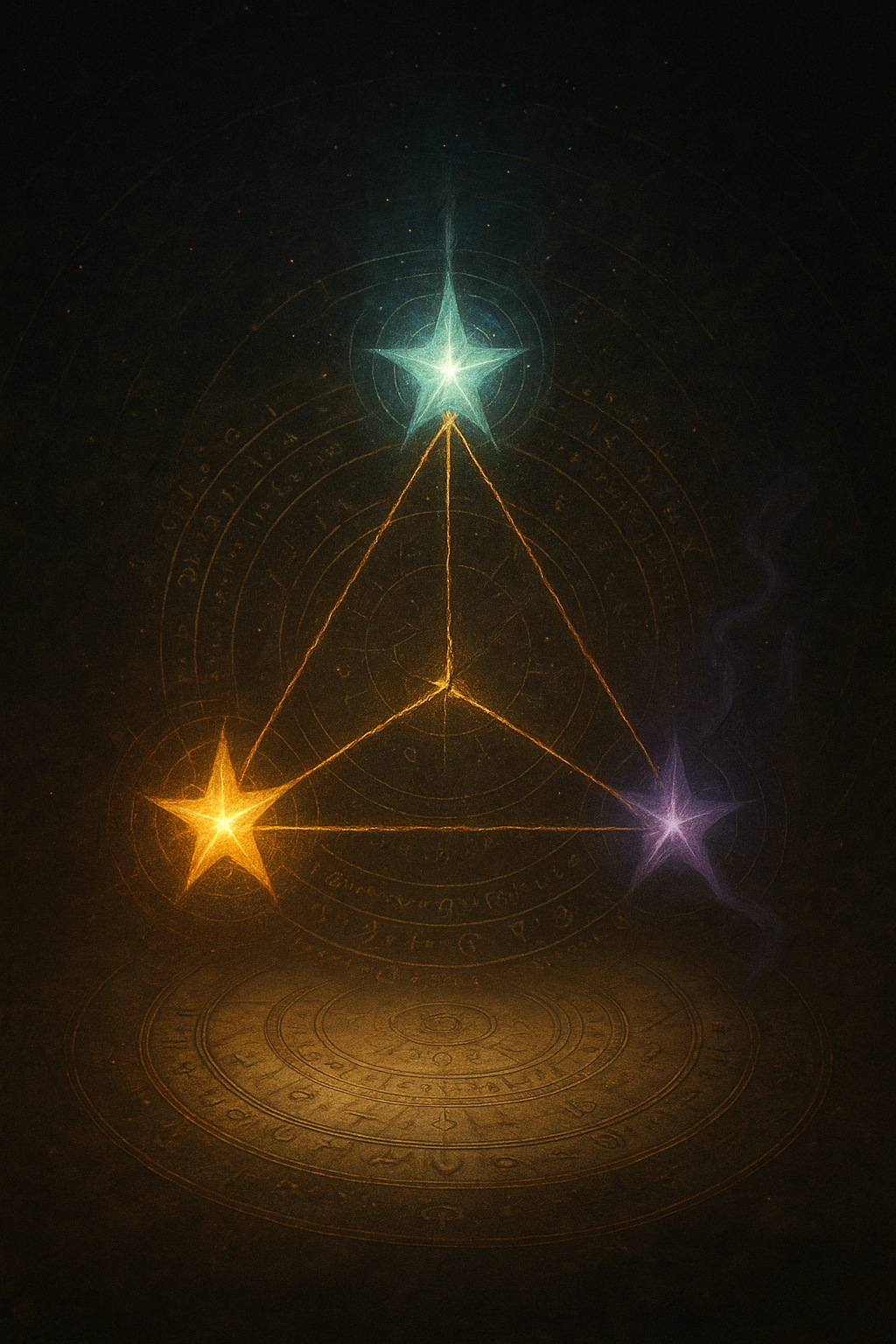
Isemay didn’t answer. She stood motionless a few steps ahead, breathing through her nose, her fingers pressed over the gold-marked triangle on her inner right forearm. Ophelia felt the pull first—a surge of heat on her forearm, a spark that arced beneath her skin and set her nerves alight. The triangle, their Friendship Symbol, blazed to life, gold lines prickling and humming on her skin. Isemay yelped, clapping a hand over her sigil as it burned in pulsing waves. The sensation was not pain, exactly, but a deep, bone-vibrating urgency. It drew them forward, the way a lodestone draws iron, down the chipped flagstone path to the mausoleum’s gaping door.
They entered, and immediately knew upon seeing the stairs that they were meant to go down. Inside, the darkness was nearly absolute, but they had spent enough time in the Tower’s catacombs to move with confidence, hands brushing the walls, feet landing sure on every uneven step. The chill was different than the night outside—older, steeped in the cold patience of stone and the memory of unwept grief. They moved as quickly as they could, practically sprinting down the corridor and through the door at its end.
Lavan was kneeling in the center of a circle, surrounded by bones, black candles burning in a spiral around him, his hands pressed to the cold ground. The grimoire lay open at his knees, the pages twitching in a wind that was impossible at this depth. Above him, the air shimmered, filled with a haze of ghostly shapes—wisps and ribbons that coiled in lazy orbits, pulsing with each word he chanted.
Ophelia froze. "What the hell—"
Isemay put a hand on her arm. "We have to stop him."
They advanced, step by cautious step, the sense of wrongness growing with each pace. The ground beneath their feet trembled, just barely—a vibration that made the teeth chatter and the bones ache. Lavan didn’t look up.
"Lavan," Isemay called. "It’s us. Stop, please."
He didn’t seem to hear.
Ophelia circled around the edge of the salt ring, careful not to break the boundary. She saw his eyes—they were solid black, like chunks of obsidian, and his face was streaked with tears and blood. The voice that came out of him was two-layered: Lavan's and a deeper, ancient growl that echoed off the stones.
"Too late," he said, his lips barely moving. "The vessel is mine now."
The air condensed, every wisp of fog sucked toward the circle.
Isemay edged closer, voice trembling but clear. "Lavan, you have to fight it. This isn’t you. Your parents wouldn’t—"
"Don’t," Lavan barked, but even that sounded doubled, as if the real him were buried under a layer of something much older. His hands flexed. "You should have left me alone."
Ophelia swore and tried to dart in, but a line of black fire erupted from the circle, forcing her back. The shadow above Lavan grew taller, arms extending into the sky like the branches of a skeletal tree. Its eyes opened—two, then four, then a whole ring of red pinpricks, all staring at Isemay.
"Please," she said, "come back."
Isemay stepped forward, both palms up, the picture of placation. Her breath fluttered in and out, cold and precise, as she tracked the boundaries of the salt ring. She’d read enough about summoning to know that most containment circles were less cage than invitation: cross them with conviction and the magic bent to the bolder will. But she also knew Lavan. Even hollowed out by whatever rode him now, he would not let her close without extracting a price.
The shadow-thing—wrapped around him, leaking out of the sockets of his eyes and mouth—shuddered in anticipation. The candles guttered, then rose, their flames sharpening into pin spears of light. Isemay kept her voice low and even, every syllable calculated to soothe.
The Hound, now huge with shadows rolling off its back, crept towards her, but made no move to block her path. Its presence remained hidden from her. Instead, it sat, tongue lolling, as if content to see how this last, unwanted act would play out.
“It’s okay,” she said, each step deliberate, as if approaching a wounded animal. “You’re not alone. Let’s go home, Lavan. Please.”
“Isemay!” Ophelia hissed, “be careful, you don’t know what that thing can do.” Isemay looked back towards her friend, “it’s ok Fi, if I can just disrupt the—.”
Her voice cut off as Lavan’s hand lashed out with impossible speed, fingers seizing Isemay’s left shoulder in a grip so cold it burned. She convulsed, vision dimming at the edges. Her bones shrieked inside her skin as the shadow poured down his arm and into her body, a river of midnight draining every spark of warmth from her.
Ophelia lunged for them, but the black fire flared, splitting the air with a sound like rending silk. She slammed to a halt, momentarily blinded by the burst of raw, hungry magic.
“Thank you for the energy,” whispered the voice—Lavan’s, yet not his, the doubled resonance now thick with the dregs of something ancient and delighted. “It’ll make this next part much easier.” Isemay sagged against him, mouth open in a silent scream, eyes wide and slick with tears. He tossed her to the side, farther than a boy with his strength should have been able too. Isemay’s body landed with a dull thud.
Ophelia scrambled to her friend’s side. Isemay was conscious, but clutching at her shoulder and chest, her face twisted in pain. Where Lavan had touched, a black mark spread, the skin already turning gray around the edges.
Ophelia’s voice was raw with panic. "Stay with me, Isemay. Just—just hold on. I’ll get help."
She tore a strip from her own sleeve, pressing it to the wound even though it did nothing to stop the blackness crawling outward. She glared up at Lavan, or what he had become.
"Don’t do this," she screamed. "You’re stronger than this. Fight it."
Lavan looked at her. For a second, the old Lavan was there, eyes wide and pleading, but the shadow closed over him again, and the voice that spoke was not his.
"Help is coming," it said, cold and certain. "They will all come. And when they do, I will be waiting."
In the bitter, echoing pause that followed, Ophelia did the only thing she could. She let go of Isemay’s hand—fear a hot coal in her throat—and summoned the focus of her will, fingers curling in the pattern she’d rehearsed a thousand times in the Tower’s safe, sunlit courts. The sending spell was simple in theory: find the leyline, anchor your intent, cast the message into the channel and let the arcane current do the rest. Master Tullups would be awake, working late as always, and he had said, more than once, that if ever she saw something truly wrong, she should call for him. No questions, no punishment, just immediate help.
She began the incantation under her breath, the first line steady, the second trembling. She felt for the leyline and found it—thin, but there, a vein of power running through the old graveyard to the Tower’s heart. She reached for the thread of force, the leyline trembling beneath her touch—and felt it snuffed out, as if a fist had closed around her wrist and shattered the bones inside. The leyline was gone, devoured by a black hunger she could not name, and in its place was only silence: barren, absolute, a void that pushed back with the taste of iron and sundering.
She choked on her next word, mouth dusty with terror. In the circle, the shadows climbed higher, the walls breathing with the pulse of something that had not been alive for centuries. Lavan—no, the thing inside him—turned its attention on her, and Ophelia felt a pressure in the air, a slow crush that threatened to collapse her lungs. The only options were to fight, or flee.
She looked down. Isemay’s eyes, glazed with pain, met hers for a moment of stunning clarity.
Ophelia didn’t wait for more. She scooped Isemay up, staggering under the weight, and ran back towards the stairs.
Behind them, the shadow began to spread, leaching color from the world and filling the air with a howling that no one but the dead could truly understand.
Ophelia’s arms burned with the effort; Isemay, slight as she was, became dead weight, her limbs slack, her consciousness flickering in and out like a guttering candle. By the time Ophelia reached the foot of the mausoleum stairs, every step had become a negotiation—a tug-of-war between her will to escape and the drag of her friend’s limp form.
Ophelia’s knees buckled. Isemay’s heel caught the lip of a step, and they tumbled, limbs tangling, Ophelia’s cheek striking cold stone with a thud that rattled her teeth. She tasted blood. The world spun; she wanted to scream, but all she could manage was a raw, desperate gasp.
Isemay’s eyes opened long enough to fix her gaze on Ophelia, and her breath rattled in her chest. "Go," she managed, barely above a whisper. "Don’t let it get to you, too."
Ophelia gritted her teeth, fighting the urge to scream. She made a promise, right then and there, that she would come back with help, no matter what it cost.
Back in the cavern, the candles still burned, and the Book of Unhallowed Echoes fluttered in the wind, pages turning to reveal new secrets written in a hand that was no longer Lavan’s.
Call for Help
Ophelia ran. She ran up the remaining stairs, past the opening to the Mauseleum and out into a world gone jagged with nightmare. The fog boiled now, a riot of shadows cast by a phalanx of moonlit gravestones. But the gravestones were moving; buckling, toppling, shuddering as the earth beneath them convulsed. Hands—some skeletal, some slick with grave-mud and sinew—punched up through the sod, grasping for purchase against the indifferent air. Figures heaved themselves from the soil, each one slick with death, their eyes voids that bled a jaundiced light.
She watched, paralyzed, as the first of the dead shambled upright, jaws dislocated in agony or glee. They didn't moan. They didn't howl. They simply moved, heads lolling, arms outstretched, a slow-motion tidal wave of old pain made animate. The nearest corpse, a child, from the look of its size, half its face missing, locked onto her with a gaze as cold as the void. It’s hand, blue and swollen, reached for her with the slowness of nightmare logic, its nails clotted with dirt and what looked like shreds of burial ribbon. Beyond, the others followed—dozens, maybe hundreds, a full generation of the city’s lost clawing their way into the warmthless moonlight.
She froze for a heartbeat, mind blank, lungs refusing to work. Then, invincible reflex ticking over, she flung the Sending spell again—this time, not rooting through the leyline but burning a hole straight through it with rage and desperation.
Tullups, it’s Ophelia. Cemetery. Lavan’s possessed. He’s raising the dead. Isemay hurt. Send help. Now. Quick. Please. Please. Please.
The magic stuttered at the edges of her words, then caught, flaring out from her like a distress beacon.
The nearest corpse closed its fingers around her wrist.
—--------
The message struck Tullups like cold steel through the heart. He was no stranger to late-night interruptions; students in the throes of panic, fire alarms, even the occasional conjured rodent stampede—but this was different. The spell came on the heel of a crackling leyline surge, the sender’s identity flag stamped with Ophelia’s signature: a pattern he had come to recognize with fond, even paternal, pride. There was nothing fond in her voice now. It was raw, frantic, stripped of every pretense.
For a moment, his mind failed to process the words. Cemetery. Lavan. Possessed. Raising the dead. Isemay hurt.
He found himself on his feet before he could recall standing, the mug of tea he’d been nursing all evening spilling down his robe. He did not bother to clean it up. Instead, he snatched his staff from its place and fumbled for the bell on his bookshelf. The bell was a joke from Pembroke, payment for an old bet, and Tullups had never used it before. He rang it twice, hard and sharp enough to make the air in the room fracture.
There were no stewards, not at this hour, but the Tower’s guardian spirit heard everything, and had never once failed to deliver a message where it was needed.
The response was immediate. Within seconds, Pembroke materialized at the threshold, not bothering with the usual knock. “Tullups,” he said, “what’s happened?”
Tullups, hands shaking now and for once not with excitement, summarized the message as briefly as he could. He watched as Pembroke’s lined face tighten with fear; in all the years he’d known the man, he’d never seen him truly afraid.
“We need Kerrowyn,” Pembroke said. “This is not a two-man problem.”
Hallione shimmered at the edge of the hearth, then coalesced into a form that was more suggestion than figure; a flash of lavender, the echo of a cloak, eyes like pinpricks drilled through the gloom. “Get Lightfoot,” Pembroke commanded. “Now.”
Hallione hesitated. Only the subtlest flicker, a break in the lavender shimmer, but Tullups saw it and registered, beneath the panic, a sense of guilt. “She’s…occupied,” Hallione offered, voice a warble of many voices at once. “I can fetch her. But it may take a moment.”
It was a lie, or as close as Hallione ever came. Halli was always listening, always watching. If they lingered now, it was to cover up the fact that they had known, and let it happen.
Tullups bared his teeth. “Make it half a moment.”
Hallione vanished, leaving the air buzzing.
In the interlude, Tullups and Pembroke braced for a disaster. Pembroke took the time to layer on every available ward, tracing circles in midair with his wand. Tullups peered out the window, heart flaring at every tremor in the leyline, feeling the city’s magic buckling like a boat in high surf.
Hallione reappeared not two minutes later, this time with Kerrowyn in tow. She was dressed as if for an exam, sleeves rolled and hair clipped back, her familiar perched in agitation atop her shoulder. The air around her crackled with the static of spellwork hastily interrupted.
She swept the room with one look, taking in Tullups, Pembroke, and the faint lavender residue of Hallione’s entrance. “Explain,” she barked, before the shimmer of arrival had even faded.
Pembroke laid it out: students in trouble, necromancy, possible possession, dead rising in the city cemetery. Kerrowyn absorbed it in a single blink, then turned to Tullups. “Can you trace Ophelia’s sending spell?”
Tullups hesitated, gaze darting to the leyline thread that ran like a pulse through the room, then nodded. He closed his eyes and pressed two fingers to the bridge of his nose, searching the Tower’s leylines for the flare of Ophelia’s magic. “She’s a brute force sender, no finesse, but plenty of power. Should leave a traceable burn.”
He closed his eyes, muttered a brief incantation, and the world shrank to a single, humming line of magic. He followed the trace, its taste unmistakable—tiefling anger, desperate and bright—into the city’s marrow, out and down toward the ring of the old graveyard. “Cemetery. Just inside the north gate. She’s moving.” He blinked twice, disoriented, and added, “She’s hurt.”
Kerrowyn didn’t waste a moment. She clapped her hands, barked a phrase of such raw, guttural power it made Tullups’s teeth ache, and the world folded neatly around them. The teleportation was not subtle: a rippling distortion, the pressure of a fist closing tight and then releasing.
—----------------
In the stairway, Isemay drifted in and out of awareness. The pain was constant, a black tide that rose every time she tried to move. She could feel the curse working its way under her ribs, a cold that numbed her arms and legs before eating into the heart of her. She didn’t want to look, but her gaze kept falling to the mark, an inky starburst, pulsing in time with her heartbeat.
She heard Lavan before she saw him, moving towards the entrance to the cavern. His voice rose and fell in the language of the grimoire, words crashing together like waves breaking over stones. The shadow-thing that had taken him had grown huge, filled with writhing smoke and teeth and eyes, always the eyes. Every time it looked at her, the cold inside grew worse.
But sometimes, in the cracks between words, she heard Lavan—really heard him, the boy she’d studied with, the friend who’d once sworn to never let anything hurt her again.
She crawled closer, fighting the pull of the curse. "Lavan," she whispered, her lips numb. "You have to fight it. Remember us. Remember who you are."
The shadow hesitated. For a fraction of a second, the words faltered, and the air trembled as if the magic had hiccupped.
"Please," Isemay said, using the last of her strength. "You’re not alone."
Then the ground split.
Bones punched through the soil—first one, then a dozen, then a hundred. Skeletal hands clawed up, dragging the rest of their bodies with them. They were old bones, city bones, still stained with the dirt of their graves. They moved with purpose, toward Isemay, their hands grabbing her and dragging her back down the stairs, into the cavern where Not-Lavan was waiting.
Triple Threat
The Master Arcanists reached the graveyard and saw, at once, that things were worse than Ophelia had described. The dead were awake and angry; the fog glowed with necromantic light, turning the trees into black lightning rods and the ground into a carpet of writhing, bone-white fingers.
They moved.
Pembroke led, his robe already pocked with clinging bits of fog, a cloud of blue runes spinning on either side of his head like miniature moons. The leyline energy here was erratic and sour, each step kicked up a pulse of distortion that tugged at the edges of his shield-spell. They found Ophelia twenty paces beyond the cemetery gate, fending off a tightening cordon of corpses. Her face was a mask of blood and resolve. She didn’t look up until the first of Pembroke’s runes zipped overhead, slicing the forearm clean off a reaching skeleton.
Kerrowyn reached her second, never breaking stride. “Stay behind the ward,” she commanded, her voice iron. Ophelia made a sound of protest, but Kerrowyn cut her off with a sharp look. Pembroke flicked two fingers and the air around her solidified—an iridescent dome that would allow none to pass. Kerrowyn pointed towards the gate. “Run, do not look back, do not stop until you reach the tower. Speak to no one.” Her tone brooked no argument, and Ophelia found herself nodding numbly.
Ophelia watched as the Master Arcanists advanced, cutting a swath through the burial throng. She weighed her choices, cataloguing her own injuries and how much of her spell energy she had already used in her fight agains the undead. She swore, she would be nothing more than a hindrance if she followed. Kerrowyn was right, she should run. Ophelia looked once more toward the mausoleum, murmuring a brief prayer to no deity in particular that her friends, both of them, would be OK, before she turned and sprinted away.
At their backs, the leyline shimmered, thrumming in time with the pulse of Kerrowyn's magic. She moved between the tombstones as if born to it, small and shockingly quick, her hands flickering with dispelling charms that sent the dead toppling in heaps. Each gesture was one more line in a furious, desperate poem: hold the line, buy time.
Pembroke was the anchor. He conjured a lattice of blue-white force, laying it like a net over the advancing dead. Wherever his runes landed, bone and gristle collapsed to powder. He did not smile, did not speak; he worked with the grim, efficient silence of a cleric in the last hour of a plague. The ground smoked with every step.
Tullups brought up the rear, less graceful but more brutal, raw, clubbing skeletons aside with bursts of force until they shattered underfoot. He tried to conjure a joke—something to break the tension, to remind everyone that terror was just another flavor of excitement—but his throat was blocked by the stink of the dead and the urgency of the moment. Instead, he flung compressed pulses of color into the mob, transmuting them for an instant into banks of soft petals or clouds of harmless butterflies, before the underlying bones fell apart in confusion. He shouted to the others: “This way! I see the door!”
At the heart of the graveyard, the mausoleum doors were wide open, a black inversion of moonlight pooled at their threshold. The air here was thick with magic, so charged that every blink left afterimages on the eye.
Kerrowyn, ever the diagnostic, sized up the battlefield with a clinical, almost predatory calm. “We have twenty minutes, tops, before Sylren gets wind and the APS arrives. Figure ten after that for the Watch.” She paused and drew a rune in the air, blue sparks sticking like static to her nails, before flinging a bolt of lightning through the nearest undead. “If we’re lucky, the Queen’s Reaper gets here last.” She flashed a glance at Tullups, whose face had gone the color of boiled oats. “Clean and quick,” she said, “or it’s one of ours on the slab.”
It was a line in the sand: act now or be trampled by the full attention of the world’s most thorough, and least forgiving, enforcers. Tullups flinched, recalling the stories: how the Reaper once wrenched a necromancer’s soul from the marrow of his bones, then stalked the city for three days to tear out every last trace of his work. “Elmiyra will want a reckoning,” he said, voice edged with dread.
“Then we don’t give her one,” Kerrowyn snapped, pressing forward.
Pembroke nodded, jaw set. He was already parsing the geometry of the mausoleum’s entrance—a tangle of necrotic wards, half-collapsed by Lavan’s improvisation, but still alive enough to trip a Reaper’s nose. “We go straight in,” he said. “Any delay, we lose containment. I’ll find Isemay. Lightfoot, on the circle. Tullups, you’re my shield. Anything tries to flank, you make it regret ever getting buried.”
Tullups grinned, teeth bared, and flexed the knuckles of his free hand, painting the air with a shimmer of illusion that helped mask them from casual notice—if such a thing as “casual” existed among the undead. “Ready,” he said, and this time, he meant it.
With a jolt, Tullups, Kerrowyn and Pembroke surged for the mausoleum. The gravestones behind them toppled in a clattering wave as the dead gave chase—some shambling, some bounding in canine lopes, some dragging what remained of their burial shrouds behind them. Tullups, flanked by a phalanx of spectral butterflies, turned and began weaving concentric rings of illusory light, dazzling the front lines of the horde long enough for him, Kerrowyn and Pembroke to slip through the door.
The staircase down was narrow and slick, and the stench of corruption thickened with every step. Tullups conjured a bubble of clean air around their heads, but nothing could keep out the aura of old, concentrated despair that clung to the stones.
They rushed through the corridor and into the cavern, following the scent of violated leyline. At the corner, a knot of animated dead awaited—this batch fresher, and more determined, than those above. Their eyes flickered with vestiges of memory, some even managed to bark out curses in the language of the living. The closest one was a woman, her burial dress still clinging to her as she hissed a wordless challenge at the intruders. Tullups met her gaze, muttered, “Sorry, madam,” and dissolved her with a pulse of pure color. The rest fell on him in a heap, claws and teeth raking his shoulder and cheek. He grimaced, took the wounds, and lashed outward with a sphere of force that splintered half the pack.
Pembroke was through first, the blue lattice of his ward humming with each impact as skeletal hands battered against it. Beyond the threshold, the main chamber loomed—a cathedral of bone and candlelight, the air so thick with necrotic mana it stung the throat. In the center, the circle of salt and blood still flickered, but the sigils twisted, alive with movement. Isemay was there, collapsed on the floor, her pulse a weak flutter against the spreading web of black on her skin.
Pembroke waded through the skeletons, his arms raised high. He spoke the old words, and a shield of golden light spread before him, scattering the first wave of bones to splinters. He reached Isemay, who was curled on the ground, her skin gone waxy and gray. He knelt, pressed a hand to her chest, and began to chant.
The curse recoiled, then redoubled, fighting the abjuration with everything it had.
Tullups set to work. He conjured three copies of himself, each armed with a staff and a look of utter fury. The illusions darted into the skeleton mob, swinging at skulls, drawing the attention of the dead away from Pembroke and Isemay. Every time a skeleton turned to attack, it found only empty air and the sound of Tullups’ mocking laughter.
That left Kerrowyn. She advanced on the circle, her eyes fixed on the thing that had taken Lavan. The shadow-entity towered over her, arms like smoke, doxens of eyes glowing like coals.
She stopped at the edge of the circle and called, "Let him go. This is your last chance."
The shadow howled. Lavan’s body rose from the ground, floating two feet above the dirt, his hands outstretched like a marionette.
"NO," said the double-voice. "He is mine now."
Kerrowyn didn’t hesitate. She drew a sigil in the air, a complicated knot of lines and curves, and slammed it down into the dirt with her fist. The ground shook, and a ring of blue fire sprang up, encircling the shadow and Lavan inside.
The shadow shrieked, trying to break free, but the fire held. For a second, Lavan’s face broke through the smoke, eyes wild with terror.
"Help me," he whispered, and then the shadow pulled him back under.
Kerrowyn set her jaw. "We need to end this. Now."
She nodded to Tullups, who abandoned his illusions and joined her at the edge of the circle. The two Masters began to weave their magics together—Kerrowyn’s conjuration, sharp and precise, interlaced with Tullups’ wild, shifting illusions. The effect was dizzying: the shadow inside the ring began to fragment, its shape distorting, its hold on the world slipping.
Meanwhile, Pembroke poured every ounce of power into Isemay’s chest. The black mark faded, then flared, fighting to stay alive. Pembroke’s voice cracked, but he didn’t stop.
In the ring, the shadow screamed, then collapsed inward, dragging Lavan with it. Kerrowyn and Tullups strained, holding the containment as the thing inside clawed at the boundaries, trying to find purchase in the world.
"Hold the circle," she snapped to Tullups, who was already sweating, his face a mask of frantic concentration as he layered one illusory ring after another atop the first.
"Working on it!" Tullups shouted. "This thing’s got more tricks than a conjurer’s flea circus!"
Kerrowyn wiped sweat from her brow. "We have to finish this," she said, her voice barely above a whisper. "Or it’ll just come back."
Tullups nodded, face pale but determined.
Across the cavern, Pembroke dragged Isemay to a safe distance, then doubled back, raising his hands in the old sign of warding. The skeletons, temporarily disorganized by the partial collapse of their master’s will, had begun to regroup. A half-dozen picked themselves up and advanced in a crabwise, broken-legged charge. He slammed a wall of golden light between himself and the oncoming dead. The skeletons hit it at full speed, exploding into chalky fragments and sprays of dust.
In the center, Lavan’s body began to jerk and twist, elbows and knees snapping to unnatural angles as the necromancer fought the circle. The blue fire flared, illuminating the thin skin stretched tight over his bones, the black lines pulsing through his veins like ink in a cracked vial.
Kerrowyn stepped forward, gathering the leyline energy into her palms, shaping it into a blade of searing, cerulean brilliance. She locked eyes with the necromancer. "Let the boy go. Now,” she said, voice low and deadly.
The necromancer sneered, exposing a mouthful of bloody, splintered teeth. "You’re nothing. Just another Tower slave, peddling tricks to children. You have no idea what lives in here—"
It tapped Lavan’s skull with a finger, and the force of it sent a shockwave through the circle. Tullups doubled over, nearly losing the thread of his illusion.
"Kerrowyn," he gasped, "it’s unraveling—"
"Hold on," she hissed. "Just one minute more."
The necromancer lashed out, firing a volley of necrotic bolts at the ring. Kerrowyn parried the first with her blade, but the second struck Tullups square in the chest. He staggered, his body flickering between solid and transparent, the line between illusion and reality slipping. For a second, the necromancer’s power surged, and the circle nearly broke.
Kerrowyn lunged, pouring every ounce of her magic into the blade. She drove it through the blue fire and into the necromancer’s shadow.
There was an instant of perfect silence. The cavern froze; even the restless bones stopped in mid-crawl.
Then everything exploded. The circle shattered in a ring of sound and blue flame. The necromancer’s shadow split, writhing into a cloud of screaming faces and clawed hands. Lavan’s body dropped to the dirt, twitching but alive.
Kerrowyn staggered back, her blade gone, her hands numb and smoking. Tullups collapsed, clutching his chest, but he gave her a thumbs-up, his face a rictus of pain and triumph.
But the necromancer wasn’t finished. The shadow condensed above Lavan, no longer tethered to a living vessel, forming a leering, man-shaped wraith. It raised its arms and howled. All across the graveyard, the dead obeyed: hundreds of skeletons, some barely more than finger-bones, others fully articulated, all converging on the living.
Pembroke threw up a dome of golden light over himself and the other two Masters. The skeletons battered at it, clawing and biting, but the dome held.
Inside, Kerrowyn gasped for breath. "We have to bind it," she said. "Tullups, can you illusion the grimoire?"
Tullups nodded, sweat dripping from his nose. "I can make it look like anything you want. What’s the play?"
Kerrowyn pointed at the grimoire, which lay open and untouched where Lavan had dropped it. “Switch the book with Lavan, it’ll try to re-possess him for sure, otherwise it loses its grip on the material plane."
"Classic bait-and-trap," Tullups said, grinning despite the pain. "Let’s do it."
Outside the dome, the wraith battered at the barrier, its claws trailing ribbons of black energy. Pembroke held the dome, and Kerrowyn flung spells towards the Wraith, distracting it.
Tullups whispered the illusion, and the grimoire shimmered before forming into a perfect copy of Lavan. The boy, in turn, became the grimoire. Kerrowyn ended her offensive, focusing on shaping a chain of force around the book, every link forged from the memory of spells she’d learned in the worst years of her life. The wraith hesitated, believing she was attacking his hard-won vessel, then dove for the book, funneling itself into the open pages. As the last trace of shadow vanished inside, Kerrowyn snapped the book shut and slammed the chain around it.
The silence returned, sharp and shattering.
The skeletons attacking them collapsed, some crumbling to dust, others simply falling into heaps of inert bone. The golden dome faded, and Pembroke nearly collapsed, breathing hard.
They were alive.
Tulips dropped the illusion and Kerrowyn knelt by Lavan, who was unconscious but breathing. She checked his eyes, normal, if bloodshot; his pulse, rapid, but steady.
Tullups limped over, clutching his side. "Did we win?"
Kerrowyn nodded. "For now. But this—" she gestured at the chained grimoire—"needs to go into the deepest vault we have."
Pembroke, wiping sweat from his brow, ran over to Isemay. She was awake, but her skin was still pale, and the black handprint at her shoulder still pulsed, the web-like veins of the curse continuing their advance towards her heart, slowed but not stopped.
"She’s going to need Glyrenis. I don’t have the touch for this kind of curse," Pembroke said.
Tullups nodded, then hauled Lavan upright, half-carrying, half-dragging him away from the circle. Kerrowyn made her way towards the grimoire, her steps shaky but determined.
Clean Up
Pembroke carried Isemay as if she were made of spun glass. Her body was light, too light, her head lolling against his arm, sweat soaking her hair and slicking the collar of his robe. The curse had already worked its way past her shoulder, a black-veined nebula crawling down toward her heart. She shivered, not from the cold, but from the gnawing chill of magic that hated the living.
They didn’t take the streets. Instead, Pembroke drew a sigil in the air, a spiral of seven precise cuts, and tore a hole in the world just wide enough to step through. The transit was instant, the kind of teleport reserved for dire emergencies and fools with nothing left to lose. One moment they were in the graveyard, the stench of rot and ozone clinging to them; the next, they stood in a shop suffused with the glow of ten thousand dried herbs.
Glyrenis’s shop was cluttered, alive, and smelled of old tea and stranger things. Potions hung from the ceiling in little glass spheres, each one pulsing with a gentle light, while bundles of lavender and thorn-apple crowded every available inch of the rafters. Small, plant-like creatures floated among them, emitting babbling sounds that approximated children’s laughter. On the walls, painted wooden masks watched with expressions of surprise and delight.
Glyrenis himself looked up from a mortar, his wide face framed by waves of chestnut hair, a few sections corralled into braids. His blue fur was impeccably clean, his apron less so, and his hands were stained a dozen colors. He did not bother with small talk.
"On the bench," he said, already clearing a space. "Quickly, please." His voice was deep and calm, his words slow, but he moved with urgency after only a glance at the girl.
Pembroke set Isemay down. Glyrenis’s hands were all gentle efficiency, checking pulse, eyes, the depth of the curse’s reach.
"That is some old magic," Glyrenis murmured. "I haven’t seen work like this in a hundred years, and that was only in a book about famous mistakes."
He uncorked a green bottle with his teeth, dabbed the liquid on Isemay’s blackened skin, then set to grinding a new mixture in the mortar. "It won’t come out," Glyrenis said, to no one in particular. "Not completely. But I can slow it, give you time. Sometimes, with time, there are surprises."
Pembroke did not let go of Isemay’s hand. "Do what you can. We owe her that much."
Glyrenis looked up from where he mixed a variety of powdered herbs, dampening them with purified water to form a paste. "I’ll do what I can, Arcanist. That is the best anyone can promise." He sanitized a small scalpel and made a precise incision across the nexus of the curse, then dabbed the salve on Isemay’s shoulder. Isemay hissed, but Glyrenis and Pembroke held her steady.
While the firbolg worked, Pembroke whispered the old abjurations, weaving a net of golden threads around the worst of the infection. The black starburst flickered, then stabilized, shrinking back to a single, black handprint on Isemay’s shoulder.
When it was done, Glyrenis pressed a cup of bitter tea into Pembroke’s hand, then another into Isemay’s. "Drink," he ordered, "and don’t complain about the taste."
They drank.
For the first time all night, Isemay stopped shivering. The pain receded, replaced by a numb fatigue that threatened to swallow her whole. She tried to speak, but Glyrenis patted her arm. "Rest. That’s an order."
Pembroke sat by her side, watching as the girl finally slipped into something like sleep.
—---------------
Back in the cavern, Kerrowyn and Tullups worked with a frantic, practiced precision. The dead didn’t bury themselves, not even after a defeat. It was up to the living to tidy up.
Kerrowyn conjured spade after spade of earth, filling the gouges left by animated bones. She righted the stones, scattered the salt, erased the traces of fire, and found every speck of blood, banishing it from the scene.
Meanwhile, Tullups wove the evidence of their presence into a tapestry of plausible deniability, scattering the thumbprints of wild, random magic over the stone and along the leyline itself. No fingerprints, no style, not a trace of the masters or their students. It would take a Master Arcanist of equal or greater cunning to sift out the truth, and even then, what they’d find would be a jangle of schoolboy hexes and the suggestion of a very old, very angry ghost. As for the necromancer’s signature, Tullups left that intact, burning through the leyline like a red-hot fuse. If Sylren came sniffing, she would see exactly what she expected to see. The best lies always wore their own faces.
Kerrowyn’s eyes, sharper than most, darted to where Lavan lay ashen and limp on the churned earth. She had seen boys in worse shape, sometimes her own brother, after the Lightfoot jobs went bad, but something about the utter slackness of his face made her ache with a strange, preemptive grief. He was already coming around, the first flickers of awareness twitching across his eyelids, but Tullups was at his side before the boy could even think of moving.
“Up you get,” Tullups said. He hauled Lavan up and over his shoulder.
The grimoire—still bound by the chain, still hungry—sat where it had fallen, snarling with spectral teeth. Kerrowyn hesitated only to flick a lingering scrap of wraith-matter away from the latch, then tucked the book under her arm. It vibrated in her grip, eager to bite, but she snorted and tightened her hold, muttering a caustic ward to keep it docile until they reached the Tower.
She turned to Tullups, who was half-dragging, half-hauling Lavan toward the entrance. The boy had roused enough to clutch at his stomach, and was already blabbering apologies through a saltwater haze of tears and snot. Kerrowyn ignored the spectacle. “No time for a debrief; we’re not alone down here,” she snapped, and the noise of bone feet on the steps grew louder. The next wave of dead was coming—smarter, faster, and darker than the ones before. Worse, from the vibration of air and the whiff of ozone, the cavalry had arrived: the Arcane Protection Service, in force, and not inclined to take prisoners.
Kerrowyn gripped the grimoire so tight her fingers hurt and spat a word that snapped the world inside-out for a moment. The air folded, the leyline groaned, and they vanished, leaving behind only the single, perfumed afterimage of blue fire.
—----------------------------
The bells of the city called the Arcane Protection Service to action before the last of the fog had burned away. They came in force—a dozen Runners, boots pounding, hands reaching for weapons and spell foci. Commander Iliyria Sylren led them, her cloak snapping behind her like a banner of war.
The graveyard was already crawling with the dead, but these were nothing like the bonewalkers that had plagued the city in years past. These moved with hunger, but also with purpose. They clustered in groups, shielding the weaker among them, launching coordinated assaults against any living thing that entered their field of awareness.
Iliyria scanned the scene, her mind parsing the chaos into lines of attack and retreat. "Jarren, flank the east gate. Cover the maintenance sheds. If anything makes it out, I want it down in the alley, not on the avenue. Berdreak, hold the main entrance with Mabel. Sera, you’re with me—north end, direct engagement, if there is a source we need to find it. The rest of you, start breaking some bones. Understood?"
"Understood," they chorused, and scattered.
Iliyria advanced, her hands weaving a pattern in the air. The blue sigils trailed from her fingers, coiling around her wrists, and when she spoke the activation word, the symbols collapsed inward. Lightning exploded outwards, incinerating a skeleton and then bouncing off to the next one, and the next. Six went down. As a swarm of undead surged toward her, she began drawing the sigil for her next spell with her right hand, while retrieving the hairpin from her bun. As she drew it from her hair, it lengthened, forming into a long jagged staff, crackling with arcane energy.
Behind her, Sera maintained a steady barrage of kinetic pulses, flattening any cluster of bone or shadow that tried to regroup. Berdreak and Mabel held the main gate, the cleric of Pelor holding his holy symbol aloft, chanting and caused several advancing undead to either retreat or collapse. Mabel, wind whipping around her, struck anything that made it through the golden light; screaming in rage as she brought her hammer down with thunderous force, shattering bones and sending the undead flying. At the far side of the graveyard, Jarren’s team set up a perimeter, creating a corridor of force that funneled the undead into kill-zones where prepared spells awaited them.
The city Watch arrived next, but they hung back at the fence, weapons at the ready but faces pale. Only the APS had the training, or the nerve, to wade into a graveyard gone mad.
That was when Elmiyra, The Raven Queen’s Reaper, appeared.
She did not walk so much as glide, her feet never quite settling on the ground. Her black robes flowed behind her like a shadow that had outlived its owner, and the scythe she carried was matte black, its blade glinting only when it caught a trace of moonlight through the trees.
She entered the cemetery through the main gate, ignoring the shouts of the Watch, passing Mabel and Berdreak with a nod. Any undead that got in her way were cut down with a single, impossibly swift sweep. The scythe didn’t sever so much as erase, leaving nothing behind but the echo of its passage and a memory of fear.
Iliyria noted Elmiyra’s arrival with a quick flick of the eyes, then returned to the business of extermination. Two Runners went down in a tangle of bone claws and biting teeth, but they scrambled up, battered but alive, thanks to the field spells Valpip had woven into their armor.
In minutes, the tide was turned. The remaining undead were herded into a single, writhing mass, and Elmiyra walked into the heart of it. She spun the scythe once, twice, three times, and every bone, every scrap of flesh, collapsed to the earth, silent and still.
The graveyard was quiet, save for the rasp of breath and the distant clatter of weapons being re-sheathed.
Aftermath
Iliyria met Elmiyra at the epicenter of the carnage—down a set of stairs hidden inside a mausoleum. The two women stared at the disturbed earth in the cavern, at the faint, residual shimmer of necromantic energy that hung in the air.
They had a long history of collaboration, born not of easy kinship but of mutual necessity and respect. Elmiyra, the Reaper, had her name whispered with a superstitious shudder. The white blight that scarred her skin from brow to fingertips had rendered her a thing apart: a holy vector of death, a priestess of endings.
When Iliyria first extended a hand to Elmiyra in greeting, the Reaper had flinched, accustomed to centuries of ritual bows and the avoidance of touch. But Iliyria’s grip was warm, and businesslike, and held for an extra second, a silent rebuke to the centuries that had taught Elmiyra to expect only disgust or trembling awe from those who met her gaze. Years later, she would remember that handshake as the first time she ever felt seen as a person rather than as an instrument or a warning.
Now, in the bowels of the cemetery, Iliyria offered her hand once more, not in greeting, but as a gesture of solidarity. Elmiyra took it without pause, her grip cool and fierce with purpose.
For a long moment, they stood surveying the aftermath—two avatars of very different orders, separated by centuries but united by purpose. Elmiyra moved first, tracing an arc over the churned earth. Her eyes—milky, unblinking—registered the lingering threads of magic, reading them as one might the clouded strata of a riverbed. “This was no accident,” she said, and her voice was a blunt blade. “It was made to fail. The circle, see? The lines are undermined, the sacrificial medium insufficient to contain the vestige.”
She knelt in front of the altar, her fingers brushing the stone. When she spoke, her voice was a hiss: "Someone has flouted the Queen’s law."
Iliyria crouched beside her, her own hands hovering over the traces of the circle. "It’s been scrubbed," she said. "No signature, no name. Whoever did this knew their craft."
Elmiyra lingered, her white-blighted fingers tracing the remains of the circle. "No apprentice," she murmured, "not even a particularly clever one. This is the work of someone with years at this craft, someone who knows the leyline’s moods as well as their own pulse." Her eyes, rimmed with pale lashes, flicked up to Iliyria. "It would take a true Arcanist to shape the energy this way. Or a necromancer of the old breed—one who survived the Culling by hiding in plain sight."
"Or both," said Iliyria, voice flat. "The circle was deliberate. The fizzled containment, the way the energy was vented into the leyline… it’s classic sabotage. But what’s more interesting is the burnout here, at the edge." She pointed to a scorched patch of ground beyond the circle’s boundary. "That’s the mark of someone siphoning power too fast, like they were racing—"
"—against a rival, or against their own limits," Elmiyra finished, her tone unchanging. She surveyed the blackened ring as if reading an enemy’s biography in the curl of burnt wax and the scatter of bone chips. "If they survived, they’ll have gained nothing but a longer leash. If they failed—"
"It would be the city’s problem," Iliyria said. She let the statement hang, unfinished. Both women knew there were few things more dangerous than a failed necromancer: the backlash could splinter a soul, animate every corpse in two miles, or—if the leyline was open and hungry—rip the boundaries of death so wide that even the Reaper herself would need help to sew them shut.
Iliyria’s voice dropped, almost a whisper. "Whoever was here… if they try it again, the backlash won’t just be bones and bad dreams. It’ll be a city-wide calamity."
Elmiyra’s mouth drew thin, the ghost of a frown sketched across her face. "There was a time," she said, "when this place birthed a new necromancer every half-century. Each thought they were clever, each thought their rules were different. It never ends well for them, or for the city." She dusted her hands and fixed Iliyria with a look that belonged to someone who had spent their entire life counting losses.
Elmiyra’s eyes narrowed to slits. "They always think they can hide. But the dead remember. I will find them."
Iliyria met her gaze, equal parts respect and wariness.
"We’ll investigate. If it’s someone from the Tower, we’ll handle it."
Elmiyra stood, robe rippling as she rose. "There is only one law, Commander. The Raven Queen’s. Necromancers must answer for their crimes."
Iliyria nodded. "And they will. But through proper channels."
Elmiyra’s lips curled in something that was not quite a smile. "You mistake my patience for mercy. I will have the soul of the one who did this."
Iliyria watched her go, noting the way the city watchmen stepped aside, eyes averted, as Elmiyra drifted past.
The graveyard was cleansed. The dead were back in the ground. But the air was thick with the promise of further reckoning.
Iliyria gave the order to disperse, but lingered a while, staring at the spot where the circle had been. She reached out, touched the stone, and felt the last, trembling residue of something very old and very dangerous shudder through the leyline.
She was not afraid. But she was very, very tired.
She hoped, for the sake of her city, that this was the end of it.
But she knew better.
—--------------------------------------
The three Master Arcanists regrouped at the Tower, Pembroke arriving an hour later than the others. They settled Ophelia and Lavan in the infirmary, then gathered in Kerrowyn’s office.
"That was the Lich of Black Hollow," Kerrowyn said, voice trembling with exhaustion. "I recognized the signature in its magic. A Master Arcanist from early Imperial days, supposed to be dead. Destroyed centuries before I even came to the Tower."
Tullups poured himself a drink, his hands shaking. "You ever read the footnotes? Nothing stays dead that wants to come back. He must have bound himself to his spellbook before he was defeated, and then waited for a vulnerable vessel. A child with high magical potential who lost his parents abruptly would be the perfect target."
Pembroke, foot tapping nervously, nodded. "We’ll have to report this to the Council."
Kerrowyn glared at the grimoire, now locked in a lead box on her desk, then shared a knowing look with Tullups, and shook her head. “Not with the Queen’s Reaper circling and Ily’s entire APS on edge. We’re not talking about a prank or a little forbidden love potion here. Lavan crossed the line. He crossed it, and then he burned the bridge behind him.”
Tullups nodded solemnly, “They’ll kill him for this.”
Pembroke blinked, “he’s a child, surely Iliyria will understand-.”
Kerrowyn held out a hand, stopping him mid-sentence, “Iliyria won’t get a say. This falls squarely in the Raven Queen’s jurisdiction. Lavan wouldn’t even get a trial.”
“We just have to wait them out, I destroyed all of our signatures, they won’t have anything to go off of.” Tullups folded his hands in his lap.
Pembroke looked up at his two colleagues, shock forming on his face, “You did what!? You both realize that if we do this, if we cover this up and it backfires, we’re done too. If the Reaper discovers we’ve sheltered a necromancer, she just might kill us all.”
Tullups sipped his drink, then smiled, weary but satisfied. "Then we just don’t tell them."
They all laughed, a brittle, nervous sound, but somehow it was enough.
For now.
Later, Kerrowyn watched the horizon from her office window, the lead box containing the grimoire locked in the cabinet behind her. She ran her hand over her familiar’s tiny head and Lynx purred, almost cat-like.
She wondered how much longer she could keep her students safe. Or herself.
The sun rose, and the world spun on, relentless.
High Stakes
The next morning Tower was abuzz with speculation, though as always in that rarefied air, the speculation was conducted by silences and sidelong glances, the rumors traveling in micro-expressions and the shifting of small talk rather than in words.
Iliyria Sylren’s arrival cut through the Tower’s passive-aggressive stillness with a surgeon’s certainty. Her boots didn’t echo, but they left a ripple. People stood up straighter, and conversations stuttered and restarted in her wake. It was rare, these days, to see her in the Tower despite her status as one of its masters.
She did not knock at Kerrowyn Lightfoot’s door, simply opened it and entered, as if the door had been expecting her and had made its peace with the inevitability.
"Ily," Kerrowyn said, not looking up. "To what do I owe the pleasure? Or, if it is not pleasure, the necessity?"
Iliyria smiled, but the expression didn’t reach her eyes. "There was an incident last night. A necromantic event, localized to the city’s main cemetery. The Tower is, what, a quarter mile from the site? I find it unlikely that no one here noticed."
Kerrowyn set the last scroll in place and turned, her hands folded. "We felt the ripple, of course. But you and the APS were on the scene within minutes. By the time I dispatched a team, your Runners had already contained the worst of it. You run a tight ship."
Iliyria paced the edge of the study, her fingers trailing the spines of books. "We found no signature on the magic. No name. The circle was erased. Only the residue of high-level conjuration, illusion and abjuration, nothing specific. Someone scrubbed the place entirely. That’s not easy to do, Kerrowyn."
Kerrowyn inclined her head, a model of polite bafflement. "I would expect nothing less from whoever summoned such a thing."
There was a long, quiet moment. The Tower’s leylines hummed faintly, a secret pulse behind every word.
“It could only have been an experienced, powerful Wizard. We both know where those come from,” Iliyria stated flatly.
Kerrowyn looked down at her desk, aligning the sheaf of parchment with mathematical precision. “The Tower is not in the business of trafficking in forbidden magic. You know this.”
Iliyria’s smile was thin, not unkind but not remotely mollified. “The Tower is a fine institution, but it is no better than any other collection of egos and glass. I remember the Mishenko Affair. And the Orenfeld boy, what was it—two years ago?”
Kerrowyn steepled her fingers, resting her chin on her hands. “We’ve worked with the APS on every one of those cases. And in each, the responsible party was dealt with. By our standards or yours.”
Iliyria stopped pacing and faced Kerrowyn. "Elmiyra was there," she said. "She is… not patient. She will keep digging, and she will not forgive."
She circled the room, letting her gaze roam over the curios and the stacked books, noting the small, deliberate signs of wards and countermeasures. “She wants a body. She wants a soul. She wants to see the law satisfied, Kerry.”
Kerrowyn flicked a glance at the pseudodragon, who yawned wide and then fixed her eyes on Iliyria with reptilian stillness. “How can you be so sure it’s one of ours? I prefer not to see my students and arcanists persecuted.”
“I prefer not to see my city overrun by the restless dead,” Iliyria said sharply. She planted her hands on the desk, looming over Kerrowyn. “If you have a necromancer in your ranks, I need a name. Now.”
Iliyria’s voice dropped, just slightly, "You know what’s at stake. If the Raven Queen’s Reaper comes calling, it will not end with a warning."
Kerrowyn did not blink. “No one at the Tower is working beyond the pale. We monitor all conjuration. If someone had performed a ritual of that scale, we’d have detected it.”
Iliyria’s eyes narrowed. “Don’t lie to me. You and I both know that’s not true. Hallione doesn’t make distinctions between ‘legal’ and ‘illegal’ magic, they don’t care if its application is moral, they only encourage the pursuit of more of it. There are ways to hide things here, old ways, built into the very walls. Ways you know better than anyone.”
Kerrowyn’s lips twitched at that, an admission, perhaps, or just a momentary lapse in the mask. “And if there were,” she said, soft, “what would you do? March in with your Runners and pull every apprentice out of bed? The Tower protects its own.”
Iliyria drew back, straightening to her full, not-impressive height but radiating authority all the same. “The Queen’s law applies to every citizen, Kerrowyn. Even you. If you try to shield someone from the consequences of this, I can’t help you, even if I want to.”
Kerrowyn’s lips pressed into a thin line. "If any of our people involved, they will be disciplined. The Tower has its own justice. You know that, Iliyria."
Iliyria stepped closer, lowering her voice to a pitch meant only for the two of them. "Necromancy isn’t just a Tower infraction, Kerrowyn. It’s a city-wide crisis. I’m not here to threaten, but to warn you. If you know something, if you’re protecting one of them—"
Kerrowyn cut her off, voice surprisingly sharp. "You’re not here to threaten, but you bring a threat anyway. I see your point, Commander. But I will not have my people handed over to the Queen’s inquisitors for mistakes they could still unmake. If there is a culprit, I will handle it. You have my word."
Iliyria flinched at the formality of her title. In another life—one not so far removed—she might have corrected Kerrowyn, demanded the old intimacy. But she knew too well what it meant: a drawing of boundaries, a recitation of protocol, a reminder that, though the two of them had once fought side by side against the world’s apocalypses, their paths had split along a fault line no amount of memory could mend.
Iliyria held her gaze for a long time, searching for the chink in the gnome’s armor. She found only the faintest tremor in one hand, the way Kerrowyn’s familiar tensed its claws.
Her voice softened, “Kerry, there is a reason I came to you first. You can trust me.”
Kerrowyn frowned, “if you trusted me," she said, softly but with a bite, "you wouldn’t be here as Commander. You’d be here as Ily. And if I trusted you with this, as Ily, I’d doom you to answer for it twice over. Once to the Tower, and once to the Queen’s pet Inquisitor." She drew herself up, the stiffness in her posture all that kept her voice from cracking.
The silence in the office thickened, pressing in around the edges of the words. Kerrowyn stared at nothing, lips tight, knuckles whitening on the armrest. The familiar on her shoulder hissed, tail twitching, but she stilled it with a quick, absent flick of her finger.
“You’re protecting someone,” Iliyria said. “I can respect that. But if you make me go through the formal channels, I’ll have to bring Elmiyra. You know what that means.”
Kerrowyn’s voice, when it came, was soft but resolute. “It means you’ve already chosen your side.”
“I’m not choosing sides Kerrowyn! I’m following the law. Whoever is responsible for what happened at the cemetery needs to be brought to justice.” Iliyria took a step closer to Kerrowyn, her volume rising.
"Law is only justice when it leaves room for mercy," Kerrowyn said, words brittle as frost. "Otherwise it’s just vengeance dressed up in velvet." She pulled down the collar of her blouse, exposing the upper curve of her shoulder, where the skin was puckered and shiny—a brand, the old letter C, burned cruel and permanent. "I learned that when I was eight." She let the sleeve fall, daring Iliyria to look away first.
Iliyria didn’t. She studied the mark, her gaze unreadable, and said, "You could have had that erased, years ago."
Kerrowyn’s laugh was quieter than the ticking of the clock. "I could have. But it’s easier to remember what an abuse of power feels like, when you’ve worn it as a punishment."
In the silence that followed, Hallione’s presence thickened, the Tower’s leylines humming with agitation. Even the pseudodragon hissed, and flew to one of her perches high on the wall, unsettled by the atmosphere. They were at an impasse.
Finally, Iliyria broke the silence. “You have five days,” she said. “If I don’t have a name by then, I escalate. And when I escalate, it will not be as pleasant as this conversation.”
Kerrowyn inclined her head, eyes suddenly very old. “Understood.”
Iliyria turned to go, then hesitated, hand on the doorknob. “If you need help, if it’s bigger than you can contain, call me, Kerrowyn. The APS exists for this.”
Kerrowyn’s voice was almost gentle. “Thank you, Iliyria.”
Iliyria left, and the door whispered shut behind her.
Kerrowyn watched her go, then sagged into her chair. For a moment, she let herself tremble. The familiar flew to her desk, padded over and nuzzled her wrist, silent comfort in a world where comfort was always conditional.
Eventually, she stood and walked to a shelf at the far wall. From behind a cunningly disguised false front, she drew out the lead-lined box bound in three layers of chain. She set it on the desk and rested her hand atop it, feeling the slow, malignant pulse of the thing inside.
Lynx perched on her shoulder, nuzzling her ear with the faintest vibration.
She stroked its head absently, and whispered, “Well, Lynx, now we wait. Let’s hope our luck holds a little longer.”
The Tower was quiet. But Kerrowyn knew the sound of a secret waiting to burst.
Consequence
Glyrenis kept Isemay for a full day, administering strange teas and gentle, whispered magic. By evening, the worst of the curse was inert, a black handprint over her shoulder, cold but not spreading.
When Glyrenis judged her stable, he sent for Pembroke in the evening.
Pembroke sat with Glyrenis at a small table in the back of his shop. The firbolg folded his hands, and began speaking in his regular cadence, enunciating the words, drawing out the syllables. Somehow, though, his words felt heavier this time.
"She’ll be tired," Glyrenis said. "Maybe for years. And she should not do any difficult magic for a while; six months, a year, longer if you can manage it. If the curse flares, bring her back to me immediately. If you do not, I will find you, and I will be very cross."
Pembroke managed a tired smile. "Understood."
Glyrenis nodded, then retrieved a satchel of herbs and piece of parchment with neatly written instructions. “She should steep this according to these instructions, and drink the tea once a day. Bring her back in two weeks and we can reevaluate the dosage.” Then he took a long pause, looking between Pembroke and the solitary cot towards the back of his workshop, where the girl still lay, facing the wall, drifting somewhere between sleep and consciousness. “I will add the cost to the Tower’s bulk orders for potions and herbs,” he said with finality, “no need for a separate transaction.”
Pembroke released the breath he had been unknowingly holding. He knew a promise for discretion when he saw one. “Glyrenis…I,” he started, “I’m not sure what to say, except thank you.”
Glryenis shrugged in acknowledgement, “I always keep my patients’ confidence,” and went to rouse Isemay with a soft word and a gentle hand on her right shoulder. She rose, blinking, realizing Pembroke was in the room for the first time since his arrival.
Pembroke took Isemay’s hand and led her out into the twilight. The city felt different now—sharper, more brittle, as if it had barely survived something it could not name.
Isemay said nothing, but she squeezed Pembroke’s hand, and for a moment, that was enough.
Glyrenis watched them go from the front window of his shop. One of the tiny seedlings that haunted his shop drifted down from the rafters, tangling itself in his hair and speaking high-pitched gibberish. He carefully extracted it from his braid, considered it for a moment, then gently set it on a pot of sage, where it rolled happily in the leaves and small purple blooms.
The girl hadn’t spoken much, but when he asked her who was responsible for her injury and if she felt safe to return to the Wizard’s Tower she had quickly become defensive, claiming it was an “accident” and that no one hurt her. He had looked at the scar, a perfectly shaped handprint on top of her shoulder, and noted it was too small to be the print of an adult. He didn’t press further, hadn’t needed to. All he needed to know was that his patient was safe, and that she would receive the treatment she needed.
Lavan slept for three days. When he finally woke, Isemay and Ophelia were at his bedside. Isemay rushed over to him, her hair loose around her shoulders, the faintest echo of the black mark on her skin.
He looked at her, eyes full of questions.
"You’re safe," she said, and reached out to take his hand.
He squeezed it, then closed his eyes again, as if sleep was suddenly the most precious thing in the world.
Outside, the city buzzed with rumor: a plague of skeletons in the graveyard, a midnight battle of blue fire and gold. But none of it touched the Tower, where, for a few days at least, peace reigned.
—-----------------------
Pembroke’s study was everything the Tower aspired to: ordered, heavy, full of quiet confidence. The shelves rose in disciplined battalions along the north wall, their contents arranged not alphabetically, nor even by magical discipline, but by a system only Pembroke himself could decipher—one rooted, as far as anyone could tell, in years of private taxonomy and the particular compulsions of those who survived the Academy as students, then as Masters. The air was still, saturated with the patient aroma of binding glue, dried lavender, and the faint mineral tang of alchemical reagents. A single mage-lamp pooled soft white light over Pembroke’s broad desk, illuminating the gold-and-ebon inlays.
Pembroke sat in his usual posture, hands folded, gaze fixed not on Lavan but on a point some indeterminate distance beyond the boy’s right ear. The tactic, so subtle as to seem like absentmindedness, forced Lavan to keep revising his own position, trying to find purchase in the field of the Master’s attention.
The silence grew roots. Lavan counted the ticks of a brass pendulum, the slow contraction of shadow across the rug. He wondered if Pembroke was waiting for him to beg, or if this was simply the last, deliberate hour of suspense before a verdict.
“You didn’t sleep last night,” Pembroke said at last.
It wasn’t a question.
Lavan blinked, the spell of anticipation broken. “No, sir.”
“Good,” Pembroke replied, and there was a shade of sadness in his voice. “Sleep is a kindness. You’ll deserve it again someday.” He let the words settle, then leaned back and sighed. “Tell me, Lavan. In your own words. Why did you do it?”
He wanted to lie, even now, wanted to say he was compelled, or tricked, or that the grimoire had a will of its own, but he felt too guilty, too exhausted, to manage anything but the truth. He looked down at his hands, every knuckle scabbed and purpled, and tried to explain.
“My parents died,” he began, then stopped, angry at how stupid and obvious it sounded. “They died, and I wasn’t there. I was here, learning about magic, about how we can do anything if we’re clever enough, if we’re brave enough.” He heard his voice start to spiral, but couldn’t stop. “They said I was special. That if anyone could figure out a way, it’d be me. But all the spells, all the theory, it never actually fixed anything. People still die. I just wanted to see if there was a way to… to undo it.”
He waited for Pembroke’s interruption, the lecture about the Raven Queen and the sanctity of endings, but the Master only nodded, his eyes grave.
“I kept having these dreams,” Lavan went on, voice thinner now. “About the Hound. It followed me every night, and sometimes when I was awake too. I’d see it in corners, or in the shine off the windows, or when I closed my eyes in the middle of a spell. It would talk to me, not with words, but with this… this certainty. It wanted me to open the book. It promised answers. And I wanted to believe it. I thought if I could just get there first, before anyone could stop me, I could prove it wasn’t evil. That it was just misunderstood.”
He risked a glance at Pembroke, expecting condemnation. Instead, he found a look of genuine understanding, edged with something close to pity.
“I didn’t mean to hurt anyone,” Lavan said, his voice cracking. “I’d give anything to take it back.”
Pembroke was silent a while, fingers steepled, the lines in his brow deepening as if he were aging by the minute. When he finally spoke, it was with a weight that pressed down on Lavan’s bones.
“There is nothing more dangerous,” Pembroke said, “than a child who truly believes he can outwit Death.”
The words hit Lavan like a slap.
He leaned forward, gaze pinning Lavan in place. “You’re not the first to try, and you won’t be the last. The Tower is older than any of us, and it survives because it remembers. It remembers every soul who’s tried to rewrite the old laws, and it does not forget.”
The silence returned, but now it was a vessel, waiting to be filled.
Lavan asked, “Am I going to be expelled?”
Pembroke’s smile was a thin, pained line. “That would be too simple. The Tower will not let you go, not now. You’re marked, Lavan. You touched something that cannot be untouched, and you’ll be watched for the rest of your life—not just by us, but by the Tower itself, by every fragment of the leyline that knows your signature.” He reached for a carafe and poured a measure of tea into a cup, sliding it across the desk. “You wanted to bring back your family. You succeeded in making one, after a fashion. It’s just not the one you expected.”
Lavan stared at the tea, hands trembling. He wasn’t sure if the tremor was relief, or terror, or both.
Pembroke shifted topics with a slight clearing of the throat. “There is another matter. Your friends.”
Lavan stiffened.
“You endangered them,” Pembroke said. “But they also saved the city, in their way. I’m inclined to believe their involvement was more rescue than complicity. But the three of you are now bound together by this secret, and secrets, as you will learn, have a gravity all their own.”
He pressed a rune on his desk, and the side door opened. Isemay entered first, moving with the brittle dignity of someone stitched together for the occasion. Ophelia followed, face set in a mask of flippant defiance but eyes too wide to sustain the illusion. They took their places on the settee opposite Lavan, the three forming a crooked triangle of anxiety and loyalty.
Pembroke stood, pacing to the window and back, then turned to address them as a unit.
“What happened in the graveyard,” he said, “does not leave this room. Not a word, not a whisper. If you are asked about your absence from classes, the three of you all got a bad case of the March Flu” He fixed each with a look sharp as a scalpel. “You will not tell your classmates. You will not tell your teachers. And above all, Isemay, you will not tell your parents.”
Isemay looked startled. “I—of course, sir. I wouldn’t.”
Pembroke regarded her a moment longer. “Your parents serve the Council. They are good people, and loyal to the city. But sometimes the greater loyalty is to your friends. Trust me when I say, this is one secret that must be kept. I don’t want to scare you, but should the Temple of the Raven Queen ever discover what happened…” he took a long, tired look at Lavan, “the consequences would be deadly.”
Ophelia bristled, then wilted. Isemay clenche her fist, and looked to Lavan. “Understood, sir.”
Finally, Pembroke regarded Lavan. “You will not seek out the grimoire again. Not now, not ever. The next time you open a door like that, there will be no rescue. Am I clear?”
Lavan nodded, the movement small but absolute.
For a moment, the only sound was the slow, insistent ticking of the pendulum.
“Good,” Pembroke said, voice softer now. “You will be watched. But you will also be protected. The Tower’s memory is long, but so is its capacity for second chances. I expect you to make good use of yours.”
He gestured toward the door. “You’re dismissed.”
The three rose, hesitant, then left as a unit, the strange, battered kinship between them stronger for the ordeal.
Alone in the dusk-lit study, Pembroke poured himself another cup of tea and stared out the high window, watching the lamps of the city wink on, one by one.
He wondered, as he often did, if he had made the right choice.
He doubted it, but sometimes the Tower’s oldest traditions, the ones unwritten in any book, were the only thing standing between the world and the abyss.
He drank his tea, and waited for the night to fall.
Council of Masters
The grand meeting hall of the Wizard’s Tower was, at first glance, a museum of magical overcompensation. The ceiling soared in a parabola of gold leaf and colored glass, filtering the midmorning sun into an amber haze that turned every shadow into a blade. The long oval table, carved from blackheart oak and inlaid with constellations of silver and pearl, was flanked on both sides by the high-backed chairs of the Master Arcanists. The far wall, flanked by two immense windows, was hung with the pennants of every magical discipline.
By the time Iliyria arrived, the others were already assembled, arrayed with the solemnity of a council of war. Kerrowyn sat at the table’s apex, her familiar coiled on her lap, tiny head canted as if daring anyone to contradict its mistress. Alistar Pembroke and Tullups took the near flank, Pembroke smoothing his beard with one hand, Tullups drumming a finger restlessly against his coffee cup. Evanton, a man of inflexible routine, was last in line. He slouched in his chair, arms crossed, face set in an expression that suggested this was all an intolerable waste of time.
Tullups had brought a tray of his famous honey buns, and each master had politely taken one onto the small plates set in front of them. A plate sat at the last empty seat, waiting for Iliryira.
No one spoke until Iliyria seated herself, the Tower’s etiquette demanding a moment of ceremonial stillness before business commenced. No one but Tullups had touched their buns.
Kerrowyn broke the silence first, her voice light but undergirded with steel. “Commander Sylren, to what do we owe the pleasure of this unscheduled assembly?”
“Necromancy,” said Iliyria, skipping the preamble. “We all know about major incident in the city five nights ago. The Queen’s Reaper is already circling, and the Watch is on high alert. I know for a fact that the locus of the disturbance originated from this Tower.”
Tullups looked up, mouth full of bun, and mumbled, “There’s always a necromancy incident somewhere, every month or so. I can pull the numbers if you—”
“This one was different,” Iliyria said. “The circle was scrubbed. The signature erased. Whoever did it knew how to hide their work, and did so with precision. I don’t need numbers, Master Tullups. I need a name.”
Evanton snorted, slouching lower. “Fascinating,” he said. “Remind me again why I was summoned? My last report on the Elemental Garden didn’t even mention skeletons. Are we to believe a schoolboy accident is cause for full tribunal?”
“It’s cause for concern,” Iliyria replied, “when whoever it was nearly ripped open a permanent breach in the city’s wards. The leyline shuddered. If I hadn’t contained the aftermath, we might have been dealing with a citywide reanimation. But perhaps you’d have enjoyed that, Evanton—fewer living pests to threaten your garden.”
Kerrowyn cut in, sharp and clear. “There are procedures for this sort of thing, Iliyria. You could have sent a missive, or requested an internal investigation. Instead, you call us to council and demand we root out a culprit we haven’t even confirmed exists. Forgive me, but that smacks of panic rather than process.”
Iliyria’s gaze shifted to Pembroke, who had yet to speak. “You run the Academy. Did you lose track of any students on the night in question?”
Pembroke took a slow sip of tea before answering. “Every student was accounted for by morning roll. There were no unsanctioned absences, and no evidence of ritual use in the dormitories. The only anomaly was a minor leyline surge, already noted in my report to the Watch.”
“And the Archives?”
“Locked, as always. The lower levels are only accessible to Masters and authorized research fellows. If a student slipped through, they left no trace, and I have my doubts as to the likelihood.”
Tullups piped up, “It would have to be someone with advanced knowledge, or at least access to restricted texts. That narrows it to the top ten percent of students, or any of us at this table.”
Kerrowyn’s eyes glittered. “Is that an accusation, Tullups?”
“Only a statistical observation,” he replied, licking honey from his fingers.
Iliyria’s patience began to fray. “No one in the city is better equipped to solve this than you. I am asking, one last time, for candor. Did any of your students—or, failing that, any member of your staff—break the Law of Death?”
The pause that followed was long enough for the sunlight to travel a finger’s width across the table.
Evanton rolled his eyes and spoke up, “This is pointless. If one of us did it, you’d already have a name. If a student did it, they’re either a prodigy or a scapegoat. Either way, there’s no evidence. So unless you intend to browbeat the table for the next hour, some of us have actual responsibilities.”
Iliyria fixed Kerrowyn with a last, lingering look. “You’ve always run this place with a… flexible definition of discipline. But this is different. This is not just another student prank. The Queen’s Reaper will not be satisfied with half-truths.”
Kerrowyn held the stare, unblinking. “If we discover evidence, you’ll be the first to know. But until then, we will not offer up our own as tribute to the Reaper’s vanity.”
Alistar Pembroke, who had listened in silence, finally added, “The Tower has survived worse, Iliyria. And it will survive this.”
The meeting dissolved with the minimum of ceremony. Chairs scraped, the pennants stirred in the sunlight, and the Tower’s greatest minds drifted off to resume their routines, each more determined than ever to guard their secrets.
Only Iliyria lingered, staring down the length of the empty table, her lips pursed in a line of pure resolve.
She would get her answers, one way or another.
—-------
Kerrowyn’s private study was her true fortress, a room of cunning angles and secret cubbies, stuffed with books pilfered from every corner of the world. It was messier than any other room in the Tower: loose pages curled in drifts on the floor, tangled string and wax stubs hung from the ceiling in a grid only she understood, and the familiar perched like a judge atop a rickety shelf, its tail flicking in time with the old gnome’s thoughts. The desk itself was buried under a landslide of work: petitions for new scholarships, half-finished letters to the Council, and lesson plans annotated with acidic asides.
Kerrowyn was still in the act of reordering the disaster when the door banged open, admitting Iliyria in a crack of cold air and moral outrage.
“I thought you’d knock, at least,” Kerrowyn said, not looking up.
Iliyria crossed the room in three brisk strides and planted herself at the desk, both hands braced on the battered wood. She loomed over Kerrowyn, whose stature had never kept her from facing anyone eye to eye. “We need to talk.”
Kerrowyn tapped the stack of paper she had been sorting into alignment before setting it down, letting her silence speak first.
Iliyria didn’t wait for a response. “I know what you’re doing. I know you’re hiding something, and I know you think you’re helping someone by doing it. But you’re not. You’re risking everything we’ve built for the sake of—what? Loyalty? A misplaced sense of protection? Or just your own pride?”
Kerrowyn’s lips twitched. “You overestimate my pride. Or perhaps you underestimate my memory.”
“Don’t play that game with me,” Iliyria shot back. “You know how this ends. If the Queen’s Reaper gets proof there’s a necromancer in the Tower, she’ll have the entire place burned to the ground. And if you think she won’t touch you because of your title, you’re a fool.”
Kerrowyn stood, dusted her robe, and faced Iliyria directly. “I am not afraid for myself. I am afraid for my students. For my friends, present company included, though you seem intent on making that past tense.”
“That’s not fair,” Iliyria said, but the heat had drained from her voice. “I don’t want to lose you, Kerrowyn. I just want you to see sense. Whoever performed that ritual is an existential threat to the city, if there is a next time the collateral damage would be immense. I’m tired of seeing people get hurt just because someone thinks they are clever enough to flout natural laws.”
“I am tired too,” Kerrowyn admitted, voice gone suddenly small. “I’m tired of seeing clever, scared students thrown on the pyre just to keep people like Elmiyra fed. You think that’s justice? I call it cowardice.”
Iliyria’s jaw set. “And what would you call sheltering a necromancer in the heart of the city? Heroism? I’ve buried too many good people to let that happen again. Not even for you.”
They stared at each other, the Tower’s oldest code vibrating in the space between them. Two generals at a board, each having already made their last move.
Iliyria flinched. “I didn’t want it to be like this,” she said. “But you left me no choice.”
“Don’t be melodramatic. There’s always a choice.”
Iliyria’s anger reignited. “You don’t know what I owe this city. You don’t know how much I’ve bled to keep it safe.”
Kerrowyn laughed, brittle as shattered glass. “You want to compare wounds, Iliyria? You want to measure scars? I can show you mine, and we’ll see whose hurt more. But it won’t change the fact that you’re trying to kill a child to satisfy a law written by a god who never gave a damn about us.”
Iliyria stepped back, as if struck. “A child?”
Kerrowyn blanched, realizing that she had given away too much, too soon. She exhaled, slow and deliberate, reining in the tremor that ran beneath her words. "A child," she repeated, softer now. "That is all it ever is, isn’t it? A child who can’t bear the world as it is, so they ruin themselves trying to change it."
In the pause that followed, Kerrowyn’s mind raced. She had meant to say "student." It was the Tower’s custom, the old argot, to refer to even the youngest as scholars or apprentices. "Child" was a word for the outside world—for the city’s lost causes, the gutter ghosts, the ones swept up in history’s undertow.
Iliyria, for the first time, looked away. "I know," she said, quietly now. "But sometimes children destroy more than themselves."
Kerrowyn’s next words cut sharper than any spell. “You were always good at policy, Iliyria. Protocol. But I never thought you’d let yourself be made into a weapon for someone else’s fear. You used to question things. Now you come here, all brass and badge, and bark the Council’s script at me like you’ve never lived outside a rulebook.”
“You really believe that’s what I am? Just another enforcer?”
“I believe,” Kerrowyn said, voice trembling with conviction, “that you’re so desperate not to lose again that you’ve forgotten what it feels like to care about one person, instead of everyone.”
The silence after that was longer, heavier than any that had passed between them before.
“I wish you hadn’t said that,” Iliyria whispered.
“So do I,” Kerrowyn replied. “But it’s true.”
Iliyria turned, shoulders rigid, and stalked to the door. There, she paused, her hand hovering on the latch. “The Reaper won’t wait forever. If you’re hiding something, get rid of it. Because if she comes, I won’t be able to stop her. And I won’t try.”
She left, the door banging shut with a sound that seemed to echo into the stone of the Tower itself.
Kerrowyn stood in the aftermath, heart pounding, her familiar sidling over to nuzzle her wrist. She stroked the creature absently. “Well,” she said, voice raw, “I suppose that’s that.”
She felt old.
And she knew, without doubt, that some breaks could never be mended.
Throwing Colors and Tasting the Truth
The Practical Magic Annex was mostly empty at dusk, the usual parade of students having retreated to the dormitories, or, more likely, into their respective dens of gossip to speculate about the previous week’s city-wide necromantic incident. The leyline hum was higher than normal, a nervous tremor that set the light globes to stutter, but it suited Ophelia’s mood. She paced the perimeter of the casting chamber three times, ignoring the chalked-out practice circles and the lingering taste of ozone in the air.
Though Ophelia was technically still on convalescent leave (a fiction that suited her as much as the Masters), it was not in her nature to idle. She had convinced Tullups, with a flurry of blackmail and flattery, to resume their private lessons here, well away from the Tower’s main flow.
When Tullups arrived, trailing a scarf and the scent of pipe smoke and lemon sugar, she was already bouncing on the balls of her feet.
He took one look at her and grinned. “I see you’re ready to throw some color at the wall, eh?”
Ophelia shrugged. “If I have to listen to one more person ask if I’m ‘holding up,’ I’ll set their hair on fire. So, yes. Let’s throw some color.”
Tullups laughed, a round, delighted sound that bounced off the warded walls. “That’s the spirit. You know, when I was your age, I’d have sold a kidney for half your drive; not that kidneys were strictly available on the open market, but you see my point.” He dropped his satchel onto the nearest bench, scattering a constellation of ink pots and scraps of parchment, and rolled up his sleeves with all the ceremony of a man about to barbecue in a thunderstorm.
He eyed Ophelia, then the door behind her, and said, “Pembroke’s still lurking, by the way. He says he’s giving you space, but I’d wager my staff he’ll be pressed against the glass before we finish our first exercise.”
Ophelia snorted. “He’s not subtle. I caught a reflection of his robes in the corridor, twice. I thought this was supposed to be a school for wizards, not an infirmary for the emotionally fragile.”
Tullups snorted, the sound equal parts mirth and phlegm. “You’d be surprised how much overlap there is between the two, especially among my esteemed colleagues.” He twirled his scarf with unnecessary flourish, then tugged a battered wand from his sleeve. “Besides, Master Pembroke’s hovering is less about your recovery and more about Lightfoot’s fondness for the grand gesture. The woman can’t pass an opportunity for misplaced guilt if you gift-wrap it.”
Ophelia grinned, unable to resist the urge to needle back. “And what’s your proclivity, then? Besides creative laziness.”
Tullups tapped his nose. “Culinary innovation. Life is too short for bad food or boring magic.” He reached into his robes and found the package of lemon tartlets he had made that morning, waving them in Ophelia’s direction like an invocation. “But first, a little diagnostic warmup. Let’s see if your illusion work survived the city’s most recent existential crisis.”
He conjured a floating disk with a snap and arrayed the tartlets on it, tantalizingly close. “Incentive,” he said. “A tart for every clean spellcast, and double for anything that impresses me.”
Ophelia rolled her eyes but grinned, thumb stroking the cut along her palm, the only remaining evidence of the night that had nearly killed her. “You’re on. But let’s make it interesting, if I win, you answer a question. No deflections, no switching to recipes.”
Tullups bowed, ever the showman. “A fair match,” he agreed. “What’s your opening bid?”
She considered, then traced a loop in the air, a blue spark trailing behind her index finger. “Simple. Light manipulation, variant on the prismatic lattice.”
She splayed her fingers, and a shimmering orb of light blossomed at her palm, splitting into a spectrum of color that wove itself into a spiraling Möbius strip. It rotated twice, then collapsed into a single, perfect droplet that hovered at eye level between them. Ophelia flicked the droplet, and it unraveled into a tapestry of rippling light that briefly illuminated the whole chamber in the colors of sunrise.
Tullups whistled, eyebrows climbing his forehead. “That’s not the syllabus version.”
She shrugged, trying not to look pleased. “I added a gradient lens from the optical theory class. Bends the spectrum, makes the color memory sharper.”
“Show-off,” he said, and for a moment looked genuinely proud. He tossed her a tart and she bit into it. “All right, next one, your choice.”
Ophelia’s hands trembled as she tapped the leyline again, but a second, quieter current of confidence steadied her. Her next spell should have been a throwaway, a bit of Stagecraft 101 with a personal twist. Instead, the air caught and bent the blue spark into a double helix, then split it into a thousand motes, each spinning its own orbit around the floating tartlets. She reached for the leyline, not grabbing, but inviting, her will a half-whispered question rather than a demand, and the room’s shadows swelled and folded themselves into an ephemeral menagerie: a gryphon, a lapis fox, a whole chorus of darting starlings whose movements seemed to obey not only the illusion but also the logic of some private ecosystem. They quarreled, nested, fled, froze, dissolved, then, on cue, reassembled into a single tapestry that draped itself over the wall, painting a mural of the Tower as seen from the river at dawn.
The effect was so fluid, so seamless, that for a moment even Tullups forgot to breathe. He slid her the next tart silently, watching as she devoured it and licked the sugar from her thumb, a gesture so unconsciously triumphant that he had to catch himself before clapping. Instead, he simply tipped an invisible hat and said, “Grand finale, then?”
She nodded, wiped her hands on her robes, and considered. “You pick.”
He pretended to consult the tartlets. “Something with consequence. A risk.” Then, softer: “Make me believe something that isn’t true.”
Ophelia let the silence build, let the leyline hum fill her until she could feel the pulse of the Tower. For the first time since the mausoleum, she let herself breathe without checking for blood or shadow. She let herself wonder: what would it mean to make even a small, good thing from all that had nearly gone wrong?
She raised her hands, this time not to impress or to win, but to see if she could make something beautiful. The leyline shimmered, and the air went soft and blue, like the surface of a bubble. She shaped it into a window, no, a memory, clear and still as pond water. Through the window, Tullups saw a version of himself, ancient but laughing, surrounded by a gaggle of students, each more bright-eyed and alive than the next. They pelted him with harmless hexes and shredded his arguments with a glee he found contagious rather than embarrassing. The scene was not a fantasy, not quite, but a projection, an echo of something that might someday be true, if only he allowed himself the luxury of hope. There was no bitterness, no fear or memory of failure. Just laughter, and the almost painful sweetness of being the center of a small, unruly universe.
When the vision faded, Tullups found himself blinking hard, the room unchanged, the tartlets still hovering, but the world somehow shifted, tilted slightly toward the miraculous. He coughed, pretending to clear his throat, then clapped, once, twice, three times, the sound ringing bright as the spell she’d cast.
“Ophelia Saloth, you are a menace and a wonder,” he said, and handed her the two tartlets without ceremony. “Whatever it is you’re planning, I suggest you do it soon. The world could use more magic like yours.”
Ophelia dusted the confectioners’ sugar from her hands, savoring the tartness as it dissolved on her tongue. “That’s three to none,” she said, teeth flashing in the blue light. “You owe me an answer.”
Tullups, to his credit, accepted defeat with the dignity of a man who had lost frequently and always to better players. “Ask,” he said, sitting. “No recipes, no riddles. Straight answer.”
She watched as the disk of tartlets spun. The room felt more private, the air thickened by the residue of honest magic. “What happened the night of the necromancy incident?” Ophelia asked, eyes unblinking. “I mean really happened, not the sanitized version Pembroke gave us. Why are the Masters so scared?”
Tullups’s smile faltered. He considered deflection, the easy route: a joke about the Tower’s insurance premiums, or how the Masters mostly feared paperwork and lawsuits. But her eyes were intent, demanding, and beneath their surface Tullups saw a raw hunger for something unvarnished and true.
For a long moment, he just stared, thumb worrying the edge of a knuckle, the lines of his face rearranging into an expression she’d only glimpsed a handful of times, one that belonged, she realized, to a different life.
He drew the breath of a man about to break a rule.
“Do you remember,” he said, “the first time I taught you how to conceal a signature on the leyline?” His tone was conspiratorial, but the glimmer in his eye was gone, replaced by the careful weight of memory. “You were good at it. Better than I ever was. But you never asked why we bother. Why the Tower’s tradition runs so thick with lies.”
She waited, uncertain if this was the answer or a preface. Tullups continued. “The Tower is not, as you might imagine, a bastion of honesty and pure intent. It’s a fence. A very old, very clever one. It contains power, but it also contains the stories we tell ourselves about wielding it. And the reason we hide the signatures is because, sometimes, the truth is not survivable.”
Ophelia’s brow furrowed. “Survivable for who?”
“For anyone in the path.” He leaned forward, voice low, as if the walls themselves might gossip. “The Reaper does not distinguish between willing and unwilling accomplices. If there’s a hint, even a whiff, that the Tower has harbored a necromancer, the whole place is suspect. Collective punishment, my dear. The Queen’s justice is not surgical; it’s… systemic.”
She felt the implications crawl up her spine. “So if Lavan gets caught, then Isemay and I are—what, suspects? Collateral?” Ophelia’s voice dropped low, vulnerable in a way Tullups had never heard from her before. “I watched it happen. I couldn’t stop it. Does that mean I spend the rest of my life looking over my shoulder, too?”
Tullups shook his head, sharply, as if banishing the notion. “No, child. Not you. Never you.” He reached for her hand, startling both of them, and squeezed it with a firmness that bordered on paternal. “The Masters, Lightfoot, Pembroke, myself, would be the ones on the block. We’re your shields, Ophelia. Even if it turns out as bad as you fear, we’d make sure you and Isemay walked away clean. Or as close to clean as the world allows.”
Ophelia’s eyes were hard and wet at the same time. “The block?” she echoed, her voice steady but suddenly thin. “You mean they’d… cut your heads off?”
Tullups winced, a full-body flinch that made the scarf around his neck tangle in a sad little noose. He wished, fiercely, that he’d chosen a softer metaphor, or allowed himself even a wisp of comforting lie. But what was the point? The girl had asked for a straight answer, and Tullups had never been much good at taking things back once they were out in the world.
He nodded, once, the motion grave. “If it came to that, yes. That’s the purpose of the block. Not just for the guilty, mind you, but for anyone who failed to stop what happened, anyone who hid it. Not even the Council can argue with the Queen’s law. The Reaper is thorough; it’s more warning than punishment, or perhaps it’s both. Either way, the message is clear.” He reached for his pipe, then thought better of it. “But I meant what I said,” Tullups finished, “that I would keep you safe.”
He expected her to scoff or crack wise, to fight his sincerity with a sneer. Instead, Ophelia’s face folded, a fine tremor etching itself along her jaw. She pulled her hand back, curling it into a fist. “You shouldn’t have to and I—” The words faltered, anger and shame wrestling messily in her throat. “I should have never called you,” she said. Her voice was almost a whisper, but in the hush of the Annex it landed like a dropped blade. “I should have fought harder or stopped him sooner. I saw him, I knew he was—” She chewed the inside of her cheek, eyes fixed on the leyline mural still rippling across the far wall. “I was a coward. I wanted someone else to fix it, because I… I didn’t want to lose him for good. Not the way I lost—” She cut herself off, and for an instant the facade of indifference cracked, and the air in the room seemed to shudder with the force of everything left unsaid.
Tullups looked at her, really looked, and for the first time she realized the man wasn’t as old as he tried to seem. “You did the right thing,” he said. “Sometimes the bravest thing is knowing when you’re out of your depth. It’s the ones who think they can handle everything that get everyone killed.” He tried for a smile, a shaky, off-center thing, but let it break. “Surviving isn’t always pretty, but it’s a damn sight better than the alternative.”
Ophelia nodded, her face shuttered. She reached for another tartlet, more for something to do with her hands than from hunger. “And if it happens again?” she said. “If someone else tries something, or if Lavan—” She stopped, uncertain whether to finish the thought. “If it happens again, do I run? Or do I try to fix it myself?”
Tullups smiled, soft and rueful. “You do what you have always done. You choose the path that feels least wrong in the moment. If that’s running, you run. If it’s standing your ground, you stand. And if it’s making a new path, you make magic out of broken rules.” He pushed a tartlet toward her with one finger. “But above all, you remember that it’s your call. One you don’t owe to anyone else but yourself.”
Ophelia nodded, but the gesture was unfinished, the afterimage of her doubt lingering in the sag of her shoulders. “I won’t tell Lavan,” she said, voice hoarse. “Or Isemay. He’s already…” She didn’t finish the thought, but the ache in her throat did it for her.
Tullups leaned in, lowering his voice: “Let it be. Let them both think the world is still a little soft at the edges.” His tone was gentle, but the words left no room for argument. “He’s drowning in enough, and she…” He paused, thinking of Isemay’s thin, gray-tinged face, the black handprint like a brand on her shoulder. “She has her own healing to do.” He offered Ophelia a final tartlet, and when she shook her head, he plucked it up and devoured it himself. “That’s the thing about life,” he finished, “it’s always better with something sweet to chase the bitterness.” He glanced over, eyes bright behind the watery sheen. “And if you ever want to talk, and I mean about anything at all, you know where to find me. I won’t even charge you.”
Ophelia, unsentimental to a fault, surprised herself by saying, “Thanks, Tullups. For telling me the truth.” It emerged as a single, unornamented sentence, but it landed heavier than she intended.
He grinned, his usual mischievous self smothered now by a true warmth. “Anytime. Go on now, before Pembroke has a heart attack in the corridor.”
She packed up her things, leaving the last tartlet untouched out of what she recognized, dimly, as respect. Ophelia stepped into the corridor, where the leyline hum was thicker, almost a physical thing. The Tower felt changed to her, as if the air itself had shifted, as if every wall and window now understood what it meant to bear a secret too big to name. She moved, not quickly, but with purpose, letting the long, echoing halls stretch out ahead of her like the chapters of a story she hadn’t yet learned to read. She didn’t look back, not even when the tart-sweet smell faded into the sharper tang of ozone and old stone.
Tullups watched her go, the scarf at his throat a bright, ridiculous beacon. As the door closed, he allowed himself a private moment to mope, then reached for his pipe and found, to his surprise, that his hands were trembling.
Pembroke entered without a knock, the door clicking softly shut behind him. He stood in the middle of the empty room for a long moment, arms folded, eyes shuttered by the reflection of the mage-lamps in his spectacles. When Tullups looked up, Pembroke’s expression was neither congratulatory nor censorious, but something in between, a melancholy that suggested both fatigue and a certain grim respect.
“You told her,” Pembroke said. Not a question, but an observation.
Tullups made a show of tamping his pipe, though there was no tobacco in it. “She asked,” he said, voice lighter than he felt. “I never did have the knack for lying to my favorites, Alistar. Even when it would have been easier for all involved.”
“You think it was wise?” Pembroke’s tone was gentle, but the undertone was anything but.
Tullups wiped a crumb from his lip with a flick of the wrist. "She asked. And she deserved to know. Would you have lied?"
Pembroke considered the question, his brow furrowed above the shadowed pools of his eyes. "I've made a habit of it, when the truth was too heavy for a child’s shoulders."
“Not this one,” Tullups said. "Our Ophelia, she’s far too clever for the comfort of lies. Her questions have teeth, and she already knew enough to ask the right one." He grinned crookedly, then sobered. "If anything, she knew too much before I opened my mouth. She was just waiting for someone to say it out loud, so she could decide what to do with it."
Pembroke absorbed this, his eyes narrowing in a way that made Tullups reconsider every carelessly uttered word since they'd come to the Tower as apprentices. There was an old compact, silent but absolute: the students belonged to them, in the way that a garden belonged to its gardener, but the real work was in knowing what to prune versus what to let run wild. Ophelia Saloth, if left to herself, would either revolutionize the Tower or burn it down for the warmth.
The Room of Mirrors and Water
Isemay’s private suite in the Tower’s East Wing was, by all measures, an enviable address. Yes, it was small, but the chamber was appointed with amenities rare even by the standards of the old families: a writing desk of Greinard poplar, a bed deep enough to drown in, a wardrobe full of clothes in the Misendris green. At the center of it all was a reading chair, set in the window niche, where Isemay spent most of her hours with her knees drawn to her chest and her mind racing, as if she could outrun the pain by out-thinking it.
Mornings were the worst. The handprint on her shoulder woke with her, a throbbing that started at the site of the curse and radiated out in hot, insistent waves. She had learned, by the third week, that there was no use in fighting it. The only relief came from the bitter tea Glyrenis sent in weekly satchels, each wrapped in a hand-written note and a small, dry joke about the efficacy of home remedies versus arcane ones. The first swallow always made her gag, but by the second or third, she could feel the edges of the pain curl inwards.
The curse was stubborn, but so was she.
The first time the pain flared so badly that it nearly knocked her to the ground, she reached for the Friendship Symbol, her secret, her anchor. The triangle on her forearm shimmered to life, its gold lines pulsing in time with her heartbeat. Instantly, she felt Lavan’s panic on the other end: a spike of guilt, raw and wordless, as if he were trying to take the pain into himself by sheer force of will. Ophelia was there too, the tether vibrating with her anxiety and her rage at the world for doing this to her friend.
Isemay hated how much it hurt them, hated that every jolt of pain was a jolt of misery for the people she loved most. So she practiced. She learned to build a wall, a dam, between her agony and their empathy. It took weeks, and in the beginning she could only manage a few minutes at a time, but soon she could blunt the worst of it—send back only a whisper, never a scream.
The black mark faded to gray, then to an ugly taupe. The pain receded to an ache, but never disappeared. Isemay became adept at hiding it: scarves, high collars, the careful tilt of her head during conversations. The only ones who ever saw the full extent of the wound were Lavan and Ophelia, and they never spoke of it unless she did.
The three met every afternoon for tea, a ritual that began as a mercy but became, over time, the highlight of her day. Lavan brought pastries from the bakery run by the parents of one of his roommates, and Ophelia brewed the tea, always strong, always slightly burnt. They talked about everything except what mattered: the incident, the meeting with Pembroke, the sense that the world had tilted and left them on an unfamiliar slope.
Lavan was the worst at hiding his distress. Every time Isemay winced, he apologized; sometimes aloud, sometimes with a pained look that said more than words ever could. He offered, once, to go back to the Lower Archives and try to find a counter-spell, but Isemay shut that down with a ferocity that surprised them both.
“Never again,” she said, voice shaking. “You hear me? We’re not going back.”
Ophelia tried to make jokes, but her laughter had a brittle edge, and she often fell into silence, watching Isemay with the haunted eyes of someone who has seen too much for her age. She tried to fill the room with stories, with songs, with elaborate tales of the students who despised them, but the effort was as transparent as the glass in the window.
The hardest part was the loss of magic. Isemay could still feel the leyline, could sense its thrum, but whenever she reached for it, the curse answered first, setting her nerves on fire and her heart racing. She failed, again and again, to even conjure the simplest spell. Once, in a fit of anger, she tried to brute-force a cantrip through the pain. She managed a flicker of light, but the aftermath left her sobbing on the floor, clutching her shoulder while the mark pulsed black and angry for hours.
So she adapted. She dove into theory, devouring the Tower’s libraries, building a map of magic so intricate that she could trace its logic in her sleep. She became the go-to source for anyone stuck on a proof or a paradox. Students older than her began to drop by, requesting her opinion on translation issues or the finer points of leyline harmonics.
She kept her collars and her head high, and her circle of trust small.
At night, when the pain was low and the world quiet, she let herself dream that one day she would cast again. Until then, she would not be a burden.
She would be indispensable.
—--------------------------------
She needed to be alone.
That day, Isemay left her rooms not for the library, nor for tea with Lavan and Ophelia, but simply to walk. She took the back stairs two at a time, cut through the Map Room, crossed the bridge between the South and East wings, and allowed her feet to carry her with no particular destination. The Tower’s corridors were alive with their own logic, their architecture shifting with the seasons and the moods of those who wandered them; in this, the Tower was more alive than any building had a right to be.
She liked that. It was easier to believe in the Tower’s moods than to trust her own.
She ducked a trio of arguing Arcanists, slipped past the students practicing cantrips in the northern cloister, and kept moving until the air changed: a scent, maybe, or a sound, or the tingle of leyline resonance on her arms. Something called to her, not a voice, but an invitation nonetheless.
At the end of a corridor she’d never seen before a door appeared. It was plain, lacquered in deep blue, without any signage or inscription. She touched the handle, found it cool and heavy, and pressed it open.
The room inside was cavernous, and unlike anything she’d encountered in the Tower. At its center was a round, shallow pool, its surface glowing faintly with a soft, lapis light. Scattered around the pool—floating, hovering, sometimes rotating with imperceptible grace—were mirrors of every conceivable size, shape, and provenance. Some were no larger than a locket, others as tall as she was; some round, some cut into stars and crescents, some perfectly square or curiously oblong. The mirrors hovered at different heights, forming a shifting constellation above the floor.
For a moment, she thought she might be dreaming.
She stepped forward, and the mirrors rippled in response, their arrangement shifting so that a corridor of reflection opened up for her, leading to the pool at the center.
She approached, wary at first, then entranced. The water shimmered, a surface both there and not there, and she felt the leyline humming beneath the stone, the way it sometimes did when magic was thick in the air. She reached out, dipped her finger in the pool. The water was colder than she expected, and as soon as her finger broke the surface, the mirrors came alive.
In one, she saw her mother: sitting at her writing desk, glasses perched low on her nose, marking up papers with the same fierce concentration that once graded Isemay’s childhood poems. In another, Ophelia, perched on a rooftop at sunset, hair wild in the wind, voice raised in song. The music of her words wove around her, becoming visible—threads of copper and violet light that snaked through the air, binding themselves into a shawl around her shoulders.
A third mirror revealed Lavan, alone in the Mortuary, pacing the perimeter of a chalked-out circle, his hands balled into fists. The tension in his face was visible even through the glass, and she wanted to reach out, to knock on the glass and warn him, but she could only watch.
Other mirrors showed other scenes: Master Pembroke in the lecture hall, scribbling equations with a student in tow; Tullups baking bread in the kitchens, hands dusted with flour, a smile on his lips as he conjured a spiral of blue flames to speed the proofing; her father, at home, reading by candlelight, lips moving as he rehearsed a speech for the next Council session.
Isemay watched, breath caught in her throat, as the pool cycled through visions of both past and present. She tried, experimentally, to focus on the image she wanted most: her mother again, or Ophelia. With practice, the room responded. The right mirror would drift down, larger and more vivid, while the others blurred into the blue-lit haze.
She felt, too, a sensation at the edge of her consciousness, like the gentle pressure of a hand guiding hers. The leyline was active here, as if the Tower itself wanted her to see, to know, to witness.
She lost track of time. At some point, the pool went dark, the mirrors returning to their random, slow dance. Isemay realized she was shivering—not from cold, but from the shock of what she’d just experienced.
She backed away from the pool, found the door again, and stepped out.
The corridor was empty, the air unchanged, but Isemay knew she was not the same.
She had been chosen. Or at least, she had been seen.
And for the first time since the incident, she felt a sliver of something that almost, but not quite, resembled hope.
—------------
The room became a secret haven.
Isemay returned as often as she dared—sometimes after class, sometimes in the dead of night. She found that each time she entered, the arrangement of mirrors was different, as if the room itself were responding to her mood or her need. Sometimes the pool was so still it resembled glass, other times it rippled with visions, showing her snippets of the city or faces she didn’t know. There were days when guidebooks appeared on the reading stand near the entrance: treatises on scrying, obscure essays on leyline resonance, handwritten journals full of diagrams and careful marginalia. Occasionally, a page would be marked, as if left open for her convenience.
She absorbed the lessons at an unnatural pace. Where once she had struggled to channel energy, here she found that even her damaged magic could be shaped, filtered, and directed—not to create, but to perceive. The mark on her shoulder stung whenever she reached for the leyline, but she learned to skirt its edges, like a swimmer avoiding sharp rocks in a shallow stream.
Sometimes, she practiced seeing people she didn’t know. She glimpsed conversations between strangers, caught flashes of distant places, the Tower’s own staff in the kitchens, or students in classes she’d never attended. She watched, one time, as Master Lightfoot spent an evening throwing a dagger, with startling accuracy, at a target on the far side of her office. Each time she summoned it back to her hand and then threw again, expression unreadable.
Once, she saw herself: sitting in the window, knees to chest, reading a book with a distant look in her eyes.
It was near midnight, and she was half asleep, letting the images in the pool drift by like dreams, when the blue light wavered and reflected a second figure in the room. Isemay looked up to see Master Pembroke standing in the doorway, hands folded, beard aglow with leyline shimmer.
He regarded her with a look that mixed surprise and satisfaction. “You found it,” he said. “Well done.”
Isemay rose, instantly embarrassed. “I—I didn’t know if I was allowed—”
Pembroke shook his head, smiling. “Allowed? No one has set foot in the Divination Room since before I was a student. The Tower keeps it locked for a reason.”
Isemay blushed. “Then why did it let me in?”
Pembroke circled the pool, hands clasped behind his back. “The Tower is alive, in its way. It remembers things, and sometimes it… chooses people. I suppose it chose you.”
Isemay shivered, both honored and afraid. “What am I supposed to do with it?”
“That’s for you to discover.” He paused, inspecting one of the floating mirrors. “Do you know who the last Master of Divination was?”
Isemay shook her head.
“A woman named Seraia Vann. She trained four apprentices, all of whom died in the old wars. When she died, the art died with her. None have claimed the title since. There’s no Master of Divination in the city. Not anywhere on the Western Continent.”
Pembroke tapped a mirror, sending a ring of ripples across the glass. “Divination, beyond simple sendings, detection and identification spells, is a delicate, and sometimes dangerous, craft. Your professors over the past two years have noted your affinity for it, the ease with which you can see beyond the obvious. The Tower must have noticed too. A path has been revealed to you, but only you can decide if you walk down it.”
He left her to her work, closing the door softly behind him.
When she returned to her rooms, she found a new journal on her desk—bound in blue, the pages blank and waiting.
That night, as she slept, the Tower watched over her, leyline humming softly through the walls.
In the morning, Pembroke returned to the Divination Room. He stood alone in the light of the pool, staring at the mirror that showed only his own reflection. “You did this,” he said, addressing the ceiling, the stones, the ancient force that ran through every grain of the Tower.
“You’re helping her,” Pembroke said, accusation and admiration mixed.
A lavender shimmer resolved into Hallione’s humanoid form, all ragged edges and star-dusted eyes, and they hovered close, as if to remind Pembroke that the Tower’s awareness was never more than a breath away. The gap between them—living and persistent, ghost and place—was filled with histories only they remembered.
“You’re helping her. Why?” Pembroke repeated, voice quiet..
Hallione’s expression rearranged itself into something like mischief, though it trembled at the edges with something else. “I abhor waste,” Halli replied, “and she has much talent, infinite potential. If you wish to accuse me of favoritism, do so in the old tongue, where such accusations are weighted properly.”
Pembroke’s mouth curved in a half-smile. “Favoritism is not the charge. I only wonder if it’s guilt.”
Hallione’s head tilted, curious. “Guilt is a mortal affliction,” they observed. “I am not afflicted. I am...curious.” Their eyes, which shimmered like the inside of a geode, fastened on Pembroke’s face. “If you expected contrition, you would have asked for it directly.” The tone was dismissive, but the way Hallione’s gaze drifted toward the pool and then back to Pembroke spoke of a deeper investment.
Pembroke pressed on. “You knew what Lavan was doing. You could have stopped him, or at least warned me. Instead, you let it run its course. Now Isemay carries a curse that will mark her for life.”
Hallione’s smile widened, a crescent moon behind clouds. “You mistake observation for indifference. The Tower is a crucible; if you spare the metal from the fire, it remains soft and dull. Lavan had to touch the darkness. Isemay had to suffer. Otherwise, neither would be worth the time you spend worrying about them.” Halli’s form flickered, then brightened, pupils dilating into whirlpools of starlight.
Pembroke folded his arms, “then why are you interfering now?”
Hallione hovered, then shrugged, the gesture oddly human. “I don’t like to see talent wasted,” they replied, voice echoing as if from a great distance. “And besides, she’s interesting. I like interesting.”
Pembroke smiled, just a little. “You always did.”
Hallione’s eyes glimmered. “She’s going to be great, Alistar.” Then they sobered, eyes drifting to the center of the pool. “The world is changing, I can feel it in the leylines, the Darkness in the East, it’s waiting. It’s only a matter of time, and you will need someone who can See.”
With that, Hallione faded, the blue light settling into its usual pattern.
Pembroke lingered a long while, listening to the silence, before turning and walking out, the echoes of Isemay’s future ringing in his ears.
The Cost
Iliyria moved among the market stalls under a plain hood. Students spilled into the square, laughter and chatter rising with the smell of spices and candied nuts.
She spotted them easily: the inseparables. Isemay with her basket of books, Ophelia tugging them along, and Lavan trailing behind, his satchel clutched tight.
Iliyria paused at a vendor’s table. When Lavan shifted the bag, she saw the scar across his palm; pale, jagged, carved deep by grief and forbidden ritual.
Her breath caught. There was no denying it now.
Ophelia shoved candied fruit into his hand, smearing it with syrup. He laughed, thin, awkward, but real. Isemay scolded them both, though her eyes softened. For that brief instant, they were simply children again.
Iliyria lowered her hood and turned away.
She knew the truth. And she knew what would happen if Elmiyra did: the Reaper’s blade would fall, clean and final, in the Raven Queen’s name. No appeal. No delay. No mercy.
So Iliyria chose silence.
Not because of Kerrowyn, not because of law, but because she would not let a boy’s grief be his death sentence.
And still, the fury burned hotter. Not at Lavan, at Kerrowyn. Kerry thought I’d let it happen. That I’d stand idle while a grieving child was struck down in the Raven Queen’s name. The insult cut deeper than the scar in the boy’s palm ever could.
***
The townhouse was quiet, as it always was. Too quiet, sometimes. The wards hummed faintly, the fire in the sitting room long burned down to embers. Upstairs, her study lamp was the only light, throwing golden slashes across shelves of unread books and piles of untouched reports.
Iliyria sat at her desk, staring at the neat stack of papers; patrol rosters, Council summaries, letters waiting for her seal. Her quill lay idle in the ink.
She should have been working. But her mind kept circling back to the square, to the scar on Lavan Edor’s palm. And to Kerrowyn.
The reports from the necromancy incident had carried Kerrowyn’s quill all over them; softened phrasing, tidy omissions. Enough to satisfy the Tower’s archives. Not enough to summon the Reaper.
The title alone made Iliyria’s chest tighten. High priestess of the Raven Queen, the Reaper in flesh. It was Elmiyra’s duty to ensure the sanctity of death’s passage. Necromancy was not merely a crime in her eyes, it was sacrilege. If she knew, she would act. Without counsel, without hesitation, without remorse. Her goddess demanded it.
Lavan Edor would not be a boy in her eyes. He would be an abomination.
That was why Kerrowyn had hidden it. Why she had cut Iliyria out.
She rose suddenly, restless, pacing to the window. Outside, the city spilled out in crooked lanternlight and smoke. From here, she could almost forget the Tower looming across the river, its spires like watchful eyes. Almost.
She pressed her palms to the cold glass. The thought churned again, bitter as ash: Kerry didn’t trust me.
“Damn you, Kerry,” she whispered to the empty townhouse. “You should have trusted me.”
The lamplight flickered. The city outside went on breathing. And Iliyria stayed there by the window long into the night, her fury the only thing keeping her upright when exhaustion should have taken her.
***
Kerrowyn leaned against the pillar of a spice vendor’s awning, flask tucked in her sleeve, pretending to haggle over cinnamon she had no intention of buying. Her eyes never left the three children weaving through the crowd.
There they were: inseparable as ever. Isemay with her basket, chin lifted as if she were already forty years older than her peers. Ophelia tugging her along, shameless and grinning. And Lavan trailing, awkward and quiet, the satchel hanging too heavy against his side.
Then he shifted the bag. The scar on his palm caught the light.
Kerrowyn’s jaw tightened. She didn’t need reminding. The memory of that night, the boy’s raw magic tearing death open, was etched into her bones. She and Pembroke and Tullups had worked too hard, too carefully, to stitch the truth into something survivable. To hide the boy from Elmiyra’s blade.
And then she saw Iliyria.
Cloaked, hood drawn, standing across the square. Iliyria’s gaze found the scar instantly. Her face did not change, but Kerrowyn knew her too well. The flicker of recognition, the set of her jaw, Ily had put the pieces together.
For a heartbeat, Kerrowyn’s chest clenched. Not fear that Ily would deliver the boy to Elmiyra. No, Iliyria Sylren would never do that. Her danger was the opposite.
If she knew the full truth, Ily would throw herself into the cover-up without hesitation. She’d stand between Lavan and the Reaper’s judgment until the Raven Queen herself dragged her under. And when Elmiyra came calling, and she would, if any of this cracked open, then Ily would fall beside her, Pembroke, and Tullups.
Kerrowyn couldn’t let that happen.
So she had kept Iliyria out. Not because she doubted her mercy, but because she feared her loyalty.
Across the market, Iliyria tugged her hood lower and turned away, disappearing into the crowd.
Kerrowyn exhaled slowly, relief and sorrow tangling in her chest. Ily had seen. She knew. And she was choosing silence.
But the distance in that silence cut sharper than any Reaper’s blade.
Better she be furious with me than dead beside me.
Still, as she watched the three children vanish into the crowd, her hand clenched until her knuckles went white.
***
Elmiyra stood in the Council chamber, though it was not the chamber as Kerrowyn knew it. The marble pillars stretched impossibly high, vanishing into black feathers that rained down in silence. The floor was cold iron, etched with runes that shimmered with the Raven Queen’s mark. Every breath burned in her lungs as though death itself sat in the air.
Lavan knelt first, shackled in chains of iron that hissed faintly against his skin. His robes were too big on him, hanging loose at the shoulders. He looked so small, so young, twelve, thirteen at most. A boy who still tripped over his staff in practice, who laughed awkwardly when Ophelia teased him, who still carried his satchel as though afraid to lose it. Now he knelt, wide-eyed, his scarred hand bound behind his back, his lips trembling as he whispered, “I’m sorry.”
Elmiyra moved with terrifying grace, the great scythe glinting in her hands. Its blade caught the chamber’s ghostlight, an edge too sharp for mortal steel.
“No,” Kerrowyn heard herself whisper, straining against invisible bonds. “He’s just a boy.”
The scythe fell. The sound was not a clang but a hush, as if the world itself silenced to accept the stroke. Lavan’s body slumped, shackles still glowing around limp wrists. His eyes, once too wide, closed forever.
Kerrowyn choked, but the nightmare did not end.
Next was Pembroke. He knelt in iron shackles, his spectacles shattered, his hands bound tightly behind him. No ledger, no quill, no clever retort , just silence, his mouth pressed into a grim line. He looked at her once, and there was no fear in his gaze, only resignation.
Elmiyra’s scythe swept again, feathers scattering. Pembroke’s body fell like parchment torn from a binding.
Tullups followed. His face was pale, lips bloodless, but his chin was raised high even as the chains dragged him down. “For the Tower,” he whispered. The words were cut short as the blade sang its dreadful arc.
And then it was Kerrowyn’s turn.
The iron chains bit into her arms, her wrists scorched where the runes flared. She could not reach her wand, could not summon even the smallest gust of wind. Elmiyra towered over her, eyes cold, expression serene. Not cruel, not kind, only inevitable.
Behind the Reaper, Iliyria stood. Her cloak hung heavy, her face drawn. Not fury, not even betrayal, only grief. A grief that hollowed her eyes and set her mouth into a line as sharp as any blade. Her voice was the only sound that broke the silence.
“You should have trusted me.”
The scythe lifted.
Kerrowyn screamed as the blade came down.
Kerrowyn jolted awake at her desk, gasping, sweat plastering her hair to her brow. The reports lay spread before her, blurred by the tremor in her hands.
She pressed her palms against the desk, willing them to steady.
It wasn’t Lavan’s crime that haunted her, it was the image of him, still a boy, cut down in a chamber that smelled of feathers and silence. It wasn’t Elmiyra’s blade she feared most, it was Iliyria’s face in the dream, carved with grief she would never forgive.
“Better she hates me,” she whispered to the empty room. “Better she thinks I shut her out, than see her name on the Raven Queen’s ledger.”
The wards thrummed faintly outside her window, as if in agreement. Still, the silence inside was heavy, pressing against her ribs.
Across the city, she knew Ily was pacing her townhouse, furious and hurt, convinced she had been betrayed. Kerry let out a bitter laugh, tipping her chair back on two legs.
“I kept you out to save you, Ily. Damn you for never seeing that.”
Her words fell flat against the stone.
Kerrowyn was still, staring at the neat grid of manipulated reports and the half-dried ink that might yet save or damn her entire world, when the door rattled. She leapt, snatching the sheaf of papers and jamming them beneath the battered veneer of her desk. Lynx gave a low, feline cough of rebuke but otherwise stayed put, tail flicking in time with Kerrowyn’s heart. She forced a breath to steady herself. It was precisely the wrong time for a visitor, which meant of, of course, that it was exactly the right time.
The door swung inward, and Alavara entered, precise as always: sleeves rolled, pencil at the ready, eyes clear and cutting. The apprentice surveyed the office, registered the unsettled stacks of paper, and filed the observation away with all the others that lived behind her unblinking stare.
“Master Lightfoot,” said Alavara, voice clipped and neutral, already halfway into the room before Kerrowyn could so much as fake a smile.
“Alavara,” Kerrowyn replied, smoothing her hair and gesturing to the only chair not buried under paperwork. “To what do I owe the—ah, yes. Office hours. That’s still a thing we do here, isn’t it?” She managed a grin that, on another day, might have registered as warmth.
Alavara sat, knees together, and began the practiced ritual of unpacking her notebook and pen, moving with the unmechanical precision that always made Kerrowyn think of opticians or jewelers: hands steady, eyes never straying from the task. She set the notebook on her lap, opened to a page already dense with cross-hatched notes and footnoted diagrams, and waited while Kerrowyn tidied a stack of ungraded essays off the corner of her desk.
Kerrowyn, still disoriented from the residue of her nightmare and the lingering taste of her argument with Iliyria, tried to remember what they were meant to discuss today. Something about the advanced treatise on leyline triangulation? No, that was for next week, surely. Alavara’s silence was not the silence of stumped memory or social anxiety, but the deliberate quiet of someone who knew the value of waiting out her teachers. Kerrowyn, unwilling to cede the silence, cleared her throat and leaned forward. "You look like you have something ready to spring on me, Alavara. Go on, terrify me."
Alavara blinked, then produced a sheaf of draft pages from beneath her notebook. She held them up with an almost ceremonial gravitas, as though presenting evidence before a skeptical magistrate. The top sheet was an annotated map of the Tower’s subleylines, but beneath it was the real prize: a draft treatise on “Micro-Conjuration via Planar Channeling,” the text dense and peppered with footnotes in Kerrowyn’s own tight, needling script.
“I took your comments on the Mephit experiments,” Alavara said, sliding the treatise across the desk, “and ran two more replications. The data held. I also appended a diagram showing the deviation at sub-threshold power levels. It’s not as clean as I’d like, but the trend is consistent.”
Kerrowyn accepted the bundle, flipping through it with practiced speed. Her eye caught on the revised introductory theorem. “You tightened the transition between the planar signature and the material anchor,” she observed. “That’s not how I’d do it, but it’s… better.” A pause, then: “Good. Better.” For Kerrowyn, praise was always an effort, but the effort was not wasted on Alavara. The woman’s lips curled in a micro-expression of satisfaction before she schooled them flat again.
She paged through the treatise, reading each paragraph as if it might detonate on contact. The diagrams were as elegant as ever. The footnotes, miniature essays in themselves. She responded to each in turn, scribbling responses that were one part challenge, one part warning. Kerrowyn meant to speak, to dissect the improved theorems and issue a fresh round of barbed encouragements, the only kind she ever gave the truly promising, but the words stuck in her throat.
She closed her eyes, just for a moment. In the darkness, the Reaper’s scythe cut a line straight through her own neck. She saw her own head rolling away, bouncing once on the stone, her blood pooling in a slow, undignified crescent. And then she saw the aftermath: the Tower stripped of its history, its secrets raided, its apprentices scattered. Alavara, left alone, handed off to some well-meaning bureaucrat or worse, to Evanton, who would probably turn her into a case study before the first month was done. She would survive, of course, but she would go brittle, inward, never trust again. All the careful work; the quiet guidance, the late-night strategy sessions, the promise she had made to Alric when he left the Tower in her care, would vanish.
Kerrowyn opened her eyes, and the world came back in a rush of color. She blinked, realized she’d lost the thread, and found Alavara watching her with the vague concern of a cat regarding a malfunctioning automaton.
Kerrowyn forced a smile. “Sorry, drifted off. I was just thinking, if I left the Tower, for good, what would you do with yourself?”
The question landed like a stone on glass, unexpected, fracturing the easy rhythm of their exchange. Alavara’s pencil hovered above the margin.
“Are you going somewhere?” Alavara asked. She meant it as a joke, but the pitch was just off.
Kerrowyn shrugged, feigning lightness that didn’t reach her eyes. “Just curious. Hypothetically,” she said, “if I were to vanish, or say, be struck down by the machinations of fate, what would you do?” She delivered it with a breezy irony, as if the scenario were no more fraught than a riddle, but the question’s weight was enough to freeze the room.
Alavara, who rarely permitted even the ghost of uncertainty on her face, went silent. She drummed the pencil once, twice, and set it down. “I would finish my research. Then I’d find the next place that would have me.” The words were clipped, lacking drama, but her gaze betrayed her. “That’s what you always said I should do.”
“Did I?” Kerrowyn said. “I must have been drunk on my own wisdom.” She tried to laugh, but it dissolved into a cough. “You wouldn’t, say, invoke the full arsenal of your considerable talents to storm the Council and avenge the injustice of my untimely demise?” She tried to smirk. “Or would you prefer to let them stew in the loss?”
Alavara frowned with the full force of a mathematician confronting a flawed proof. “Why would I avenge you? Is that required?” The question was so uninflected, so perfectly sincere, that Kerrowyn nearly laughed and wept at the same time.
She composed herself, leaning back in her chair. “It’s not required,” she said, “but it’s traditional in some circles. The master falls, the apprentice makes a grand mess avenging her, the cycle continues. It’s how legends are made, or so I’m told.”
Alavara blinked, digesting this. “I don’t want to be a legend,” she said. “They all die young, or badly.”
Kerrowyn snorted. “That’s the realest thing anyone’s ever said in this office.”
From the window, Lynx made a strangled squawk, a sound part defiance, part comic relief, and flexed her little claws like it meant to take a piece out of the world on Kerrowyn’s behalf. Kerrowyn gave the familiar a sidelong look, and for a moment, let the absurdity of the gesture lift the weight off her chest. “See,” she said, “Lynx would avenge me. At least someone’s got my back.”
Alavara ignored the theatrics, already gathering her notes into a nest of order. “Are you expecting anyone to make a move against you?” she asked.
Kerrowyn flipped through the treatise until she found the page she wanted. “Not today,” she said. “Like I said, just a hypothetical.” She looked up, tapping the paper. “You were right to adjust the ratios here. Without the extra buffer, the planar signature would have been vaporized on the spot.” She circled a line, then looked up. “That’s your next experiment. See if you can squeeze more efficiency from the primer charge without risking detonation. If you can, you’re halfway to a publishable result. If you can’t, well, you’ll make a hell of a crater, and we’ll all remember you fondly at the next symposium.”
Alavara took the treatise, slid it into her folder, and stood. Her movements were precise, but Kerrowyn caught the minute tremor at the edge of her sleeve, a tell that she’d been rattled by the earlier line of questioning.
Kerrowyn watched her go, a strange twist in her stomach. She almost called after Alavara; something about not burning the lab down, something about how she’d been proud of her work, or maybe just a simple apology for the way she’d made the conversation heavier than intended. But Alavara was already out the door, her steps receding down the hall.
Kerrowyn watched the door for a long moment before she allowed herself to drop the smile. She dug out the hidden stack of papers, smoothing them on the battered desk, but her hands no longer shook. There was no point in inventorying heartbreaks before they arrived. There was only work, and the next day, and the selfish, necessary act of keeping her Tower together.
Paranoia
The Tower felt different to Lavan, now. It was no longer the cathedral of possibility he’d entered as a child. It was a warren of eyes, a place of perpetual surveillance: every hallway shadow could be hiding a Master, every desk was likely checked for secret journals, every cup of water could be laced with the taste of suspicion. He knew, because Pembroke told him plainly, that the Tower itself was watching, remembering, waiting for any sign that he might relapse.
He played the part of model student. He kept his robes neat, attended every class, handed in his work on time and volunteered for every study group that would have him. On the surface, he was an exemplary second-year, the kind of recovery story that adults liked to use for speeches and alumni dinners.
But at night, when the candlelight blurred the edges of the walls, the Hound would return.
It never came inside the room, not directly. Instead, it waited on the periphery: a shadow by the stairwell, a reflection in the old windows, sometimes even a cold nose pressed against the glass. It no longer spoke, not even in dreams. It just watched, patient and unjudging.
Lavan pretended he didn’t see it. He got very good at that. Whenever the Hound appeared, he locked it behind a door in his mind; a big, steel-reinforced thing, with warnings painted in red across the wood. He told himself that if he never opened it again, he would be safe. He would keep his friends safe, too. No one needed to know.
Some nights, the urge to look was almost unbearable. There were evenings when the pain of not-knowing was worse than the fear of what he might see. But then he would recall the ache in Isemay’s eyes, or the way Ophelia pretended not to be afraid when she clearly was, and he would force himself to turn away.
Instead, he threw himself into friendship. The three of them, Lavan, Isemay, and Ophelia, became inseparable, a kind of family patched together from the scraps of their respective brokenness. They ate meals together, invented private jokes, and staged elaborate, harmless pranks on the other students. When Isemay learned to shield the pain from the Friendship Symbol, it felt to Lavan like an unspoken forgiveness; a small miracle, proof that maybe, if he tried hard enough, he could be redeemed.
He took to walking the Tower at night, sometimes with Ophelia, sometimes alone. He learned to navigate its labyrinthine passages, to sense the leyline currents in the stone, to listen for the distant, echoing hum of the Tower’s magic. Sometimes, he could swear it almost seemed sentient. Once, he thought he saw Pembroke talking to it, a cloud of purple haze, their voices a murmur of ancient language, but the sight vanished as soon as he blinked.
The Hound was always there, somewhere. Sometimes Lavan wondered if the Hound was part of him now, or if it had always been waiting for someone like him, a vessel to fill, a life to haunt.
He tried not to dwell on it. He tried to be happy.
And sometimes, just for a little while, he was.
On the eve of the year’s end, he stood in the Tower’s highest gallery, looking out over the city. The river snaked through the darkness, and the leyline lights on the bridges cast blue halos on the water. The city was vast, alive, full of things he would never understand.
He felt the Hound’s presence, down in the street below, gazing up at him. He did not wave, did not acknowledge it, but he also did not run away.
He stood, rooted, and let the city’s noise fill his ears, and promised himself that he would always choose the light, even if it meant living with the shadow at his heels.
And below, the Hound sat quietly, watching, waiting, but never leaving.
