
The Gentleman's Final Form
Date: Senaris 1
Terms of Asylum
They sat, silently, in the bunkroom, the space felt haunted by expectation; every battered cot and mismatched blanket a monument to humiliation and defeat. The Councilors, so recently the undisputed authorities of the city, now sat like guilty children caught rifling through their own cookie jar. Their old clothes, shredded by arrows, torn by hasty escape, or just too caked in blood and stink to be salvageable, were gone, replaced by an ill-sorted inventory of castoffs from the Gentleman’s Circle: rough-spun shirts, too-tight trousers, and a lopsided surplus of work boots. For every dignified attempt at sartorial adaptation, there were three more that read as pure farce. Lambert Sackville, whose shoes were designed for the feet of someone three times his size, perched on his bunk as if afraid he might topple from it. Even Sanibalis, usually immune to embarrassment, wore an ancient, moth-eaten cardigan with the resolute air of a condemned man.
Urion Angrist remained stretched on his cot, unconscious but alive, breathing shallowly, still death-pale, but propped up with extra blankets and the occasional restorative draught. Alias and Leta Beves sat together, still exhausted from their recent resurrection. The rest of the Council, Orintha Runecoat, Sanibalis, Cornelia Thompson and Lambert Sackville, clustered at the far end of the room, engaged in what appeared to be a competitive grieving match. They rarely raised their voices; the words themselves were less important than the grinding comfort of repetition.
Lieutenant Brigit Lagrave, demoted from Head of Council Security to traitor in the span of a single night, leaned against the entry, eyes darting from face to face. She was restless, unaccustomed to feeling so useless.
The only hint of purpose came from Iliyria Sylren and Brynne Lyndell. Brynne stood beside a patchwork table, methodically cleaning weapons with a kind of holy patience, every line of her posture tight as bowstring. She rarely glanced up, but when she did, her gaze landed on each person in the room with the same, clinical scrutiny she reserved for a patient in triage. Iliyria, for her part, looked more like her old self; sleeves rolled up, silver hair wild, voice steady as she fielded questions and complaints from the other survivors.
It was into this pantomime that Ophelia Saloth stepped, perfectly composed in a fresh set of Gentleman’s Circle finery. She wore them like a challenge, a reminder that they stood in her court, and at her mercy. The room snapped to attention with her entrance; every set of eyes drawn to the figure who now held their fate in her hands.
Ophelia paused on the threshold. For a second, her gaze caught on Isemay, tucked into a low bunk, her body a question mark of discomfort. The half-elf’s hair, usually immaculate, hung limp and unwashed, clinging to her cheek in feverish little knots. She lay curled, hands jammed beneath her ribs, as if holding herself together. Ophelia thought about stopping, kneeling at her side, but she no longer had the right. She filed the thought away, allowing only the faintest flicker of guilt to cross her face before she moved on.
“Councilors,” Ophelia said, her voice cutting through the gloom. “Commander. Runners.” She listed the titles with a precision that bordered on caustic.
Sanibalis, recovering first, mustered a threadbare smile. “Ah, the Gentleman herself. Or do you prefer—”
Ophelia cut him off with a look. “We don’t have time for the usual pleasantries. I need the room.” She scanned the space, confirming the identities and condition of each occupant, then moved to join Iliyria, who straightened and met her gaze with the faintest nod.
“Where’s Dingus?” Ophelia asked, her tone absent of warmth. “And the others, his team?”
Iliyria answered, “They left to go to the apothecary. Glyrenis’s shop, I think. Isemay has a condition that needs… intervention.” She left the word hanging, pointed as a fishhook.
Ophelia’s eyes flicked once to the half-elf in the corner, then away. “Of course she does,” she murmured. “And after that?”
“They were supposed to check on Evanton. There was…” she paused, hesitating, “a distress signal.”
Ophelia processed this without comment. The tension in her jaw was visible, but she forced it down, trading the urge to ask more for the discipline of getting on with it. “Good. Let them do what they need to. But it means the timeline just got shorter.”
She turned to face the Council proper, drawing her words as taut as piano wire. “The Circle expects an announcement. It should happen tonight. Sooner, if possible. I want to get ahead of the rumor mill, not chase it around the tunnels for a week while someone else spins the narrative.”
Lieutenant Lagrave, who had drifted closer in the hope of being useful, frowned. “Announce what, exactly? That you’re sheltering the entire government under the nose of a criminal syndicate? That seems… risky.”
Ophelia bared her teeth in what might have been a smile. “It’s safer than letting them discover it on their own. At least this way, there’s a plan. And the Circle respects plans, more than you might expect.”
Iliyria cut in, measured but pointed. “I thought you said only those you trusted knew we were here.”
Ophelia regarded her with a kind of amused patience. “No. I said, the people I trust most know you are here. There is a difference. This is a city of thieves, Commander. Secrets are a currency.”
Orintha Runecoat, voice raw from earlier debate, muttered, “So what is the plan, exactly? We introduce ourselves and hope not to get stabbed on sight?”
Ophelia shook her head. “No. The councilors stay here. The Gentleman’s Circle may be a den of cutthroats, but even they won’t breach their own sanctuary unless there's an open revolt. You’re safe, at least for now.” She shot a glance at Brynne and Iliyria. “But I need you and your Runners to act as official liaisons. If this goes sideways, I’ll need proof that we’re acting as allies, not adversaries.”
There was silence. Brynne glanced at Iliyria, as if waiting for a cue. She pursed her lips, then nodded.
“I want to wait for Team Seven,” Iliyria said. “We have no margin for error, and if something happens to us, this room is a massacre waiting to happen.”
Ophelia’s answer was flat, iron. “You don’t have that luxury. The rumor mill’s already churning. The longer we wait, the less control we have over how the Circle reacts.” She folded her arms, making a show of impatience. “Tonight, we go in unified, or not at all.”
Brynne, watching with the subtlety of a hawk, said nothing but began to gather her things, binding her sword, tightening the laces of her boots. The others, sensing the tide had turned, followed suit. Barret and Kethry, moved as a pair, sticking close to Felara, who limped but kept up, the remains of Team Six and the only other Runners to escape the Watch’s inquisition.
Orintha Runecoat, ever the cynic, muttered, “Great. One more suicide mission for the books.” She slouched into her seat, jaw set, as if already bracing for the fallout.
Ophelia ignored her. She scanned the room once more, taking inventory of every face, every wound, every set of eyes watching her with a mix of suspicion and hope.
She beckoned to Iliyria. “Ready?”
The commander nodded. “As I’ll ever be.”
Ophelia strode to the door. As she passed the bunks, she let her hand trail for the briefest moment over Isemay’s shoulder, a pressure so light it might have been accidental, but enough to make the half-elf stir and open her eyes. There was no forgiveness in the gaze that met Ophelia’s, but no accusation either. It was the look of someone who had already measured the cost, paid it, in full, and had nothing left to offer.
Ophelia let the moment pass, then led the group into the twisting tunnels that comprised the inner sanctum of the Gentleman’s Circle. She did not look back. Behind her, the survivors of the Council and the last, battered line of the city’s defenses watched, then looked at each other as if only now realizing how few of them were left.
The lights in the corridor flickered, then steadied as the group disappeared down the passage.
In the bunk room, the silence stretched. Orintha Runecoat, unable to abide it, grunted and rolled over, tucking her chin into the moth-eaten sweater. Lambert Sackville murmured something to himself, and Sanibalis just stared at the ceiling, his fingers laced over his stomach as if calculating the odds.
Lieutenant Lagrave stood by the door, her hand resting on the hilt of her sword. She watched the tunnel long after the others had vanished, as if expecting the darkness itself to return the favor and blink first.
It did not.
In the darkness beyond, Ophelia marched, every sense alert, every memory of pain and regret locked away behind the mask of necessity. She had made her decision, and now all she had left was the follow-through.
She could hear the noise of the Revelry ahead: the muffled roar of the city’s most infamous criminal syndicate, gearing up for another night of excess.
Ophelia squared her shoulders, summoned the voice she used to command armies of thieves and killers, and stepped forward into the audience that had, for better or worse, become her own.
The Full Gentleman
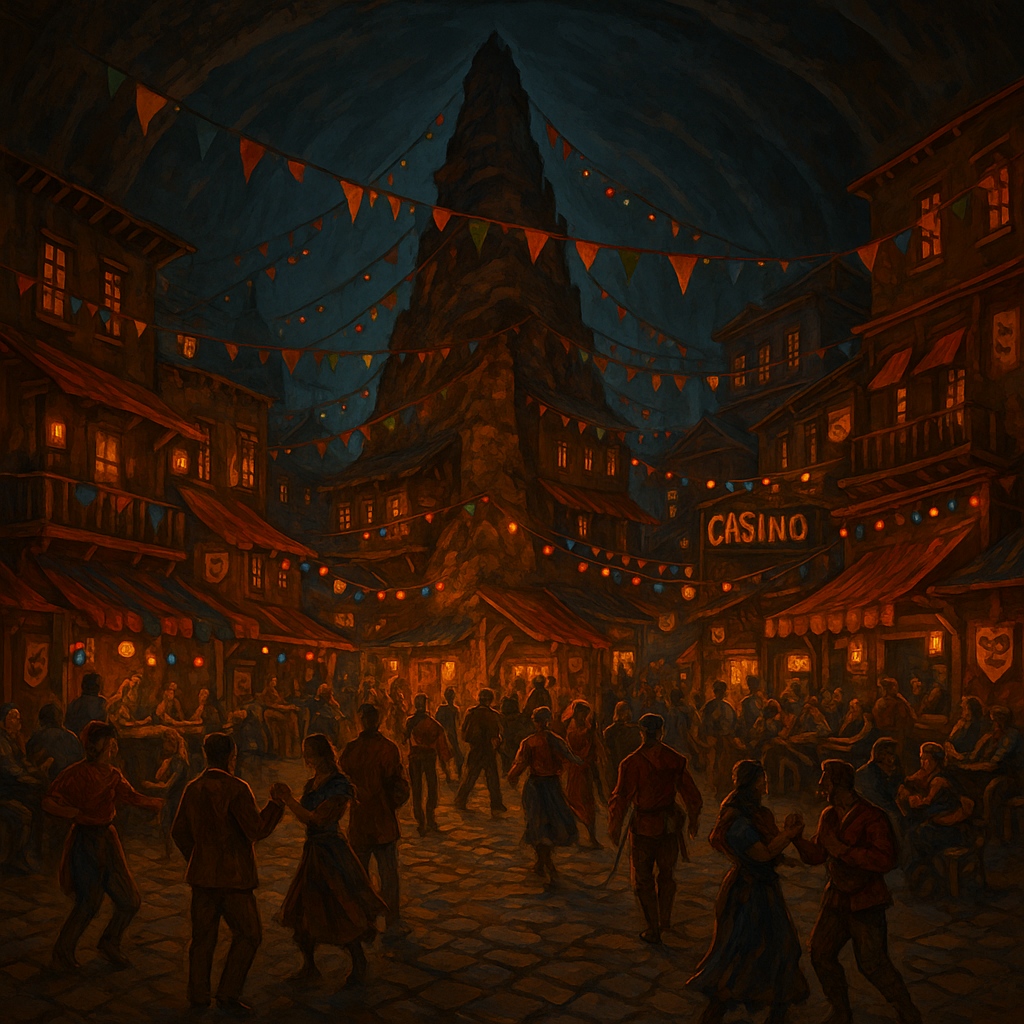
The Revelry was less a room and more a city within a city: a honeycomb of taverns, gambling dens, fighting pits, and pleasure domes welded together by tunnels that had started as storm drains and, over the years, become arteries for the city’s most persistent forms of corruption. Tonight, the mood was particularly taut. Rumor had outpaced reality by at least two laps, and the crowd inside pulsed with an anticipation bordering on predation.
Iliyria led her cadre into the main cavern, a vast amphitheater whose air was thick with sweat, smoke, and the alchemical perfume of distilled vice. The effect on her runners was immediate: Barret squared his shoulders, his armor gleaming in defiance; Kethry slunk low, eyes darting from threat to threat; Felara drew closer to Brynne, the two of them moving as if tethered by invisible line.
Iliyria herself was no stranger to these crowds, but tonight she was not the Commander of the APS, a Master Arcanist, or even a guest of the Council. She was an interloper, and the Circle knew it. She felt their eyes crawl over her as she passed; some with contempt, most with calculation, all with a hunger that boded ill for anyone who displayed weakness.
At the center of the chamber stood a stage, ringed by torchlight and flanked by a pair of goons who had been bred for the sole purpose of standing intimidatingly still. Ophelia moved straight for it, her stride unbroken, the pressure of expectation pooling behind her like a wake. Iliyria, matching her pace, was aware that every step they took was being counted, measured, and scored by a thousand silent bookies.
They mounted the stage. The crowd surged forward, a living tide, and then hushed to a dull, breathing murmur.
Ophelia waited for exactly three seconds, long enough for every throat to tighten, every mind to race ahead to the worst possible outcome, before she spoke.
“My friends,” she began, her voice somehow both velvet and steel, “thank you for your patience. I will not waste your time.”
The first heckle came at once: “We’re not your friends, Gentleman!” It was a woman’s voice, thin and sharp, from the upper gallery. A ripple of laughter followed, and a few hands went up in a mock salute.
Ophelia took it in stride. “True enough,” she conceded, smiling. “I haven’t earned your friendship. But I’ve certainly earned your respect, and you know it.”
There was a beat of silence. Then, from the pit, a gruff man called, “Prove you’re the Gentleman, then! We’ve heard enough fairy tales.”
Ophelia’s lips curled. “You want proof?” She flicked her hand, and her body flickered; a strobe of illusion, each beat a different incarnation of the Gentleman: a portly old man with mutton chops and monocle; a scarred half-orc in full mercenary regalia; a delicate young woman with eyes black as pitch, a handsome middle-aged human man; finally, the face she wore now. The crowd gasped, then went utterly still.
“And this,” she said, “is my final form.”
There was scattered applause, but more than that, there was attention. Real, dangerous attention.
Ophelia raised her left hand. A golden glow ignited along her palm, then spread in a branching pattern across the skin, sigil of the Circle, unmistakable. Across the chamber, dozens of others did the same. The marks answered, an electric resonance arcing from hand to hand, signifying allegiance, power, and for the first time tonight, unity.
She let the silence settle before speaking again. “I bring you news, and ask a favor.” She drew out the words, each one a landing point in the dark. “The Council is here. In these tunnels. As our guests.”
The uproar was immediate and near-violent. Voices rose, insults flew, someone in the gallery actually flung a brick at the stage. Ophelia caught it, one-handed, and tossed it aside with contempt.
“I know what you’re thinking,” she continued, as if addressing a particularly dim classroom. “You’re wondering why I would bring the fox into the henhouse, why I would risk our entire operation for the sake of a few scrawny bureaucrats. You’re wondering if I’ve gone soft.” She paused, and for a second her gaze seemed to land directly on every doubter in the room.
“Here’s why: The Watch has turned. They’ve taken the city by force, with help from something worse than politicians.” She let that sink in. “Demons. Not the ones you drink with, but the real ones. The kind that flay the soul and leave the meat for their pets. They’re using the Watch as a front, but it’s only a matter of time before the knives turn inward, and every last one of you is on the menu.”
There was a hush, cold and stunned.
Ophelia pressed on. “We have a common enemy. We always have, but now the lines are clear. If the Watch succeeds, if the demons win, Nightvalley becomes an abattoir, and you, my delightful little vipers, become livestock.” She swept her hand across the crowd, as if blessing them.
Somewhere near the stage, a voice grumbled: “Why should we care? The Council never gave a shit about us.”
Ophelia nodded. “You’re right. They’ve never cared. But the difference is, now they need you. Now they know you’re worth more alive than dead, and they’ll pay for the privilege.” She smiled, the full Gentleman, and every criminal in the room saw the promise in it.
“I am not asking you to fight for free. There will be compensation, and plenty of it. If you choose not to fight, I will not force you. But if you think hiding in these tunnels will save you from what’s coming, you haven’t been paying attention.”
A moment’s silence. Then, from the back, a low, angry rumble: “Tarma was right! You’re soft!” The speaker was enormous, a slab of man covered in scars and tattoos. He stood, spat on the ground, and bared his teeth in challenge. “You hold us back, always have with your rules. Now you want us to trust the Council? You’re not fit to lead the Circle, and you sure as hell can’t protect us from demons!”
He pointed, an accusing finger shaking with rage. “And you brought that elven bitch with you!” The crowd swiveled as one, focusing their hatred on Iliyria, whose face remained impassive.
Iliyria felt the Runners tense behind her, but she held up a hand: wait. It was Ophelia’s move.
Ophelia studied the challenger, narrowed her eyes in silent calculation. Then, in a gesture so casual it bordered on contempt, she turned her back to the audience and strolled to the far end of the stage. For a moment, it looked as if she might retreat.
Then she turned. She sprinted for the edge of the platform, and, at the last moment, leapt, vaulting over the heads of the crowd in a series of summersaults. The air crackled as she landed directly in front of the challenger, both rapiers drawn, blades gleaming in the torchlight.
Iliyria was impressed. If she had blinked she would have missed the trick. Ophelia had summoned an illusion of herself making the jump, and then misty stepped with such precise timing that she appeared at the exact moment the illusion landed. To everyone else, Ophelia had just completed a near impossible acrobatic feat.
Ophelia pointed a blade at the man’s throat. “Say it to my face.”
The crowd inhaled as one, a single sharp note of disbelief.
The man growled, flexed, his hands balling into fists the size of hams. “You’re not worth my time,” he spat, but everyone saw the hesitation.
Ophelia’s smile was ice. “Then fight me. Here and now. If you think you’re the better leader, prove it.” She pivoted her foot, the tip of her boot grinding an invisible line into the stone. “Winner keeps the Circle.”
The challenger bellowed, charged, and the duel began.
It did not take long for the duel to become the only thing happening in the Revelry. The crowd, so rowdy moments ago, now surged back to form a rough circle, the crush of bodies held in place by a gravitational pull as old as humanity itself. Ophelia and the brute, his name was Skarn, though nobody present ever called him by it, circled each other, the air between them charged with the pure, unrefined promise of violence.
Iliyria felt the tension roll through her Runners. She gestured, a single sharp motion: hold. Brynne’s hand hovered at her hilt, Barret’s jaw worked like a vise, and Felara looked as if she might launch herself from the stage at the first sign of cheating. But there was nothing to do but wait.
Iliyria, watching from the stage, had seen hundreds of fights, some more brutal, some more clever, but never one so perfectly engineered for spectacle. Ophelia fought like she lived; unpredictable, dirty, and with an artistry that bordered on the divine. She feinted, baited, drew blood with the first pass, then danced back, letting the man tire himself in a flurry of missed swings.
Ophelia was smaller by a full head, but she made it work for her. She moved in low arcs, letting Skarn’s huge swings pass through empty air, replying with quick, surgical flicks of her rapiers, just deep enough to draw blood, never deep enough to finish. Skarn’s first few passes were pure show, but he soon tired of missing and switched to brute efficiency. His battle-axe carved through a table, split a cask, and made a gouge in the stone at her feet.
The crowd fell silent. They could see it, too: Ophelia was bleeding him, in every sense.
She could have killed him at any point, anyone with half an eye for swordplay could see it, but she chose instead to draw it out, to make it a lesson. Every time the man swung, she dodged by a hairsbreadth, then countered with a flick that opened a new cut. Blood spattered the floor. The crowd, which had started by booing, now watched in a rapt, terrible silence.
Iliyria felt the Runners relax, just a fraction. The room had stopped seeing her as an enemy, and started to see her as a witness. That was enough.
The duel went on, and Ophelia’s expression changed; less amusement, more focus, a tightening of the jaw that spoke of real effort. The brute was strong, and his pain tolerance was spectacular. He took hits that would have felled a horse and kept coming, his blood now pooling around his boots.
Then he made a mistake. He overreached, swinging his battle-axe in a desperate, two-handed arc. Ophelia ducked beneath, sidestepped, and with a single, precise thrust, drove her rapier through his hand. The man screamed, tried to pull away, but Ophelia held fast, twisting the blade until he dropped to his knees.
She leaned in, her face inches from his. “Never call me soft,” she whispered.
Then, with a single motion, she pulled the blade free, flicked the blood into his eyes, and stepped back. She waited to see if he would yield, but when Skarn stood, ruined hand clutching his battle axe, the battle began anew.
It was midway through the next exchange, when Ophelia scored a nasty cut across the back of Skarn’s thigh, that Iliyria saw the sign. A quick, almost invisible whistle, a bandit’s code, high and thin. She let her gaze flick left, saw the accomplice, a narrow-faced man near a bar, drop a hand to his belt and ready a throwing knife, eyes fixed on Ophelia’s unprotected back.
Iliyria reacted without thinking. She vanished in a ripple of blue energy; misty step, a signature move if there ever was one, and reappeared directly between Ophelia and the blade. The knife pinged off the arcane shield she summoned at the last second, ricocheting into the crowd and drawing a yelp of protest.
Ophelia, locked in with Skarn, glanced back for just a heartbeat. Their eyes met. A nod, gratitude, or at least acknowledgment, and then she ducked as Skarn tried to use the distraction to cleave her in half.
Iliyria reached up to her hair, plucking out the solitary hairpin that held the nest of silver in place, and drew her staff, feeling the length of it settle into her hand like an old friend. The crowd was shifting, growing more agitated by the second. Skarn’s supporters, recognizable by their tattooed arms and matching rings, began to converge on the ring, emboldened by the failed knife throw. Several broke ranks and surged at the stage, their intent unmistakable.
Brynne was the first to meet them. She moved with an economy Iliyria had never seen before, not wasting a single motion as she dropped one, two, three thugs with the flat of her sword. Barret joined, swinging the butt of his weapon in precise, measured arcs, knocking attackers aside with a paladin’s grim restraint.
Felara, always one to upstage, teleported herself onto the lighting rig above the crowd and fired down a barrage of arcane arrows, each one finding a target with deadly accuracy. One bolt pinned a man’s sleeve to the bar; another exploded a pitcher of beer in a spray of shrapnel and foam.
Kethry, caught between two charging thugs, transformed in a swirl of fur and muscle, becoming a lioness. She went for the legs, not the throat, tripped up a half-dozen in the first pass, then roared so loud it rattled the glassware in the upper galleries.
Iliyria grinned, despite herself. Her Runners were not the best paid, or the best organized, but gods, they were good.
The melee was a storm now. Ophelia and Skarn continued their duel at the eye of it, every motion a perfect piece of theater, every exchange a study in contrast. Skarn’s swings slowed, his breaths coming ragged. Ophelia, by comparison, seemed to get lighter, her footwork more fluid, her strikes less tentative.
Iliyria kept her focus on the periphery, using the staff to knock aside improvised weapons and keep her team unencumbered. It was in the chaos, as she parried a mug hurled at her head, that the sending spell hit her, a jolt in her mind, like a tap on the shoulder from an invisible friend.
Iliyria, it’s Bolt. We’re pinned by Watch on all sides. Any chance you could teleport us out?
She replied, mentally: I’m occupied. Currently in the middle of a riot. Sorry, but you’re on your own. Try not to die.
A blast of fire exploded somewhere on the far side of the chamber, sending a new wave of panic through the onlookers. Iliyria spun, saw the accomplice who had tried the knife now wielding a makeshift Molotov, sparks dancing along his sleeve. She aimed her staff and unleashed a bolt of lightning; clean, clinical, exactly as much as was required. The man dropped, smoking, and the bottle shattered harmlessly on the stone.
Back in the ring, Ophelia was pressing her advantage. Skarn was bleeding from half a dozen wounds, none of them fatal but each a testament to her skill. He swung wide, missed, and Ophelia stepped inside his guard, slamming the hilt of her rapier into his solar plexus. He staggered, gasping, and dropped to one knee.
Ophelia did not gloat. She simply leveled the blade at his face. “Yield,” she said, “or die.”
Skarn spat blood and looked up, eyes wild. “You can’t kill me. They’ll never respect you.”
Ophelia tilted her head, genuinely curious. “Then why are they all still watching?”
Skarn looked past her, saw the crowd, silent now, cowed, many of them holding injuries or tending to friends who’d fared worse. No one moved to help him. No one even flinched.
He lowered his head. “Fuck you.”
Ophelia finished it, a quick jab right to the heart. She turned to the crowd while he bled out, lifted her hand in the same gesture as before, and once again the sigils of the Circle lit up across the audience.
“Anyone else?” she asked, her voice low but carrying.
No one replied.
Iliyria took the opportunity to scan the room. Her Runners stood, bruised but intact. The bodies on the floor groaned and moaned, but few were truly dead; a mercy, or perhaps just a lack of time.
Ophelia walked back to the stage, took a moment to wipe her blades on a tablecloth, then addressed Iliyria without looking up. “Thank you,” she said, “for the backup.”
Iliyria grinned. “You’re the showman. I’m just support.”
They met eyes, shared a brief, hard-earned respect. Then Ophelia, ever the leader, turned to the crowd. “Skarn challenged my right to rule. I gave him his chance. Now, either you stand with me, or you leave. There is no middle ground.”
The crowd went silent, then began to applaud, a slow, uncertain clap that built, second by second, into a storm of approval.
Ophelia let the applause wash over her. She sheathed her rapiers, raised her hand again, and the sigil glowed one last time.
“Circle meeting adjourned,” she said, voice level.
One by one, the Circle members dispersed; some dragging their wounded, others melting into the shadows, a few simply sitting where they were, too tired or too stunned to move. They were already rewriting the story for themselves: the Gentleman’s strength, the elven bitch’s composure, the inevitability of the new order.
Iliyria, watching it all, felt a chill. She understood, in that moment, just how much control Ophelia really had, not just over her own people, but over the story the entire city would tell about this night. She had won not just the duel, but the narrative, and that was the only currency that mattered in the Revelry.
The power in the room had shifted, and everyone could feel it.
They walked back towards the stage together, neither speaking at first. Only when they were out of sight did Ophelia allow herself a ragged, shuddering breath. She wiped the blood from her cheek, then looked at Iliyria.
“You think you could have done better?” she asked, voice brittle but honest.
Iliyria shook her head. “Not a chance in hell.”
They shared a laugh, a real one.
Brynne, Barret, Felara, and Kethry joined Iliyria at the base of the stage. Brynne’s knuckles were split, but she looked content. Barret nodded at Ophelia, acknowledging the authority of the moment. Felara leaned against the wall, blood running from a scalp wound, but she smiled like she’d just won a bet.
Kethry, back in human form, limped over, shaking out her arm. “What a jerk,” she said, nodding at Skarn’s still form.
The Revelry slowly emptied, leaving only the survivors, the blood, and the wreckage. It felt, Iliyria thought, like the aftermath of a storm: battered, exhausted, but weirdly hopeful.
Ophelia watched the last of the Circle disappear, then let herself sag against a pillar, breathing hard.
“Is it always like this?” Barret asked.
“Only on the good nights,” Ophelia replied.
They stood together in silence, the adrenaline slowly ebbing, the future pressing in from all sides.
For a moment, there was peace.
Call it Even
Ophelia redrew her rapiers and wiped them clean on the hem of her pants. A flourish that was both necessary and, Iliyria suspected, calculated for effect. Then she returned the blades to their sheaths with a practiced flick. She regarded the runners and Iliyria, the exhaustion written on their faces, the bruises blooming like wildflowers across their arms and cheeks.
“Well,” she said, with a smile that didn’t quite reach her eyes, “I appear to owe you lot a drink.”
They made their way to the nearest bar, tonight, that meant a counter hastily assembled from old doors and scavenged wood, staffed by a sullen teen with a black eye and an uncanny knack for remembering faces. The place was mostly empty now; the crowd had fled to safer corners, or perhaps gone home to nurse their wounds and grievances in private.
Ophelia ordered a round. “Whatever’s strongest, and enough to make us forget the taste of blood for an hour.”
The drinks arrived: a yellow-brown whiskey, sharp as a whip. Ophelia slid one down the bar to Iliyria, who caught it, regarded it for a moment, then slid it back.
“I don’t drink,” Iliyria said.
Ophelia gave her a once-over. “Impressive,” she replied, and tossed back her own shot in one go. The whiskey made her cough, but only a little.
They sat in silence for a few minutes. Brynne nursed her hand, flexing it experimentally; Felara picked at the dried blood on her scalp and winced at every touch. Barret and Kethry sat together, the former lost in thought, the latter watching Ophelia with the wary affection reserved for wild animals one hoped to befriend.
Finally, Iliyria broke the silence.
“So,” she said, “this is where you’ve been. All this time.”
Ophelia did not answer immediately. She poured herself another shot, more careful with it this time.
Iliyria pressed on. “When you left the Tower, Pembroke asked me to look for you. As a personal favor. He was… worried. For a while, he thought you’d been killed. Or worse.”
“I know,” Ophelia said. “I got his letters. At first.”
“You did a good job of staying hidden. Nobody found a trace.”
“I had motivation,” Ophelia said, and let the words hang there, soft and defiant.
Iliyria’s eyes narrowed. “But you left a lot of people behind.”
Ophelia’s hand went to her forearm, thumb tracing the long, faint scar where the Friendship Symbol had once been. “I know,” she said, and for a moment her voice was almost too low to hear. “I know what it did to Lavan. And Isemay.”
“It wasn’t just them,” Iliyria replied, and her words had an edge. “Pembroke and Kerrowyn panicked. Tullups blamed himself, for years, he retired early, you know. Couldn’t bear to teach after that. And every year until his death, your Uncle Staunch sent a letter to the APS, asking if there was any update on the search.” She paused. “I answered most of them. I lied.”
Ophelia took it in, nodding. “You did the right thing.”
“I’m not sure I did,” Iliyria said.
Ophelia finished her drink, set the glass down with unnecessary force. “It was worth it,” she said, not meeting Iliyria’s gaze. “All of it. If I had to do it again, I’d do it the same way.”
Iliyria watched her, trying to parse whether the assertion was meant for her benefit or for Ophelia’s own. She decided it didn’t matter.
She leaned back, letting her hair tumble loose around her shoulders. “You’re going to have to choose a side, eventually,” she said, but her tone was less threat and more weary prophecy.
Ophelia looked at her then, for the first time in the conversation. “I know,” she said. “But for tonight, let’s call it even.”
They toasted, Iliyria with water, Ophelia with whatever the bartender handed her next. Brynne, Barret, and the others joined in, the gesture awkward but real.
In the empty Revelry, for a moment, the war was forgotten. Old enemies, old friends, and the newest survivors sat together at the bar, watching the minutes tick by, waiting for the city to catch its breath.
Tomorrow would be ugly again. But tonight, there was peace.
