
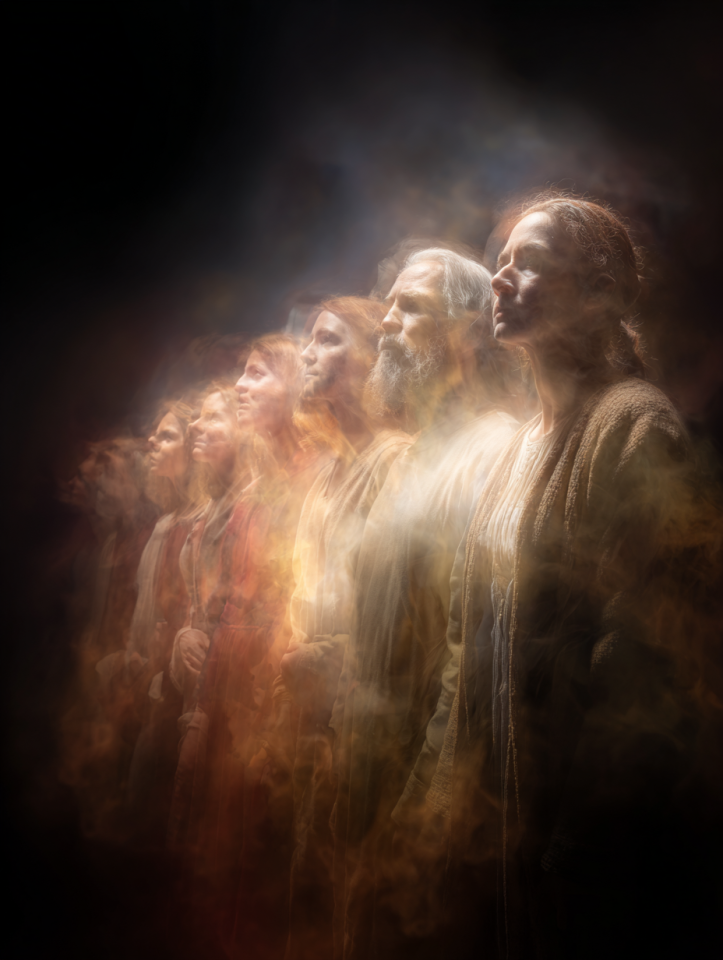




Zi (ZEE)
Spirit / Animating Essence
Known in the oldest records as Zi, the force of spirit in Tir na nÓg is not the soul of an individual, but the ambient reservoir from which all vitality arises and to which all life eventually returns. Zi is the breath beneath breath, the spark before thought—a presence that precedes identity. It is not a being, nor a collective of the dead. It is the ground-state of presence: the raw, shared potential of aliveness. In this way, spirit is not something one has, but something one draws from, briefly inhabits, and eventually contributes back to.
Zi permeates all living things without hierarchy. A tree and a poet are equally steeped in it; a newborn and a river current are both of its motion. It is not individuated, but it can express individually—becoming shaped by context, relationship, and experience. Where Wergom (magic) is the energy of interaction, Zi is the field that makes interaction possible. Where Cuimhne (memory) holds what has happened, Zi holds what could. Its presence is more often felt than seen—subtle warmth, a stirring in the quiet, or the sudden sense that something essential has entered the room.
The presence of Zi does not increase or decrease; it circulates. Beings born into Tir na nÓg draw from it naturally. In moments of creativity, love, or grief, they may give some back. Death is not a departure but a returning—a gentle dissolution of individuated form into the shared field. Rituals involving Zi do not summon spirit, but acknowledge its flow: the hush before naming a child, the silence held after a final breath, the woven pauses in poetry that allow the invisible to breathe between the lines.
To live with awareness of Zi is to move with reverence, not for fear of offense, but out of respect for one’s shared source. In this way, spirit is not mystery—it is mutuality. It does not hide in heaven or haunt the in-between; it resides in the everyday, in the motion of hands, in the eyes that linger, in the deep inhale of morning. Zi is not distant. It is what life borrows, carries, and—when ready—returns.
Zi (Spirit)
| OBSERVATION |
|---|
| Zi is observed internally as a baseline condition of vitality, experienced as the sense of being alive rather than as a discrete thought or memory. Individuals often describe it as a subtle awareness of presence, comparable to noticing breath or warmth without focusing on a specific source. Externally, it is noted in the consistent impression that all living things, regardless of type, display a similar underlying animation that cannot be traced to mechanical or biological function alone. Applied in practice, Zi is recognized through pauses, silences, or moments where activity briefly ceases and attention is directed toward the fact of being alive. Naming ceremonies, final vigils, or shared creative acts serve as observational contexts where this animating quality is acknowledged. These actions do not attempt to manipulate or measure Zi directly; instead, they provide structured conditions in which its circulation is more readily perceived. From these patterns, observers assume that Zi is not tied to individual identity but is a collective reservoir of vitality from which living beings draw. It appears constant in volume, neither increasing nor diminishing, only circulating. The prevailing inference is that the end of life does not signify loss of this essence but redistribution, returning the individuated portion back into the ambient field. |
Scientific Name
Miotasach;



