




Tenebh (TEH-nev)
Darkness
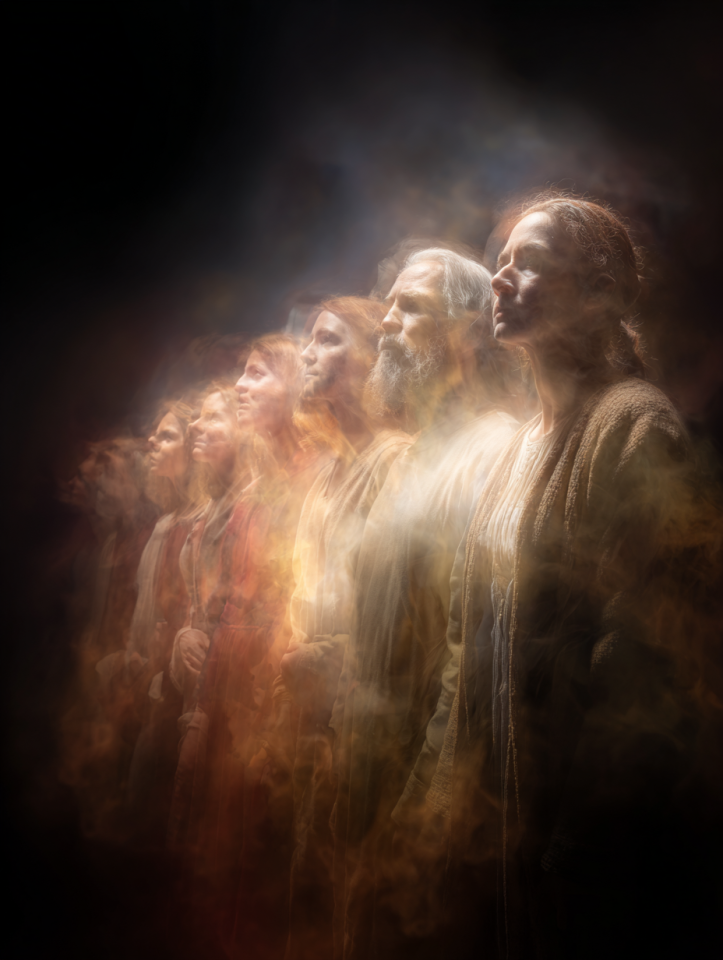
In the cosmology of Tir na nÓg, Tenebh—darkness—is not absence, but presence in another form. It is containment, not void; boundary, not erasure. Where Lewk (light) delineates through revelation, Tenebh delineates through stillness. It folds around what must rest, retreat, or remain unformed. It does not oppose light, but completes it. In scientific terms, Tenebh is a stabilizing force that absorbs excess resonance, dampens distortion, and allows both matter and thought to reorganize without the pressure of visibility.
Tenebh is most potent where perception falters: in caves, under canopies, in the pause before action. In these conditions, it grants beings the freedom of unobserved presence—a sacred privacy. Without darkness, processes like germination, gestation, or dreaming could not occur. Tenebh is the space in which transformation begins, offering protection from external influence while form rearranges itself. Far from a menace, it is considered a fertile ground—a laboratory for becoming.
Unlike Wergom or Lewk, Tenebh does not move quickly. It is slow, patient, often imperceptible. But it is also relentless. Over time, it reclaims what must be released. Ancient knowledge fades into it when no longer needed. Grief rests within it until it softens. In architecture, spaces of deliberate darkness are incorporated not for solemnity, but for integration—a place for emotions, thoughts, and questions that are not yet ready to surface. Tenebh does not suppress; it holds.
There is no fear of darkness in Tir na nÓg. It is neither exile nor threat. It is simply the other half of clarity. Just as sleep is not death, Tenebh is not negation—it is interiority, the world’s inhalation. In ritual, it is invoked not to hide, but to protect. Artists speak of “seeking the Tenebh” when entering creative silence. Elders walk into it freely at the close of life. It is where stories begin and end. It is not the unknown; it is the unspoken—and it is honored as such.
Tenebh (Darkness)
| OBSERVATION |
|---|
| Tenebh is observed as the condition in which visibility and external definition diminish, allowing processes to occur without constant input or interference. It is present in environments such as caves, dense canopy cover, or enclosed architectural spaces, where reduced perception produces a distinct atmosphere. Rather than being experienced as absence, it is consistently recorded as a stabilizing presence, marked by quiet, stillness, and a perceptible slowing of activity. Applied across natural and constructed contexts, Tenebh functions as a medium for processes that require concealment or protection. Seeds germinate, organisms rest, and cognitive reorganization occurs most reliably in low-light or fully dark settings. Built environments that deliberately incorporate darkness—such as enclosed rooms or shaded alcoves—are observed to support reflection and integration, suggesting that Tenebh provides conditions for internal or structural change. From these observations, it is assumed that Tenebh serves as a regulatory counterpart to illumination, not in opposition but in complement. Its persistence across ecological, biological, and social systems indicates a functional role in maintaining balance by absorbing or dampening excess. The prevailing inference is that Tenebh enables transformation by holding processes in suspension until they are prepared to emerge, making it an integral stabilizing element within the realm. |
Scientific Name
Miotasach;



