
The Major Gods of Eana
Harmonic Divinities
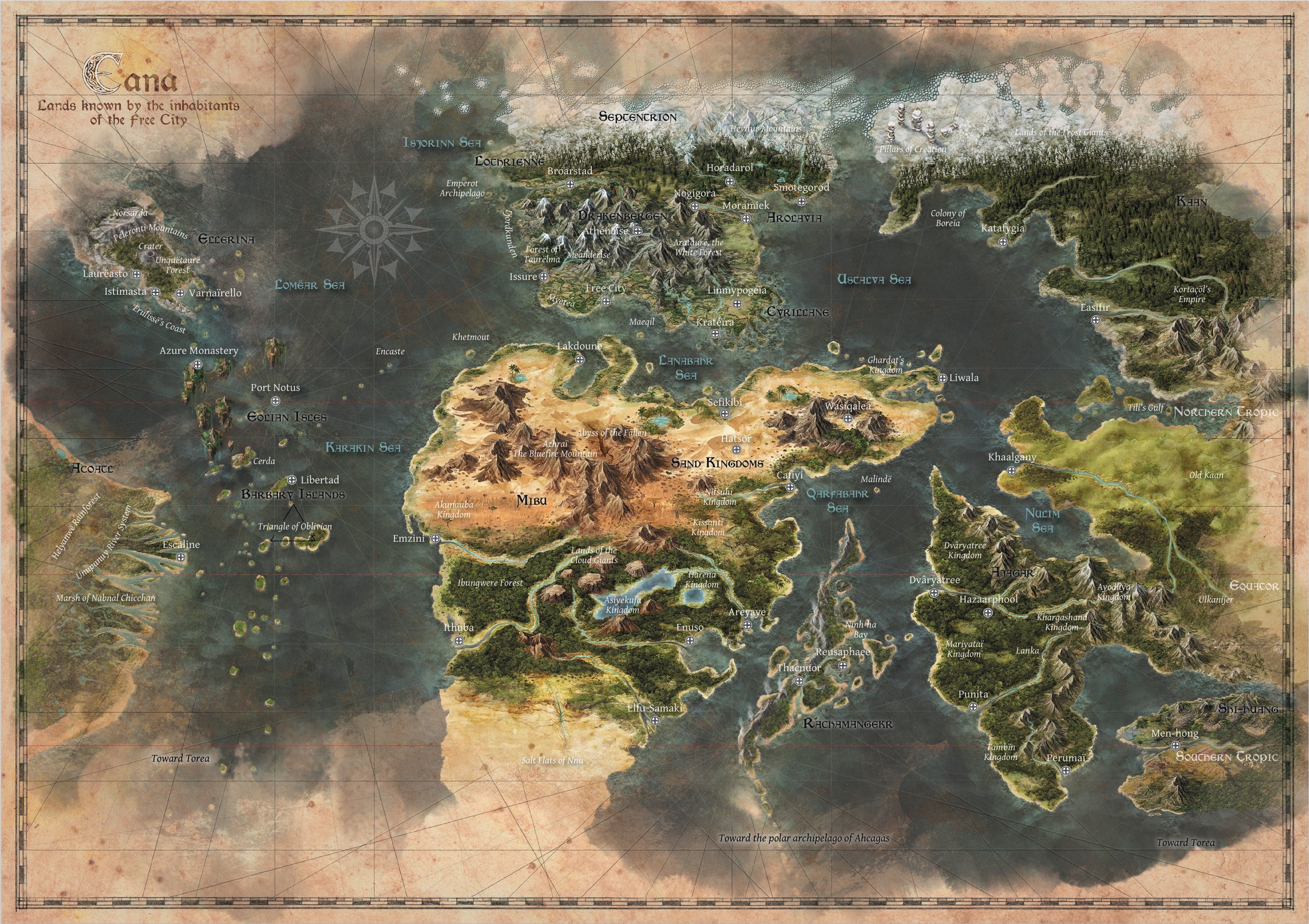
World Eana
Other names: Eana (elves, druids, and rangers of Cyfandir), Starstag (Lothrienne,
Arolavia), Great Tree (Lands of Mibu)
World is said to be the first divinity, the one who gave birth to the world that bears its name: Eana. World is honored by populations with a close relationship to nature, particularly societies of hunters, gatherers, small cultivators, and fishers. However, no one has ever heard of Eana granting wishes or prayers: this primordial divinity only lends powers to druids and rangers. In the eyes of druids, Eana embodies the balance required for the very existence of all forms of life.
Maker Maker
Other names: the Fool (Sand Kingdoms), the Potter (dwarven peoples), the Father of Plenty (Kaani Empire)
Maker is the very spirit of creation, the one who surprises, astonishes, amazes, and sometimes horrifies. He is always looking for ideas and inspiration, and gives equal value to perfect beauty and unspeakable monstrosity. In the myths, he is the one responsible for the incredible variety of species, which he made as he experimented with shapes, colors, ideas… For this reason, certain clerics of Maker encourage individual experience and adventure. Others act as the patrons of inventors, those who seek innovative solutions to problems or face difficulties head on. Another one of Maker’s facets also gives rise to cults that worship monstrosity.
Blacksmith Blacksmith
Other names: Verndari (“Defender” in Dwarvish), the Lawgiver or the Judge (Shihuang), the Warrior (commonly used in northern regions)
Blacksmith is a divinity associated with fire and order. He is the one who settles disputes and brings the light of the sun, protecting people from savagery.
Blacksmith is the favored god of dwarves and of all of those who act as defenders of society. Though he is worshiped by good-aligned individuals, Blacksmith also has a rigid and sometimes unyielding side that can result in religions that pay homage to his callous, tyrannical aspects.
Flora Flora
Other names: Coirë (elves), Lif-edlish (Septentrion), Belle (Cyrillane, Sand Kingdoms)
Flora is the child-goddess of spring and sprouting life. She brings joy, love, and luck, as well as relief and hope in trying times. Despite her fragile aspect, Flora is also a divinity that supports brave endeavours. She is said to still be capable of fighting long after the fortresses of Blacksmith have fallen. Just like life itself, she can bloom and prosper in the worst conditions, displaying feats of ingenuity in adapting and evolving.
Entropic Divinities
Death Death
Other names: Mask (Sand Kingdoms), Abysses (Barbary Islands and assorted island-dwellers), Blade (Kaani Empire)
Mysterious and often unfathomable, Death is a divinity that embodies the end, eternity, transience, silence, oblivion, and secrets. Her clergy are the inventors of seals and magic items that protect one’s mind from attempts to read it or to coerce the truth out of it. Many adepts of Death fight the undead and everything that goes against the natural cycle. They are also very involved in the study of mysteries.
Other branches that worship Death exalt the morbidity and decrepitude related to her. More dangerous cults see in death the ultimate transcendence and work from the shadows to bring it about by fomenting wars, fanning epidemics, and sowing the seeds of other disasters.
Frostelle Frostelle
Other names: the Crone (Lands of Mibu), Nolwë (“Wise” in Elvish), the Bite (Kaani Empire)
Frostelle is a goddess of winter, purity, time, humility, moderation, patience, and determination. She guides people through their ordeals with wisdom and great open1mindedness. Where Flora sees life as a whole, Frostelle accepts the death of those who have given up on fighting or whose time has come.
Clerics who worship this divinity generally put great value on temperance and sometimes gather in ascetic communities. In polar regions, clerics of Frostelle act as advisors to the tribes they belong to, teaching the cycle of seasons and survival. When times are particularly hard, some can become so desperate as to attempt to attract the goddess’s clemency through rituals and sacrifices.
Night Xonim
Other names: Xonim (Kaani Empire), the Magician (Cyrillane, Sand Kingdoms), the Watcher (Barbary Islands)
During her mortal life, Xonim was a shrewd wizard and politically gifted woman, the mother of Tamerakh the conqueror. She reached godhood thanks to her son who came and freed her from the world of the dead. She has since been the goddess of magic, darkness, intrigue, beauty, and wealth. She is known for her ambivalence and for her sympathy for tieflings, whom she protects no matter their actions. A cunning schemer, she made her clergy indispensable by teaching them how to craft the infamous Xonim’s Bonds, chains that neutralize the capabilities of magic users. Xonim’s clerics, feared and envied, often become the advisors of guilds, factions, or kings. Their dogma leads them to uphold the interests of the side they have chosen to the best of their abilities, even should it lead them to conflict with other clerics of Xonim. In this lifelong competition, they are expected to display their talents and intelligence.
Storm Tamerakh
Other names: Tamerakh (Kaani Empire), the Destroyer (most of Cyfandir), the Liberator (many sects, mainly in Cyrillane) Before he reached the status of god and became Storm, proud Tamerakh was a warlord and a brutal conqueror. To him, the word “impossible” had no meaning: limits were there to be overcome. Unrestrained and madly bold, but also gifted with a sharp mind that allowed him to seize any opportunity within his reach, Tamerakh made it his goal to surmount the final frontier: death. However, he refused to become something like a mummy or a vampire: godhood was the only acceptable end. Ultimately, he triumphed over fate and became a god. More impressive still, he freed his mother Xonim from death and deified her as well. Tamerakh is worshiped by rebels, by all of those who want to rise against a system. He is the god of turmoil, the one who gives a chance to those who are brave enough to stray from the beaten path and forge their own destiny. The nstability that Tamerakh revels in is very often at odds with authorities who see his believers as dangerous and seditious elements.
The Star Pantheon
The polytheistic worship of the Star is one of the most common in Cyfandir. It is even the official religion in Lothrienne. In its orthodox version, it includes five divinities: Flora as a child or young girl named Aster, Maker as a child or teenager named Gùnd, Blacksmith as a mature man named Ulgurd, Frostelle as an aging woman named Haldrìn, and Death as an angelic mask simply named “the Mask.” Night and Storm are not recognized as gods, but rather as evil spirits associated with fallen angels: the former is a corrupter named Niflhel while the latter is a destroyer named Varanid, and both represent mortal dangers for society.
The worship of Eana, though tolerated, is considered a dated, pagan religion. Certain heretics venerate the seven-pointed Star, including Niflhel and Varanid as true divinities to the initial pantheon. These believers claim that their message is more enlightened and have attracted the wrath of the orthodox Star church. According to these believers, the world of Eana is influenced by seven divinities, and rejecting two of them because they are ambivalent or dangerous is childlike. Divine reality must be accepted as it is.

Comments