Water nests
"When I first saw these cute little huts, my heart melted. They were planted and nurtured with so much love, and each one was so beautifully decorated by the frog people with little flowers and leaves. Inside, they were also very cozy and inviting for their size, so I immediately felt at home."Excerpt from the travel diary of Fâlyn Ravalis, Téshàn botanist -

The settlements of the Qiriri are not immediately recognizable as such, since their buildings are neither made of stone nor do they have obvious windows and doors. They are not simply constructed, but rather organic, cultivated and nurtured by the Water Folk, or blending seamlessly into the environment as if they had always been there. Certainly, they are not as comfortable as those of the Firewalkers or as cozy as those of the Goblins. They are functional and optimally adapted to life in and around the water and to the varying currents of the topography.
Water Lily Pavilions
In or near tranquil lakes, wide, slow-flowing rivers, marshes, or sheltered lagoons, water lily pavilions are typically built in two different sizes. Due to their delicate construction, these pavilions are rather intimate and offer space for a small family of about four to six adult Qiriri. Larger families inhabit several pavilions connected by small reed bridges. The structures are mostly covered in moss or "decorated" with reeds and large leaves, blending perfectly into the shoreline vegetation. From a distance, they are hardly distinguishable from natural clumps of vegetation or beaver lodges. Additionally, the pavilions are often protected by reed belts and water lily beds, which are difficult for larger terrestrial predators to traverse.
The smaller dwellings can most easily be described as floating nests with leafy roofs. The Qiriri search the bottom of bodies of water for living roots or strong plant fibers that are flexible yet provide excellent support in turbulent weather. The roots are woven together with a dense circular or oval network of robust floating aquatic plants and fibers.
Specially cultivated giant lotus leaves or other large-leaved aquatic plants such as water rhubarb or marsh squash are used for the roof. These enormous leaves essentially form the supporting column around which the entire nest is built. Inside, the nests consist of at least two levels above and below the water's surface. The water level serves for cooling off and bathing. The upper level contains spaces for sleeping and eating.
Larger dwellings are built directly on the giant water lily leaves. Thin, flexible reeds are used to construct light, stable domes. Then, durable ropes are woven from rushes and water hyacinths, which are used to tie the leaf edges to the reed structure and cover them with reed mats or woven rushes. The roofs are often domed and covered with living mosses or even small marsh plants.
The walls are additionally insulated with a layer of damp clay, mucilage, and moss. The houses feature a living area that serves as a central meeting place, sleeping area, and workspace. The furnishings consist of raised platforms made of woven mats, which protect against the water's moisture. Through an open hatch or a small, covered platform at water level, the inhabitants can slide directly into the water. Niches built into the walls and sealed with clay serve as storage for tools and collected food.
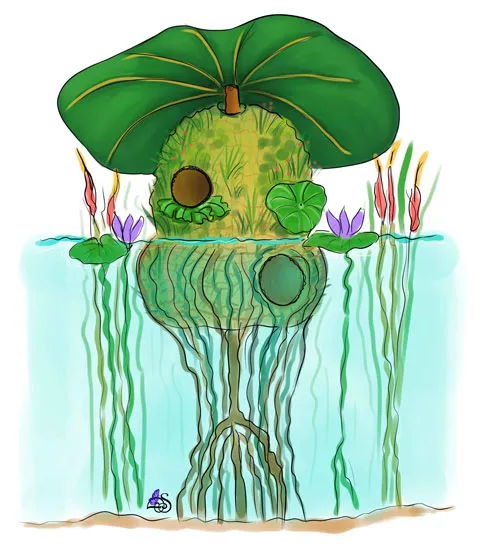
Water lily pavilion by Blue Fairy 74
Mangroven Cottages
As the name suggests, these are dwellings connected to mangrove-like trees and shrubs. The blue-spotted red bark mangrove is particularly prized for its exceptionally strong and flexible wood. This type of building is primarily cultivated in tidal areas and estuaries, where the water flows more rapidly, and provides space for six to ten qiriri (mangrove dwellings). The huts are a secure haven from predators due to the dense network of stilt roots and the constant ebb and flow of the tides. Furthermore, only the inhabitants know the safe paths and channels through the dense mangrove thickets.
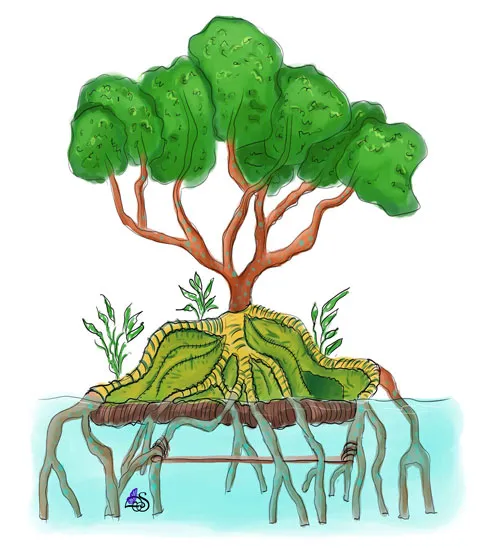
Mangrofen Cottage by Blue Fairy 74
By "weaving" the roots together, the huts are robust enough to withstand the tides and fluctuating water levels. The roots of the trees and shrubs serve as supporting beams and are guided as they grow to form walls, load-bearing columns, and sheltered chambers.
Similar to stilt houses, a nest-like flood platform made of woven branches serves as the foundation for the living area, keeping the rooms dry even at high tide. The roots above the water level are "stitched together" with a tarpaulin made of water-repellent marsh leaves. The seams are further sealed with a slime adhesive. Small clumps of herbaceous marsh plants are tied to the roots for camouflage.
The inner walls of the flood platform are constructed with a mixture of mud, algae, reeds, and twigs, which, after hardening, forms a robust organic shell. Additionally, the Qiriri use dried, saltwater-resistant seagrass and thick algae mats as insulation and sealing material for the foundation, as these materials are flexible and resistant to rot in the humid climate. On the dry level, there are sleeping areas, a central fire pit with a smoke vent in the roof, and storage areas protected from moisture.
The low-water level is an open platform made of dead wood and driftwood, accessible only at low tide and used as a work area and boat landing or "boat garage". Ropes made of lianas and water hyacinths serve as railings, decorations, or supports for suspension bridges over which the Qiriri reach the entrances.


I am reminded of the Uro people who live on Lake Titicaca. Reading this has been very nice and peacefully relaxing.
Yes, something like that is what I have in mind for the development of Qiriri; for example, I am very enthusiastic about their water gardens. Thank you so much :).
Here are my Entries for the water continent Ulűri̋qi̋