Ulűri̋qi̋an Current Calendar
"Damn it! I could have sworn we Brictaelgica were the masters of nature and knew everything about it. But no, these froggy greenlings have shown me that I'm nothing more than an ordinary fellow. They are simple people, and so is their calendar, if you can even call their system of timekeeping that. But man, when they tell their stories about important stages of their lives, there's something epically flowery about it, even though I'm very glad I'm not one of those chrono-thingamajigs who has to write down their events or put them in those history books."- Berrin Oakleaf, brictaelgian fieldmaster -

The tidal calculation
The Burîghòh of the Qiriri is very unusual for outsiders whose calendars are based on celestial bodies or gods, as it is based on the oscillation of ocean currents, the migrations of marine animals (whether dangerous or important for their own food supply), and plant growth underwater and on land. The Qiriri divide their "year" into six periods, the length of which can vary from year to year, resulting in the Ulűri̋qi̋an calendar differing drastically from others.
The water people don't reckon directly in years, but rather in descriptive events, such as the "Year of Great Blossoms," which naturally varies from place to place due to the topography and location of the many islands in different climate zones. Another problem is that the periods don't have precise, but only approximate, number of days, and they blend seamlessly into one another. They can overlap or even be entirely absent. This makes it particularly difficult for outside historians to place significant events of the Ulűri̋qi̋an calendar within other Elaqitan calendars.
Overview
Name: Burîghòh
Year: 270 to 385 Òh / 6 Bugihrî
Periods: 6 Bugihrî with varying day lengths
Months & Weeks: None
Days: Only the first and last day of a period receive an additional suffix
Hours: 4 Ôquil
Etymology
Periods
oquihrî - botlgrî - rôlgrîohihgrî - gribuhrî - ûmohrí
Days
obi-oquihrî-ról - obi-botlgrî-rólobi-rôlgrî-ról - obi-ohihgrî-ról
obi-gribuhrî-ról - obi-ûmohrí-rol
Hours
moli̋qui - qűlbriquiìlriqui -lûmiqui
The six periods are derived from Bugihrî, the current, and mean something like "current of the tides" ("oquihrî"), "current of the fins" ("botlgrî"), "current of colors" ("rôlgrî"), "current of the depths" ("ohihgrî"), "current of salt" ("gribuhrî") and "current of chaos" ("ûmohrí").
The Qiriri do not assign numbers to the periods, as is the case with most known calendars, because the order of the periods is not fixed and there are no direct names for months or days of the week. Only the first and last day of a period receive an additional prefix or suffix, "obi-" and "-ról," respectively, to mark the beginning and end. Since the Qiriri have no written records beyond underwater paintings and everything is passed down orally, more precise divisions are unnecessary in the culture of this aquatic people.
They measure the length of the day based on the water levels of tidal hours, which they divide into the "tidal of shell whispering" ("moli̋qui") for the lowest level of the ebb, the "tidal of foam" ("qűlbriqui") as the rise of the water, the "tidal of seaweed dancing" ("ìlriqui") for the highest level of the flood, and the "tidal of crab trail" ("lûmiqui") as the retreat of the water.
The periods and the festivities that take place
Due to the dynamic nature of the cycle calendar, it appears unpredictable to outsiders when the Quiriri celebrate their festivals or holidays, which in other cultures take place on fixed days of the month. However, since they at least name or predict the first and last day of a cycle, this often marks the beginning of preparations. If a cycle is missed, various ancestral rituals are performed in place of the festival to ask the ancestral spirits for guidance and protection. The specific rituals vary depending on which cycle is missed.
oquihrî - Current of the tides
This period lasts approximately 20 to 30 days, divided into low and high tides that deviate from the normal tides, and into strong and weak currents. For the Qiriri, the changing of the tides symbolizes a phase of activity and departure, as well as a search for inner peace in preparation for the approaching sea voyages with all their inherent risks. There are various healing and meditation rituals for navigators and hunters, as well as the "blessing festival" for boats and equipment.
botlgrî - Current of fins
This period, which can last between 40 and 60 days, begins when large herds of livestock enter the respective territories or dangerous predators invade. It marks the main hunting season and is the most important period for the Qiriri people to obtain protein-rich food. Shortly after the first sightings, the "wave of arrival" is celebrated. At the end, the Qiriri honor the most successful hunters with the "dance of the nets."
rôlgrî - Current of colors
During this phase, the sea blossoms, as colorful, often fragrant carpets of algae and other flowering plants like water lilies or vibrant seagrasses cover the water in many regions. This accelerated growth is triggered by warmer currents and the resulting influx of nutrients that are otherwise less abundant in the area. The period lasts ten to 25 days and is the time for harvesting marine plants. For the Qiriri people, it symbolizes beauty and the cycle of life, which they celebrate with the "Festival of Braided Colors."
ohihgrî - Current of the depths
For approximately 80 to 100 days, increasingly colder and highly nutrient-rich deep water is washed to the surface. Not only is plankton awash, but deep-sea creatures can also be driven ashore. Everything grows and thrives, and for the Qiriri, this marks the beginning of the most important harvesting phase, a time to slowly prepare for the "resting phase" of the seas and to build up reserves. It is not only the longest period but also the most sacred time for the Qiriri, which is why the ceremonies are deeply spiritual. The "Festival of Renewal" and the "Wave of Deep Offering" are celebrated as expressions of gratitude to the sea.
gribuhrî - Current of salt
The sea's natural environment retreats into a kind of hibernation. During this period of approximately 50 to 70 days, strong currents weaken, and schools of fish are rarely seen. The blue or turquoise color of the lagoons and seas transforms into a pale gray-blue, and the air smells and tastes distinctly saltier. It is a time for remembering the past and for reaffirming one's own resilience, which is why the Qiriri celebrate the "Festival of Remembrance" and the "Memorial of Salt."
ûmohrí - Current of chaos
This period is rather rare, but is most feared by the Qiriri, as the currents move in the opposite direction during this phase, disrupting the nature of the sea and potentially destroying the livelihood of the sea people. It lasts between 70 and 100 days. Various small protective and mourning festivals are held, during which the ancestors are asked for assistance. The "Festival of Benevolent Waves," which includes rituals of fasting and offerings to the ancestors, is intended to appease the sea and be a beacon of hope.
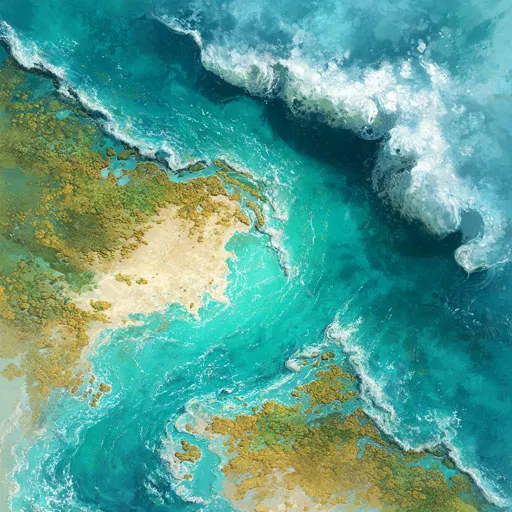
Current of tides by Blue Fairy 74 ft. Midjourney
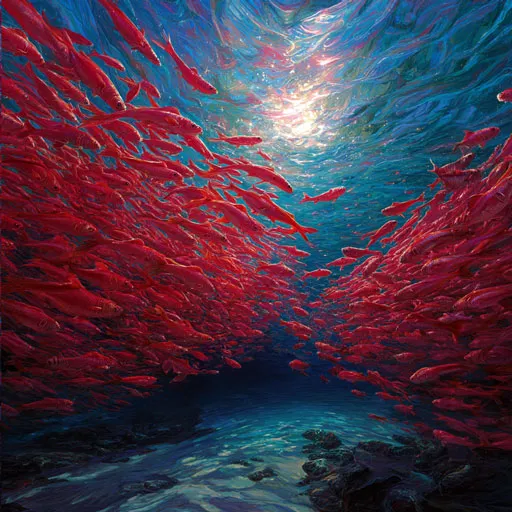
Current of fins by Blue Fairy 74 ft. Midjourney
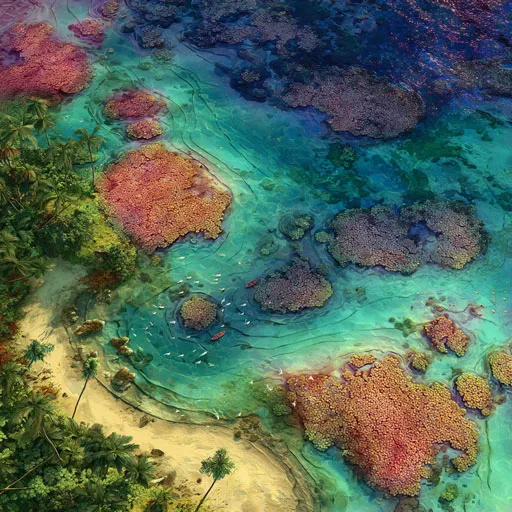
Current of colors by Blue Fairy 74 ft. Midjourney
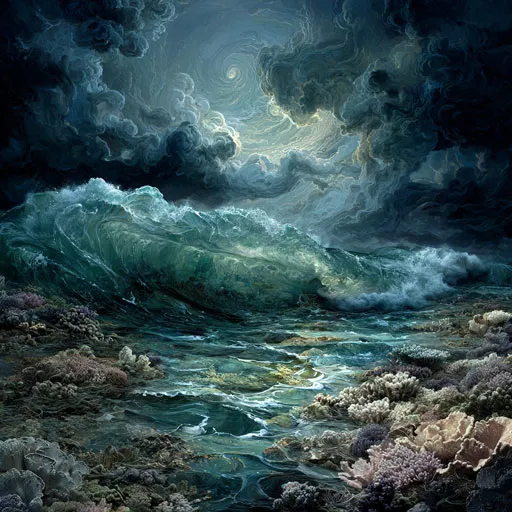
Current of chaos by Blue Fairy 74 ft. Midjourney


This sounds like every historian's nightmare. I guess this took quite some time to develop. But it really is something else and makes total sense. Even the fact that everything is in motion within that "calendar" is super logical.
That's such a relief! I put a lot of thought into it, and I'm so glad you like it. Thank you sooooooooooooooooooooooo much!
Here are my Entries for the water continent Ulűri̋qi̋