Qíímúri̋í - Water Language
Imō qǒtl qoȉ̯h Qíímúri̋í? Bő muī̯ bríː míːtl roi̯̋ imō ǒǒqől, iō̯ imō lìl qől ˈbrûqȉː ˈmīriō̯ qiȍ̯l. So, you want to learn Qíímúri̋í? Well, that might be very difficult with your physical limitations, but you should be able to manage a few sounds with your tongue.

Qíímúri̋í is arguably the most unusual of all the Elaqitan languages. Originally, a language developed underwater, where sound waves travel faster and at a lower frequency than on land, inextricably linked to the perception of the environment and functioning on a multisensory level. With the conquest of land, ancient Qíímúri̋í also changed due to the slower transmission of sound in the air. While modern Qíímúri̋í consists of only eight consonants and six vowels, its pure tonal nature, with five different pitches as well as falling and rising tones, makes it far more complex and much more difficult to learn than the other languages of Elaqitan.
The Development of Qíímúri̋í
Underwater, the Qiriri communicate using vibrations generated by clicks, touch, and sonar, supplemented by whistles, complex songs (similar to those of terrestrial whales), and various visual responses from their counterpart. In murky and dark waters, they navigate using sonar and echolocation. Special frequencies also allow the Qiriri to conduct conversations that cannot be overheard or to communicate over long distances without attracting predators.
Did you know, that:
In addition to vocalizations, the Qiriri also communicate through gestures, facial expressions, changes in skin color, and fin movements. This allows their communication partners to understand these body movements even when acoustic signals are disrupted, such as during storms or strong currents.
The ancient Qíímúri̋í language is still used underwater today, but not to the same extent as before the conquest of the land. Influenced by rural vocalizations, the original underwater language has been simplified and no longer possesses the complexity of antiquity.
Very few Qiriri remain who truly understand and can speak the ancient Qíímúri̋í language. Among the few remaining Qiriri are water healers who communicate with ancestral spirits and tide weavers who pass on myths and legends to future generations. These are a small elite who still master the ancient language and have, in some cases, further developed it into a synchronous interplay of vocalizations, vibrations, and color changes.
With the conquest of the land over two thousand years ago, Qíímúri̋í evolved further due to increased air breathing. While ancient Qíímúri̋í was spoken fluently, using frequencies and vibrations, the modern language is shorter, louder, and less nuanced. Click sounds and ultrasonic waves are inaudible on land, which is why new sounds such as croaking, belching, chattering, and guttural tones significantly altered ancient Qíímúri̋í. Amphibious accents and distinct dialects, which arose on the various islands of Uluriqi, also contributed to this.
Since the Qiriri people have not developed a true writing system beyond the Rock murmuring, visual responses to spoken words, both underwater and on land, still play a significant role.
Life on land has led to the addition of numerous new words to explain new phenomena and concepts that did not previously exist underwater. Many of these words were derived from the ancient language Qíímúri̋í or paraphrased using terms from the old language. For example, the word "fire" actually means glowing water. Mountains are solid waves, and "sky" means something like an upside-down sea.
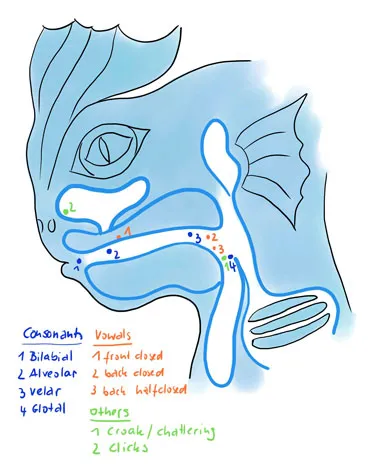
Places of articulation of Qíímúri̋í by Blue Fairy 74


I love the idea of the language altering over time since they migrated to the land. Fascinating language article. <3
Explore Etrea | WorldEmber 2025
Thank you so much, it was a lot of fun exploring these differences and the development from water to land. Now, of course, I have to develop the other language articles in the same way, which scares me a little.
Here are my Entries for the water continent Ulűri̋qi̋