
Móràz Ithéa - Siren of the Dead
"Do you hear that?"
"Do I hear what?"
"That melody? It's like a music box. It's magical. Let's go find it!"
"Arai, come on. I don't hear anything! But maybe we should get out of here."
"Arai? - AAARAI! "Doesn't it sound beautiful?"...
Artist in life and after death
The fairy elves believe that a true genius is born only every 500 years. Móràz Ithéa was one of them. She lived in the 2nd millennium before the founding of the Council and is considered one of the greatest singers and composers of the Air Continent. Many fairy elves are better known by her stage name Razhea, which means "euphony" in Old Vimtésh. Of course, after more than four thousand years, it is difficult to say whether the stories about her are true or pure legend. Her voice is said to have sounded clear, pure, and sensual like that of a siren. Her compositions permeated space and could bring decor and wallpaper to life. Her patrons considered it a gift bestowed by the stars – but her envious ones called it dark magic.
It is said that Móràz Ithéa, hoping to create a powerful hymn to the heavens and thereby achieve immortality, composed so many pieces that she forgot to sleep, eat, and drink. Other legends claim that she fell so in love with her singing that she could never stop singing and still does so today. There are even records of faerie elves who heard the voice or a melody of the long-dead Razhea and were frightened to death by it. And then there are the legends of objects possessed by Razhea's spirit that, to this day, would drive faerie elves to madness and death with the composed pieces. Many believe her to be a Rá Khúpà — a demonic spirit woman — who haunts faerie elves with her singing to wreak revenge on them.
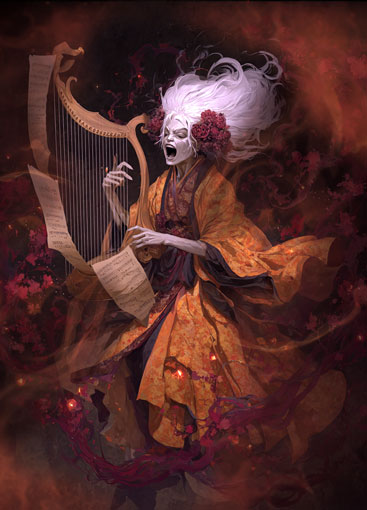
by Blue Fairy 74 - Midjourney-Collage
Arai had heard the sound of a music box that must have been in one of the rooms of the abandoned house and immediately began searching for it. It lured him, called to him, and sounded ever more sweet the closer he came. Arai entered the room from which the notes penetrated his soul and discovered the enchanting little music box standing on the dresser. He opened the lid, and a small fairy plucked a lute. Now, behind Arai, the most beautiful song he had ever heard sounded. Slowly, he turned around, and then he saw her—Móràz Ithéa, the Siren of the Dead. Wrapped in a magnificent orange-yellow robe, the spirit's body floated, surrounded by a red mist that slowly spread through the room like tentacles, snaking toward Arai and tugging at his clothing. Razhea's snow-white hair, streaked with bleeding strands, curled around her head in the breeze like a halo. The boy could only see the siren's eyes; the rest of her face was hidden behind a red veil. Beside the siren, a scroll unfurled, on which small, glowing red notes could be seen. Now the spirit woman drew out her lute and lifted the veil, revealing a bony mouth to begin Arai's hour-long death song.
Appearance of Death
As she once did during her lifetime, Razhea is said to be dressed in elaborate long robes. Her hair is snow-white, streaked with blood-red strands or small flowers. While the upper half of her face is reminiscent of her original beauty, the lower half is withered, gnarled, and mummified, concealed beneath a veil.
Some accounts claim she floats, surrounded by a dark red smoke. She does not speak, but when she opens her mouth, the escaping sounds can be recognized as vibrations. She is said to carry a scroll containing her latest composition and a Káshoun, a type of stringed instrument. Objects such as music boxes, grandfather clocks, musical instruments, or wind-up dolls serve as bait to lure her victims.
Nourishment of Death
As soon as the ghost siren faces her victim, she catches them in the surrounding smoke, which catches on their clothing. The scroll floats beside her, and she begins to play on the Kàshoun. The victim is trapped, like a fly in a spider's web. Now the siren can drain the victim's life energy with her song until only a desiccated skeleton falls to the ground. This can last for several hours.
It is possible to survive an encounter with Móràz Ithéa. However, the ghost woman primarily haunts single, young and middle-aged fairy elves. These usually have no family or friends. To escape the tentacled smoke, however, a rescuer is needed, which is why these lucky breaks are extremely rare.
So be on your guard when you encounter objects that make sounds. They could be the last sounds you hear.


This is amazing! :D I’m very flattered and honored to be a part of Elaqitan <3
I'm so glad you like it. I was worried I might have gone overboard. You didn't make it easy for me, but the references to Japan and music inspired me, and it fits so well with the art-loving fairy elves. Thank you for being part of the circle.
Here are my Entries for the water continent Ulűri̋qi̋