

Nightstalker
Serve as a Holy Inquisitor in the Shadows
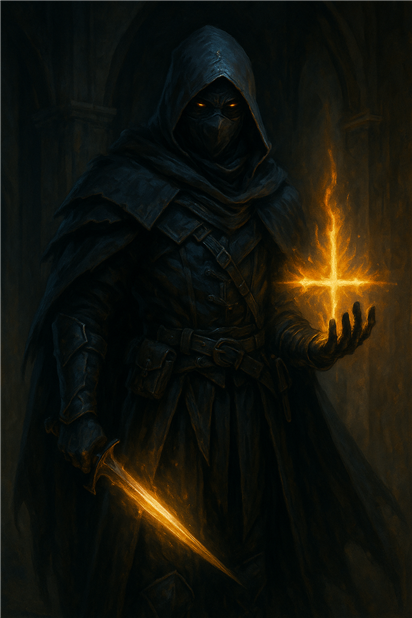
Nightstalkers are the covert blades of the Order of the Sacred Flame—rogues sworn to the All-Father who walk quietly where the Church cannot be seen to act, stalking heretics, Rift-touched horrors, and rogue spellcasters through alleys, sanctums, and war zones. Where Confessors interrogate in the light and Templars wage holy war in the open, Nightstalkers move in silence—slipping past wards, shadowing their quarry for days, and ending blasphemy with a single, consecrated strike.
Blending roguish subtlety with austere divine magic, a Nightstalker wields sacred power not to heal the world, but to excise what the All-Father has deemed unforgivable—branding foes with Radiant judgment, twisting the trajectory of hostile spells, and turning every Sneak Attack into a potential sentence. Where a Paladin pronounces verdict before witnesses, a Nightstalker delivers it in a whisper and a single Radiant strike. To those who cling to forbidden power, they are a whispered terror: you may evade the Church, you may flee the Templars—but you cannot hide from the Sacred Flame that watches in the dark.
Prepared Spells of Level 1+. You prepare the list of level 1+ spells that are available for you to cast with this feature. To start, choose three level 1 Cleric spells.
The number of spells on your list increases as you gain Rogue levels, as shown in the Prepared Spells column of the Nightstalker Spellcasting table. Whenever that number increases, choose additional Cleric spells until the number of spells on your list matches the number in the Nightstalker Spellcasting table. The chosen spells must be of a level for which you have spell slots. For example, if you’re a level 7 Rogue, your list of prepared spells can include five Cleric spells of level 1 or 2 in any combination.
Changing Your Prepared Spells. Whenever you gain a Rogue level, you can replace one spell on your list with another Cleric spell for which you have spell slots.
Spellcasting Ability. Wisdom is your spellcasting ability for your Cleric spells.
Spellcasting Focus. You can use a Holy Symbol as a Spellcasting Focus for your Cleric spells.
Level 3: Spellcasting
You have learned to cast spells. Cantrips. You know three cantrips: Sacred Flame and two other cantrips of your choice from the Cleric spell list. Whenever you gain a Rogue level, you can replace one of your cantrips, except Sacred Flame, with another Cleric cantrip of your choice. When you reach Rogue level 10, you learn another Cleric cantrip of your choice. Spell Slots. The Nightstalker Spellcasting table shows how many spell slots you have to cast your level 1+ spells. You regain all expended spell slots when you finish a Long Rest.Nightstalker Spellcasting
Rogue Level |
Prepared Spells |
1 |
2 |
3 |
4 |
|---|---|---|---|---|---|
3 |
3 |
2 |
— |
— |
— |
4 |
4 |
3 |
— |
— |
— |
5 |
4 |
3 |
— |
— |
— |
6 |
4 |
3 |
— |
— |
— |
7 |
5 |
4 |
2 |
— |
— |
8 |
6 |
4 |
2 |
— |
— |
9 |
6 |
4 |
2 |
— |
— |
10 |
7 |
4 |
3 |
— |
— |
11 |
8 |
4 |
3 |
— |
— |
12 |
8 |
4 |
3 |
— |
— |
13 |
9 |
4 |
3 |
2 |
— |
14 |
10 |
4 |
3 |
2 |
— |
15 |
10 |
4 |
3 |
2 |
— |
16 |
11 |
4 |
3 |
3 |
— |
17 |
11 |
4 |
3 |
3 |
— |
18 |
11 |
4 |
3 |
3 |
— |
19 |
12 |
4 |
3 |
3 |
1 |
20 |
13 |
4 |
3 |
3 |
1 |
Alternative Design. At your table, you can choose Charisma instead of Wisdom as the spellcasting ability for Nightstalker features and spells, representing Nightstalkers who channel faith through force of personality rather than quiet discernment.
Level 3: Radiant Execution
Your Sneak Attacks carry the searing light of the Sacred Flame. When you deal Sneak Attack damage, you can choose for all the Sneak Attack damage to become Radiant damage instead of the weapon’s normal damage type.Level 3: Veil of Judgment
You are trained to move unseen in the shadow of sanctuaries and war-torn streets, and to feel the tremor of blasphemous magic in the air. You gain the following benefits: Inquisitorial Training. You gain proficiency in the Intelligence (Religion) skill. Sacred Stealth. When you make a Dexterity (Stealth) check while you are in Dim Light or Darkness, you can add your Wisdom modifier to the roll (minimum bonus of +1). Sense the Unhallowed. You are preternaturally sensitive to spellcasting and warped power. If a creature you can see within 60 feet casts a spell, you can still discern that it is casting a spell, even if the spell has no verbal or somatic components.Level 9: Inquisitor’s Brand
You learn to carve a fragment of holy judgment into your enemies with a single precise strike. You gain the following Cunning Strike option: Inquisitor’s Brand (Cost: 2d6). You attempt to brand the target with Radiant judgment. The target must make a Wisdom saving throw, or it gains the following effects for up to 1 minute:- The target sheds Dim Light in a 10-foot radius and cannot benefit from the Invisible condition.
- The target cannot benefit from Half Cover or Three-Quarters Cover against your attack rolls.
- Whenever the target casts a spell, it takes Radiant damage equal to your Wisdom modifier (minimum 1), and it has Disadvantage on saving throw it makes to maintain Concentration.

Comments