

Hrrak'mar - the Red Dragonkin
Hrrak'mar
Ability Score Increase +2 CON, +1 STR
Size Medium
Speed 30 ft
Innate Spellcasting: (CON) / Does not need components
- You know the 'Produce Flame' cantrip. The flame initially materializes in your mouth, and can be hurled by spitting.
- At L3, you learn "Dragon's breath" spell (XGE) but must choose fire damage as the breath type. (1/Long rest with this feature). When you cast the spell using this feature, the target's eyes glow a fiery orange-yellow for the duration.
Languages. Common, Draconic
Basic Information
Anatomy
Of the five dragonkin races, the Hrrak'mar are known for being the biggest and the strongest. They stand over 6' tall and have thick tails that reach nearly to the ground. Like the true dragons that created them, the Hrrak'mar are capable of producing and exhaling fire. They are also hardy and fairly resistant to heat and flame, and as they age their scales toughen to make them practically immune to all sources of fire.
Genetics and Reproduction
A gravid female typically lays 2-4 eggs roughly 2 weeks after becoming pregnant. Hrrak'mar eggs, which are black or dark grey to look like volcanic rock, are typically laid in communal nesting areas where all eggs laid near the same time will be kept together where they are tended to by dedicated crèche workers. Like crocodiles, the temperature that the eggs are kept at during the incubation period can influence the gender distribution of the children and wild swings in temperature can adversely affect their early development, so one of the important jobs that the crèche workers have is to make sure that the environment is kept at just the right temperature at all times.
Ecology and Habitats
Hrrak'mar typically dwell in the hottest regions of the world, such as the hot deserts near the equator and near active volcanoes. In ancient times every Hrrak'mar settlement was directly associated with one of the red-scaled Flame Dragons, but after the Last Dragon War the Flame Dragons were slow to recover and many were driven to hiding - some say many fled to other planes and other worlds - in the years following due to the role that Xarka, First of the Flame Dragons, played in the deaths of Tsalindar and Hrassitssar - the First of the Storm and Frost dragons, respectively. This period of tense relationships in the early days of the new peace agreement allowed Hrrak'mar settlements to flourish away from the direct supervision of the Flame Dragons and eventually led them to becoming somewhat independent from their dragon creators. All Hrrak'mar are still obligated to serve one Colour Cycle, or 5 drachs (~15 years) in military training and service under the dragon who is traditionally the head of their settlement, and the Hrrak'mar military schools are some of the best in all of the civilized lands - for those who can stand the heat, at least.
Civilization and Culture
Common Dress Code
Hrrak'mar live in places of extreme heat where most clothing would either get in the way or in some places outright catch on fire. Their dress code tends to be quite minimalist, consisting primarily of belts and sashes with pockets to make carrying things easier. When travelling, Hrrak'mar find most foreign places uncomfortably cold and will tend to dress more warmly.
Common Customs, Traditions and Rituals
Hrrak'mar are famous for their tradition of the Fire Dance, which grew out of early courtship displays into an all-night festival put on in most communities. The largest festivals hosted by the largest centres draw performers and audiences from hundreds of miles around and can even draw crowds of non-Hrrak'mar "Cold-folk" to brave the scorching conditions of a typical Hrrak'mar city.
Fire Dance festivals feature teams of dancers and drummers who use their fire-breathing to put on some of the most spectacular displays of pyrotechnics in the world. There are several different styles of Fire Dance festivals that have evolved, the most common competitive style being the Kormakal format. In this style, many teams gather to take turns performing. For each performance, one male team and one female team - each consisting of either one dancer and one drummer or five dancers and three drummers - are paired up at random. Each dance has three phases, beginning with an introductory dance, where each team gets to establish their rhythm and show off their well-practised moves; the challenge, where the dancers must perform to the rhythm of the other team's drummers; and the climax, where both teams' drummers create a new rhythm together that both teams' dancers must perform to - an ending that symbolically harkens back to the origins of the Fire Dance as a courtship ritual. Performances are rated both on their individual merits and on how well the teams worked together, crowds cheer for their favourites, and at the end of the night the winners are crowned.
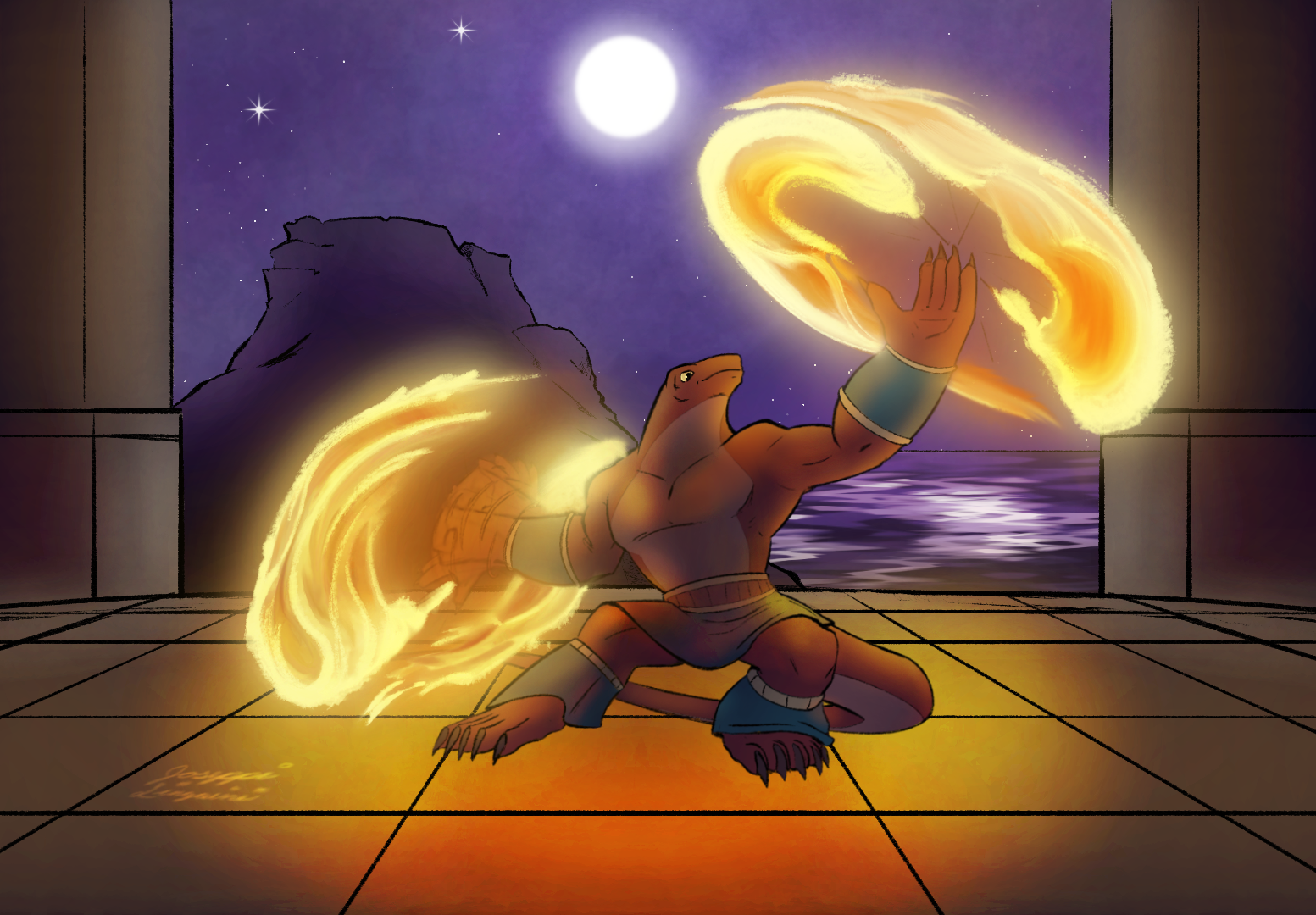
Hrrak'mar Performer
Origin/Ancestry
Created by the Red Dragons
Lifespan
Up to one Long Cycle, or 90 years

Comments